

Mammoths Beneath Castlepook31470 BCE
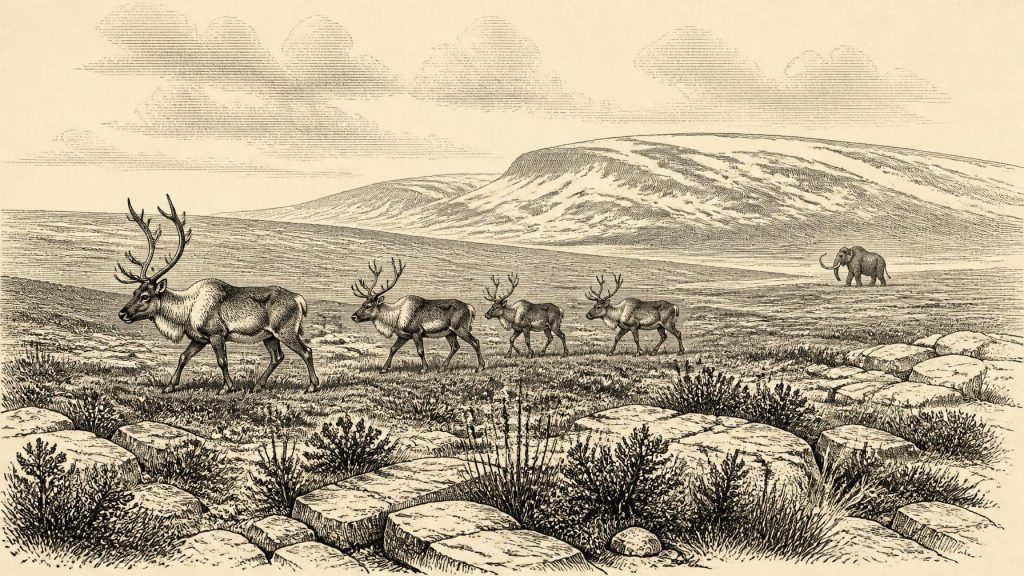
31,470 BCE is a modern label for an uncertain MIS 3 interval, rather than a recoverable Irish calendar year. Before the Last Glacial Maximum, climatically variable Ireland included open, cold landscapes that intermittently supported mammoth, reindeer, giant deer, bears, hyaenas, wolves, foxes and lemmings. Castlepook Cave, County Cork, preserves these remains, although early excavation, disturbed deposits and revised radiocarbon dates require caution: its fauna accumulated across multiple phases, not one scene. A cut-marked reindeer femur may indicate Upper Palaeolithic butchery about 33,000 years ago, but cannot prove settlement or permanent population. Castlepook instead documents ecological change and possible human presence.
Dateline
“31,470 BCE” is a useful modern filing label, not a date at which Irish history can be observed year by year. No written record, settlement layer or environmental sequence permits calendar-year precision at this depth of time. In radiocarbon terms, the label sits roughly 33,400 years before 1950, but radiocarbon ages must be calibrated and carry substantial uncertainty. The responsible historical setting is therefore the middle of the Late Pleistocene, within Marine Isotope Stage 3 (MIS 3), rather than one recoverable year. For Ireland, the most important evidence comes not from people or monuments but from caves, bones, sediments and the changing behaviour of ice.
A Country in a Cold Age
Ireland at this point was part of the wider north-west European world of the last glacial cycle. It was not the uniformly ice-buried land sometimes imagined from later Ice Age maps. The great Last Glacial Maximum, when the British–Irish Ice Sheet reached its fullest late-glacial extent, lay ahead: current reconstructions place that maximum principally around 25,000–23,000 years ago. Yet MIS 3 was itself climatically volatile. Evidence from the North Atlantic, Greenland ice cores, Irish landforms and raised coastal deposits indicates alternating colder and relatively milder episodes, together with shifting ice margins. It would be misleading to draw a neat line between a wholly frozen Ireland and an entirely open one.
The best interpretation is of a landscape changing over long spans rather than staying fixed for centuries. Parts of Ireland could have supported open, cold-adapted vegetation and large mammals, while glaciers occupied or approached other regions at different times. In southern Ireland, cave faunas show that animals entered and survived during pre-Last Glacial Maximum intervals. Newer research also argues for substantial ice-sheet growth and retreat phases before the maximum itself. Thus the terrain around the date conventionally called 31,470 BCE may have combined exposed limestone country, thin soils, sparse plant cover, seasonal watercourses and broad areas of cold grassland, herb-rich steppe or tundra-like vegetation. This is an environmental reconstruction, not a map of a particular summer.
Castlepook’s Uneven Archive
The central Irish locality for this period is Castlepook Cave, also called Mammoth Cave, near Doneraile in north County Cork. Its passages were excavated mainly in the early twentieth century by Richard J. Ussher and colleagues. The work produced a striking collection of Pleistocene animal remains, later held largely by the National Museum of Ireland. Mammoth gave the cave its popular name, but the collection includes evidence of reindeer, giant deer, brown bear, foxes, lemmings, wolves and spotted hyaena. Such a list is extraordinary in an Irish context, where later ice action, erosion and antiquarian excavation have left an exceptionally patchy record.
It is also an archive that demands caution. Many bones were recovered before modern excavation standards, and the original spatial relationships of finds were often poorly recorded. Cave deposits can be altered by water, roof collapse, carnivores, burrowing animals and later human disturbance. A bone found in a cave does not automatically mean that the animal died there, that a person killed it nearby, or that all the other bones belonged to the same moment. Radiocarbon redating has been particularly important because improved pretreatment of bone collagen showed that several earlier Irish cave dates were too young. At Castlepook, some revised determinations proved roughly 5,000 to 12,000 radiocarbon years older than their predecessors.
That revision places important Castlepook animals firmly within MIS 3. It supports the broad conclusion that mammoth, reindeer and spotted hyaena were present in Ireland during parts of the period before the Last Glacial Maximum. It does not prove that every species in the cave shared one habitat or one generation. The older Irish Quaternary Fauna Project rightly warned against treating the cave assemblage as a single, simultaneous ‘mammoth-steppe’ scene. The remains accumulated through more than one phase, and different animals may have reached the cave through different processes. Castlepook illuminates a long environmental window, not an annual census.
Reindeer, Mammoth and Hyaena
Nevertheless, the fauna establishes the scale of ecological possibility. Reindeer imply open country with extensive grazing and browsing opportunities, and their seasonal movements elsewhere in northern Europe show how mobile such herds could be. Woolly mammoth remains point to the presence, at least intermittently, of a much larger herbivore able to exploit cold, open environments. Giant deer added another large browser or mixed feeder to the picture. Hares, lemmings and foxes represent the smaller animals on which cold-climate food webs depended. The precise plant communities in north Cork cannot be reconstructed from the bones alone, but the combined evidence is incompatible with the dense temperate woodland familiar in modern Ireland.
Spotted hyaena makes Castlepook especially vivid. This animal is known in Ireland principally from the Cork cave assemblage. Hyaenas could transport bones, chew carcasses and use sheltered places as dens; tooth marks on mammoth material are consistent with carnivore activity. Their presence warns against assigning every broken or marked bone to hunters. Bears may likewise have used caves as refuges or dens, causing their skeletal remains to be disproportionately represented. Wolves and foxes could have scavenged, hunted small prey or followed larger carcasses. In this world, a limestone cavity was not merely a quiet shelter: it could be part of a wider network of scavenging, predation, denning and natural bone accumulation.
There was no settled Irish countryside in any later sense. No farms, fields, roads, villages, ports or managed herds have been identified from this period. Nor can researchers responsibly name tribes, languages or territories. The animals themselves reveal movement between Ireland and neighbouring lands, but they do not disclose the exact routes. Sea level was lower globally than today, while local relative sea level was affected by the immense weight and changing margins of ice. Whether particular crossings involved exposed coastal tracts, temporary islands, ice, shallow-water passages or combinations of these cannot be specified for this nominal year.
The Reindeer Femur Question
Human history enters the discussion through one remarkable but limited object: a reindeer femur from Castlepook. Re-examination identified a deep incision interpreted by zooarchaeologist Ruth Carden as a cut or chopping mark made on fresh bone by a sharp stone tool during butchery. The bone has been publicly associated with an age of about 33,000 years ago. If both the direct dating and the identification of the mark as human-made withstand continuing scrutiny, it would be evidence that a person or small group processed a reindeer in Ireland during the Upper Palaeolithic, far earlier than the securely demonstrated terminal-Pleistocene human activity at Alice and Gwendoline Cave in County Clare.
But the distinction between an important trace and a proved occupation is crucial. The femur is not accompanied by a securely associated hearth, stone-tool assemblage, dwelling surface, food store, burial or repeated butchery floor of comparable age. It comes from an old collection rather than a recently excavated, sealed context. A date on an animal bone dates the animal’s death, not necessarily the instant of any surface modification; interpretation of a mark also requires taphonomic judgement. The most that can presently be said is that Castlepook preserves a serious possible indication of human handling of a reindeer in MIS 3. It cannot establish a permanent population, a named culture or an Irish settlement in 31,470 BCE.
Society Beyond the Evidence
Consequently, political affairs, diplomacy and warfare are absent from the Irish evidence—not because prehistoric people elsewhere lacked social relationships, but because no Irish material of this age can demonstrate them. Nor is there evidence here for formal religion, artwork, teaching, exchange systems or leadership. Upper Palaeolithic groups elsewhere in Europe possessed sophisticated stone technologies and, in some regions, rich symbolic traditions. Those wider comparisons establish what humans were capable of; they must not be imported as facts about Castlepook. No Irish engraved object, ornament, pigment use or securely dated tool kit currently connects this place to such practices.
If people did reach the island during an MIS 3 interval, the most restrained inference is that they were highly mobile foragers capable of coping with a cold, exposed landscape and of exploiting animal resources. A single butchered limb would suggest a brief act of carcass processing, not a household economy. Even hunting cannot be assumed: a group might have taken an animal, found one dead, or acquired part of a carcass through scavenging. Reindeer meat, marrow, hide, sinew and bone would all have been useful to Ice Age people, but none can be demonstrated from the Irish specimen alone. The economy visible with confidence is the natural economy of herds, predators and seasonal ecological change.
What This Date Represents
The significance of 31,470 BCE for Ireland is therefore neither a battle nor a foundation, but a threshold of knowledge. Castlepook shows that Late Pleistocene Ireland was not an empty abstraction between glaciations. At least during portions of MIS 3, southern Ireland supported a varied cold-age fauna including reindeer and mammoth, along with formidable carnivores. Its possible cut-marked reindeer femur poses an unresolved but consequential question about exceptionally early human visits. Ongoing excavation, microscopic analysis, improved collagen dating and study of surviving deposits may refine the answer. Until then, this distant ‘year’ should be understood as a carefully bounded prehistoric landscape: real animals, real climatic pressures, and only the faintest possible human footprint.
Primary Sources
- A reconsideration of the radiocarbon dating of the Marine Isotope Stage 3 fauna from southern Ireland
- The Irish Quaternary Fauna Project
- The Exploration of Castlepook Cave, County Cork, Being the Third Report from the Committee Appointed to Explore Irish Caves
- Occurrence of mammalia relicts at site Castlepook Cave
- Irish Cave Exploration
- 2022:564 – Castlepook Cave, Castlepook South, Cork
- Heritage Artefacts of County Cork
- Mammoth Cave
- First evidence of a Late Upper Palaeolithic human presence in Ireland
- New insights on the fauna of Ireland's Younger Dryas and Early Holocene from Alice & Gwendoline Cave
- Figure 6.— The subdivision of the Quaternary Period in Ireland
- The timing and magnitude of the British–Irish Ice Sheet between Marine Isotope Stages 5d and 2: implications for glacio-isostatic adjustment, high relative sea levels and ‘giant erratic’ emplacement
- Stratigraphic and palaeo-geomorphological evidence for the glacial-deglacial history of the last British-Irish Ice Sheet in the north-western Irish Sea
- Trimlines, blockfields and the vertical extent of the last ice sheet in southern Ireland
- Dynamic cycles, ice streams and their impact on the extent, chronology and deglaciation of the British–Irish ice sheet
- New data for the Last Glacial Maximum in Great Britain and Ireland
- The IntCal20 Northern Hemisphere radiocarbon age calibration curve (0–55 cal kBP)
- A stratigraphic framework for abrupt climatic changes during the Last Glacial period based on three synchronized Greenland ice-core records: refining and extending the INTIMATE event stratigraphy
- The problem of a late quaternary landbridge between Britain and Ireland
- The extinction of the giant deer Megaloceros giganteus (Blumenbach): New radiocarbon evidence