

The Reindeer Femur at Castlepook31415 BCE
Around 31,415 BCE, Ireland lay within the climatically unstable Marine Isotope Stage 3, approaching but preceding maximum last-glacial ice expansion. Evidence cannot date events to a single year. Derryvree sediments in Fermanagh indicate locally ice-free, treeless, cold wetlands with open vegetation. Castlepook Cave, Cork, yielded reindeer, mammoth, giant deer, predators and other cold-climate fauna; revised dating places key remains in this period. A reindeer femur bearing possible stone-tool cut marks suggests, but does not prove, human activity. Mixed cave deposits and absent associated artefacts preclude claims of settlement. Ireland’s record documents environments and animal movements; secure human evidence came later.
Dateline
“31,415 BCE” is a modern calendar label, not a date that anyone living in prehistoric Ireland could have recognised. At roughly 33.4 thousand calendar years before AD 1950, it falls within the later part of Marine Isotope Stage 3, a long and climatically unstable phase of the Late Pleistocene. No Irish deposit can be tied responsibly to this individual calendar year. The evidence instead consists of dated bones, cave sediments, buried plant-bearing muds and the wider reconstruction of the British–Irish Ice Sheet. Those sources can illuminate an interval around this point; they cannot furnish an annual chronicle.
The crucial discipline is to separate three things: what has been found, what it dates, and what historians infer. A radiocarbon determination dates the death of organic material, within a range and with methodological limits; calibration converts radiocarbon years into calendar-age probabilities rather than exact historical anniversaries. The modern IntCal20 curve reaches back to 55,000 calendar years before present, but its older sections necessarily carry broader uncertainty than historical dating. For Ireland in this age, calibrated ranges and climatic phases are more meaningful than a numbered BCE year.
A Landscape Before Maximum Ice
Around this broad interval, Ireland was in a cold world moving towards the Last Glacial Maximum, not yet at the fullest, best-documented extent of the last ice sheet. Later evidence shows that the British–Irish Ice Sheet expanded substantially from about 30,000 years ago and that its marine margins reached maximum positions in different sectors at different times, commonly around 26,500–23,000 years ago. This means that “Ireland under ice” is too blunt a description for 31,415 BCE. Ice cover, sea level, coastlines and habitable ground varied by region and through time; the sequence remains actively researched.
The best local environmental clue comes not from Cork but from Derryvree near Maguiresbridge, County Fermanagh. Roadworks there exposed organic silts and fine sands lying between glacial tills: the sedimentary signature of a freshwater setting that existed before a later ice advance. The deposit produced cold-climate plant and animal remains and a conventional radiocarbon determination of 30,500 +1,170/−1,030 BP. It is an important indication of an ice-free or at least non-glacial interval in part of the northern interior during the Middle Midlandian, the regional name then used for this part of the last glacial cycle. It is not an annual weather record, nor a direct date for 31,415 BCE.
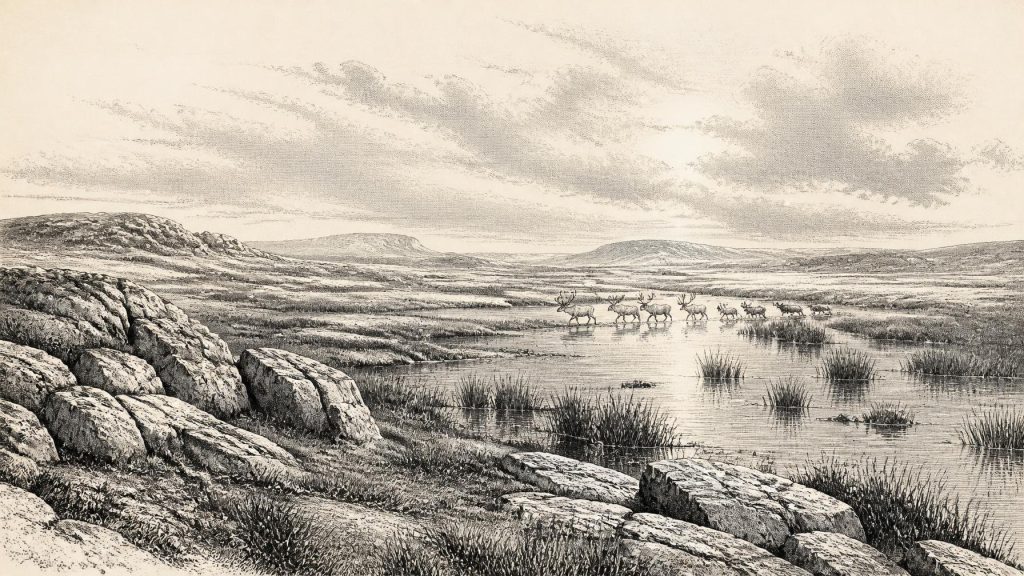
Derryvree suggests a treeless, wet, cold landscape rather than a forested Ireland. Fossil mosses, sedges and aquatic or waterside plants, including bogbean, point to shallow freshwater, marshy ground and open vegetation. Insects and other biological indicators reinforce the impression of severe conditions. Yet even here caution matters. Pollen can travel far, and a few grains of tree pollen do not demonstrate woodland beside the pool. Nor should one small buried basin be inflated into a map of the whole island. It provides a valuable local window on cold-stage ecology, not a complete national landscape.
Castlepook and the Animal World
South-west of Derryvree, Castlepook Cave near Doneraile in north Cork preserves Ireland’s most evocative evidence for this deep period. Also known as Mammoth Cave, it was explored in the early twentieth century and yielded a large collection of animal remains. Its assemblage includes reindeer, woolly mammoth, giant deer, brown bear, mountain hare, foxes, wolves, lemmings and spotted hyena. These remains show that parts of Ireland could support, or at least receive, a mobile cold-climate fauna whose members also occurred across north-western Europe. They do not establish that every species lived together at exactly the same time or in the same valley.
Modern re-dating has altered the story. Earlier cave-bone chronologies were often based on techniques and pretreatments now known to be vulnerable to contamination, especially at great age. A 2020 reassessment of material from Castlepook, Foley Cave and Shandon Cave found that several Castlepook bones were between roughly 5,000 and 12,000 radiocarbon years older than earlier results had suggested. The revised evidence places important elements of the southern Irish fauna within Marine Isotope Stage 3 and indicates that giant deer and spotted hyena may have disappeared locally before the Last Glacial Maximum, perhaps around 40,000 calibrated years BP.
For a date around 31,415 BCE, reindeer are especially relevant. Their presence is direct faunal evidence that cold-adapted herbivores reached Ireland during the broader pre-maximum interval. Such animals would have found forage in open vegetation and, like all large herbivores, would have attracted predators and scavengers. Spotted hyena remains at Castlepook are a reminder that caves were not automatically human shelters: carnivores could drag in carcasses, gnaw bones and disturb deposits. The cave record therefore speaks first to animal movement, death and accumulation, and only secondarily—if at all—to people.
The Marked Bone
A fragment of reindeer femur from the Castlepook collection has become central to debate because it bears deep marks interpreted by Ruth Carden as traces made with a stone tool during butchery. County Cork heritage publications place the bone at about 31,000 BC, broadly close to the notional year considered here. If that interpretation and association are sustained, it would be striking evidence that one or more Upper Palaeolithic people processed a reindeer in Ireland far earlier than the securely dated late-glacial human trace from County Clare.
But this is not a licence to write of an established Cork settlement in 31,415 BCE. The femur was recovered during antiquarian excavation from a cave system whose deposits have been mixed, reworked and incompletely recorded. A bone date establishes the age of that animal, not a precise moment of cutting; a mark must separately be distinguished from damage caused by carnivores, sediment or excavation. There is no securely associated hearth, stone-tool assemblage, dwelling floor, burial, repeated occupation surface or contemporaneous group of modified bones. The most responsible conclusion is that Castlepook offers a significant but still limited possible signal of human activity, not proof of permanent colonisation.
That distinction changes how everyday life can be described. If people did reach the island in this phase, they were almost certainly highly mobile hunter-gatherers equipped with perishable clothing, wooden gear and stone tools, much of which would leave little trace. A single act of carcass processing could represent hunting, opportunistic scavenging or the recovery of an animal killed by predators; the available Irish evidence cannot choose confidently among these possibilities. Nor can it tell us the size, language, kinship system, seasonal round or origin of any visiting party.
No Polities, No Proven Diplomacy
There is no evidence whatsoever for rulers, tribes with recorded names, political institutions, borders, warfare, diplomacy or trade networks in Ireland at this date. Those are not gaps to be filled with imaginative storytelling. Even the question of access is difficult. Lower global sea levels changed the geography of the Irish Sea region, but glaciation, changing shorelines and incomplete palaeogeographic evidence prevent a simple assertion of a dependable land bridge. The existence of large mammals proves that routes of dispersal were sometimes available; it does not demonstrate a continuously open human route or regular contact.
Likewise, no Irish evidence from around this interval identifies houses, camps, food stores, clothing, ritual sites, art, teaching, burial practice or a shared religion. Caves such as Castlepook may preserve bones because limestone cavities shelter material from weathering, but their deposits often combine the actions of water, animals and early excavators. Absence of evidence is not proof that people had no beliefs, skills or culture; it means that none can be responsibly assigned to Ireland from the present record. The first securely dated evidence of human presence on the island is much later: cut marks on a brown-bear patella from Alice and Gwendoline Cave, County Clare, dated by two methods to calibrated ranges centred on about 12,800–12,600 cal BP.
An Island of Possibilities
The history of Ireland around 31,415 BCE is therefore principally environmental history, with an unresolved archaeological edge. Cold wetlands at Derryvree, a varied Ice Age fauna in southern caves, and the advancing trajectory of the British–Irish Ice Sheet establish that this was neither a timeless frozen blank nor a recognisable human society. It was a changing, open and often severe landscape in which reindeer and other mammals moved through habitable pockets. The Castlepook femur raises the serious possibility that people entered that world. Future excavations in undisturbed cave deposits, accompanied by improved dating, microscopic mark analysis and environmental sampling, may show whether that possibility becomes a securely evidenced chapter of Irish prehistory.
Primary Sources
- A reconsideration of the radiocarbon dating of the Marine Isotope Stage 3 fauna from southern Ireland
- The Irish Quaternary Fauna Project
- A Middle Midlandian Freshwater Series at Derryvree, Maguiresbridge, County Fermanagh, Northern Ireland
- Palaeoecology
- Spotted Hyena Skull
- Heritage Artefacts of County Cork
- The Exploration of Castlepook Cave, Co. Cork. With 3 plates.
- Occurrence of mammalia relicts at site Castlepook Cave
- Mammoth Cave
- First evidence of a Late Upper Palaeolithic human presence in Ireland
- New insights on the fauna of Ireland's Younger Dryas and Early Holocene from Alice & Gwendoline Cave
- The IntCal20 Northern Hemisphere Radiocarbon Age Calibration Curve (0–55 cal kBP)
- The problem of a late quaternary landbridge between Britain and Ireland
- Maximum extent and readvance dynamics of the Irish Sea Ice Stream and Irish Sea Glacier since the Last Glacial Maximum
- Stratigraphic and palaeo-geomorphological evidence for the glacial-deglacial history of the last British-Irish Ice Sheet in the north-western Irish Sea
- Advance and retreat of the marine-terminating Irish Sea Ice Stream into the Celtic Sea during the Last Glacial: Timing and maximum extent
- Timing and pace of ice-sheet withdrawal across the marine–terrestrial transition west of Ireland during the last glaciation
- Trimlines, blockfields and the vertical extent of the last ice sheet in southern Ireland
- BRITICE Glacial Map, version 2: a map and GIS database of glacial landforms of the last British–Irish Ice Sheet
- A critical review and re-investigation of the Pleistocene deposits between Cranfield Point and Kilkeel, Northern Ireland: implications for regional sea-level models and glacial reconstructions of the northern Irish Sea basin