
The Castlepook Femur Mark31316 BCE
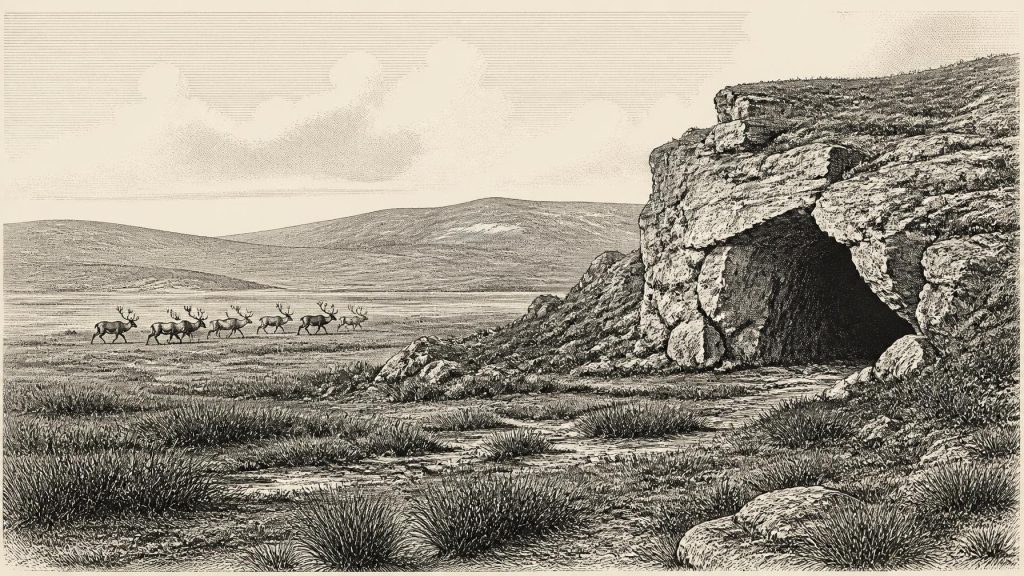
At the notional date of 31,316 BCE, Ireland lay within the climatically unstable MIS 3 Late Pleistocene, with open, treeless vegetation, changing ice margins and lower seas. Castlepook Cave in north County Cork preserves a complex faunal archive, including reindeer, mammoth, giant deer, predators and small cold-adapted mammals, demonstrating episodic animal access to southern Ireland. Revised dating has qualified earlier conclusions about their survival. A reindeer femur bearing a possible stone-tool cut may indicate human carcass processing about 33,000 years ago but lacks associated artefacts or occupation evidence. It therefore suggests, rather than proves, Palaeolithic visitors, settlement or human presence.
Dateline
Modern calendar-year precision is not available for Ireland in 31,316 BCE. No community then used a calendar that can be aligned with ours, and neither archaeology nor palaeoclimate can recover an event from this particular year. The date is best treated as a conventional point of reference: arithmetically, it falls about 33,265 years before AD 1950, within the Late Pleistocene and Marine Isotope Stage 3 (MIS 3). On the annually counted Greenland ice-core chronology, this is close to the opening of Greenland Stadial 6, which began about 33,360 years before AD 2000. That correlation provides a broad North Atlantic climatic setting, not a precise weather report or an Irish historical date.
A Cold Island Margin
Ireland at this time was part of an unstable Ice Age world, long before the Last Glacial Maximum reached its greatest extent around 25,000–23,000 years ago. MIS 3 was not one unbroken freeze. It was marked by sharp shifts between relatively milder Greenland interstadials and colder stadials, expressed in the ice cores as rapid changes in temperature and atmospheric dust. Around the notional date used here, the wider North Atlantic climate was entering, or had recently entered, a colder phase after Greenland Interstadial 5.2. What that meant on the ground in Ireland cannot be measured year by year. It does, however, warn against imagining a fixed landscape.
There was no familiar green Ireland of oak woods, enclosed fields and settled coastlines. In colder intervals, much of the exposed land would have supported open, treeless vegetation: grasses, sedges, herbs, dwarf shrubs and patches of moss, varying with soil, drainage, exposure and proximity to ice. Permafrost processes, snow cover, strong winds and seasonal thaw shaped ground that was often thinly vegetated. Rivers carried sediment through valleys very different from those of the present. Caves, hollows and waterlogged deposits are therefore unusually valuable, because they preserve scraps of bone, plant material, insects and sediment that open country elsewhere has often lost.
The outline of the island was also unlike today’s. Global sea level was lower than at present, exposing parts of the surrounding continental shelf, but Ireland’s connections with Britain and the continent remain a complicated geological question. Ice, sea level, crustal movement and changing channels all mattered. It is unsafe to picture a simple, permanent dry road from Cork to Britain or mainland Europe. At most, the reduced sea and altered ice margins may have changed the scale and difficulty of movement for animals and, if people visited, for people as well. The routes available during one climatic episode could disappear during the next.
Castlepook’s Deep Archive
The principal Irish evidence relevant to this broad period comes from Castlepook Cave, also known as Mammoth Cave, near Doneraile in north County Cork. Excavated chiefly in the early twentieth century and investigated again in 2022, its passages yielded a remarkable concentration of Ice Age animal remains. Its importance lies not in a neatly sealed village floor, but in its long, complicated faunal archive. Carnivores used caves; animals died or were dragged inside; water and later disturbance could move material. Old excavations also did not record every deposit to modern standards. Any historical reconstruction must begin with those limitations.
Nevertheless, direct dating and re-dating show that Ireland did at intervals support a far richer MIS 3 mammal community than the modern island does. Castlepook has produced remains attributed to reindeer, woolly mammoth, giant deer, brown bear, wolf, Arctic fox, mountain hare, lemmings and spotted hyaena. Individual bones need not all be contemporary, and a species’ presence in a cave does not establish a resident breeding population across the country. Yet the assemblage makes one conclusion secure: parts of southern Ireland were accessible to large and small cold-adapted mammals during the middle of the last glacial cycle.
That conclusion has become stronger but more qualified as dating methods improved. The Irish Quaternary Fauna Project used accelerator radiocarbon dating to test older cave collections and showed that mammals had reached Ireland between at least roughly 45,000 and 20,000 radiocarbon years ago. More recently, Ruth Carden’s reassessment of southern Irish MIS 3 material found that several earlier determinations, made before modern ultrafiltration procedures for bone collagen, were too young. Some animals once thought to have survived towards the Last Glacial Maximum instead belong much earlier in MIS 3; giant deer and spotted hyaena may have disappeared locally by about 40,000 calibrated years ago. The lesson is important: a date attached to an old cave bone is evidence under continual scientific review, not an unchanging fact.
The Reindeer Bone and People
A fragment of reindeer femur from Castlepook gives this otherwise remote point in time exceptional interest. County Cork’s heritage publications identify it as a Palaeolithic object dating to about 31,000 BCE and interpret a deep incision as a cut made by a sharp stone tool during butchery. If that interpretation is accepted, it is evidence that a person handled the carcass in Ireland around 33,000 years ago, vastly earlier than the island’s securely documented Mesolithic settlement after the Ice Age.
But this is not grounds for inventing an Irish Palaeolithic tribe, camp or named hunting expedition. No stone tool, hearth, dwelling, human bone, burial or stratified occupation surface has yet been securely associated with the femur. Nor does the bone show that the animal was killed in the cave. A carcass might have been processed outside and a discarded portion later carried underground by hyaenas, wolves or other agents. The National Museum of Ireland accordingly still states that clear evidence for a Palaeolithic human presence on the island has not emerged. The responsible position is to describe Castlepook as a significant possible or reported indication of human activity, rather than proof of continuous settlement.
The absence of a known settlement should not be mistaken for proof that no person ever crossed the landscape. Mobile Upper Palaeolithic hunters can leave exceptionally slight traces, especially where later ice, erosion, sea-level rise and antiquarian digging have removed or mixed deposits. Equally, the spectacular fauna should not be mistaken for an abundant archaeological record. Castlepook is presently an anomaly: a cave collection that demonstrates animal movement and raises a human question, but cannot answer it decisively.
Life In An Open Landscape
If people did reach southern Ireland in this climatic world, they would have been highly mobile hunter-gatherers, not farmers. Their subsistence would have depended on knowledge of seasonal animal movements, shelter, fuel, stone for cutting tools and safe routes across difficult ground. Reindeer would have offered meat, fat, hide, sinew and bone; other large mammals might have supplied similar resources, though no Irish butchery assemblage establishes a regular local hunting economy. Any suggestion that people pursued mammoth, giant deer or hyaena in Ireland is interpretation beyond the present evidence. The cut-marked reindeer femur can support only the narrower possibility of carcass processing.
There is likewise no evidence for political institutions, chiefs, territories, warfare, diplomacy, formal religion, art or learning in Ireland at this date. These are not omissions in a fuller archive; they are questions the surviving Irish material cannot yet answer. It would be reasonable, by comparison with Upper Palaeolithic societies elsewhere in Europe, to expect social knowledge embodied in skills, oral communication, kin networks and practices surrounding animals and places. Yet comparison is not evidence of an Irish ritual, language or culture. The island has produced no contemporary cave art, carved object, personal ornament or structured burial from which such claims could responsibly be made.
Nor can trade be demonstrated. The movement of mammals proves that ecological corridors existed at certain times, not that people exchanged goods across them. Flint would have been useful for sharp tools, but no securely dated Irish Palaeolithic lithic assemblage has been recovered from Castlepook or another site. The later discovery of such material, particularly in a well-recorded context, could transform understanding. For now, the economy visible in Ireland is nature’s economy: herds exploiting vegetation, predators and scavengers using animal remains, and caves acting as traps and repositories.
Regional Change, Not a National Story
There was no Ireland-wide society to narrate in 31,316 BCE. Conditions varied regionally, and the archaeological record is heavily concentrated in a few caves and sedimentary exposures. In northern Ireland, buried organic layers between tills at places such as Aghnadarragh and Derryvree preserve evidence for earlier cold-stage environments, including wetland plants and insects. Such deposits demonstrate the value of palaeoenvironmental evidence, but they cannot simply be treated as snapshots of north Cork at the same moment. Their dates, depositional histories and climatic contexts differ.
The key development around this notional year is therefore not a political event but a scientific one: Ireland’s deep past is better understood as episodically inhabited or visited by fauna, and perhaps briefly by people, during a changing MIS 3 landscape. Castlepook’s bones connect north Cork to a wider north-west European world of tundra-steppe animals and abrupt climatic shifts. They also impose discipline. The evidence supports reindeer and other mammals in Ice Age Ireland, a complex cave history, and one provocative possible trace of human butchery. It does not support a settled population, a calendar date, a kingdom or a continuous ancestral line from these possible visitors to later Irish communities.
Primary Sources
- A Reconsideration of the Radiocarbon Dating of the Marine Isotope Stage 3 Fauna from Southern Ireland
- The Irish Quaternary Fauna Project
- Heritage Artefacts of County Cork
- Archaeological Heritage of County Cork
- Prehistoric Details
- 2022:564 – Castlepook Cave, Castlepook South, Cork
- New Insights on the Fauna of Ireland's Younger Dryas and Early Holocene from Alice & Gwendoline Cave
- First Evidence of a Late Upper Palaeolithic Human Presence in Ireland
- Growth and Retreat of the Last British-Irish Ice Sheet, 31,000 to 15,000 Years Ago: the BRITICE-CHRONO Reconstruction
- Stratigraphic and Palaeo-Geomorphological Evidence for the Glacial-Deglacial History of the Last British-Irish Ice Sheet in the North-Western Irish Sea
- Maximum Extent and Dynamic Behaviour of the Last British-Irish Ice Sheet West of Ireland
- A Stratigraphic Framework for Abrupt Climatic Changes During the Last Glacial Period Based on Three Synchronized Greenland Ice-Core Records
- The IntCal20 Northern Hemisphere Radiocarbon Age Calibration Curve (0–55 cal kBP)
- The Problem of a Late Quaternary Landbridge Between Britain and Ireland
- Deglaciation, Earth Crustal Behaviour and Sea-Level Changes in the Determination of Insularity: A Perspective from Ireland
- Quaternary Site Descriptions
- The Subdivision of the Quaternary Period in Ireland
- Aghnadarragh
- The Dungarvan Valley Caves Project: Second Interim Report
- Mammoth Cave
- Occurrence of Mammalia Relicts at Site Castlepook Cave
- The Exploration of Castlepook Cave, County Cork