

Castlepook’s Hyena Horizon31298 BCE
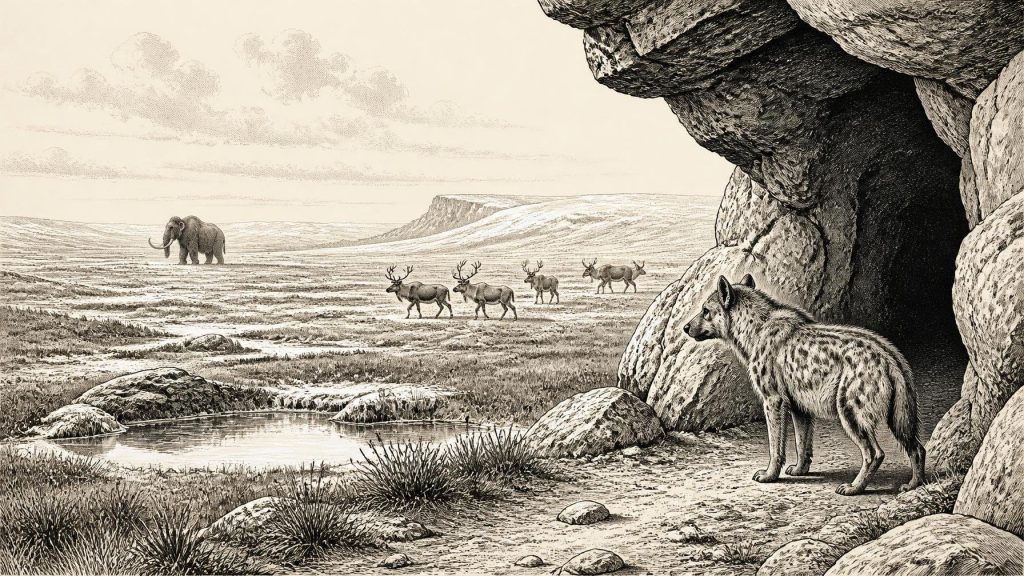
Around 31,298 BCE, Ireland cannot be reconstructed as a dated historical event, but evidence places it within variable MIS 3 Ice-Age conditions. Castlepook Cave, County Cork, preserves fauna accumulated over millennia, including mammoth, reindeer, giant deer, bears, wolves and spotted hyenas, indicating cold open steppe habitats and continental connections before the Last Glacial Maximum. Derryvree, County Fermanagh, records tundra wetlands in a related period. Changing sea levels, ice margins and glaciation shaped access and preservation. A disputed modified reindeer bone suggests possible human activity, but no secure settlement exists. Ancient DNA may clarify faunal links; permanent occupation there remains unproven.
Dateline
“31,298 BCE” is a modern chronological label, not a date that can be recovered from an Irish record of events. No calendar, settlement sequence or securely stratified archaeological site allows historians to say what happened in Ireland in that particular year. In scientific terms, the point lies about 33,250 years before AD 1950, within the Late Pleistocene and broadly within Marine Isotope Stage 3 (MIS 3), an unstable part of the last Ice Age. The responsible scale is therefore not a single year but calibrated ranges of centuries and millennia. Ireland at this depth of time is known chiefly through caves, fossil animals, glacial sediments, plant remains and the dating of those deposits.
The most evocative Irish evidence relevant to this horizon comes from Castlepook Cave, also called Mammoth Cave or Doneraile Cave, near Doneraile in north County Cork. It is not a prehistoric village and has yielded no secure domestic floor, hearth, house or cemetery of this age. Rather, it is a limestone cave system whose deposits and old collections contain an exceptional record of Ice-Age mammals. Its importance lies in showing that Ireland, before the maximum spread of the last ice sheet, formed part of a wider north-west European ecological world.
A Date Beyond Annals
Dating this world is necessarily complicated. Radiocarbon results are expressed first in radiocarbon years before present, where “present” conventionally means AD 1950; they must then be calibrated against independently dated records because atmospheric carbon-14 has varied through time. The IntCal20 curve extends back to 55,000 calendar years before present, but even a good measurement produces a probability range rather than a pin-point historical date. A calendar conversion from 31,298 BCE is useful for organising an archive, not evidence that archaeologists can isolate the corresponding season or generation.
That caution matters particularly at Castlepook. Most of its famous fauna was excavated in the early twentieth century, when methods of excavation, recording and bone treatment were very different from those now expected. Bones came from a cave complex used and disturbed by water, carnivores, sediment movement and later investigation. Recent reassessment has shown that several older radiocarbon measurements from southern Irish cave assemblages require reconsideration because improved sampling and ultrafiltration techniques can yield substantially older results. The cave is consequently a vital archive, but not a simple, undisturbed time capsule.
The broad conclusion is firmer than any precise reconstruction: large mammals occupied or reached Ireland during the middle and later parts of the last glacial period, well before the Last Glacial Maximum. Geological Survey Ireland identifies Castlepook as the country’s richest site for vertebrate remains dating towards that maximum, with dated material spanning a long interval, approximately 45,700 to 19,950 years before present. Not every species need have lived there together, and no single date represents the whole assemblage. Yet the collection establishes repeated animal presence in an Ireland that would later be profoundly transformed by expanding ice.
A Cave of Predators and Prey
Castlepook’s fauna includes woolly mammoth, reindeer, giant deer, brown bear, wolf and spotted hyena, alongside smaller cold-adapted animals such as Arctic fox, lemmings, hare and stoat. Such a list should not be converted into a picturesque parade in which every animal appears side by side. The remains accumulated over a long period, and caves selectively preserve bones brought in by predators, scavengers or moving water. Even so, the combination indicates an open, cold landscape capable of supporting grazing animals and their predators.
Spotted hyena gives the title its particular force. Hyenas were not exotic visitors from a warmer Africa: Pleistocene spotted hyenas ranged across Europe and were highly effective hunters and scavengers in cold-steppe environments. At Castlepook, their bones and the patterning of other faunal remains make the cave especially important for understanding carnivore activity in Ireland. A cave was probably a place of danger and intermittent occupation for animals, rather than a neutral shelter. Hyenas may have dragged carcass parts underground, while bears, wolves and smaller scavengers also formed part of the food web.
Woolly mammoth and reindeer are equally significant. They point towards the mammoth-steppe or tundra-steppe conditions familiar from many Late Pleistocene regions: treeless or sparsely wooded country, productive in grasses, sedges and herbs during the short growing season, but exposed to severe winter cold. Giant deer, the animal later called the Irish elk, was not uniquely Irish, but its fossils are central to Ireland’s deep past. Their presence confirms that this was not an empty, frozen island. It was a changing habitat in which large herbivores could move through suitable terrain, pursued by carnivores and subject to abrupt climatic shifts.
Fermanagh’s Buried Wetland
County Fermanagh offers a different, more local kind of evidence. At Derryvree, near Maguiresbridge, road works cut through a drumlin and exposed freshwater silts and fine sands sealed between glacial deposits. The organic horizon produced a radiocarbon result of 30,500 ± roughly 1,100 radiocarbon years before present. That measurement does not date 31,298 BCE exactly, and calibration places it earlier than the nominal calendar year considered here. It nevertheless illuminates a related MIS 3 interval in which northern Ireland had cold, periglacial wetlands before renewed glaciation buried the evidence.
Pollen, plant macrofossils, mosses and beetles from Derryvree describe an open tundra environment rather than the familiar woodland of later Ireland. Sedges, aquatic plants and moss-rich ground occurred around pools and wet hollows. The evidence has been interpreted as a muskeg-like wetland mosaic, with shallow water, saturated ground and sparse vegetation beyond it. The site does not prove that every part of Ireland looked identical. It does demonstrate that Ice-Age Ireland contained ecological variety: waterlogged basins could preserve plants and insects even while exposed uplands and open plains remained cold, windy and thinly vegetated.
Climate was not static. Greenland ice-core records show that MIS 3 was marked by dramatic millennial-scale shifts between colder stadials and relatively milder interstadials. Around 32,000 years before present, Greenland evidence indicates stadial conditions, but translating that signal into a temperature or snowfall figure for any Irish valley would be unsafe. Ireland stood at the Atlantic edge of Europe, where ocean conditions, sea ice, wind and the growth of the British–Irish Ice Sheet could make local responses complex. The sound historical conclusion is one of pronounced variability and growing environmental pressure, not a claim for a fixed national climate.
Land, Sea and Ice
Ireland was also geographically unlike the modern island, although the popular image of a permanent “land bridge” should be avoided. Global sea level was much lower during glacial times, exposing land on continental shelves and changing coastlines. Ice margins, marine channels and local isostatic movements also changed the routes available to animals. The presence of mammoth, reindeer, hyena and other continental species shows that connection or passage was possible at various times. It does not establish one continuous dry route, nor does it identify the path by which a particular herd entered Ireland.
Ice-sheet research makes the date especially transitional. The Last Glacial Maximum, when the British–Irish Ice Sheet reached its greatest overall extent, came later, broadly between about 27,000 and 21,000 calendar years ago, although individual sectors advanced and retreated at different times. Evidence from western and southern Ireland suggests substantial ice-sheet activity before that maximum as well. At about 31,298 BCE, the island was therefore not simply “before the ice” or wholly under it. Different regions may have experienced different combinations of open country, perennial snow and ice, advancing margins, and terrain affected by severe frost.
The later ice sheet would erode, bury and rearrange much of the earlier landscape. This helps explain why evidence is so fragmentary. Potential campsites on exposed ground may have been destroyed; former coastal plains now lie beneath the sea; and caves, though valuable, have their own biases. Absence of a settlement is not proof that no person ever entered Ireland. But it is equally important not to treat that possibility as demonstrated occupation.
People: Possibility, Not Population
Claims for human activity in Ireland at roughly this depth of time require particular restraint. A reindeer femur from Castlepook has been reported as bearing a linear modification interpreted by some as a fresh-bone cut or chopping mark made with a sharp stone tool. If that interpretation and its dating were securely upheld, it could indicate that a human visitor processed a reindeer carcass in Ireland far earlier than the well-established Late Upper Palaeolithic evidence from Alice and Gwendoline Cave in County Clare, dated to about 12,810–12,590 calibrated years before present.
Yet the Castlepook bone cannot currently sustain a larger story of settlement, community or migration. The animal’s date is not automatically the date of the mark; the bone was not recovered in a modern excavation with an associated lithic assemblage, hearth, dwelling, repeated butchered refuse or human remains. Marks on bone must be distinguished from carnivore damage, trampling, breakage, weathering and excavation scars. The prudent description for around 31,298 BCE is therefore a contested indication of possible human activity, not proof of a permanent Irish population.
For the same reason, political affairs, diplomacy, named leaders, warfare, religion and formal learning cannot be reconstructed. No polity, tribe, ritual practice, language or belief system is known from Ireland at this date. If people did visit, they would have belonged to mobile Upper Palaeolithic hunter-gatherer worlds documented elsewhere in Europe, where knowledge of animal behaviour, stone-working and seasonal landscapes was essential. That comparison can suggest possibilities, but it cannot fill Ireland’s evidential silence with imported customs.
Economy Without Markets
There is no evidence for farming, herding, pottery, metalworking, markets or long-distance trade in Ireland at this point. The only securely visible “economy” is ecological: herbivores converted short-season vegetation into meat and movement; predators and scavengers exploited them; caves became repositories for selected remains. If humans were present, hunting and carcass processing would be plausible activities, but still unproven beyond the disputed bone modification.
Recent sedimentary ancient-DNA work at Castlepook adds a promising, explicitly preliminary line of evidence. A 2026 preprint reported ancient genetic traces from twelve taxa, including mitochondrial sequences from Irish cave hyenas and woolly mammoths. It argues that the Irish animals belonged to wider Eurasian populations and supports faunal connectivity before the Last Glacial Maximum. As a preprint, it should not be treated as the final word; nevertheless, it shows how old cave sediments may yet refine the story of routes, populations and vanished animals.
For now, the lasting significance of this year lies not in an event but in a horizon. Castlepook and Derryvree reveal an Ireland of mammoths and hyenas, reindeer and wet tundra, advancing ice and altered coastlines. They also teach a methodological lesson: deep history becomes more truthful, not less compelling, when its limits are stated plainly. Around 31,298 BCE, Ireland can be seen as an intermittently accessible, environmentally severe part of Ice-Age Europe. Whether a person stood beside a reindeer there remains an important question, not an established fact.
Primary Sources
- Castlepook Cave, County Cork: County Geological Site Report
- A reconsideration of the radiocarbon dating of the Marine Isotope Stage 3 fauna from southern Ireland
- First evidence of a Late Upper Palaeolithic human presence in Ireland
- New insights on the fauna of Ireland's Younger Dryas and Early Holocene from Alice & Gwendoline Cave
- Radiocarbon constraints on the history of the western Irish ice sheet prior to the Last Glacial Maximum
- Growth and retreat of the last British–Irish Ice Sheet, 31,000 to 15,000 years ago: the BRITICE-CHRONO reconstruction
- Dimensions and chronology of the last ice sheet in Western Ireland
- Late Pleistocene chronostratigraphy and ice sheet limits, southern Ireland
- Trimlines, blockfields and the vertical extent of the last ice sheet in southern Ireland
- Palaeoecology: Irish Quaternary Association Field Guide
- The IntCal20 Northern Hemisphere radiocarbon age calibration curve (0–55 kcal BP)
- IntCal: International Radiocarbon Calibration
- The problem of a late Quaternary landbridge between Britain and Ireland
- Sedimentary ancient DNA reveals Late Pleistocene faunal connectivity between Ireland and Eurasia
- Spotted Hyena Skull
- Castlepook Cave, Castlepook South, County Cork: Excavation Report 2022
- Mammoth Cave
- The Irish Quaternary Fauna Project
- Anthropogenic changes to the Holocene nitrogen cycle in Ireland
- Our Ancient Landscapes: Hunter-Gatherers in Ireland
- Irish Quaternary Association
- Antarctic evidence for an abrupt northward shift of the Southern Hemisphere westerlies at 32 ka BP