
Derryvree’s Periglacial Seedbank31296 BCE
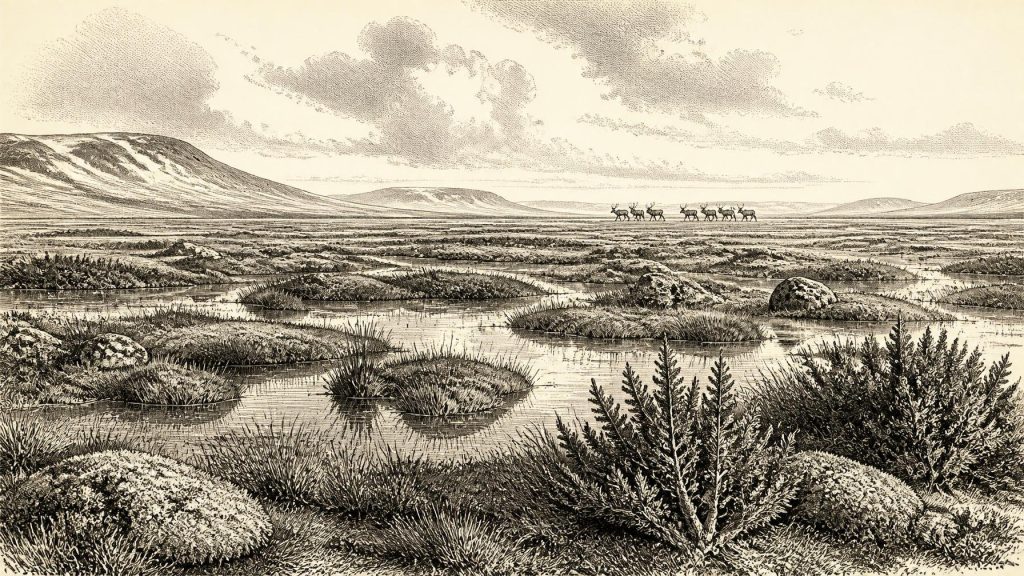
Rather than documenting a single year, evidence for Ireland around 31,296 BCE describes a variable later MIS 3 environment. At Derryvree, Fermanagh, organic freshwater sediments between tills indicate a locally ice-free tundra wetland with mosses, sedges, low shrubs and cold-adapted plants. Castlepook Cave, Cork, preserves a long-accumulated fauna of mammoth, giant deer, reindeer, predators and scavengers, demonstrating intermittent access for cold-stage mammals. Ice conditions, sea levels and routes changed repeatedly, preventing island-wide conclusions. A possibly stone-tool-marked reindeer bone may indicate brief Upper Palaeolithic human activity, but lacks contextual evidence of settlement. No states, agriculture or named peoples can be claimed.
Dateline
The label “31,296 BCE” is a modern way of locating a point in deep time, not a year for which Ireland has an event-by-event history. In the dating convention used by archaeologists, it lies about 33,245 years before AD 1950, the reference point for “BP” (before present). That does not make it an exact archaeological timestamp. At this age, radiocarbon results require calibration because atmospheric carbon-14 varied over time, and calibration produces probability ranges rather than a single secure calendar year. The responsible subject is therefore Ireland during a broad later Marine Isotope Stage 3 (MIS 3) interval, before the Last Glacial Maximum, rather than an imagined occurrence in one numbered year.
A Window Between Ice Advances
The most valuable Irish evidence close to this timescale comes not from a settlement, but from a buried natural archive at Derryvree, near Maguiresbridge in County Fermanagh. Road works in 1969 exposed freshwater silts and fine sands containing organic material, trapped between two layers of till: the unsorted debris laid down by glacier ice. Their order is crucial. A glacial episode created the lower till; water, plants and small animals left traces during an interval when ice was absent locally; then a later glacier sealed the deposits beneath another till. The upper ice advance preserved what it also partly obscured.
Organic material from this deposit, Birm-166, returned a conventional radiocarbon age of 30,500 ± 1,200 radiocarbon years BP. Later calibration has expressed the result broadly as c. 36,900–31,700 calibrated years BP. The nominal date of 31,296 BCE falls within that wide span, but the distinction matters: the deposit accumulated over time and cannot tell us what happened in that particular year, season or generation. Nor can one Fermanagh wetland stand for the whole island. It does, however, offer rare direct testimony that a locally ice-free, freshwater landscape existed in northern Ireland during part of this cold and changing period.
Plants of a Harsh Wetland
Derryvree’s plant and insect evidence points to open, treeless tundra rather than the wooded Ireland familiar from much later prehistory. The assemblage includes grasses and sedges, herbs, juniper and a rich moss flora. Fossils of bogbean, dwarf willow, mountain-avens and lesser clubmoss reinforce the picture of cold-adapted vegetation around wet ground. Freshwater traces, including water-milfoil, indicate pools or slow water. Older investigators used the word “muskeg” for this mossy, waterlogged terrain: a useful description of saturated hollows and organic-rich pools, though not a complete map of the wider landscape.
This was not necessarily an unbroken snow desert. Short growing seasons could produce productive patches beside water, while exposed ground supported sparse low vegetation. Yet the interpretation remains ecological, assembled from the preferences of surviving plant remains, pollen and insects. Pollen can travel, sediments can be reworked, and the site preserves only a small portion of a former landscape. What the evidence securely rules out is a dense temperate forest at Derryvree. It strongly suggests severe winters, frequent freezing and thawing, and a climate in which water, moss, sedge and low shrubs occupied sheltered or seasonally wet places.
Castlepook’s Animal Archive
County Cork supplies a complementary, though differently formed, record. Castlepook Cave near Doneraile, also known as Mammoth Cave, is Ireland’s outstanding pre-Last Glacial Maximum vertebrate site. Excavations in the early twentieth century recovered more than 2,000 bones, while later dating programmes showed that the cave assemblage accumulated across a long interval rather than during one moment. Its fauna includes woolly mammoth, giant deer, reindeer, brown bear, wolf, Arctic fox, lemmings and spotted hyaena. The National Museum of Ireland holds important elements of this collection, including a spotted-hyaena skull.
Those animals demonstrate that Ireland was accessible to a far broader cold-stage mammal community than its modern fauna. Reindeer and mammoth indicate open country capable of supporting large grazers; predators and scavengers indicate a food web with carrion as well as living prey. But caution is essential. A cave is a collecting place, not a census. Hyaenas may have dragged bones in, water could move material, animals might die naturally in or near passages, and early excavations did not meet modern standards of stratigraphic recording. Bones dated thousands of years apart cannot be turned into one perfectly contemporary scene. Castlepook reveals recurring animal use of Ireland, not a single herd assembled in 31,296 BCE.
Ice, Water and Access
This was a period of rapid environmental instability. The British–Irish Ice Sheet had not yet reached its later maximum extent, generally placed within roughly 27,000–21,000 years ago in older syntheses and examined in more detail by recent reconstructions. Its growth and retreat were neither uniform nor identical in every Irish region. Evidence from Ireland, Britain and adjacent seas indicates dynamic ice activity during MIS 3, while the precise outline of ice at any one moment remains debated. Derryvree’s inter-till deposit shows local freedom from ice during its formation; it must not be used to claim that all Ireland was then ice-free.
Nor should modern coastlines be projected backwards. Sea level, glacial loading of the land and the form of the Irish Sea basin all affected whether animals and people faced dry ground, ice, water or a changing combination of them. The arrival of large mammals shows that routes into Ireland existed at intervals, but it does not identify a permanent land bridge, a particular crossing point or a route usable in every century. Ireland’s status as an island or near-island was environmentally consequential: access was a changing constraint, not a simple yes-or-no condition.
The Human Question
The most provocative evidence is a fragment of reindeer femur from the historic Castlepook collection. Zooarchaeologist Ruth Carden’s re-examination identified a deep mark reported as consistent with cutting or chopping fresh bone using a stone tool; the bone has been reported as about 33,000 years old. If that assessment is confirmed, it may record the processing of a reindeer carcass by Upper Palaeolithic people in Ireland far earlier than the well-established later settlement record. Such an encounter would be historically important, but its limits are equally important.
The bone is not from a newly excavated, undisturbed occupation surface. No securely associated hearth, lithic assemblage, dwelling, burial, human bone, ornament or artwork establishes a camp or resident community in Ireland at this date. A radiocarbon determination dates the animal bone, while identification of a surface mark as human-made is a separate taphonomic judgement; trampling, carnivore action, sediment abrasion, excavation damage and handling must be excluded. The National Museum of Ireland accordingly continues to describe clear Palaeolithic proof of humans in Ireland as absent. The careful conclusion is that a brief human visit or carcass-processing episode is possible, not that permanent occupation has been demonstrated.
What Cannot Be Claimed
There were no Irish states, kings, borders, diplomatic missions or named peoples that can responsibly be assigned to this date. There is likewise no Irish evidence for warfare, agriculture, trade networks, formal religion, monuments, writing, schools or artistic traditions in the thirty-second millennium BCE. Upper Palaeolithic communities elsewhere in Europe made sophisticated tools, clothing, art and social connections, but those achievements are context, not evidence for their presence at Derryvree or Castlepook. It would be anachronistic to call any possible visitors “Irish” in an ethnic, linguistic or political sense.
The economy that can be discussed is ecological rather than institutional. Large herbivores converted sparse vegetation into meat and other resources; carnivores, hyaenas and perhaps occasional people exploited carcasses. If people reached Ireland, mobility and knowledge of seasonal animal movements would be plausible in a wider north-west European context, but they remain inference rather than demonstrated Irish practice. The principal story is therefore not a human polity but a precarious living landscape: wetland plants surviving frost, grazing mammals finding open forage, and ice repeatedly reshaping the ground on which all depended.
A Record of Survival
Derryvree’s seedbed and Castlepook’s bones preserve two fragile kinds of evidence from a world later glaciers largely erased. Together they show that Ireland around the broad timescale denoted by 31,296 BCE was neither the green, forested island of popular imagination nor an unchanging blanket of ice. It was a variable northern environment, locally open and wet, visited or occupied by Ice Age animals and perhaps, fleetingly, by people. Its historical value lies precisely in that restraint: the evidence is slight, difficult and incomplete, but it is real enough to reveal a far deeper Irish past than written history can reach.
Primary Sources
- Castlepook Cave, County Geological Site Report
- The Irish Quaternary Fauna Project
- A Reconsideration of the Radiocarbon Dating of the Marine Isotope Stage 3 Fauna from Southern Ireland
- Spotted Hyena Skull
- 2022:564 – Castlepook Cave, Castlepook South, Cork
- Prehistoric Details
- The Mesolithic in Ireland: When Was It?
- The Subdivision of the Quaternary Period in Ireland
- A Middle Midlandian Freshwater Series at Derryvree, Maguiresbridge, County Fermanagh, Northern Ireland
- BSBI: Menyanthes trifoliata
- BSBI: Salix herbacea
- BSBI: Dryas octopetala
- BSBI: Selaginella selaginoides
- BSBI: Myriophyllum alterniflorum
- Growth and Retreat of the Last British–Irish Ice Sheet, 31,000 to 15,000 Years Ago: The BRITICE-CHRONO Reconstruction
- The Timing and Magnitude of the British–Irish Ice Sheet Between Marine Isotope Stages 5d and 2
- Extent and Timing of the Last Glacial Maximum in Britain and Ireland: A Review
- Late Pleistocene Chronostratigraphy and Ice Sheet Limits, Southern Ireland
- Dimensions and Chronology of the Last Ice Sheet in Western Ireland
- Last Glacial Maximum Cirque Glaciation in Ireland and Implications for Reconstructions of the Irish Ice Sheet
- The Deglaciation of the Western Sector of the Irish Ice Sheet from the Inner Continental Shelf to its Terrestrial Margin
- Deglaciation, Earth Crustal Behaviour and Sea-Level Changes in the Determination of Insularity: A Perspective from Ireland
- The IntCal20 Northern Hemisphere Radiocarbon Age Calibration Curve (0–55 cal kBP)
- The IntCal20 Approach to Radiocarbon Calibration Curve Construction: A New Methodology Using Bayesian Splines and Errors-in-Variables