

Derryvree’s Periglacial Lake31232 BCE
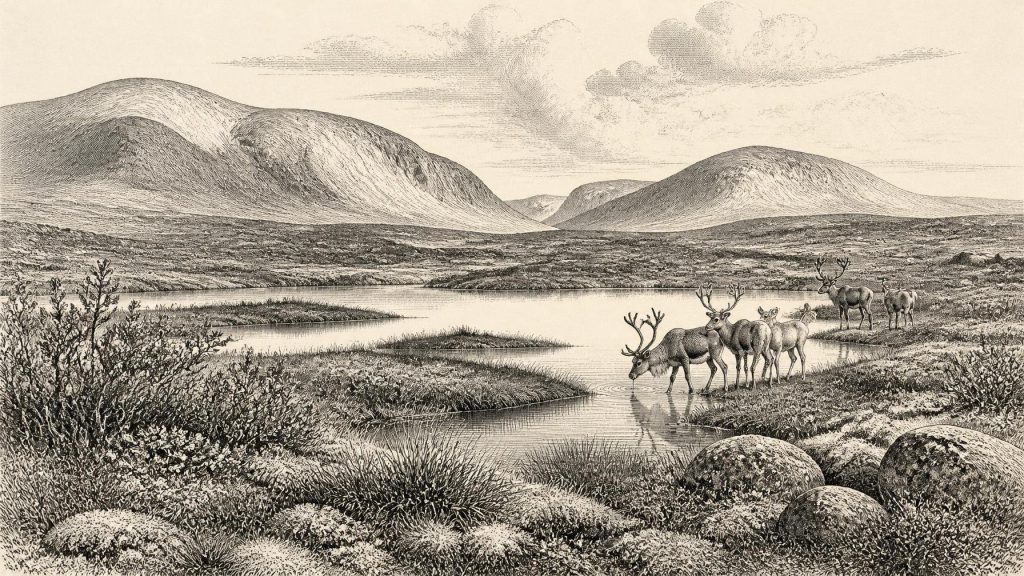
31,232 BCE is a label within a broad Late Pleistocene range, not a datable Irish event. At Derryvree, County Fermanagh, freshwater silts between glacial tills record an ice-free interval, dated roughly 36,900–31,700 calibrated years before present. Plants, insects and sediments indicate cold, treeless tundra wetlands with pools, mosses and sedges, demonstrating ecosystems rather than uniform lifelessness. Castlepook Cave fauna shows that cold-stage mammals reached Ireland, although remains accumulated across periods. A cut-marked reindeer femur may indicate Upper Palaeolithic human activity, but proves neither settlement nor occupation. No evidence establishes polities, farming, monuments, trade or practices; climate shaped this Atlantic frontier.
Dateline
The label 31,232 BCE is a modern way of counting backwards, not a date at which Ireland’s archaeological record can identify an event, a ruler or even a single season. For this depth of time, modern calendar-year precision is unavailable. The relevant evidence belongs broadly to the Late Pleistocene, within Marine Isotope Stage 3, and is dated in ranges derived from radiocarbon measurements, calibration and stratigraphic relationships. The most illuminating Irish record is not a settlement but a buried freshwater deposit at Derryvree near Maguiresbridge, County Fermanagh. It offers a rare glimpse of an ice-age landscape during an interval when that locality was free of glacier ice.
A Date Inside a Range
Derryvree was exposed by roadworks in 1969, when a cut through a drumlin revealed organic silts and fine sands between two thick layers of till, the unsorted sediment left by moving ice. The sequence is unusually eloquent. First came glaciation, represented by the lower till; then an interval in which freshwater sediment, plants and insects accumulated; later, ice again crossed the ground and laid down the upper till. It records environmental change on a grand scale, but not an annual diary.
Organic material from the freshwater bed produced a conventional radiocarbon age of 30,500 radiocarbon years before present, with a substantial uncertainty. Using modern calibration, scholarship places the deposit broadly at about 36,900–31,700 calibrated years before present. The calendar label 31,232 BCE falls within that wide span, but it cannot be used to date the whole deposit to a particular year. Nor should the Derryvree evidence be treated as a complete map of Ireland. It demonstrates that this part of Fermanagh experienced an ice-free interval; it does not prove that every region of the island was simultaneously open, habitable or alike.
This caution matters because the last glacial cycle was neither a single unbroken freeze nor a steady march towards colder weather. North Atlantic climates shifted sharply between relatively milder interstadials and severe stadials, sometimes over timescales far shorter than the span represented by an archaeological period. Ireland lay at the Atlantic edge of this unstable world. Ice sheets grew, altered their flow and later reached their greatest late-glacial extent after the period considered here. Around 31,232 BCE, the decisive historical force was therefore climate: it determined where water could remain liquid, which plants could grow, where animals could feed, and whether people could travel through or survive in the region.
An Open, Cold Wetland
The fossils at Derryvree point to a treeless tundra and periglacial environment rather than woodland, farmland or a familiar Irish bog. Mosses, sedges, aquatic plants and small invertebrates indicate wet ground with shallow pools and plentiful plant matter: a muskeg-like wetland in a cold open landscape. The recorded flora included bogbean, water-milfoil, dwarf willow, mountain-avens, Arctic-alpine plants and grasses or herbs adapted to exposed conditions. Beetle remains are especially valuable because many insects have tightly defined ecological requirements. Together, plant and insect evidence suggests a landscape with standing or slowly moving freshwater, mossy margins and low vegetation, subjected to long cold winters.
That reconstruction is evidence-based, but it has limits. The silts preserve organisms from a particular basin and its catchment, not every hillside or coast. A wet hollow may have supported plants absent from nearby drier ground. Likewise, the presence of cold-adapted species shows that severe conditions prevailed locally; it does not supply exact temperatures for 31,232 BCE. Nonetheless, Derryvree decisively counters any image of a uniformly lifeless Ireland. Where ice had withdrawn or had not advanced, water, vegetation and insects formed functioning ecosystems. These were sparse northern communities, but they were communities of living things.
Animals at the Atlantic Margin
Caves and museum collections add a different kind of evidence. The Irish Quaternary Fauna Project showed that a varied mammal fauna reached Ireland at intervals between at least about 45,000 and 20,000 years ago. Castlepook Cave, also known as Mammoth Cave, near Doneraile in north County Cork is particularly important. Re-dating of bones using improved ultrafiltration methods established that several remains once thought younger were in fact much older, within Marine Isotope Stage 3. The cave assemblage includes animals suited to very different niches and times, among them reindeer, giant deer, woolly mammoth, brown bear, wolf, Arctic fox, lemmings and spotted hyaena.
That list must not be converted into a claim that all these animals stood together on the same day, or that every species was present in every Irish region around this calendar label. Cave bone collections often accumulated over thousands of years. Carnivores can carry prey into caves; water can move bones; animals can die in fissures; and early twentieth-century excavations removed much of the stratigraphic context that modern archaeologists require. The secure conclusion is important enough: during parts of the pre-Last Glacial Maximum, Ireland supported, or was reached by, a substantial cold-stage fauna. Reindeer in particular signal open country with accessible grazing, while hyaena remains remind us that caves could be dens and scavenging places rather than human shelters.
The Castlepook Human Question
The closest possible human connection to this period is a reindeer femur from Castlepook Cave. It has been reported as about 33,000 years old and bears a deep mark interpreted by zooarchaeologist Ruth Carden as having been made by a sharp stone tool while fresh tissue was being cut. If that interpretation is sustained, it would provide evidence that people processed a reindeer in Ireland during the Upper Palaeolithic, vastly earlier than the long-established Mesolithic occupation after the final retreat of the ice.
Yet responsible history must preserve the word if. The specimen comes from an old cave collection rather than a newly excavated, sealed occupation floor. A radiocarbon determination dates the animal bone, not a named hunter, a camp or the exact moment when its surface was marked. Nor has Ireland produced a securely associated hearth, stone-tool assemblage, dwelling, burial, ornament, artwork or human skeleton of this age. Recent investigations at Castlepook have sought surviving Pleistocene deposits, but the site’s earlier excavation history and complex sediment movement make contextual recovery difficult. The reindeer femur is an exceptionally significant possible trace, not proof of a settled population.
People Without a Recorded Polity
There can be no meaningful account of Irish political affairs, diplomacy, institutions, named communities or warfare for 31,232 BCE. No writing existed in Ireland, and the material record does not identify a polity, boundary or leader. If small groups of Upper Palaeolithic people entered the island, they were almost certainly mobile hunter-gatherers operating within wider north-west European networks, rather than inhabitants of an enduring Irish state or village. This is an inference from the wider European Upper Palaeolithic context, not a fact demonstrated by an Irish camp.
The same distinction applies to everyday life. Reindeer, if processed by people, could have supplied meat, fat, hides, sinew and bone; sharp stone edges were widely used elsewhere in Europe for butchery. But Castlepook’s marked femur cannot reveal whether the animal was hunted, scavenged, butchered at the cave or carried there by a carnivore after people had taken part of the carcass. It tells us nothing certain about family size, language, clothing, beliefs, artistic traditions or routes of travel. A temporary visit during a favourable climatic interval is possible; permanent occupation is not established.
No Farms, No Monuments, No Trade Record
There is no evidence for agriculture, domestic animals, cultivated fields, houses, ceramics, metalworking, monuments or formal exchange networks in Ireland at this time. The economy documented by the landscape was ecological rather than agricultural: plants growing in cold wetlands, herbivores exploiting open ground, and predators or scavengers following animal resources. Any human economy, if present, would have depended upon mobility and knowledge of seasonal terrain. But neither trade nor travel routes can be recovered from the Irish evidence alone. Lower global sea levels and changing ice margins altered regional geography, yet the exact practical connections between Ireland, Britain and continental Europe at a given moment remain uncertain.
Religion and learning are equally beyond direct recovery. Upper Palaeolithic societies elsewhere made sophisticated tools, ornaments and images, but it would be unsound to assign any specific artistic or spiritual tradition to Ireland from a single disputed modification on bone. The absence of such evidence is not evidence that people lacked culture; rather, it reflects the fragility of archaeological traces, later glaciation, and the small number of surviving and excavated deposits.
The Most Important Development
The principal development appropriate to 31,232 BCE is the existence of an Irish environmental archive revealing a cold but active landscape before the Last Glacial Maximum. Derryvree’s freshwater bed demonstrates that, within a broad calibrated range embracing this modern year label, an ice-free Fermanagh basin held pools, sedges, mosses, insects and tundra plants between episodes of glaciation. Castlepook adds evidence of large mammals in southern Ireland and raises the provocative possibility of a fleeting human encounter with reindeer. Together they replace a blank Ice Age Ireland with a more complex picture: not a known human homeland, but a changing Atlantic frontier where life persisted and where people may, briefly and precariously, have entered the record.
Primary Sources
- A Middle Midlandian Freshwater Series at Derryvree, Maguiresbridge, County Fermanagh, Northern Ireland
- The Irish Quaternary Fauna Project
- A reconsideration of the radiocarbon dating of the Marine Isotope Stage 3 fauna from southern Ireland
- Growth and retreat of the last British–Irish Ice Sheet, 31,000 to 15,000 years ago: the BRITICE-CHRONO reconstruction
- Exploring controls of the early and stepped deglaciation on the western margin of the British-Irish Ice Sheet
- Pattern and timing of retreat of the last British-Irish Ice Sheet
- Maximum extent and dynamic behaviour of the last British–Irish Ice Sheet west of Ireland
- Dynamic cycles, ice streams and their impact on the extent, chronology and deglaciation of the British-Irish Ice Sheet
- Episodic speleothem deposition tracks the terrestrial impact of millennial-scale last glacial climate variability in SW Ireland
- Spatio-temporal dynamics of speleothem growth and glaciation in the British Isles
- The IntCal20 Northern Hemisphere Radiocarbon Age Calibration Curve (0–55 cal kBP)
- IntCal20
- New insights on the fauna of Ireland’s Younger Dryas and Early Holocene from Alice & Gwendoline Cave
- 2022:564 – Castlepook Cave, Castlepook South, Cork
- Archaeology Research Excavation Grant 2022: Castlepook Cave Final Report
- Heritage Artefacts of County Cork
- The Archaeological Heritage of County Cork
- Figure 6: The Subdivision of the Quaternary Period in Ireland
- Conserving Quaternary geoheritage in Northern Ireland
- The earliest evidence for anatomically modern humans in northwestern Europe