Derryvree Wetland31228 BCE
Modern dating labels 31,228 BCE only approximately describe later Marine Isotope Stage 3 Ireland, lacking written or securely dated human evidence. Derryvree, County Fermanagh, preserves freshwater organic sediments between glacial tills, radiocarbon dated broadly to the mid- to low-30,000s calibrated years BP. Pollen, seeds, mosses and insects show a cold, exposed, largely treeless wetland of sedges, grasses, aquatic plants and pools during an ice-free interval. Cave faunas demonstrate wider Pleistocene animal diversity, but cannot establish species present locally then. Later glaciation and rising seas destroyed evidence. Ireland’s earliest secure human trace dates only to 12,800–12,600 calibrated years BP, far later.
Dateline
The label 31,228 BCE is a modern way of counting backwards, not a date that can be matched to a recorded Irish event. No written record, named person, settlement, political community or calendar exists for Ireland at this depth of time. In archaeological terms, it falls broadly around 33,200 calibrated years before present, with “present” conventionally fixed at AD 1950. That apparent precision is misleading: the evidence is dated in ranges, often with substantial uncertainty, and describes episodes lasting centuries or millennia. The responsible subject is therefore Ireland during the later part of Marine Isotope Stage 3, a climatically unsettled interval of the last Ice Age before the greatest expansion of the British–Irish Ice Sheet.
The closest Irish evidence is not a chronicle but a buried wetland at Derryvree, near Maguiresbridge in County Fermanagh. Road works in 1969 exposed sands, silts and organic sediments sealed between two layers of glacial till within a drumlin. The organic horizon produced a conventional radiocarbon age of 30,500 ± 1,100 radiocarbon years BP. Calibration makes clear why an exact BCE year cannot be claimed: the deposit belongs broadly to a span around the mid-30,000s to low-30,000s calibrated years BP, rather than to a single moment. Nevertheless, it is an unusually valuable window on an Irish landscape close to the requested date.
A Wetland Between Ice Advances
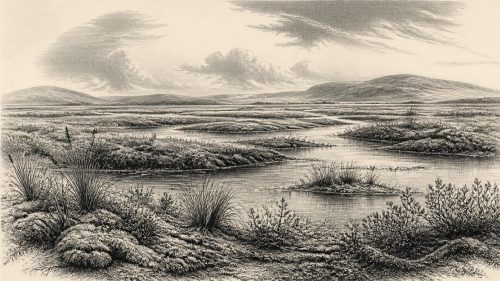
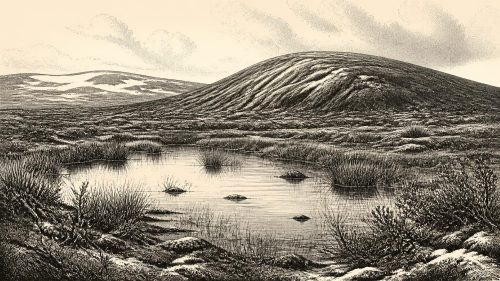
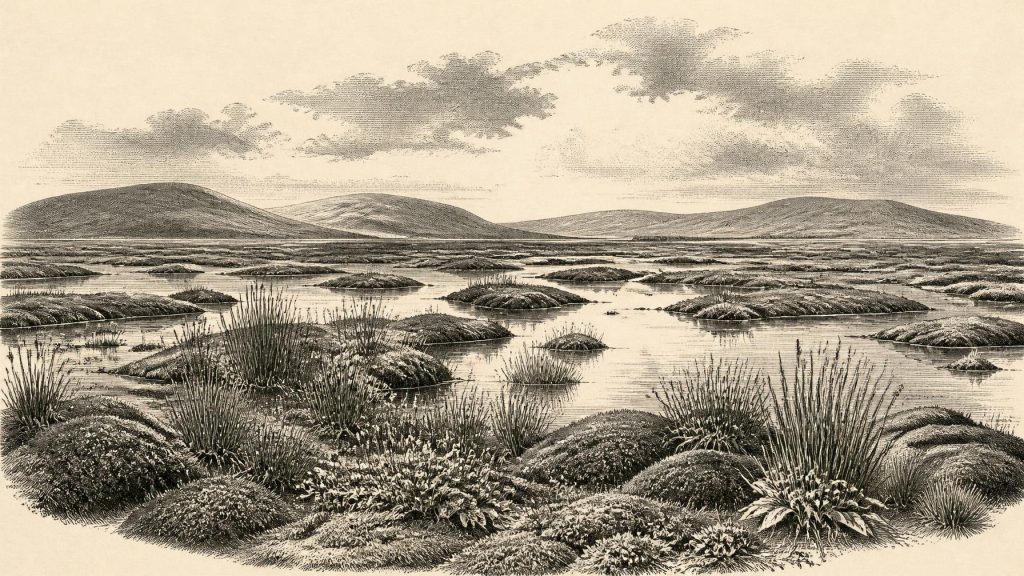
Derryvree demonstrates that northern Ireland was not simply a permanent white void throughout the last glacial cycle. At the time represented by its freshwater beds, standing or slowly moving water occupied a hollow in an open, cold landscape. Pollen, plant macrofossils, mosses and insect remains accumulated in mud before a later ice advance buried the site. These remains are direct evidence for a functioning wetland ecosystem; the wider reconstruction of its appearance and climate is interpretation, albeit interpretation grounded in several independent kinds of evidence.
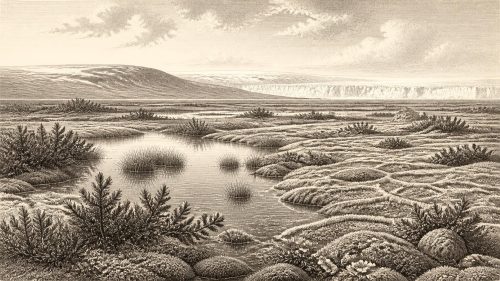
The vegetation was predominantly treeless. Grasses, sedges, herbs and dwarf-shrub or tundra elements dominate the environmental signal, while mosses and aquatic or wet-ground plants indicate saturated margins, shallow pools and peaty ground. A fossil seed of bogbean, Menyanthes trifoliata, is especially evocative: it indicates freshwater or fen-like conditions, not a dry polar desert. Other finds include water-milfoil and aquatic mosses. Pollen from juniper occurs, but this need not mean a nearby juniper woodland; pollen can travel, and the total assemblage points to exposed, largely treeless terrain.
“Muskeg” is a useful, though imperfect, term for this mosaic: waterlogged ground rich in mosses and sedges, broken by pools and probably subject to freezing, thawing and seasonal shifts in water level. The insect assemblage supports the existence of plant-rich wet ground in a severe climate. Summers may at times have allowed plant growth and liquid water, but winters were harsh. This was no agricultural landscape. There is no evidence of fields, grazing livestock, hedges, planted woodland or domesticated crops; farming in Ireland lay tens of millennia in the future.
Ice, Water and an Unstable Island
Ireland’s place within the British–Irish Ice Sheet system was changing. The great ice expansion generally associated with the Last Glacial Maximum came later, reaching its maximum extent roughly between 26,000 and 20,000 years ago, depending on region and measure. Around the Derryvree interval, however, ice growth, local glacier activity, sea level and the availability of ice-free ground were already matters of profound environmental consequence. Reconstructions of the wider ice sheet beginning at 31,000 years ago are necessarily model-based in many areas, because direct chronological constraints are uneven. They should not be read as a map of conditions in one numbered year.
The later ice sheet profoundly affected what can now be known. Glaciers eroded bedrock, reworked older sediment, buried surfaces beneath till and altered river systems. Rising seas after the Ice Age drowned large parts of the former coastal plain and shelf. A campsite beside a river, a trackway across soft ground or a short-lived animal kill site would have had poor odds of surviving these processes. The scarcity of evidence is therefore meaningful, but it is not a simple census of all who or what may once have been present.
At Derryvree, the sequence itself tells this story of change. Freshwater sediment was laid down during an interval in which the locality was not overridden by ice; later glacial sediment sealed it. That relationship gives the deposit exceptional importance. It records an ecological interlude between glacial episodes, not an enduring environmental norm for the whole island. Conditions in limestone caves in Cork, coastal lowlands, uplands and the Irish Sea basin may have differed significantly at the same broad time.
Animals Without a Yearly Fauna List
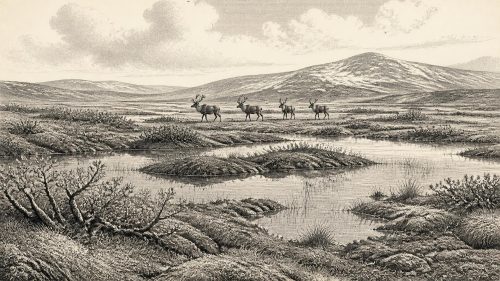
Irish cave deposits reveal that large mammals entered Ireland during parts of the Middle and Late Pleistocene. Castlepook Cave, near Doneraile in County Cork, has yielded remains of spotted hyena, woolly mammoth, reindeer, giant deer, brown bear, wolf, Arctic fox, mountain hare and lemmings. These finds establish that Ireland was, during favourable phases of the wider period, part of a north-west European world in which cold-adapted and open-country mammals could move and survive. They also show that the island’s Pleistocene fauna was richer than its modern fauna might suggest.
Yet this is precisely where caution matters. Cave deposits are often mixed, disturbed or accumulated over long intervals. Recent reassessment of Marine Isotope Stage 3 fauna from southern Ireland has revised the implications of older radiocarbon determinations, indicating that some Castlepook mammals may be considerably older than once thought and may have disappeared locally well before the Last Glacial Maximum. The Castlepook record must therefore not be turned into a claim that mammoths or hyenas stood at Derryvree in 31,228 BCE. It is evidence for a changing regional fauna across a long interval, not a wildlife inventory for a particular year.
Nor should “giant Irish deer” be imagined as an animal confined to Ireland. Megaloceros giganteus ranged widely across Eurasia, though Irish fossil discoveries made it famous. Its imposing antlers, like mammoth remains, belong to a deep-time fauna whose local presence depended on habitat, climate, migration routes and survival through successive cold phases. Predators and scavengers, notably spotted hyena, remind us that a reindeer or giant deer carcass could enter a cave through animal behaviour rather than human hunting. Bone accumulations require taphonomic investigation before they can be translated into stories of people.
The Human Question
There is no securely dated settlement, stone-tool assemblage, hearth, burial, house, artwork or human bone that demonstrates a resident human population in Ireland around this time. Consequently, there is no responsible basis for describing chiefs, tribes, alliances, warfare, diplomacy, religion, language, trade routes or learned traditions in 31,228 BCE. Such subjects belong to later archaeological and historical periods, not to the Derryvree wetland record.
Ireland was not necessarily beyond the reach of people. Upper Palaeolithic communities elsewhere in north-west Europe were capable hunters, foragers and travellers in severe climates, and Pleistocene animal movements show that Ireland was not permanently isolated from neighbouring landmasses. But capability elsewhere is not proof of occupation here. The earliest currently secure evidence of human activity in Ireland is much later: a cut-marked brown-bear patella from Alice and Gwendoline Cave, County Clare, dated to about 12,800–12,600 calibrated years BP. That find is important precisely because it is direct evidence, while no comparably secure human trace belongs to the Derryvree interval.
One may reasonably infer the challenges that any brief visitor would have faced: exposure to cold, variable weather, difficult ground, dangerous large animals and the need for fuel, shelter, hides, food and workable stone. A small mobile party might leave little behind. But this remains an inference from comparative Upper Palaeolithic archaeology, not a demonstrated account of Irish life. The distinction preserves the significance of the evidence rather than diminishing it.
Deep Time, Not Empty Time
To call this prehistoric Ireland “empty” would be too absolute. Derryvree preserves water, sedges, mosses, insects and cold-adapted plant communities; cave sites preserve traces of animals that crossed and lived in parts of the island during the broader Ice Age. These are not marginal details. They reveal ecological connections, climatic volatility and the processes that shaped the physical Ireland inherited by later peoples. Drumlins, glacial sediments, altered drainage and drowned coastlines are part of that long inheritance.
But it would be equally wrong to make the evidence tell a story it cannot carry. Around the modern label 31,228 BCE, Ireland is known through calibrated ranges, stratigraphy, pollen, seeds, insects, bones and the later action of ice. Derryvree’s buried wetland offers the clearest image: an exposed, treeless, cold landscape where mossy, sedgy ground and open water persisted for a time between advances of ice. It is a fragmentary record, but a remarkable one—proof that even in one of Ireland’s least knowable ages, life left traces.
Primary Sources
- A Middle Midlandian Freshwater Series at Derryvree, Maguiresbridge, County Fermanagh, Northern Ireland
- Irish Pleistocene Biostratigraphy
- Figure 6.— The Subdivision of the Quaternary Period in Ireland
- Palaeoecology
- The Irish Quaternary Fauna Project
- A Reconsideration of the Radiocarbon Dating of the Marine Isotope Stage 3 Fauna from Southern Ireland
- Spotted Hyena Skull
- Growth and Retreat of the Last British–Irish Ice Sheet, 31,000 to 15,000 Years Ago: the BRITICE-CHRONO Reconstruction
- The Timing and Magnitude of the British–Irish Ice Sheet Between Marine Isotope Stages 5d and 2
- Late Pleistocene Chronostratigraphy and Ice Sheet Limits, Southern Ireland
- Last Glacial Maximum Cirque Glaciation in Ireland and Implications for Reconstructions of the Irish Ice Sheet
- Character of Advance and Retreat of the Southwest Sector of the British-Irish Ice Sheet During the Last Glaciation
- Stratigraphic and Palaeo-Geomorphological Evidence for the Glacial-Deglacial History of the Last British-Irish Ice Sheet in the North-Western Irish Sea
- The IntCal20 Northern Hemisphere Radiocarbon Age Calibration Curve (0–55 cal kBP)
- IntCal Publications
- First Evidence of a Late Upper Palaeolithic Human Presence in Ireland
- New Insights on the Fauna of Ireland's Younger Dryas and Early Holocene from Alice & Gwendoline Cave
- The Colonization of Ireland: A Human Ecology Perspective
- The Antiquity of Man in Ireland
- The Mesolithic in Ireland: When Was It?
- Geology of Ireland
- Ireland Through Geological Time
- Outreach and Education Resources
- Field Guides