Mammoth Cave Before the Maximum31227 BCE
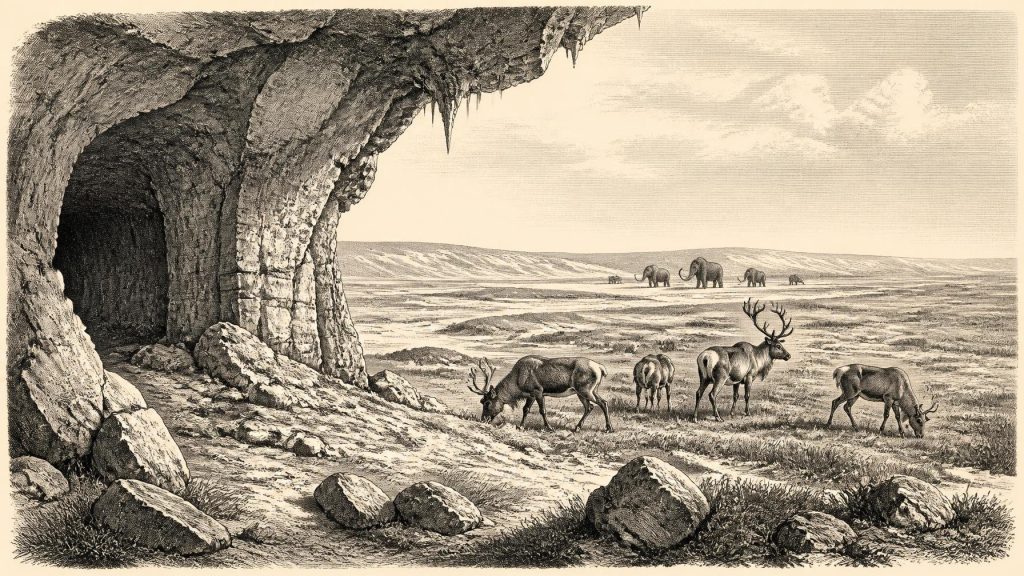
31,227 BCE represents an approximate point in Marine Isotope Stage 3, when Ireland was becoming colder as the British–Irish Ice Sheet grew, but before its maximum extent. Landscapes, coastlines and routes changed with climate, ice and lower sea levels. Castlepook Cave, County Cork, preserves a cold-stage fauna including reindeer, mammoth, giant deer, bear, Arctic fox, lemmings and hyaena, indicating open tundra-like habitats. A dated reindeer bone bearing a tool mark suggests a brief human visit, but requires confirmation and cannot prove settlement. No institutions are recoverable. It remains a threshold marked by environmental change, fragmentary fauna and uncertain human presence.
Dateline
31,227 BCE is a modern calendar label, not a date that can be recovered from the Irish archaeological record with year-by-year precision. Expressed approximately in the language used by Quaternary scientists, it falls around 33,200 years before present, though converting between BCE, radiocarbon years and calibrated calendar years is not exact. The responsible history of Ireland at this depth of time must therefore use ranges, stratigraphy and probabilities rather than claim that an identifiable event happened in this particular year. It belongs to Marine Isotope Stage 3, in the later Pleistocene, when climates in north-west Europe were highly unstable and the last British–Irish Ice Sheet was beginning its major growth towards its later maximum.
A Date Within a Long Transition
At about 33,000 calibrated years ago, Ireland stood before—not at—the fullest extent of the last glaciation. The term “Last Glacial Maximum” can be misleading if imagined as a single instant across every region. Ice sheets expanded and reached their greatest limits at different times. Current syntheses place substantial growth of the British–Irish Ice Sheet after roughly 35,000–32,000 years ago, while the Irish Sea sector expanded markedly from about 30,000 to 26,000 years ago; its furthest south-western advance came later, around 25,600 years ago. Thus 31,227 BCE belongs to an ice-building world whose outlines were changing over millennia, not to a settled, uniform age of ice.
This distinction matters for Ireland. Much of the familiar physical evidence of the last glaciation—drumlins, tills, striated rock, meltwater channels and many moraines—records later advances and retreats. It cannot automatically tell us whether a particular valley, cave entrance or coastal plain was ice-covered in a narrowly defined year more than 33 millennia ago. Geological Survey Ireland’s mapping demonstrates the scale and variety of this glacial inheritance, but the landforms are the accumulated result of repeated movements of ice, sediment and meltwater. They are archives of process rather than annual chronicles.
An Unstable Cold Landscape
The best broad interpretation is that Ireland was increasingly cold, open and environmentally severe, but was not necessarily a single continuous white sheet from coast to coast at this date. The exact extent and thickness of ice remain subjects of active research, particularly in mountain areas and around the Irish Sea. Later evidence confirms that the Irish Sea Ice Stream became a powerful outlet of the wider ice sheet and eventually occupied much of what is now the Irish and Celtic seas; however, its maximum is generally dated to about 25,000–23,000 years ago, several thousand years after the date considered here.
Where land was exposed, it would not have resembled modern Ireland. During cold-stage intervals, tree cover was greatly reduced or absent and low vegetation supported grazing animals adapted to open conditions. The detailed Irish environmental record for precisely 33,200 years ago is fragmentary, so a neat reconstruction of particular plants, temperatures or coastlines would be overconfident. Yet the animal assemblages from Irish caves, combined with wider north-west European evidence, support an interpretation of tundra or mammoth-steppe-like mosaics: grass- and herb-rich open ground, patches of wetland, frost-affected soils and sheltering limestone caves. Such habitats could change markedly as climate oscillated and ice margins migrated.
Sea level was lower globally than today because vast volumes of water were stored in continental ice sheets. The modern Irish coastline and Irish Sea should therefore not be projected unchanged into this period. Still, whether Britain and Ireland were connected by dry land at every phase, and which routes were traversable, depends on local ice, relative sea level and changing topography. The prudent conclusion is not a confidently drawn land bridge, but a changing western fringe of Europe in which marine basins, exposed shelves, glaciers and terrestrial corridors repeatedly altered possibilities for animal and human movement.
Castlepook’s Older Fauna
The most important Irish evidence relevant to this broad horizon comes from Castlepook Cave near Doneraile, County Cork, historically also called Mammoth Cave. Excavations in the early twentieth century produced a large but imperfectly recorded collection of bones. Later re-examination and improved accelerator radiocarbon methods have shown that some southern Irish cave faunas are substantially older than earlier measurements suggested. Castlepook therefore preserves evidence for an Ice Age animal community in Ireland during Marine Isotope Stage 3, before the final major ice expansion.
The assemblage is especially significant because it includes animals whose presence evokes a very different Ireland: reindeer, woolly mammoth, giant deer, brown bear, Arctic fox, hare, lemmings and spotted hyaena. Not every species need have lived side by side at the same moment; cave collections can combine material deposited over long periods, and early excavations often disturbed layers or recorded their positions inadequately. Nor does a bone in a cave necessarily indicate an animal died there. Carnivores may have carried prey inside, water and sediment may have moved remains, and human or animal activity may have reworked deposits. The evidence securely establishes a varied cold-stage fauna; the exact ecological snapshot remains an interpretation.
Reindeer are particularly relevant. Their bones occur in Irish Pleistocene contexts and their ecology is consistent with open, cold landscapes. Mammoth remains at Castlepook likewise attest to conditions capable of sustaining, at least episodically, large herbivores associated with Late Pleistocene northern Europe. Hyaenas imply predators and scavengers able to exploit carcasses and shelters. This was not an economy created by Irish farmers or herders—agriculture, domesticated stock, villages and fields lay tens of millennia in the future—but an ecological system shaped by seasonality, mobility, predation and climatic pressure.
The Human Question
Whether people entered Ireland at or near this time is the most consequential and most uncertain question. A reindeer femur from Castlepook has been publicly reported as dating to about 33,000 years ago and as bearing a deep mark interpreted as consistent with cutting or chopping by a stone tool. If that interpretation and its association with the dated bone are upheld through full specialist publication, it could represent very early Upper Palaeolithic human activity in Ireland: not a settlement, but a person or small party handling a reindeer carcass. It would push the evidence for human presence far earlier than the long-accepted record.
That is not, however, a licence to populate 31,227 BCE with named hunters, camps, routes or traditions. A single modified bone cannot demonstrate a permanent population, a dwelling, a tool kit, kinship group, language, political territory or sustained hunting economy. Its cave context is complicated, and the distinction between a human cut mark and damage caused by carnivores, excavation, sediment movement or other processes demands careful microscopic and contextual assessment. The National Museum of Ireland has traditionally stated that no clear evidence had established Palaeolithic human presence in Ireland; more recent work at Alice and Gwendoline Cave in County Clare has supplied evidence of human activity only much later, during the terminal Pleistocene, around 12,700 calibrated years before present.
The most balanced description is therefore that an early human visit to southern Ireland around this broad period is possible and potentially very important, but remains a matter requiring further publication and testing. If people did reach Castlepook, they were unlikely to have encountered an isolated island society. They would have been mobile Upper Palaeolithic foragers operating at the far north-western edge of European ecological networks, following opportunities created by animals, exposed ground and changing coasts. That wider comparison is reasonable; a claim for regular Irish occupation is not presently warranted.
No Polities, No Recorded Religion
For the usual categories of historical writing, the evidence is mainly silence. There were no documented Irish kingdoms, chiefs, treaties, battles, diplomatic missions, towns, markets, shrines or schools in 31,227 BCE. There is no basis for assigning political authority or organised conflict to Ireland at this date. Nor can cave bones reveal a religion, ritual calendar, spoken language, artistic canon or inherited ethnic identity. The absence of such evidence is not proof that a passing human group had no beliefs or social relationships; it means that archaeology cannot responsibly recover them here.
Likewise, “trade” should not be imagined as commerce between Irish communities. The relevant movements were ecological and geographical: animal dispersal, possible human foraging journeys, and the transport of bone and sediment into caves. The durable cultural traces normally used to discuss learning and society—stone assemblages, hearths, structures, ornaments, burials and art—have not been securely demonstrated for Ireland at this early horizon. Ireland’s first substantial and sustained archaeological record belongs much later, after deglaciation, with Mesolithic communities conventionally dated from about 8000 BCE.
What This Year Can Mean
The significance of 31,227 BCE is therefore not a dated episode but a threshold. Ireland was entering the long build-up to the last great ice advance. Its caves preserve evidence that cold-adapted animals, including reindeer and mammoth, ranged through at least parts of the island in the broader period. Castlepook offers a tantalising possibility that people briefly shared that world, while also demonstrating why deep prehistory must distinguish a dated specimen from a securely dated human event. Future excavation of intact deposits, improved dating and microscopic study may clarify the picture. For now, the most defensible Irish history is one of a changing Ice Age landscape, a rich but discontinuous animal record, and a human presence that remains possible rather than proven for this exact calendar year.
Primary Sources
- Growth and retreat of the last British–Irish Ice Sheet, 31 000 to 15 000 years ago: the BRITICE‐CHRONO reconstruction
- Extent and timing of the Last Glacial Maximum (LGM) in Britain and Ireland: a review
- Maximum extent and readvance dynamics of the Irish Sea Ice Stream and Irish Sea Glacier since the Last Glacial Maximum
- The evolution of the terrestrial-terminating Irish Sea glacier during the last glaciation
- Stratigraphic and palaeo-geomorphological evidence for the glacial-deglacial history of the last British-Irish Ice Sheet in the north-western Irish Sea
- Last Glacial Maximum cirque glaciation in Ireland and implications for reconstructions of the Irish Ice Sheet
- Late Pleistocene chronostratigraphy and ice sheet limits, southern Ireland
- Radiocarbon constraints on the age of the maximum advance of the British-Irish Ice Sheet in the Celtic Sea
- A reconsideration of the radiocarbon dating of the Marine Isotope Stage 3 fauna from southern Ireland
- The Irish quaternary fauna project
- New insights on the fauna of Ireland's Younger Dryas and Early Holocene from Alice & Gwendoline Cave
- Archaeology Research Excavation Grant 2022: Final Report
- 32564: Castlepook Cave, Co. Cork
- Mell Flint Flake: Prehistoric Details
- The Mesolithic in Ireland: when was it?
- Ireland through geological time
- Quaternary
- Themes: Quaternary
- Last Glacial Maximum cirque glaciation in Ireland and implications for reconstructions of the Irish Ice Sheet
- Distribution and range expansion of deer in Ireland
- Geology of Ireland
- The Last Glacial Termination in Northern Ireland