Castlepook Fauna31089 BCE
Around 31,089 BCE, Ireland lay within a fluctuating cold-stage environment before the Last Glacial Maximum. Lower sea levels altered coasts, but no definite route from Britain or evidence of permanent human settlement exists. Derryvree, County Fermanagh, preserves a wetland sequence between glacial tills, indicating open, treeless tundra-like conditions. Castlepook Cave, County Cork, contains remains of mammoth, reindeer, giant deer and predators, accumulated over long periods. A cut-marked reindeer femur may indicate human carcass processing, but cannot prove occupation. Later ice-sheet advances reshaped Ireland and destroyed much earlier evidence, leaving a fragmentary record of changing ecosystems, animals and possible transient visitors.
Dateline
A Date Beyond Annals
31,089 BCE is a modern label for a point in deep prehistory, not a year for which Ireland has a chronicle, named ruler, settlement record or recoverable political event. Modern calendar-year precision is not available. In the archaeological convention that counts backwards from AD 1950, it falls roughly 33,038 calendar years before present, but the evidence comes in radiocarbon ranges, disturbed cave deposits and long environmental sequences whose uncertainties are measured in centuries or millennia. The responsible subject is therefore Ireland during the later part of Marine Isotope Stage 3, before the fullest expansion of the Last Glacial Maximum ice sheet.
This was not yet the familiar island of farms, woods, towns or even securely demonstrated hunter-gatherer communities. It was a changing north-west European landscape on the margin of major climatic fluctuations. Ice, sea level, vegetation and animal ranges were all in motion over timescales far larger than a single numbered year. The historical record for this era is exceptionally fragmentary because later glaciers eroded, buried and reworked much of what had existed on land.
An Island in a Changing Ice Age
Ireland’s precise geography around this date cannot be reconstructed as a fixed map. Sea level was lower than today because vast quantities of water were locked in northern ice sheets, exposing areas of continental shelf. Yet low sea level did not automatically mean an easy, continuous land route from Britain to Ireland. The extent of ice, water and exposed ground shifted repeatedly, while the Irish Sea basin and northern approaches were shaped by both glacial ice and relative sea-level change. Animal movement and any human approach to Ireland may have been possible during suitable phases, but no particular route can be demonstrated for 31,089 BCE.
The island was approaching, rather than already at, the Last Glacial Maximum. Modern reconstructions place the maximum extent of the British–Irish Ice Sheet later, broadly around 27,000–23,000 calibrated years before present, with maximum ice volume around 23,000 years ago. That later ice sheet profoundly remodelled Ireland’s surface. Drumlins, tills, moraines and scoured bedrock are its legacy, but its erosive force also helps explain why evidence for earlier landscapes and people survives only in unusual protected deposits.
Climate at this date should not be pictured as a single, uninterrupted white wilderness. The later Pleistocene contained sharp climatic oscillations. In some localities Ireland had open, cold-adapted terrain, seasonal wetlands and extensive grazing country; in others, advancing ice or periglacial conditions could make the landscape markedly harsher. The balance of evidence points away from closed forest. Any tree pollen found in cold-stage deposits must be assessed cautiously, since pollen can travel long distances. It does not by itself prove nearby woodland.
Derryvree’s Buried Wetland
The clearest environmental evidence relevant to this broad era comes from Derryvree, near Maguiresbridge in County Fermanagh. Road works in 1969 cut through a drumlin and revealed freshwater silts and fine sands sealed between two distinct till sheets. That order matters. An earlier glacier had deposited till; an interval without local ice then allowed waterborne sediment and organic material to build up; a later advance buried the wetland beneath fresh glacial sediment.
The organic deposits produced the radiocarbon determination Birm-166, reported as 30,500 radiocarbon years BP with an uncertainty of +1,170/−1,030 years. This is an uncalibrated radiocarbon result, not a date that can honestly be converted into one exact BCE year. Modern calibration curves are essential at this depth of time because atmospheric carbon-14 changed substantially; they yield probability ranges rather than a single anniversary. The Derryvree sequence therefore illuminates a lengthy cold interval around the date in question, not the weather or events of 31,089 BCE itself.
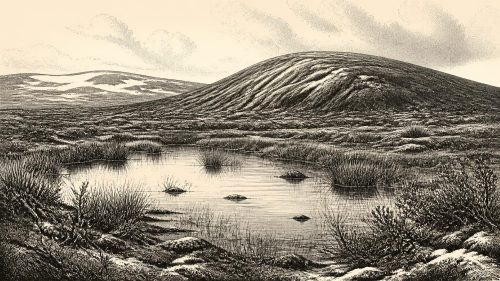
Its flora and fauna point to treeless, open tundra or muskeg-like wetland under a periglacial regime. Sedges, mosses, dwarf shrubs and cold-adapted aquatic plants indicate shallow water, saturated ground and patches of open vegetation rather than a uniform frozen desert. Such a wetland would have been a small ecological refuge: a place where meltwater or groundwater collected, plants grew during the short productive season and insects, birds and mammals could exploit a concentrated resource. It was nevertheless one locality in Fermanagh, not a complete map of Ireland.
Castlepook and the Animal Record
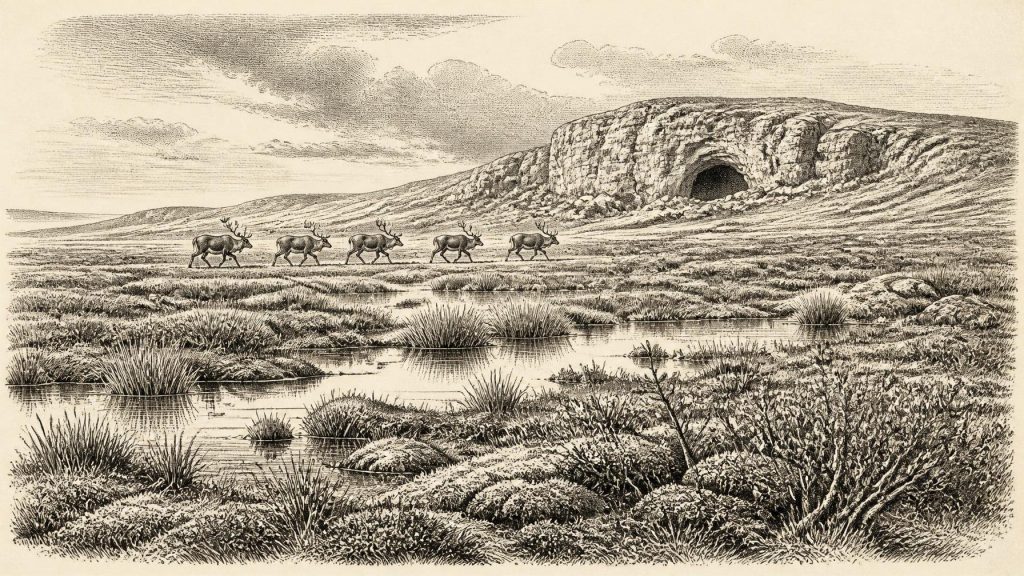
In north County Cork, Castlepook Cave near Doneraile – long known as Mammoth Cave – supplies a different sort of evidence. Its cave deposits and museum collections make it the richest known Irish site for Pleistocene vertebrate remains. They include woolly mammoth, giant deer, reindeer, brown bear, wolf, Arctic fox, lemmings and spotted hyaena. The assemblage shows that, during suitable phases before the Last Glacial Maximum, Ireland supported a far more varied cold-stage fauna than the modern island does.
That list must not be turned into a single cinematic scene. Cave deposits can accumulate over very long periods. Animals may die at different times; hyaenas can drag bones into dens; water, burrowing and older excavation methods can mix material. The original major exploration of Castlepook took place in the early twentieth century, before the detailed stratigraphic recording, sieving and scientific dating expected today. Later research has also shown that some older radiocarbon determinations from southern Irish caves need reassessment as laboratory pretreatment methods improve.
Even so, the fauna is historically important. Reindeer imply open country capable of sustaining grazing herds, perhaps with seasonal movements across a wider region. Mammoths and giant deer indicate extensive plant resources in at least some phases. Predators and scavengers, including hyaenas and wolves, show that carcasses were contested resources and that caves could belong as much to carnivores as to people. This was a living landscape shaped by seasonal scarcity, mobility and risk, not merely an empty prelude to later Irish history.
The Reindeer Femur Question
One Castlepook specimen gives this period unusual archaeological interest: a fragment of reindeer femur bearing a deep surface incision interpreted by zooarchaeologist Ruth Carden as consistent with cutting by a sharp stone tool during carcass processing. Public accounts have associated the bone with roughly 33,000 years ago, making it potentially far earlier than the better-attested terminal Pleistocene evidence for human activity in Ireland. If the mark is confirmed as a stone-tool cut made when the bone was fresh, it may be evidence that people handled a reindeer in Ireland during this broad interval.
That is a significant but deliberately narrow claim. A radiocarbon date indicates when the animal died within a statistical range; it does not independently date a surface mark, identify the person who made it, show where the animal was killed or establish the length of any human stay. Nor has Castlepook produced a securely associated house, hearth, stone-tool assemblage, burial or intact butchered-animal concentration of this age. A single modified bone cannot demonstrate a permanent population, a named cultural group or a settled hunting camp.
The nearest firm comparison is also contextual rather than identical. Directly dated pre-Last Glacial Maximum deer remains from south-east Irish caves include a calibrated range of 32,930–31,280 cal BP, equivalent approximately to 30,981–29,331 BCE. Such dates demonstrate that large deer were present in Ireland around the wider period, but they do not date Castlepook’s incision or place people at a particular spot in 31,089 BCE. The evidence supports possibility and investigation, not certainty beyond what the object itself can bear.
People, Society and What Cannot Be Recovered
If people did visit Ireland at this time, the safest interpretation is that they were members of very small, highly mobile Upper Palaeolithic groups whose movements were tied to animals, seasons and routes across changing coastal and shelf landscapes. Reindeer could have offered meat, fat, hide, sinew, antler and bone. Yet none of these practical uses can be demonstrated from the isolated femur alone. There is no basis for describing dwellings, clothing, language, kinship, ritual, artistic traditions or regular trade in Ireland at this date.
Accordingly, political affairs, diplomacy and organised conflict are absent from the record, not overlooked subjects. There are no polities, leaders, borders, treaties or battlefields to identify. Nor is there evidence for farming, herding, metalwork, monuments, writing, formal religious institutions or exchange networks on the island. A possible short visit by hunters would not be equivalent to colonisation. Even the question of whether Ireland had a recurrent human presence before the Last Glacial Maximum remains open.
Culture and learning survive only in the broadest possible sense: in the accumulated knowledge that any mobile people would have needed to survive a cold, variable environment. Reading animal movement, finding sheltered ground, processing carcasses and navigating unfamiliar terrain would have required skill. But these are reasonable inferences from Upper Palaeolithic lifeways elsewhere in Europe, not discoveries made in Ireland. They must remain clearly separate from the direct Irish evidence.
Regional Change as the Main Story
The largest development around 31,089 BCE was environmental. In Fermanagh, wetlands could briefly preserve plants and small animals between episodes of glaciation. In Cork, limestone caves trapped a long and complex record of large mammals and carnivores. Across the island, glaciers and periglacial processes were preparing to alter or destroy many older surfaces. The coming maximum of the British–Irish Ice Sheet would leave a landscape whose surviving Ice Age archive is scattered, difficult to date and often dependent on old collections.
For this reason, the most truthful account of Ireland in 31,089 BCE is not a tale of a particular king, raid or settlement. It is a cautiously reconstructed world of open cold-country vegetation, wetlands, reindeer and other large mammals, carnivore dens, shifting coasts and advancing ice. Castlepook’s marked femur offers a tantalising possibility of human contact; Derryvree gives secure evidence for a cold freshwater ecosystem. Together they reveal not a calendar year with known events, but an island at the edge of habitation and on the threshold of profound glacial change.
Primary Sources
- A Middle Midlandian Freshwater Series at Derryvree, Maguiresbridge, County Fermanagh, Northern Ireland
- The Irish Quaternary Fauna Project
- A Reconsideration of the Radiocarbon Dating of the Marine Isotope Stage 3 Fauna from Southern Ireland
- The Exploration of Castlepook Cave, County Cork
- Occurrence of Mammalia Relicts at Site Castlepook Cave
- Castlepook Cave, County Cork: County Geological Site Report
- Ancient DNA Reveals Regional and Temporal Variation in Red Deer Populations in Europe
- Growth and Retreat of the Last British–Irish Ice Sheet, 31,000 to 15,000 Years Ago: the BRITICE-CHRONO Reconstruction
- Early Deglaciation of the British-Irish Ice Sheet on the Atlantic Shelf Northwest of Ireland Driven by Glacioisostatic Depression and High Relative Sea Level
- Dimensions and Chronology of the Last Ice Sheet in Western Ireland
- Ireland: Submerged Prehistoric Sites and Landscapes
- The Problem of a Late Quaternary Landbridge Between Britain and Ireland
- Deglaciation, Earth Crustal Behaviour and Sea-Level Changes in the Determination of Insularity: A Perspective from Ireland
- The IntCal20 Northern Hemisphere Radiocarbon Age Calibration Curve (0–55 cal kBP)
- First Evidence of a Late Upper Palaeolithic Human Presence in Ireland
- New Insights on the Fauna of Ireland's Younger Dryas and Early Holocene from Alice & Gwendoline Cave
- The Mesolithic in Ireland: When Was It?
- The Quaternary of Ireland
- Advances in Irish Quaternary Studies
- Sedimentary Ancient DNA Reveals Late Pleistocene Faunal Connectivity Between Ireland and Eurasia