
Castlepook’s Unfound Hearth30934 BCE
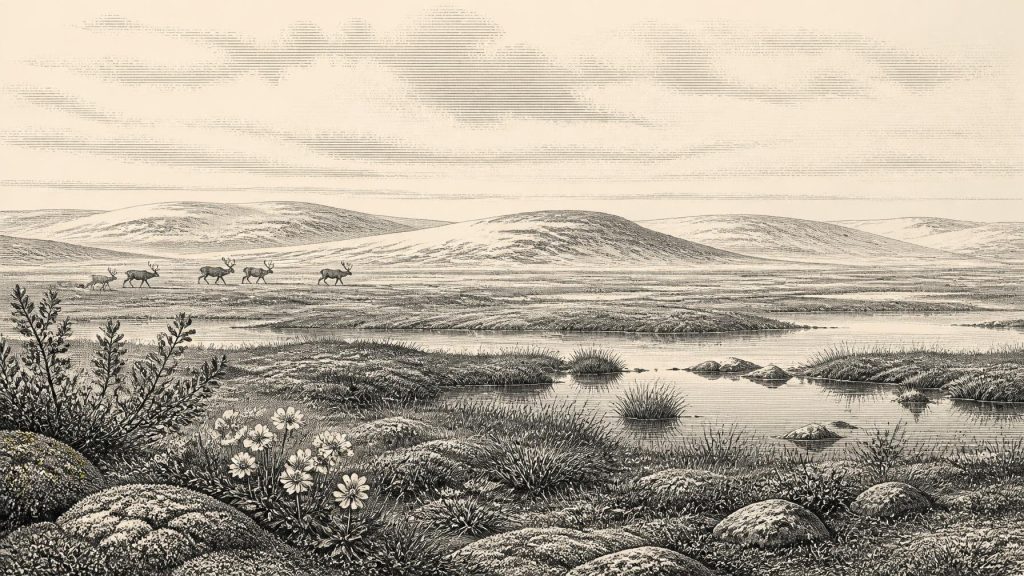
Around 30,934 BCE, Ireland lay within the unstable later Last Glacial period, not a date capable of precise historical reconstruction. Derryvree, County Fermanagh, preserves freshwater sediments formed between glacial episodes, indicating cold, open tundra wetlands with plants and invertebrates. Castlepook Cave, County Cork, contains MIS 3 fauna including reindeer, mammoth, giant deer, predators and lemmings, accumulated over periods rather than simultaneously. A reindeer femur, possibly cut with a stone tool around 31,000 BCE, may be Ireland’s earliest human trace. It proves neither settlement nor hunting. Later ice expansion erased evidence; no hearth, occupation surface or associated tools has been found.
Dateline
Modern calendar-year precision is not available for Ireland in 30,934 BCE. The label is useful only as a point within a very long prehistoric interval: roughly 32,883 years before AD 1950, the conventional ‘present’ of radiocarbon dating. It falls in the later part of Marine Isotope Stage 3 (MIS 3), a climatically unstable phase of the Last Glacial period. No Irish chronicle, calendar, settlement sequence or event can be assigned to this numbered year. The responsible history is therefore one of calibrated ranges, fossils, sediment layers and carefully qualified inference rather than a dated narrative.
The nearest archaeological and environmental evidence places parts of Ireland in a cold, changing world before the fullest expansion of the last British–Irish Ice Sheet. Crucially, this was not necessarily an island sealed beneath continuous ice at every moment. Nor was it the wooded, temperate country familiar from later prehistory. Local ice margins, frozen ground, open vegetation, wetlands and animal movements altered over centuries and millennia. Evidence from northern and southern Ireland illuminates different places and spans; it cannot be compressed into a single island-wide weather report for one year.
A Range Rather Than a Year
The best closely relevant environmental sequence comes from Derryvree, near Maguiresbridge in County Fermanagh. Roadworks in 1969 exposed organic freshwater silts and fine sands trapped between two thick layers of glacial till within a drumlin. The order of deposits is revealing. Ice had affected the locality before the freshwater bed formed; plants, small animals and sediment accumulated during an ice-free interval there; later glacial action buried the bed beneath another till. That makes Derryvree an unusually valuable record of environmental change, not a frozen instant in time.
Organic material from the bed produced a conventional radiocarbon age of 30,500 years BP, with a large uncertainty of +1,170 and −1,030 years. Later calibration places the deposit broadly around 36,900–31,700 calibrated years BP, approximately 34,950–29,750 BCE. The article’s notional year falls within that wide range, but no individual plant, pool or occupation can be tied to 30,934 BCE. The proper conclusion is narrower: during part of this span, south Fermanagh supported a cold freshwater ecosystem between episodes of glaciation.
Water Beneath the Drumlin
Derryvree’s pollen, plant macrofossils, mosses and invertebrate remains indicate open tundra vegetation and a periglacial regime: ground affected by intense frost, seasonal thaw and short growing seasons. The deposit includes evidence for sedges, mosses and cold-adapted plants such as dwarf willow, mountain avens, lesser clubmoss and bogbean, alongside aquatic or wetland plants including water-milfoil. This was not a featureless snowfield. Around shallow or slow-moving freshwater, low vegetation could take hold; beyond it, exposed ground was likely sparse, cold and wind-swept.
Some pollen was poorly preserved, and isolated grains of tree pollen do not establish nearby forest. They may have travelled far or been redeposited. The stronger evidence supports an open, largely treeless landscape. Terms such as ‘tundra’ are useful shorthand but should not imply that every region of Ireland looked identical. Derryvree describes a particular northern locality and its catchment. It does, however, demonstrate that life persisted in ice-age Ireland in habitats where wet ground and freshwater were available.
Fauna on a Cold Landscape
Southern cave deposits provide a second, larger-scale view. Castlepook Cave, also known as Mammoth Cave, near Doneraile in north County Cork, has yielded one of Ireland’s most important Pleistocene animal collections. The Irish Quaternary Fauna Project showed that a broad range of mammals reached Ireland at various times between at least about 45,000 and 20,000 years ago. Improved radiocarbon pretreatment has also shown that several Castlepook specimens were substantially older than previously believed, placing significant elements of the assemblage in MIS 3.
The cave record includes reindeer, woolly mammoth, giant deer, brown bear, wolf, Arctic fox, mountain hare, collared lemming, Norwegian lemming and spotted hyaena. These animals do not all prove to have lived together at the exact same moment: Castlepook accumulated bones across a long period. Yet the assemblage firmly establishes that Ireland participated in the wider north-west European cold-stage fauna. Grazing animals suggest expanses of herb-rich open country; wolves and hyaenas indicate predators and scavengers following such resources. Spotted hyaena is especially notable, with Castlepook the principal Irish record.
Caves are not straightforward food stores. Carnivores can drag in carcass parts, gnaw bones and leave them exposed to trampling, water movement, collapse and later excavation. A mammoth or reindeer bone in a cave therefore demonstrates the animal’s presence in the surrounding landscape, not necessarily human hunting, cooking or residence in the cave. This distinction is central to responsible interpretation of Ireland’s very early past.
The Marked Reindeer Femur
One Castlepook object makes this broad period especially important for Irish history. A reindeer femur in the National Museum of Ireland’s natural-history collection bears a deep surface mark interpreted by zooarchaeologist Ruth Carden as having been made with a sharp stone tool during butchery. County Cork heritage material dates the bone broadly to about 31,000 BC, close to the date represented here; it also considers it likely that the butchered remains entered the cave later, perhaps carried by scavengers. If the interpretation of the mark is upheld, it would be Ireland’s earliest presently claimed trace of human activity.
That claim must remain conditional. The femur comes from an old cave collection rather than a modern excavation of a sealed occupation surface. A radiocarbon determination dates the animal bone, not automatically the moment it was marked, the place where the carcass was processed or the number of people involved. Identifying a cut mark is a separate taphonomic judgement, requiring the exclusion of carnivore damage, abrasion and other natural or modern alterations. No securely associated stone-tool assemblage, hearth, shelter floor, human burial or human remains of comparable age has yet been recovered in Ireland.
The evidence can therefore support a limited but remarkable proposition: one or more people may have processed a reindeer in Ireland during the Upper Palaeolithic. It cannot establish a permanent settlement at Castlepook, a continuous population on the island, a named people or a particular route of arrival. A visiting hunting party, seasonal movement after game, or a short-lived incursion from the wider north-west European world are reasonable interpretations, not demonstrated facts.
Society Beyond Recovery
There is no evidence for political institutions, rulers, territories, diplomacy or organised warfare in Ireland at this date. There is likewise no Irish evidence for agriculture, herding, metalworking, market exchange, monuments, formal religion, writing or schools. The absence of such evidence should not be mistaken for a claim that any visitors lacked social bonds, knowledge or belief. Upper Palaeolithic communities elsewhere in Europe possessed sophisticated stone technologies and rich cultural practices. But mainland comparisons provide context only: they cannot supply an Irish language, identity, ritual or artistic tradition where Irish finds do not.
Everyday life is recoverable only in the most general terms. If people did reach Ireland, they were mobile hunter-gatherers rather than farmers. Reindeer could have offered meat, hide, sinew, fat, marrow and bone, but the single marked femur cannot reveal which resources were taken, whether the animal was hunted or scavenged, or whether processing occurred at the cave. There is no evidence for trade in the later prehistoric sense. Mobility across the sea and adjacent landmasses may have connected people, animals and raw materials, but no securely identified imported object or exchange network belongs to this Irish horizon.
Ice Yet to Come
The later Last Glacial Maximum is essential to understanding the sparse record. Research on the British–Irish Ice Sheet shows that its major expansion and maximum extent varied between sectors, with much of the best-dated Irish evidence for maximum conditions later than this article’s period, broadly after about 27,000 years ago and into the 20,000s BP. Southern Ireland was extensively glaciated during that later phase. Advancing ice eroded landscapes, remodelled drainage and buried or destroyed many earlier deposits.
Glaciation helps explain why evidence of any earlier human presence might be exceptionally slight, but it cannot be used to invent lost camps or populations. The balance of evidence around 30,934 BCE is both evocative and restrained: an Ireland of open, frost-affected wetlands in Fermanagh; cold-country mammals in Cork; and one reindeer bone whose possible cut mark may record a fleeting human action. Castlepook’s hearth remains unfound. That is not a failure of the record, but its most important historical fact.
Primary Sources
- A Reconsideration of the Radiocarbon Dating of the Marine Isotope Stage 3 Fauna from Southern Ireland
- A Middle Midlandian Freshwater Series at Derryvree, Maguiresbridge, County Fermanagh, Northern Ireland
- The Irish Quaternary Fauna Project
- Growth and Retreat of the Last British–Irish Ice Sheet, 31,000 to 15,000 Years Ago: The BRITICE-CHRONO Reconstruction
- The Timing and Magnitude of the British–Irish Ice Sheet Between Marine Isotope Stages 5d and 2
- Late Pleistocene Chronostratigraphy and Ice Sheet Limits, Southern Ireland
- Trimlines, Blockfields and the Vertical Extent of the Last Ice Sheet in Southern Ireland
- Maximum Extent and Dynamic Behaviour of the Last British–Irish Ice Sheet West of Ireland
- Timing and Pace of Ice-Sheet Withdrawal Across the Marine–Terrestrial Transition West of Ireland During the Last Glaciation
- BRITICE Glacial Map, Version 2: A Map and GIS Database of Glacial Landforms of the Last British–Irish Ice Sheet
- The Exploration of Castlepook Cave, Co. Cork
- Occurrence of Mammalia Relicts at Site Castlepook Cave
- Heritage Artefacts of County Cork
- Archaeology Research Excavation Grant 2022: Final Report
- Archaeological Heritage of County Cork
- Palaeoecology
- IQUA Newsletter No. 58
- First Evidence of a Late Upper Palaeolithic Human Presence in Ireland
- Palaeolithic Ireland – New Evidence Emerges from the Emerald Isle
- New Insights on the Fauna of Ireland’s Younger Dryas and Early Holocene
- The Mesolithic in Ireland: When Was It?
- Palaeolithic Ireland: Fleeting Footprints in a Frozen Land