The Incised Castlepook Femur30935 BCE
About 30,935 BCE, Ireland lay within the climatically unstable MIS 3 of the Late Pleistocene, not a precisely datable historical year. Derryvree, County Fermanagh, preserves freshwater sediments between glacial tills, indicating treeless tundra wetlands with sedges, mosses, aquatic plants and cold-adapted fauna. Castlepook Cave, County Cork, yielded reindeer, mammoth, giant deer, predators and other cold-stage animals, showing links with north-west Europe. An incised reindeer femur may indicate human butchery, but lacks associated tools, hearths or settlement evidence. No Irish communities, political structures or material culture are securely known. Advancing ice increasingly shaped this fragmentary landscape during the ensuing glacial expansion.
Dateline
30,935 BCE is a useful modern label, but it was not a year that anybody in Ireland could have named, recorded or remembered in a calendar. It lies roughly 32,900 calendar years before AD 1950, within the Late Pleistocene and Marine Isotope Stage 3 (MIS 3), a long, climatically unstable interval of the last Ice Age. No excavated Irish layer can be assigned responsibly to this individual year. The evidence instead consists of wide calibrated ranges, glacial sequences, animal bones and plant remains. It can illuminate conditions in and around Ireland, but not a dated political event, a named community or an annual chronicle.
Dating a Calendarless Landscape
The closest local chronological anchor is the Derryvree freshwater deposit near Maguiresbridge in County Fermanagh. Roadworks in 1969 cut through a drumlin and exposed organic silts and fine sands between two distinct sheets of till, the unsorted debris left by glacier ice. The sequence establishes an important order of events: ice deposited the lower till; an ice-free freshwater and wetland environment developed; later ice covered and sealed the deposit beneath the upper till. It does not supply a single moment in time.
Organic material from Derryvree produced the conventional radiocarbon determination Birm-166, 30,500 +1,170/−1,030 radiocarbon years BP. Radiocarbon years are not the same as calendar years, because atmospheric carbon-14 has varied through time. Later calibration places the deposit broadly at about 36,900–31,700 calibrated years BP, or approximately 34,950–29,750 BCE. Thus 30,935 BCE falls within a large scientific range associated with the deposit, but it is not the date of a particular Derryvree season, settlement or encounter. The uncertainty is not a defect to be concealed: it is the proper scale of resolution for Irish evidence this deep in time.
Derryvree’s Open Wetland
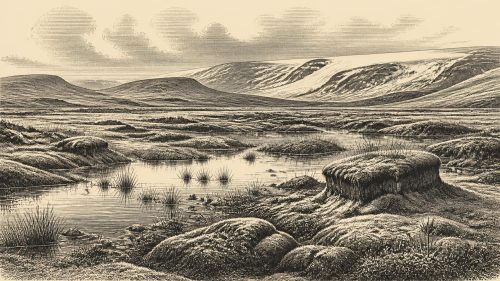
Derryvree is the strongest direct environmental witness for this broad period. Its flora and fauna indicate a treeless, open tundra or muskeg landscape under periglacial conditions. Mosses, sedges, grasses, herbs, dwarf shrubs and aquatic plants occurred around shallow water, saturated ground and small pools. Fossil remains include bogbean (Menyanthes trifoliata) and mountain avens (Dryas octopetala), species consistent with cold, open environments. Insects strengthen the picture of wet ground rich in plant matter rather than a barren expanse of continuous snow or bare stone.
This was not modern Fermanagh transplanted into an Ice Age. There is no evidence for the familiar dense woodland, hedged fields, peat-cutting landscape or settled lakeshores of later millennia. Trees were absent locally, and winters were severe. Yet the freshwater silts show that water persisted and plants colonised sheltered low ground. The reasonable interpretation is a mosaic: wet hollows and pools, sedge-rich margins, mossy patches and exposed open ground, varying across short distances according to drainage, wind and snow cover. Derryvree should not, however, be treated as a complete map of Ireland. It records one northern locality, accumulated over time, not every coast, upland or valley on the island.
Castlepook and the Animal World
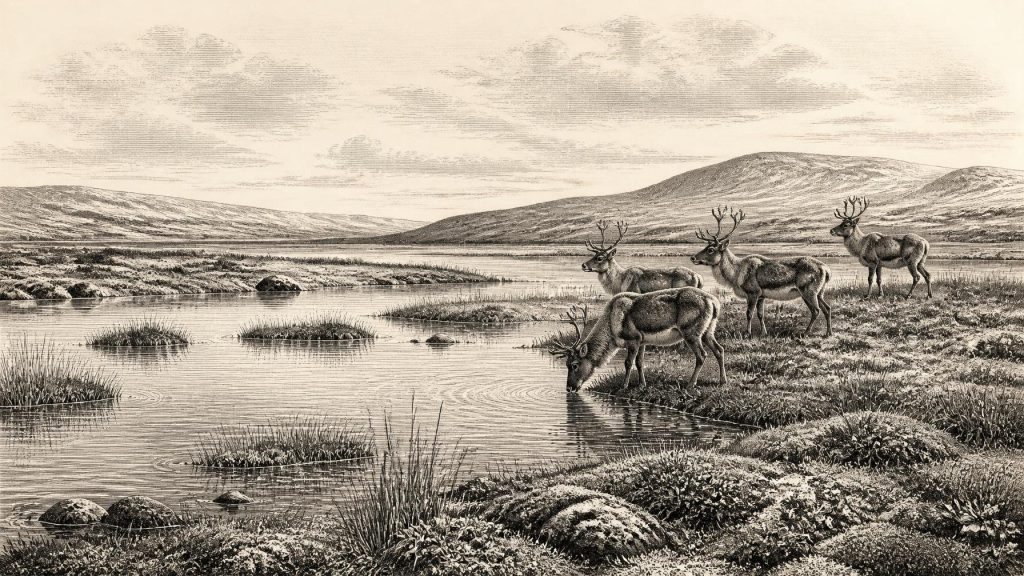
County Cork provides a different but complementary archive. Castlepook Cave, also called Mammoth Cave, near Doneraile, yielded a major assemblage of Pleistocene animal remains during excavations in the early twentieth century. The surviving collection includes reindeer, woolly mammoth, giant deer, brown bear, wolf, Arctic fox, hare, lemmings and spotted hyena. Modern redating has shown that at least part of this fauna belongs to MIS 3, although old cave collections require particular caution: bones came from complex deposits, some earlier determinations have been reassessed, and not every specimen necessarily represents the same episode.
The Castlepook animals demonstrate that Ireland was connected, ecologically and at least intermittently, to the wider north-west European cold-stage world. Reindeer and Arctic fox suit open cold country; mammoth, giant deer and predators imply substantial grazing landscapes and food chains. Spotted hyena is especially significant. The National Museum of Ireland identifies Castlepook as Ireland’s principal last-cold-stage mammal site and places hyena and associated mammals in a migration episode from Britain to Ireland broadly between 45,000 and 30,000 years ago. That conclusion concerns animal movement, not a permanent human population.
A Bone and a Question
The article’s title refers to a reindeer femur from Castlepook that has been publicly presented as about 33,000 years old and bearing a deep incision interpreted by zooarchaeologist Ruth Carden as a chop or cut made by a sharp stone implement. If that interpretation is sustained, it would be potentially momentous: a person may have processed reindeer in Ireland during MIS 3, far earlier than the long-established record of post-glacial occupation. The notional year 30,935 BCE lies close enough to this broad horizon for the bone to matter greatly to any account of the period.
But the distinction between evidence and interpretation is crucial. Radiocarbon dating determines the age of the animal bone, not automatically the date or cause of every mark on its surface. A mark may be anthropogenic, carnivore-related, produced during excavation, or altered after burial; its form must be assessed taphonomically. Moreover, Castlepook has not produced a securely associated hearth, stone-tool assemblage, dwelling floor, human remains or a stratified butchery area of comparable age. The femur is therefore important possible evidence of a brief human visit, not proof of a settled Ice Age society in Ireland.
Society Without a Settlement Record
For political affairs, diplomacy and conflict, the responsible answer is silence. There are no named peoples, leaders, territories, alliances, fortifications, weapons assemblages or burial rites from Ireland securely attributable to this date. It would be misleading to imagine tribes governing the island, battles over reindeer grounds, or relations between an “Irish” population and neighbours. Ireland as a modern nation had no relevance to the people, if any, who may have entered this landscape.
The same caution applies to everyday life, religion, culture and learning. No contemporary house, camp, hearth, artwork, grave, ornament, pottery vessel, textile, boat or written mark is known from Ireland. There was no farming, stock keeping, metalworking, village economy or trade network demonstrated by Irish evidence at 30,935 BCE. If people did reach Castlepook, a short hunting or scavenging visit is a plausible inference from the proposed modification of the reindeer femur and the available fauna. It remains an inference, not an excavated household or an enduring community.
Across the water, Upper Palaeolithic groups in Britain and continental Europe used stone technologies and hunted cold-stage animals. That wider context makes a human arrival in Ireland conceivable, particularly when sea level was lower and animal dispersal was possible. It cannot fill the Irish evidential gap. Lower seas did not automatically create a simple dry land bridge across every channel, and no Irish Palaeolithic seafaring craft is known. Any crossing, whether over ice, water or changing coastal terrain, remains unobserved in the Irish archaeological record.
Ice Building Beyond the Horizon
The Derryvree interval preceded the full Last Glacial Maximum, but it belonged to a world moving towards much greater ice-sheet growth. Recent reconstructions show the British–Irish Ice Sheet building rapidly from about 31,000 to 26,000 years ago, with regional margins advancing and retreating asynchronously. The later maximum transformed much of Ireland and its surrounding shelves. Deposits such as Derryvree survived precisely because they were buried between tills: living wetland sediment became a sealed archive beneath later glacial action.
For 30,935 BCE, then, Ireland is best understood not as an empty page but as a fragmentary Ice Age archive. Fermanagh preserves cold freshwater life between episodes of glaciation; Cork preserves an unexpectedly rich animal world and a disputed hint of human butchery. Together they show a place of open wetlands, grazing animals, carnivores and advancing ice. They do not yet reveal a calendar year, a community’s name or a continuous human past. That restraint is what makes the evidence valuable.
Primary Sources
- A Middle Midlandian Freshwater Series at Derryvree, Maguiresbridge, County Fermanagh, Northern Ireland
- A reconsideration of the radiocarbon dating of the Marine Isotope Stage 3 fauna from southern Ireland
- First evidence of a Late Upper Palaeolithic human presence in Ireland
- New insights on the fauna of Ireland's Younger Dryas and Early Holocene from Alice & Gwendoline Cave
- The Irish Quaternary Fauna Project
- Irish Pleistocene biostratigraphy
- The subdivision of the Quaternary Period in Ireland
- Exploring controls of the early and stepped deglaciation on the western margin of the British Irish Ice Sheet
- Growth and retreat of the last British–Irish Ice Sheet, 31,000 to 15,000 years ago: the BRITICE-CHRONO reconstruction
- Trimlines, blockfields and the vertical extent of the last ice sheet in southern Ireland
- New data for the Last Glacial Maximum in Great Britain and Ireland
- Maximum extent and dynamic behaviour of the last British–Irish Ice Sheet west of Ireland
- Timing and pace of ice-sheet withdrawal across the marine–terrestrial transition west of Ireland during the last glaciation
- The IntCal20 Northern Hemisphere Radiocarbon Age Calibration Curve (0–55 cal kBP)
- Spotted Hyena Skull
- Prehistoric Details
- Archaeological Heritage of County Cork
- Heritage Artefacts of County Cork
- Menyanthes trifoliata
- Dryas octopetala
- Pleistocene Vertebrates in the British Isles
- Ireland's Palaeolithic Archaeology – Fleeting Footprints in a Frozen Land
- The colonization of Ireland: A human ecology perspective
- Marine Archaeology Technical Report