The Doneraile Butchery Claim30881 BCE
Around 30,881 BCE, Ireland experienced unstable Late Pleistocene conditions during Marine Isotope Stage 3, before the Last Glacial Maximum. Derryvree, County Fermanagh, preserves freshwater organic deposits between tills, indicating an ice-free, tundra-like wetland with sedges, mosses, insects and sparse vegetation during an interval of glacial advance and retreat. Castlepook Cave, County Cork, contains remains of mammoth, reindeer, giant deer and carnivores, documenting recurring cold-stage fauna rather than one event. A marked reindeer femur may indicate stone-tool butchery and fleeting human activity, but lacks contextual evidence. No settlement, polity or society is demonstrable; later ice expansion transformed and obscured earlier landscapes.
Dateline
Modern calendar-year precision is not available for Ireland in 30,881 BCE. This is a retrospective point on a modern calendar, roughly 32,830 calendar years before AD 1950, the reference point conventionally used for “before present” (BP). No Irish written record, named community, settlement sequence or event can be assigned to that particular year. The responsible subject is therefore not an imagined annual chronicle, but the Late Pleistocene evidence that falls broadly around it.
That evidence belongs to Marine Isotope Stage 3, a long, climatically unstable phase of the last Ice Age, and to the early build-up of the last British–Irish Ice Sheet. Ireland was not yet the completely ice-covered landscape associated with the later Last Glacial Maximum, but neither was it a stable or uniformly habitable country. Conditions changed across centuries and millennia, differed sharply by region and altitude, and were shaped by expanding ice, frost, open water and sparse vegetation. The island’s present coastlines, rivers, soils and woodlands did not exist in their modern form.
A Date Inside a Range
The most important environmental record close to this notional date comes from Derryvree, near Maguiresbridge in County Fermanagh. Roadworks exposed a remarkable sequence within a drumlin: organic freshwater silts and fine sands lying between two layers of till, the unsorted debris deposited by moving glacier ice. The arrangement establishes a relative sequence. Ice affected the locality; an interval followed in which freshwater sediment and organic matter accumulated; and glacier ice later returned or advanced over the site.
An organic sample from the Derryvree freshwater beds produced the conventional radiocarbon determination BIRM-166, about 30,500 radiocarbon years BP, with a substantial uncertainty. Published calibrations have placed this evidence broadly at about 36,900–31,700 calibrated years BP. The modern label 30,881 BCE lies within that wide span, but it cannot identify a day, season or even a particular generation represented in the sediment. Calibration is necessary because radiocarbon years and calendar years are not identical, while a single old measurement carries both laboratory uncertainty and the complications of a changing atmospheric radiocarbon record.
Derryvree therefore does not provide a photograph of all Ireland in 30,881 BCE. It is a local archive, exceptionally valuable precisely because later glaciation destroyed, buried or disturbed so much older ground. Still, it securely shows that this part of Fermanagh supported an ice-free freshwater environment during an interval within the wider cold stage. That is a major correction to any simple picture of an Ireland permanently sealed beneath ice.
A Wetland Between Glaciers
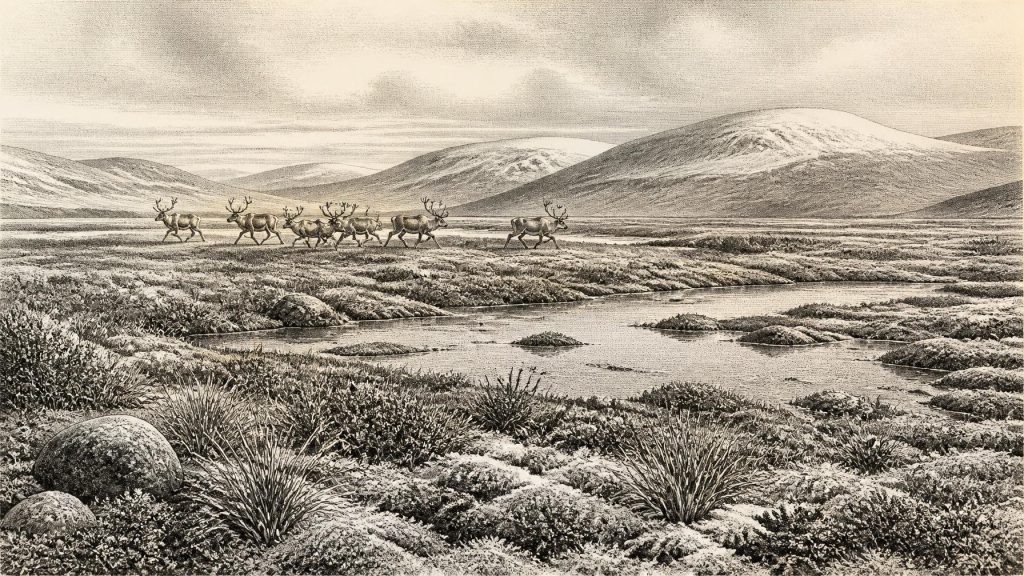
Pollen, plant macrofossils, mosses and insect remains recovered from the Derryvree deposits point to an open, largely treeless landscape. Sedges, grasses, herbaceous plants, mosses and low shrubs occupied wet ground around shallow water. Researchers have described the setting as muskeg-like: cold, waterlogged terrain in which mossy and sedgy vegetation could flourish in sheltered, saturated patches even as frost and short growing seasons limited taller plant cover. The evidence supports tundra-like wetland, not forest, farmland or a settled village.
Such a place would have been seasonally exacting. Fine sediment settled in quiet water; plants grew at the margins; insects completed life cycles in and around the pools; yet winter frost, periglacial processes and exposure were fundamental features of the wider landscape. The pollen record is especially useful when read alongside macrofossils and insects, but it has limits. Wind can carry pollen far from its source, and deposits may record vegetation from more than one nearby habitat. It follows that Derryvree demonstrates a local cold-stage ecosystem, rather than providing an island-wide temperature reading or a definitive map of vegetation.
Other northern Irish inter-till and sub-till organic deposits, including material from Greenagho and Hollymount, reinforce the broader conclusion that ice cover waxed and waned across the region during the Midlandian glaciation. The timing and extent of early ice advances remain subjects of refinement, but modern reconstructions of the British–Irish Ice Sheet agree that its major growth and eventual maximum were complex, regionally uneven processes. The peak ice volume came later, around 23,000 years ago. Around the date represented here, Ireland was approaching a harsher phase rather than experiencing a single simultaneous freeze.
Castlepook and Its Animals
In north County Cork, Castlepook Cave near Doneraile supplies a very different archive. Its old name, Mammoth Cave, reflects the spectacular Ice Age fauna found in its limestone passages. Bones recovered there include woolly mammoth, reindeer, giant deer, brown bear, wolf, fox, mountain hare, lemmings and spotted hyaena. Together they reveal that parts of Ireland formed a north-western extension of wider European cold-stage animal ranges. Reindeer and lemmings in particular suit open, cold country; mammoth and giant deer evoke extensive grassland and herb-rich habitats; hyaenas and wolves show that large carnivores followed or scavenged among the herbivores.
It would nevertheless be wrong to place every one of these creatures together outside the cave in 30,881 BCE. Castlepook’s assemblage accumulated over a long period, and individual bones have different histories. Carnivores could drag carcass parts into caves; animals could die near fissures; water and disturbance could move material; and much of the early excavation predates modern standards of recording. Radiocarbon programmes have shown that the wider pre-Last Glacial Maximum fauna ranges across many thousands of years. The cave is evidence for recurring animal presence and changing habitats, not a single intact herd scene.
The fauna also warns against treating modern Ireland as a guide to its Ice Age ecology. The island then supported mammals long absent from its later historical fauna, while its physical links and sea levels differed from today’s. The exact routes by which animals reached and left Ireland cannot be reconstructed from Castlepook alone. Yet their presence shows that, during suitable intervals, the island was ecologically connected to wider north-west European landscapes rather than being an isolated refuge with its later, restricted fauna.
The Reindeer Femur
Castlepook has particular importance because a reindeer femur has been interpreted as bearing a deep mark made on fresh bone by a sharp stone tool. County Cork heritage material dates the object to about 31,000 BC, close to the chronological horizon considered here, and identifies the assessment with palaeozoologist Ruth Carden. If the mark is correctly identified and contemporary with carcass processing, it is potentially evidence that Upper Palaeolithic people butchered a reindeer in Ireland. It would push the claimed human story of the island far earlier than the well-established post-glacial settlement record.
Its importance requires caution rather than embellishment. A marked bone is not a settlement. It does not prove that people hunted the animal at Castlepook, butchered it in the cave, lived nearby, arrived in a family-sized group or returned repeatedly. There is no securely associated hearth, stone-tool assemblage, dwelling floor, burial, human skeleton or substantial concentration of butchered waste from this horizon. Nor can the age of an animal bone by itself date precisely the instant when a surface mark was made. The most that can responsibly be said is that the femur presents a serious, still limited claim for a brief human encounter with an Irish reindeer carcass.
Recent excavations and surveys at Castlepook have sought intact deposits and clearer contextual evidence. Their importance lies partly in testing the older collections, whose scientific potential is immense but whose original excavation records are incomplete. Until securely stratified artefacts or occupation traces are recovered, the Castlepook femur should remain a carefully stated possibility of human activity, not the foundation for a settled Palaeolithic Ireland.
No Polities, No Proven Society
There is no evidence from Ireland around this horizon for political institutions, rulers, diplomacy, warfare, territorial states or ethnic identities. “Ireland”, “Fermanagh” and “Cork” are modern geographical names used to locate the evidence; they do not imply a people who conceived of an Irish country. Likewise, the archaeological record cannot support claims about a language, kinship system, formal learning, ritual practice, religion or art at this date. Silence on these subjects is not a failure of imagination but a necessary result of the surviving material.
If people did visit, their practical economy may have included the use of animal carcasses for meat, fat, hide, sinew or bone, as the interpretation of the reindeer femur would suggest. But trade, regular exchange networks, farming, permanent storage and domestic animals cannot be inferred. The most defensible picture is of a fluctuating, resource-limited landscape in which animals moved through open habitats and any human presence was, at present, archaeologically fleeting.
A Landscape Facing Transformation
The chief development appropriate to 30,881 BCE is environmental change. Derryvree’s freshwater wetland and Castlepook’s animal remains preserve evidence from before the later expansion of the Irish sector of the British–Irish Ice Sheet. As ice grew, it scoured terrain, rearranged drainage, deposited till and profoundly reduced the chances that delicate traces of earlier plants, animals and people would survive. The later glacial landscape was not merely colder: it was actively remade.
For that reason, the surviving evidence is both sparse and extraordinary. Beneath a Fermanagh drumlin, plants and insects record a cold freshwater interval between ice advances. In a Cork cave, bones preserve the passage of a vanished fauna and perhaps the touch of a stone tool on reindeer bone. Together they illuminate a prehistoric Ireland of wet tundra, animal movement and climatic instability—not a calendar year of kings, battles or settlements, but a fragile window onto the deep past.
Primary Sources
- A Middle Midlandian Freshwater Series at Derryvree, Maguiresbridge, County Fermanagh, Northern Ireland
- Irish Pleistocene Biostratigraphy
- The Irish Quaternary Fauna Project
- The Irish Quaternary Fauna Project
- Figure 6: The Subdivision of the Quaternary Period in Ireland
- References and Recommended Reading
- Growth and Retreat of the Last British–Irish Ice Sheet, 31,000 to 15,000 Years Ago: the BRITICE-CHRONO Reconstruction
- BRITICE-CHRONO Maps and GIS Data of the Last British-Irish Ice Sheet 31 to 15 ka
- Project Findings Provide Essential Insight into the Last British–Irish Ice Sheet
- The IntCal20 Northern Hemisphere Radiocarbon Age Calibration Curve (0–55 cal kBP)
- IntCal Publications
- Heritage Artefacts of County Cork
- Guide to the National Museum of Ireland
- Archaeology Research Excavation Grant 2022: Castlepook Caves Project Final Report
- Archaeology Research Excavation Grant Report: Castlepook Cave Fieldwork
- 2022:564 – Castlepook Cave, Castlepook South, Cork
- Clogher Valley Earth Science Conservation Review
- Proceedings of the Royal Irish Academy
- A Palaeo-Glaciological Reconstruction of the Last British-Irish Ice Sheet
- Ireland’s Palaeolithic Archaeology – Fleeting Footprints in a Frozen Land