BIRM-166’s Tundra Seedbank30715 BCE
About 30,715 BCE, Ireland lay within the fluctuating cold conditions of Marine Isotope Stage 3, although no precise contemporary year or human history can be established. Derryvree, County Fermanagh, preserves organic sediments between glacial tills, dated by BIRM-166 to roughly the mid-to-late 30,000s calibrated years ago. Its freshwater tundra environment supported sedges, mosses, bogbean, dwarf willow and mountain avens. Castlepook Cave, County Cork, contains cold-stage fauna including mammoth, reindeer, giant deer, predators and small mammals. A possibly cut-marked reindeer bone raises, but does not prove, human presence. Changing ice, sea levels and later glaciation shaped habitats and substantially obscured evidence.
Dateline
The label 30,715 BCE is useful only as a modern point on a deep-time timeline. It was not a year known, counted or recorded by anyone in Ireland. No event, ruler, community or settlement can responsibly be assigned to it. In calendar terms it falls about 32,664 years before 1950, within Marine Isotope Stage 3 (MIS 3), a fluctuating interval of the last Ice Age before the Last Glacial Maximum. At this depth of time, even good evidence normally dates deposits, animal deaths and environmental episodes within ranges of centuries or millennia, not to a single calendar year.
The responsible history of Ireland at this point is therefore a history of landscapes and evidence. The island’s record is fragmentary: later glaciers eroded, redeposited or buried many older surfaces, while caves and rare organic deposits preserve discontinuous glimpses. The closest Irish evidence does not supply a diary entry for 30,715 BCE. Rather, it establishes that parts of Ireland had supported cold-adapted plants and animals during the broader Middle Midlandian phase, and that conditions could alter dramatically as ice expanded and climate oscillated.
A Date Without a Contemporary Chronicle
Radiocarbon years and calendar years must not be confused. The celebrated Derryvree deposit near Maguiresbridge, County Fermanagh, produced a conventional radiocarbon determination of 30,500 radiocarbon years before present, BIRM-166, with a substantial uncertainty of +1,170 and −1,030 years. “Before present” in radiocarbon work means before 1950. Because atmospheric radiocarbon concentrations have changed through time, that result cannot simply be subtracted from 1950 to make a BCE date. Modern calibration curves place it broadly in the mid-to-late 30,000s calibrated years before present, rather earlier than 30,715 BCE.
That distinction matters. Derryvree is not evidence that a particular pond, plant or animal existed on the exact modern-calendar date used here. It is a securely important window on the kind of periglacial Ireland that existed during the wider period. Conversely, the difference of several thousand years is large in an Ice Age climate system capable of abrupt shifts. The best conclusion is modest: around this point in MIS 3, Ireland belonged to a cold North Atlantic world in which open habitats, changing ice margins and restricted biological corridors were more important than the later, familiar geography of woods, fields and coasts.
Water and Tundra at Derryvree
Road works in 1969 cut through a drumlin at Derryvree and exposed fine sands, freshwater silts and organic layers trapped between two thick sheets of till. This sequence is unusually valuable because the lower till demonstrates an earlier advance of glacier ice, while the upper till shows that ice later returned or overrode the area. Between those episodes, an ice-free basin held water long enough for sediment, plant remains and small animal evidence to accumulate.
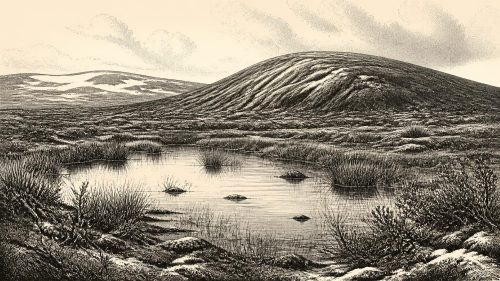
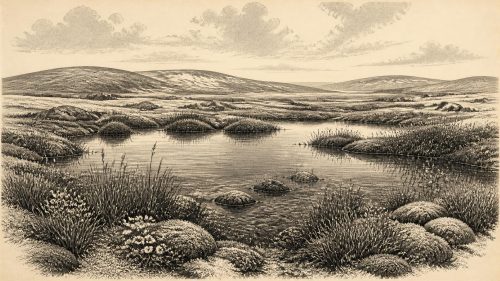
The organic material indicates treeless, open tundra or muskeg: a wet, peaty landscape with shallow freshwater, sedges, mosses and low-growing cold-tolerant plants rather than forest. Fossil remains reported from the deposit include bogbean (Menyanthes trifoliata), dwarf willow (Salix herbacea) and mountain avens (Dryas octopetala). These species do not provide a picturesque reconstruction of a flowering meadow in every season. They are ecological indicators. Together with the sedimentary setting and invertebrate evidence, they support the interpretation of a cold periglacial environment in which frost processes, short growing seasons and poorly drained ground shaped life.
Derryvree also corrects a common misconception about glacial Ireland. “Ice Age” did not mean that every part of the island was permanently sealed beneath uniform ice. The record instead shows alternation: areas could be ice-free, watery and biologically productive for a time, then later be engulfed or transformed by renewed glaciation. Such intervals were not benign in a modern sense. Trees were absent, winters severe and the productive season brief. Yet ponds, marshy margins and open vegetation supplied habitats for specialised plants and animals.
Animals in the Irish Cold
For the island’s larger fauna, Castlepook Cave near Doneraile in north County Cork is the principal archive. Its old excavations and later investigations recovered remains attributed to woolly mammoth, reindeer, giant deer, brown bear, wolf, Arctic fox, mountain hare, lemmings and spotted hyaena. Individual specimens have different dates, and a cave assemblage is not a census of animals living together on one day. Water movement, carnivore activity, old excavation methods and disturbance complicate the original relationships between bones. Nonetheless, the collection establishes that Ireland supported, or at least received carcasses from, a varied cold-stage mammal fauna during MIS 3.
The spotted hyaena is especially instructive. Castlepook appears to have functioned in part as a carnivore den and bone-accumulating place. Gnawed bones, coprolites and hyaena remains point to scavenging, predation and transport into the cave. Mammoth and reindeer remains are therefore not straightforward proof of local human hunting or a nearby kill site. They reveal a food web: large herbivores and carrion, predators and scavengers, and limestone caves that could serve as shelters, dens, traps and sedimentary archives.
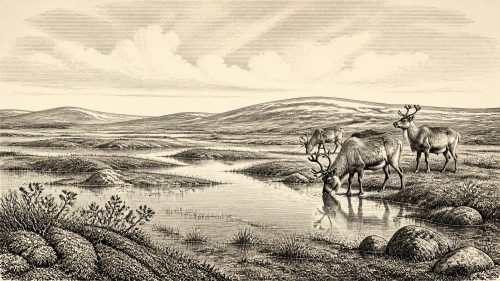
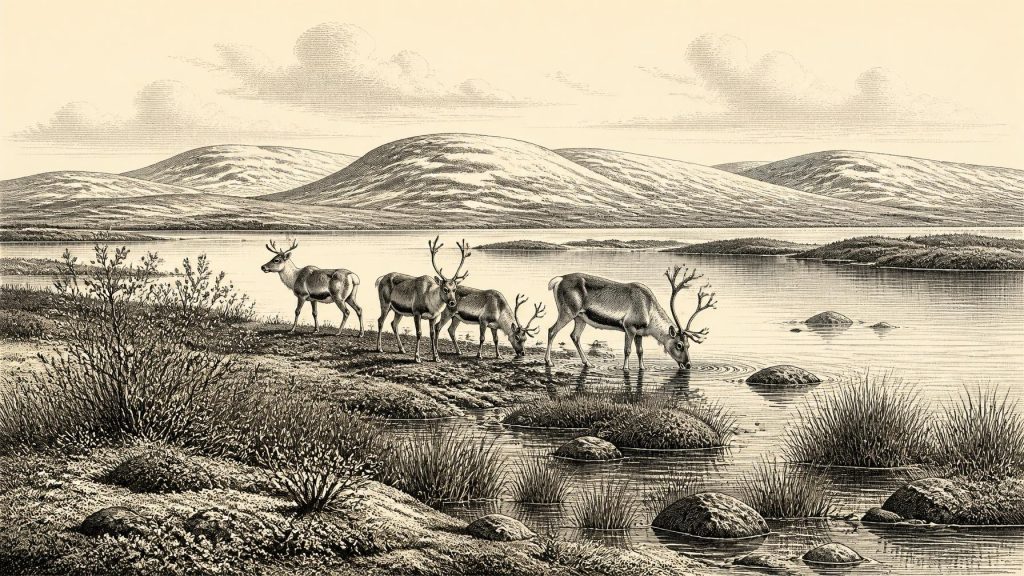
Reindeer suit the Derryvree evidence particularly well as a broad environmental comparison: their presence implies open country rather than dense woodland. Mammoth, giant deer and horse-like open-ground grazers or browsers, where represented, likewise fit a mosaic of grassland, herb-rich tundra and wetland. But the phrase “mammoth steppe” should be used carefully in Ireland. It is a useful comparison with wider northern Eurasian open habitats, not proof that every Irish valley replicated the drier continental grasslands of eastern Europe. Atlantic moisture, local relief, pools and boggy ground would have created varied conditions.
People: A Major Question, Not a Settled Fact
There is no securely demonstrated settlement in Ireland dating to 30,715 BCE: no excavated dwelling, hearth, stone-tool assemblage, burial, camp floor or stratified food-processing area. Consequently there is no evidence for political authority, diplomacy, warfare, named communities, religion, formal learning, trade networks or everyday domestic life on the island at this date. It would be misleading to invent hunter bands, rituals at caves or seasonal villages merely because such things are known elsewhere in Upper Palaeolithic Europe.
A reindeer femur from Castlepook has nevertheless made the question more interesting. It has been reported as carrying a deep mark interpreted by zooarchaeologist Ruth Carden as damage made by a sharp stone tool while a fresh carcass was processed; public accounts associate the bone with an age of about 33,000 years. If that interpretation is confirmed, it may indicate a brief human encounter with a reindeer in Ireland during MIS 3. Its implications would be important, but narrow. A marked bone could indicate the cutting of meat, hide or sinew; it could not identify the hunter, prove a permanent population, establish a route of arrival or show continuous occupation.
That claim requires continued scrutiny because the specimen comes from an old cave collection rather than a recently excavated, intact occupation surface. A radiocarbon measurement dates the animal’s death within a range, not necessarily the instant, location or agent of modification. The mark itself must be distinguished from carnivore damage, trampling, sediment abrasion, excavation damage and natural breakage. The National Museum of Ireland’s cautious public position remains appropriate: clear Palaeolithic human presence in Ireland has not yet been established.
An Island in Transition
Ireland’s relationship with Britain and continental Europe was also unlike that of today, though it cannot be simplified into a permanent land bridge. Sea level during MIS 3 was generally lower than at present, but coastlines, marine channels and ice margins changed repeatedly. Animal colonisation was possible during favourable windows, as the fossil record demonstrates. Whether people travelled by the same routes at this time remains unproven. Later glaciation probably removed much of the terrestrial evidence that might have settled the matter.
The principal development relevant to 30,715 BCE was thus environmental instability. Ice sheets had not yet reached their later maximum extent, but their growth and reorganisation were underway on the wider British-Irish stage. In subsequent millennia, major ice expansion would cover or reshape large parts of Ireland, eliminating habitats and obscuring earlier deposits. Derryvree survived precisely because its sediments were sealed between tills; Castlepook endured because a cave could trap bones even while its deposits were disturbed.
For this date, Ireland cannot be described as a country of farms, tribes or kingdoms. It was a changing northern landscape of tundra vegetation, wet ground, herbivores, carnivores and advancing ice. The evidence is sparse but powerful: a Fermanagh freshwater bed, a Cork cave fauna, and scientific dates that reveal periods rather than anniversaries. Their lesson is not that we can narrate one exact prehistoric year, but that Ireland possessed an unexpectedly rich and dynamic Ice Age past long before its securely documented human history began.
Primary Sources
- A Middle Midlandian Freshwater Series at Derryvree, Maguiresbridge, County Fermanagh, Northern Ireland
- The Irish Quaternary Fauna Project
- The Irish Quaternary Fauna Project
- Castlepook Cave, County Geological Site Report
- Figure 6.— The Subdivision of the Quaternary Period in Ireland
- Outreach and Education Resources
- Menyanthes trifoliata
- Salix herbacea
- Dryas octopetala
- Prehistoric Details
- Guide to the National Museum of Ireland
- 32564: Castlepook Cave, Co. Cork
- IntCal Publications
- IntCal History
- Dimensions and Chronology of the Last Ice Sheet in Western Ireland
- Response of the Irish Ice Sheet to Abrupt Climate Change During the Last Deglaciation
- Early Deglaciation of the British-Irish Ice Sheet on the Atlantic Shelf Northwest of Ireland Driven by Glacioisostatic Depression and High Relative Sea Level
- Last Glacial Maximum Cirque Glaciation in Ireland and Implications for Reconstructions of the Irish Ice Sheet
- Character of Advance and Retreat of the Southwest Sector of the British-Irish Ice Sheet During the Last Glaciation
- Exploring Controls of the Early and Stepped Deglaciation on the Western Margin of the British-Irish Ice Sheet
- Dansgaard–Oeschger Events in Climate Models: Review and Baseline Marine Isotope Stage 3 Protocol
- The Marine δ18O Record Overestimates Continental Ice Volume During Marine Isotope Stage 3
- Global Distribution of Centennial-Scale Records for Marine Isotope Stage 3: A Database
- Marine Isotope Stage 3 Sea Level Fluctuations: Data Synthesis and New Outlook