Bogbean Vegetation30675 BCE
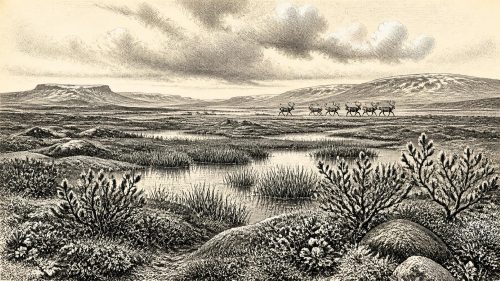
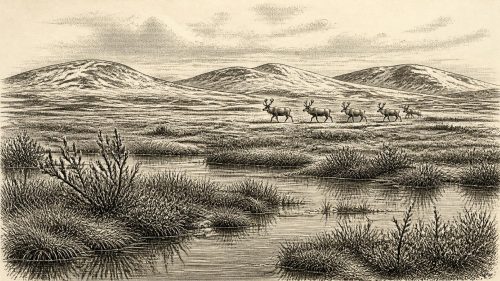
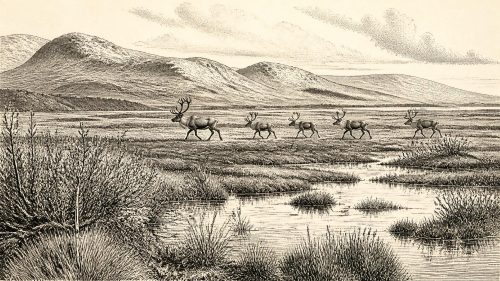
Around 30,675 BCE, Ireland was experiencing a cold, changing Late Pleistocene climate rather than a datable historical event. At Derryvree, County Fermanagh, organic sediments between glacial tills preserve evidence of an ice-free wetland with tundra-steppe vegetation, including bogbean, mountain avens and clubmoss. Castlepook Cave, County Cork, contains diverse pre-Last Glacial Maximum fauna, including reindeer, mammoth, deer, bears, foxes, lemmings and hyaenas, though remains accumulated over time. A possibly butchered reindeer bone suggests, but cannot confirm, early human visits. Lower seas and shifting ice altered connections, while advancing ice later transformed and obscured Ireland’s landscapes and buried earlier evidence across Ireland.
Dateline
The label “30,675 BCE” offers a useful point of orientation, but it cannot identify an event in Ireland on a particular year, day or season. No written calendar, settlement sequence or precisely dated human action survives from this depth of time. In relation to the radiocarbon convention of “before present” (AD 1950), it is roughly 32,600 years ago. The responsible frame is therefore a broad Late Pleistocene interval, not an anniversary: Ireland lay within Marine Isotope Stage 3, during the later part of the last Ice Age.
The strongest directly relevant Irish environmental evidence comes from Derryvree, near Maguiresbridge in County Fermanagh. There, organic freshwater silts and sands were discovered between two glacial tills: deposits laid down by ice lie below and above the organic layer. A conventional radiocarbon determination of about 30,500 years BP, with a substantial statistical uncertainty, has been calibrated broadly to about 36,900–31,700 years before present, or approximately 34,950–29,750 BCE. The nominal year falls within that range. It does not permit an excavator to assign one plant seed, insect or pool edge to 30,675 BCE itself.
An Island Between Ice Advances
Derryvree records an interval when freshwater and vegetation existed at a site that had experienced glaciation and would later be overtaken or sealed by renewed ice-related deposits. This makes it exceptionally valuable, because later ice sheets eroded, rearranged and buried much of Ireland’s earlier landscape evidence. The sequence does not prove that the whole island shared one uniform climate or surface condition. It does demonstrate that part of north-central Ireland contained an ice-free wetland environment during this wider span.
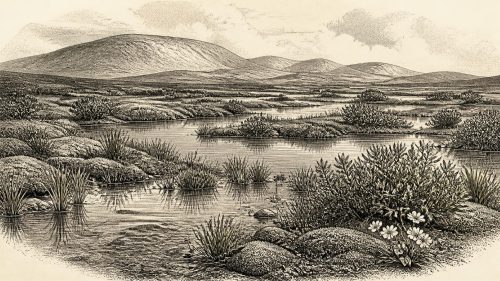
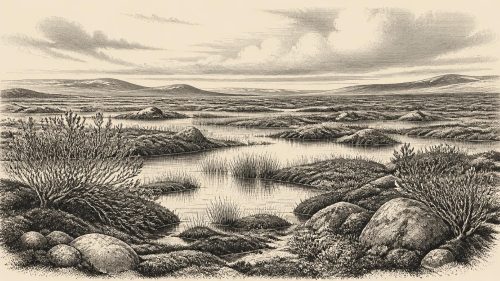
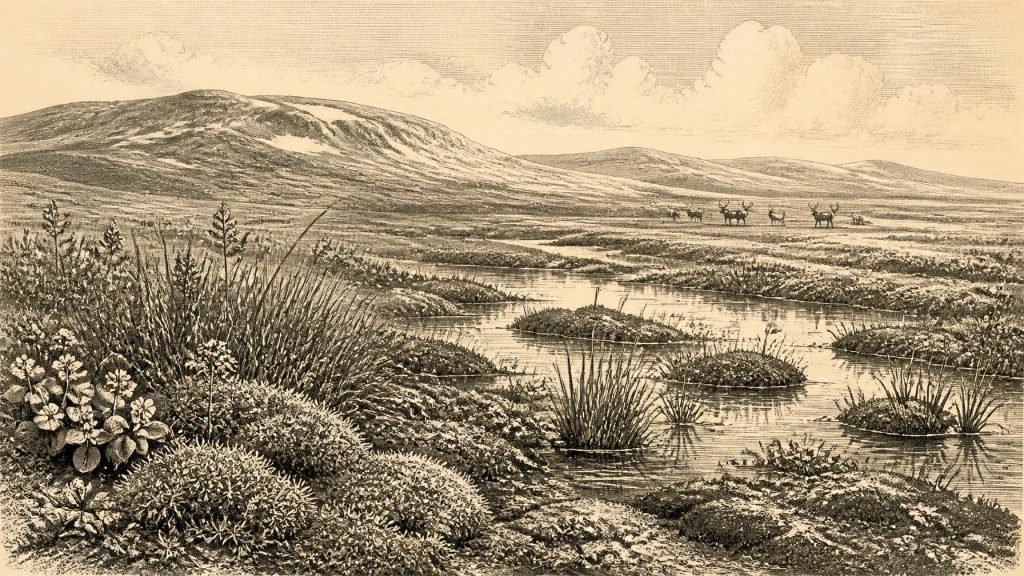
The landscape was cold, exposed and largely treeless. Fossil plants and small animal remains from Derryvree point to a tundra or tundra-steppe mosaic, with wet ground, shallow water and open mineral soils rather than woodland. Mosses, sedges and Arctic-alpine plants form the core of the evidence. The record includes bogbean (Menyanthes trifoliata), mountain avens (Dryas octopetala) and lesser clubmoss (Selaginella selaginoides), species well suited to cold, open or wet settings. Their fossil presence is evidence for local habitats and climatic conditions; it is not evidence for a modern-looking Fermanagh flora spread evenly across Ireland.
Water is the essential feature of this picture. Fine sediments, aquatic plant remains and wetland organisms show that, even within a severe glacial climate, pools, marshy margins and freshwater channels could persist. Seasonal thaw, meltwater, groundwater and changing drainage would have created a patchwork of usable and unstable ground. In older terminology the Derryvree deposits have been described as a treeless muskeg environment. For a visitor standing there, the decisive impression would probably have been openness: low vegetation, saturated hollows, exposed slopes and long views interrupted by ice, snow or frozen ground according to season.
Cold Fauna and Cave Archives
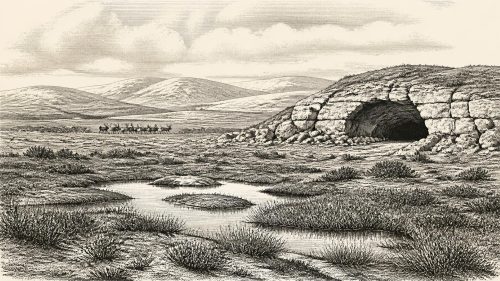
County Cork preserves another major window onto this part of Irish prehistory. Castlepook Cave, near Doneraile, contains Ireland’s richest known assemblage of vertebrate remains from before the Last Glacial Maximum. More than two thousand bones have been recovered from its passages and chambers, although early twentieth-century excavation methods and disturbed cave sediments mean that they cannot be treated as one neatly sealed community living at one moment.
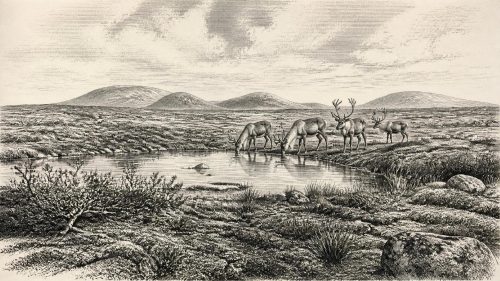
Direct dates and faunal study nevertheless show that the cave accumulated remains over a long stretch of the Middle and Late Pleistocene. Among animals represented are reindeer, woolly mammoth, giant deer, brown bear, wolf, red fox, Arctic fox, mountain hare, collared lemming, Norwegian lemming and spotted hyaena. This is powerful evidence that cold-adapted animal communities reached Ireland before the main late glacial ice maximum. It also cautions against imagining an empty, featureless ice desert.
Castlepook was not necessarily a place where all these animals lived side by side at the same time. Carnivores could have dragged prey or scavenged carcasses into the cave; animals could have died there naturally; moving water and later excavation could have mixed material from different episodes. Spotted hyaena remains are especially important because they reveal a large predator and a likely bone-accumulating agent in the wider landscape. The cave is therefore both an ecological archive and a taphonomic problem: it tells us which creatures occurred in Ireland, while demanding care about how their bones came to rest together.
The Human Question
Human presence is the most compelling and most limited part of the evidence. A reindeer femur from Castlepook has been interpreted as bearing a deep mark made while the bone was fresh, consistent with butchery by a stone tool. Its reported age of around 33,000 years ago has made it a possible indication of Upper Palaeolithic human activity in Ireland far earlier than the formerly accepted terminal-Pleistocene evidence. Yet the claim concerns a single modified bone from an old cave collection, not a settlement surface with hearths, tools, shelters and repeated domestic activity.
That distinction matters greatly for 30,675 BCE. The bone’s date is not a calendar date for the cut, and neither its age nor the Derryvree environmental range demonstrates people living in Ireland during this exact nominal year. At most, the evidence supports the possibility that people reached or used parts of Ireland during the broader pre-Last Glacial Maximum period. It does not establish a continuous population, a named community, or an occupation extending island-wide.
If the mark does represent butchery, it suggests an economy based on opportunistic or planned use of large game, perhaps during a short visit rather than permanent residence. Reindeer would have offered meat, marrow, hide, sinew, bone and antler. But those uses are informed by better-preserved Upper Palaeolithic sites elsewhere in north-west Europe; they should be regarded as plausible comparisons, not discoveries made at Castlepook. No securely dated toolkit, dwelling, grave, artwork or food-processing area from Ireland can presently supply a fuller social portrait for this interval.
Society Without Institutions
There is consequently no evidential basis for political affairs, rulers, warfare, diplomacy, law or organised territorial states in Ireland at this date. Nor is there material evidence for religious monuments, formal burial rites, schools, writing, markets or long-distance trade networks on the island. Their absence from the record is not proof that people had no beliefs, social relationships or knowledge. It reflects the much narrower question archaeology can answer here: whether traces of such activity have survived later glaciation and been found in securely dated contexts.
Any people present would have belonged to small, mobile hunter-gatherer societies, as was normal in Upper Palaeolithic Europe. Mobility, close observation of animal movements, knowledge of stone and bone materials, and familiarity with dangerous cold environments would have been vital forms of learning. This is an interpretation from the wider European archaeological record rather than a documented Irish social system. It is safer to say that Ireland’s evidence has not yet revealed the camps and material culture that would allow archaeologists to reconstruct household life or belief in detail.
Changing Coasts and Connections
Ireland was part of a wider north-west European environmental zone, but it was not simply an extension of Britain or the continent. Lower global sea levels altered coastlines and exposed areas now beneath the Irish and Celtic Seas. At the same time, ice margins, cold waters and shifting sea routes could create formidable barriers. The arrival of land mammals proves that connections existed at some stages of the Pleistocene, but the precise routes, dates and conditions of particular crossings remain uncertain.
The crucial regional development around this broad period was climatic deterioration towards the Last Glacial Maximum, whose fullest expression came thousands of years later. Modern reconstructions of the British–Irish Ice Sheet indicate growth from about 31,000 years ago, followed by a maximum ice volume around 23,000 years ago, but they also emphasise regional variation and incomplete chronological control. Derryvree’s wetland is therefore not a peaceful pause outside the Ice Age; it is a fragile archive from a changing glacial world.
What This Date Can Mean
For Ireland, 30,675 BCE is best understood through a few hard-won pieces of evidence: freshwater deposits trapped beneath later glacial sediments in Fermanagh; a cold-climate flora preserved in those deposits; and cave faunas in Cork that include both prey animals and formidable carnivores. Together they show that the island contained habitable ecological pockets during part of this cold interval. They cannot identify a specific event, person or political community in the numbered year.
The period’s historical importance lies precisely in that restraint. Derryvree preserves the traces of bogbean and other life in a landscape repeatedly transformed by ice. Castlepook preserves bones from an animal world that later disappeared from Ireland. The possible butchered reindeer bone raises, but does not finally settle, the prospect of a very early human visit. Around this notional date, the Irish past is not yet a story of named peoples and events. It is a story of water, plants, animals, ice and the rare survival of evidence.
Source References
Hover over a number to see the source. Select it to open the source.

- [1] Figure 6.— The subdivision of the Quaternary Period in Ireland
- [2] Section 1: Introduction
- [3] A reconsideration of the radiocarbon dating of the Marine Isotope Stage 3 fauna from southern Ireland
- [4] Castlepook Cave
- [5] New insights on the fauna of Ireland's Younger Dryas and Early Holocene from Alice & Gwendoline Cave
- [6] Growth and retreat of the last British–Irish Ice Sheet, 31,000 to 15,000 years ago: the BRITICE-CHRONO reconstruction
- [7] The timing and magnitude of the British–Irish Ice Sheet between Marine Isotope Stages 5d and 2: implications for glacio-isostatic adjustment, high relative sea levels and ‘giant erratic’ emplacement
- [8] Trimlines, blockfields and the vertical extent of the last ice sheet in southern Ireland
- [9] Oscillating retreat of the last British-Irish Ice Sheet on the continental shelf offshore Galway Bay, western Ireland
- [10] Radiocarbon constraints on the age of the maximum advance of the British–Irish Ice Sheet in the Celtic Sea
- [11] Extent and timing of the Last Glacial Maximum (LGM) in Britain and Ireland: a review
- [12] Pattern and timing of retreat of the last British-Irish Ice Sheet
- [13] ESCR Site Summary
- [14] BSBI: Menyanthes trifoliata
- [15] BSBI: Dryas octopetala
- [16] BSBI: Selaginella selaginoides
- [17] Occurrence of mammalia relicts at site Castlepook Cave
- [18] 32564: Castlepook Cave, Castlepook, Cork
- [19] The Mesolithic in Ireland: when was it?
- [20] Pleistocene vertebrates in the British Isles
- [21] The Irish Quaternary Fauna Project
Primary Sources
- Figure 6.— The subdivision of the Quaternary Period in Ireland
- Section 1: Introduction
- A reconsideration of the radiocarbon dating of the Marine Isotope Stage 3 fauna from southern Ireland
- Castlepook Cave
- New insights on the fauna of Ireland's Younger Dryas and Early Holocene from Alice & Gwendoline Cave
- Growth and retreat of the last British–Irish Ice Sheet, 31,000 to 15,000 years ago: the BRITICE-CHRONO reconstruction
- The timing and magnitude of the British–Irish Ice Sheet between Marine Isotope Stages 5d and 2: implications for glacio-isostatic adjustment, high relative sea levels and ‘giant erratic’ emplacement
- Trimlines, blockfields and the vertical extent of the last ice sheet in southern Ireland
- Oscillating retreat of the last British-Irish Ice Sheet on the continental shelf offshore Galway Bay, western Ireland
- Radiocarbon constraints on the age of the maximum advance of the British–Irish Ice Sheet in the Celtic Sea
- Extent and timing of the Last Glacial Maximum (LGM) in Britain and Ireland: a review
- Pattern and timing of retreat of the last British-Irish Ice Sheet
- ESCR Site Summary
- BSBI: Menyanthes trifoliata
- BSBI: Dryas octopetala
- BSBI: Selaginella selaginoides
- Occurrence of mammalia relicts at site Castlepook Cave
- 32564: Castlepook Cave, Castlepook, Cork
- The Mesolithic in Ireland: when was it?
- Pleistocene vertebrates in the British Isles
- The Irish Quaternary Fauna Project