BIRM-166’s Moss-Rich Interval30293 BCE
30,293 BCE is a modern label within an uncertain Marine Isotope Stage 3 interval, not a datable Irish event. At Derryvree, County Fermanagh, moss-rich freshwater sediments between glacial tills, radiocarbon dated broadly to 34,950–29,750 BCE, show an ice-free episode supporting cold-adapted wetland and open-ground plants. They demonstrate local environmental opportunity, not island-wide conditions. Castlepook Cave, County Cork, preserves pre-Last Glacial Maximum fauna including reindeer, mammoth and carnivores, although deposits span long periods. A cut-marked reindeer femur may indicate early human processing, but cannot establish settlement or society. Lower sea levels altered routes, while ice and climate made mobility uncertain there.
Dateline
30,293 BCE is not a date at which Irish archaeology can identify an event. No contemporary writing, ruler, settlement plan or annually dated deposit survives from this part of the Late Pleistocene. The number is a modern calendar label projected far beyond the resolution of the evidence. What can responsibly be said is that it falls within a broad, unstable interval of the last Ice Age, conventionally placed in Marine Isotope Stage 3, when climate, ice margins, vegetation and animal ranges altered repeatedly over centuries and millennia.
The nearest especially valuable Irish chronological evidence comes from Derryvree, near Maguiresbridge in County Fermanagh. There, a road cutting exposed a layer of organic, moss-rich freshwater sediment between two tills: the stony clays left by separate advances of glacier ice. A conventional radiocarbon determination, BIRM-166, gave about 30,500 radiocarbon years before present, with a large uncertainty. Calibration has placed the deposit broadly at roughly 36,900–31,700 calibrated years BP, or approximately 34,950–29,750 BCE. Thus 30,293 BCE lies within the wide calendar range associated with this deposit, but cannot be tied to one season, plant, animal, or human action in it.
A Wetland Between Ice Advances
Derryvree matters because its stratigraphy records sequence rather than a single fossil find. Ice had occupied the locality and laid down a lower till. Then, during an ice-free phase at that spot, water and organic material accumulated in a shallow basin or wetland. Later ice advanced across the area again, burying the freshwater sediments beneath an upper till. The buried layer is therefore direct evidence that at least part of Fermanagh was not continuously covered by glacier ice throughout the relevant span. It does not demonstrate that all Ireland was open, nor that the whole island shared one uniform climate.
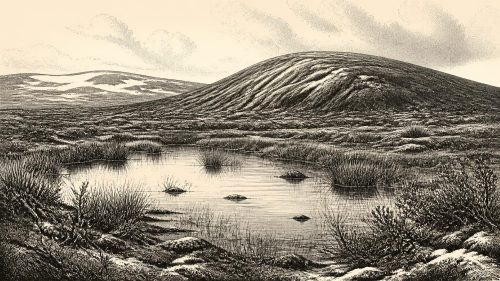
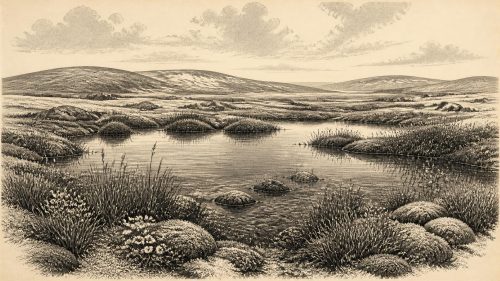
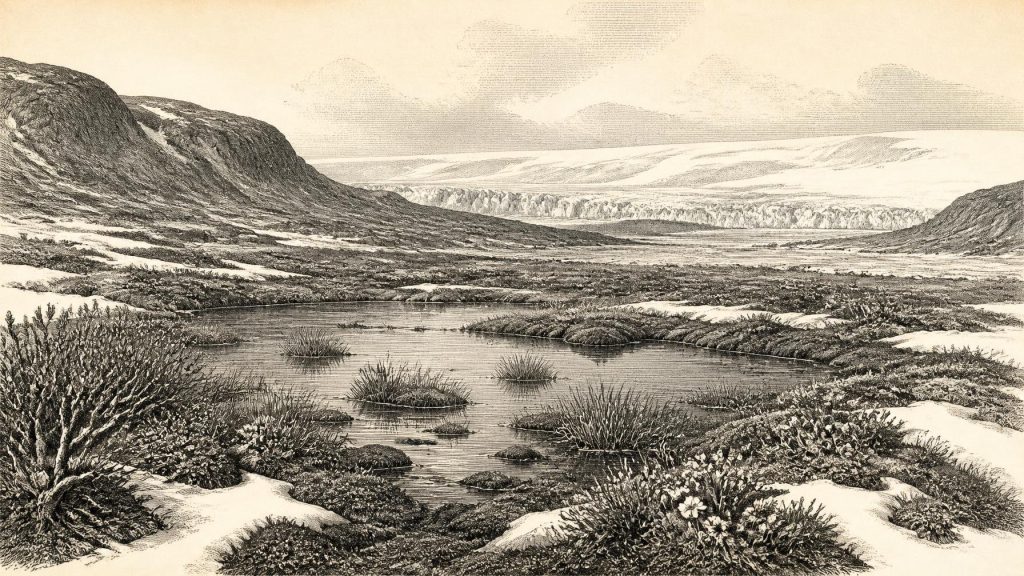
The plants recovered from the Derryvree organic deposits point to a cold, open environment with wet ground and shallow fresh water. Mosses, sedges, bogbean or buckbean (Menyanthes trifoliata), water-milfoil, dwarf willow, juniper, mountain avens and other hardy taxa have been reported from the sequence. Taken together, they suggest a treeless or almost treeless mosaic: sedgy margins, wet mossy ground, small pools, patches of low shrub and herb-rich open land. These are not the plants of later wooded Ireland. Nor should they be arranged into a picturesque, permanent ‘tundra’ without qualification: plant remains were deposited over time, and the climate was variable. Their great importance is that they show living freshwater and terrestrial communities in an interval later sealed by ice.
This was an Irish landscape on a geological threshold. The global Last Glacial Maximum is generally dated to about 26,000–20,000 years ago, while reconstructions of the British–Irish Ice Sheet show that major expansion was under way across the wider region around the late 20,000s years BP. At about 30,293 BCE, it is safer to envisage pronounced regional contrasts than an island either entirely white with ice or entirely open to travel. Glaciers, snowfields, frost-shattered uplands, cold lakes and exposed grass-herb terrain could coexist across relatively short distances as ice centres and margins changed.
Fermanagh’s Local Evidence, Ireland’s Wider Uncertainty
It is tempting to turn Derryvree into a national climate report, but its evidential reach is local. The sediments describe conditions in and around one Fermanagh basin during a broad interval. They cannot supply a complete map of coastlines, glaciers or vegetation for every Irish region in 30,293 BCE. Much of the physical record has itself been eroded, reworked or concealed by later ice. The islands’ position at the Atlantic edge also meant that relatively small climatic shifts could change precipitation, sea ice, glacier behaviour and the viability of plants and animals.
Nevertheless, Derryvree corrects an older simplification: Ice Age Ireland was not a timeless, featureless ice desert. It had episodes and localities in which water moved, plants grew and animals could find food. The sequence is evidence for environmental opportunity, though not necessarily ease. Open ground in a cold climate could be windswept, seasonal and highly exposed. A wetland that sustained sedges, mosses and aquatic plants might have been surrounded by ground difficult for large animals, and conditions could deteriorate rapidly as ice returned.
Animals at Castlepook
County Cork provides the other major Irish perspective on this deep period. Castlepook Cave, near Doneraile, long known as Mammoth Cave, has yielded a remarkably rich Pleistocene faunal assemblage. Its collections include remains attributed to woolly mammoth, reindeer, spotted hyaena, brown bear, wolf, fox, hare, lemmings and other animals. These bones are invaluable proof that Ireland participated in wider north-west European Ice Age ecosystems. Yet they do not prove that every species lived together, or even occupied the cave, at the same moment. Cave deposits can be accumulated by carnivores, water, natural deaths, sediment movement and early excavators over very long periods.
Reassessment of radiocarbon dates has made Castlepook especially important for Marine Isotope Stage 3. Modern pretreatment and ultrafiltration techniques can exclude contaminating carbon that made some older bone dates appear too young. The resulting work places key Castlepook fauna firmly before the Last Glacial Maximum, demonstrating that animals including reindeer were present in Ireland during colder, changing pre-maximum conditions. It also shows why confidence must be graduated: a directly dated bone says much more about one animal’s age than an undated specimen from the same cave says about the whole assemblage.
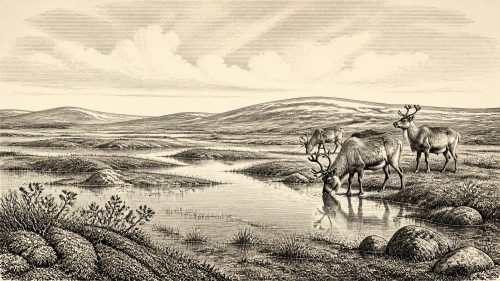
For everyday ecology, reindeer are particularly evocative but should not be romanticised. They imply access to open-country forage and connect Ireland with the fauna of the exposed western European continental shelf and Britain. Carnivores such as hyaena and wolf indicate competition around carcasses rather than a benign pastoral landscape. Mammoth remains attest to the potential reach of very large herbivores into the Irish record. But no securely dated animal census exists for 30,293 BCE. The responsible conclusion is that parts of Ireland supported, at different times within this broad period, cold-adapted animal communities capable of moving through landscapes transformed by ice and climate.
The Reindeer Femur and Human Possibility
The most consequential, and most carefully qualified, evidence for people is a reindeer femur from Castlepook. The bone has been reported as about 33,000 years old and bears a deep linear mark interpreted by zooarchaeologist Ruth Carden as a fresh-bone incision or chop made by a sharp stone tool. If that diagnosis and chronological association withstand further scrutiny, it is evidence that people processed a reindeer in Ireland far earlier than the formerly accepted terminal-Pleistocene human record. County Cork’s heritage publication gives the artefact a broad date of around 31,000 BC, close enough to make it highly relevant to the present chronological horizon.
Even so, this is not evidence for an Irish ‘society’ in the usual historical sense. The cut mark does not reveal the language, identity, number, kinship structure or route of those involved. It does not establish a permanent settlement, a village, a cemetery, a hearth, a tool-making floor or continuous occupation. It cannot prove whether a hunting party killed the animal, encountered a carcass, stayed at the cave, or made repeated crossings to the island. The bone is best understood as a potentially momentous trace of an action, not a licence to invent a population.
There is consequently no evidential basis for political affairs, diplomacy, territorial rule or organised conflict in Ireland at this date. Nor can archaeologists identify religion, formal learning, art or exchange networks in the island’s record for this precise period. If people did reach Ireland, their material culture has not yet been recovered in a securely dated assemblage capable of answering those questions. The absence is meaningful: claims about chiefs, tribes, ritual sites, trade in flint, or battles would be speculation rather than history.
Mobility Without a Known Shoreline
Sea level was much lower than today because large volumes of water were stored in ice sheets. Ireland’s coastline was therefore farther out in many places, and the Irish Sea region had a markedly different geography. Low sea level did not automatically create a simple, dry route from Britain or continental Europe; glaciers, proglacial lakes, rivers, cold seas and changing land bridges all mattered. Around 30,293 BCE, the practical routes available to animals or people remain uncertain and must be reconstructed from regional glacial and sea-level evidence, not assumed from a modern map.
That uncertainty shapes the economic story. There is no direct evidence for farming, herding, metalworking, pottery or sustained trade; all belong to vastly later Irish prehistory. At most, the Castlepook femur raises the possibility of mobile hunter-gatherers exploiting a large-animal resource during a favourable interval. Such an inference fits the wider Upper Palaeolithic world, but it remains an inference, not a demonstrated Irish settlement pattern. The strongest evidence for this period remains environmental: moving ice, freshwater sediments, tough cold-climate plants and the bones of animals that survived in a volatile Atlantic landscape.
In this sense, Ireland around 30,293 BCE was not yet a historical country but a changing zone of habitat, ice and possible movement. Derryvree’s moss-rich mud preserves a brief ecological opening between glacial advances. Castlepook preserves the longer, harder-to-date record of animals, carnivores and perhaps a humanly modified bone. Together they make the year intelligible—not as a calendar anniversary, but as part of a deep Pleistocene interval in which the conditions for life, and perhaps fleeting human presence, existed before ice again reshaped the island.
Primary Sources
- Heritage Artefacts of County Cork
- Archaeology Research Excavation Grant 2022: Castlepook Cave, Co. Cork
- A reconsideration of the radiocarbon dating of the Marine Isotope Stage 3 fauna from southern Ireland
- Trimlines, blockfields and the vertical extent of the last ice sheet in southern Ireland
- Exploring the controls on the early to middle deglaciation of the last British-Irish Ice Sheet
- The timing and magnitude of the British–Irish Ice Sheet between Marine Isotope Stages 5d and 2: implications for glacio-isostatic adjustment, high relative sea levels and ‘giant erratic’ emplacement
- New age constraints for the maximum extent of the last British-Irish Ice Sheet (NW sector)
- Pattern and timing of retreat of the last British-Irish Ice Sheet
- Figure 6.— The Subdivision of the Quaternary Period in Ireland
- The Quaternary of the Irish Midlands
- Irish Quaternary Association: Field Guides
- Irish Quaternary Association: Publications
- Irish Quaternary Association: Outreach and Education Resources
- Irish Quaternary Association: Outreach Links, Events & Exhibitions
- The Irish Quaternary Fauna Project
- First evidence of a Late Upper Palaeolithic human presence in Ireland
- First evidence of a Late Upper Palaeolithic human presence in Ireland
- The colonization of Ireland: A human ecology perspective
- New insights on the fauna of Ireland’s Younger Dryas and Early Holocene from Alice & Gwendoline Cave
- Castlepook Cave, Castlepook South, County Cork: Excavation Report 2022