Reindeer Bone at Castlepook30262 BCE
30,262 BCE is not a datable Irish event but a point within a broad Late Pleistocene range. At Derryvree, County Fermanagh, freshwater silts between glacial tills, radiocarbon-dated broadly to 34,950–29,750 BCE, preserve tundra wetland plants and insects, demonstrating an interval of cold, open habitat between ice advances. Castlepook Cave, County Cork, contains diverse fauna including mammoth, reindeer, giant deer and predators, indicating intermittent ecological connections with wider Ice Age populations. A cut-marked reindeer femur may record Upper Palaeolithic butchery, though not settlement or permanent colonisation. Glaciation, climatic instability and disturbed deposits limit interpretation, leaving environmental evidence rather than political history.
Dateline
30,262 BCE is a modern calendar label, not a date at which Ireland’s archaeological record can identify a particular event, individual or season. No written calendar, settlement layer or historical tradition reaches remotely this far back. The most responsible approach is to place the notional year within a wider Late Pleistocene window: roughly 32,211 years before AD 1950, during Marine Isotope Stage 3, a climatically unstable part of the last Ice Age.
Calendar precision is especially misleading at this depth in time. Radiocarbon results are reported in radiocarbon years before present, where “present” conventionally means AD 1950, and then calibrated against independent records of past atmospheric carbon. The resulting calendar ranges can span millennia. Around the date in question, Ireland is illuminated chiefly by glacial sediments, fossil plants, insects and cave bones. These sources can reveal environments and possibilities, but they do not provide an annual chronicle.
A Wetland Between Ice Advances
The most useful Irish evidence close to this horizon comes from Derryvree townland, near Maguiresbridge in County Fermanagh. Road works in 1969 cut through a drumlin and exposed an extraordinary sequence: a lower sheet of glacial till, then freshwater silts and fine sands rich in organic remains, followed by a second till. Till is the unsorted sediment deposited by glacier ice. The order of these layers establishes a clear local sequence. Ice had occupied or passed across the ground; a later interval permitted freshwater sediment and living things to accumulate; renewed glacial activity ultimately buried the wetland.
Organic material from the Derryvree deposit produced the conventional radiocarbon determination BIRM-166, 30,500 years BP, with a sizeable uncertainty of plus 1,170 and minus 1,030 years. Published calibration places the deposit broadly at about 36,900–31,700 calibrated years BP, or approximately 34,950–29,750 BCE. The nominated year falls within that wide range. It cannot, however, be assigned to a particular stratum, pool or organism in the deposit. Derryvree is evidence for an extended environmental interval, not proof of what happened throughout Ireland in one numbered year.
The two tills are equally important because they show why the Irish record is so fragmentary. Later ice often eroded, mixed or concealed older landscapes. A temporary wetland preserved beneath a drumlin is therefore a rare survival. Its evidence does not establish that all parts of the island were ice-free at once. It does show that south Fermanagh included an open freshwater environment between local phases of glaciation, while the wider British–Irish Ice Sheet was changing in scale and configuration.
Cold Water, Open Ground
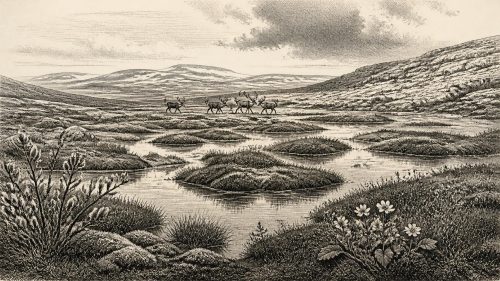
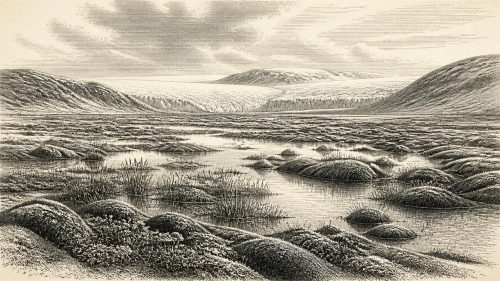
Derryvree’s organic silts preserve a cold-climate community rather than a forest. Mosses, herb pollen, sedges and other plant macrofossils point to open tundra or muskeg: waterlogged ground with shallow pools, wet margins and sparse dry-land vegetation. Finds including bogbean, water-milfoil, dwarf willow, juniper and mountain-avens have helped researchers reconstruct a varied but treeless habitat. Such plants should not be imagined as a tidy modern meadow. Their presence indicates a mosaic of wet hollows, mossy ground, exposed mineral soils and seasonal water, shaped by severe winters, short growing seasons and frost.
Insect evidence strengthens that interpretation. Beetle assemblages are particularly valuable because different species occupy precise habitats. At Derryvree they support the picture of periglacial wetland with open pools, decaying plant material and mossy margins. They do not supply a thermometer for 30,262 BCE, yet together with the flora they indicate conditions much colder and more exposed than modern Fermanagh. The landscape was not necessarily lifeless: summer light could support plants, insects and grazing animals, but it was an ecologically demanding world.
This was also an age of abrupt climatic change on the North Atlantic fringe. Greenland ice cores show that Marine Isotope Stage 3 contained sharp shifts between colder stadials and relatively milder interstadials. It would be unsafe to match one Irish sediment directly to a single Greenland fluctuation without stronger dating evidence. Nevertheless, the wider pattern explains why Ireland’s ice margins, vegetation and animal habitats could change markedly over periods far longer than a human lifetime but short in geological terms. The advance towards the Last Glacial Maximum, when ice became much more extensive, still lay ahead.
Castlepook’s Animal World
County Cork offers a second, very different line of evidence. Castlepook Cave, near Doneraile and sometimes called Mammoth Cave, has produced Ireland’s richest assemblage of Pleistocene vertebrates. Its Ice Age fauna includes woolly mammoth, reindeer, giant deer, brown bear, wolf, Arctic fox, mountain hare, lemmings and spotted hyaena. A mammoth bone has yielded a conventional radiocarbon age of about 33,500 BP, while a hyaena bone has also produced a broadly comparable age. These dates establish that cold-adapted and open-country animals reached Ireland during the middle part of the last glaciation.
The cave is not a simple snapshot of one landscape. Its bones accumulated over a long time; carnivores could have dragged carcass parts inside; water, collapse and early excavation methods disturbed the deposits; and not all specimens need be contemporary. Castlepook can therefore demonstrate the presence of species in a broad period, but it cannot provide a reliable census of one year or prove that each animal encountered the others. Even so, the assemblage makes clear that Ireland intermittently supported far more varied large-mammal communities than those familiar in the island’s later history.
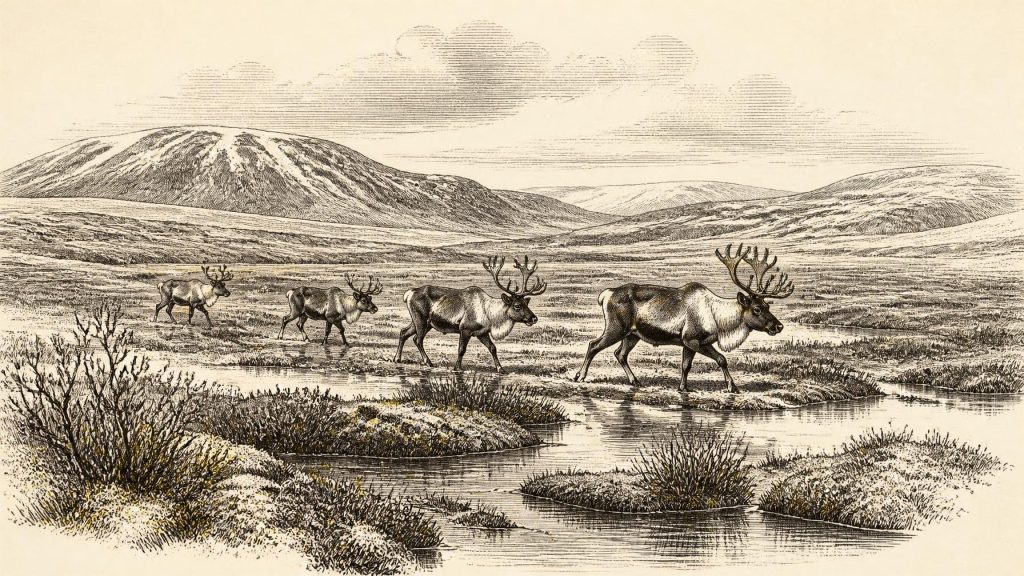
A reindeer femur from Castlepook has become especially significant. Zooarchaeologist Ruth Carden identified a deep linear mark on the bone and interpreted it as damage made by a sharp stone tool during the processing of fresh carcass tissue. County Cork heritage material has associated the find broadly with c. 31,000 BCE. If that interpretation is confirmed, it is potentially evidence that people handled a reindeer in Ireland during the Upper Palaeolithic, far earlier than the secure post-glacial settlement record. Yet the claim must remain narrow. The femur is neither a house nor a hearth, tool kit, burial, occupation floor or evidence for a continuously resident population.
People: Possibility, Not a Polity
There is no basis for describing a government, chiefdom, war, diplomacy or named community in Ireland around 30,262 BCE. Nor can archaeology identify a religion, language, kinship system, trade network or artistic tradition for this precise horizon. No securely stratified Palaeolithic settlement, human burial or associated stone-tool assemblage of this age has been published from Ireland. The Castlepook incision is important precisely because it may preserve a fleeting act of butchery, but a single altered bone cannot answer how many people were present, whether they hunted or scavenged the animal, how long they stayed, or from where they came.
If people did visit, their practical economy would have depended on immediate survival in a cold, mobile landscape: knowledge of animal movements, carcass processing, shelter, fuel and seasonal hazards. That is an inference from Upper Palaeolithic lifeways elsewhere in north-west Europe, not a direct description of an Irish camp. Likewise, low sea levels altered the geography of the surrounding shelves, but they do not prove an easy land route into Ireland at this particular time. Animal remains prove movement and habitat availability, not the exact routes followed by animals or people.
For the same reason, it is better to speak of ecological connections than trade or diplomacy. Reindeer, mammoth and carnivores belonged to wider Late Pleistocene populations whose ranges could extend across regions now divided by sea. A human visit, if the Castlepook mark is correctly interpreted, would suggest that Ireland lay within the outer reach of Upper Palaeolithic movement. It would not show permanent colonisation. The later growth of ice across much of the island is likely to have erased or buried many potential traces, making absence of evidence difficult to interpret.
An Island’s Deep Archive
The strongest history for this date is therefore environmental. In Fermanagh, a freshwater wetland briefly occupied ground between episodes of glaciation. Its plant and insect remains reveal cold, open, wet terrain. In Cork, cave deposits preserve the bones of a striking Ice Age fauna and a possible indication of human carcass processing. Across Ireland, changing ice, low sea levels and unstable climate continually reshaped what habitats existed and what evidence survived.
30,262 BCE should not be treated as the year of a known Irish event. It is a point within a broad calibrated range and a much longer environmental story. What survives is not a political history but a set of physical witnesses: silt beneath till, mosses and beetles in an ancient wetland, bones in a limestone cave, and one contested cut on a reindeer femur. Their restraint is their value. They permit a vivid account of Ice Age Ireland while marking clearly the boundary between evidence and imagination.
Primary Sources
- A Middle Midlandian Freshwater Series at Derryvree, Maguiresbridge, County Fermanagh, Northern Ireland
- Palaeoecology: Quaternary Field Guide of Ireland
- The Subdivision of the Quaternary Period in Ireland
- Quaternary Site Descriptions
- Irish Pleistocene Biostratigraphy
- The Irish Quaternary Fauna Project
- Pleistocene Vertebrates in the British Isles
- Castlepook Cave, County Geological Site Report
- Heritage Artefacts of County Cork
- Archaeology Research Excavation Grant 2022: Castlepook Cave Final Report
- 2022: Castlepook Cave, Cork
- Trimlines, Blockfields and the Vertical Extent of the Last Ice Sheet in Southern Ireland
- The Timing and Magnitude of the British–Irish Ice Sheet Between Marine Isotope Stages 5d and 2
- Growth and Retreat of the Last British–Irish Ice Sheet, 31,000 to 15,000 Years Ago: The BRITICE-CHRONO Reconstruction
- Growth and Retreat of the Last British–Irish Ice Sheet, 31,000 to 15,000 Years Ago: The BRITICE-CHRONO Reconstruction
- Maximum Extent and Readvance Dynamics of the Irish Sea Ice Stream and Irish Sea Glacier Since the Last Glacial Maximum
- Radiocarbon Constraints on the Age of the Maximum Advance of the British–Irish Ice Sheet in the Celtic Sea
- The IntCal20 Northern Hemisphere Radiocarbon Age Calibration Curve (0–55 cal kBP)
- IntCal: International Radiocarbon Calibration
- The Problem of a Late Quaternary Landbridge Between Britain and Ireland
- Ireland: Submerged Prehistoric Sites and Landscapes
- Prehistoric Details: National Museum of Ireland
- The Mesolithic in Ireland: When Was It?
- New Insights on the Fauna of Ireland's Younger Dryas and Early Holocene from Alice & Gwendoline Cave