Castlepook’s Last Corridor30261 BCE
Around 30,261 BCE, Ireland was entering the Late Midlandian glacial expansion, though conditions varied regionally and the island was not yet wholly ice-covered. Lower sea levels altered coasts and possible routes, without guaranteeing easy crossings. Derryvree deposits, older than the nominal date, record freshwater tundra vegetation in an ice-free interior. Castlepook Cave preserves a time-averaged cold-stage fauna, including mammoth, reindeer and predators, but cannot describe one moment. A possibly stone-cut reindeer bone offers tentative evidence of human activity, not settlement. Advancing ice reshaped landscapes and erased evidence, leaving a deep prehistory understood chiefly through environmental archives and cautious scientific interpretation.
Dateline
Modern calendar-year precision is not available for Ireland around 30,261 BCE. The numbered year is a useful point on a modern timeline, not the date of a recorded occurrence. In conventional before-present terms it lies at roughly 32.2 thousand calendar years ago, but the evidence is dated in broad calibrated ranges, often with substantial uncertainty. The responsible picture is therefore of a changing Late Pleistocene landscape during Marine Isotope Stage 3, not of an Irish event, ruler, community or expedition that can be assigned to one year.
A Landscape on the Edge of Glaciation
This was the Late Midlandian, Ireland’s last great glacial episode. It was not yet the full Last Glacial Maximum, when an expanded Irish Ice Sheet covered almost all of the island between roughly 26,000 and 19,000 years ago. At about 32,000 calibrated years before present, however, Ireland was approaching a decisive environmental threshold. Syntheses of the ice-sheet evidence suggest that much of Ireland remained ice-free until about this time, after which the ice sheet expanded dramatically. The exact timing, extent and local pattern remain subjects of research: ice did not advance in a neat, simultaneous front across every region.
That distinction matters. Around this notional date, some lowland basins, caves and coastal plains may still have offered seasonally usable terrain, while uplands and northern or western districts could have been increasingly dominated by snowfields, glaciers, permafrost and severe cold. The sea was far lower than today because immense quantities of water were locked in northern ice sheets. Ireland’s present shoreline did not exist. Wider coastal shelves were exposed, and routes towards Britain and continental Europe were geographically different. Yet low sea level does not by itself prove a simple, dry land bridge or an easy human crossing at any particular moment: ice margins, rivers, estuaries, marshes and changing sea passages all affected movement.
Derryvree’s Earlier Wetland
The most revealing Irish environmental archive for the broader period comes from Derryvree near Maguiresbridge in County Fermanagh. Roadworks there exposed silts and fine sands trapped between two thick sheets of glacial till. The deposit was laid down in freshwater conditions before it was overridden and sealed by later ice. Its organic material produced the radiocarbon determination BIRM-166, 30,500 radiocarbon years before present, with a wide original error range. Calibration places it appreciably earlier than the calendar year in this article, rather than providing a date for it.
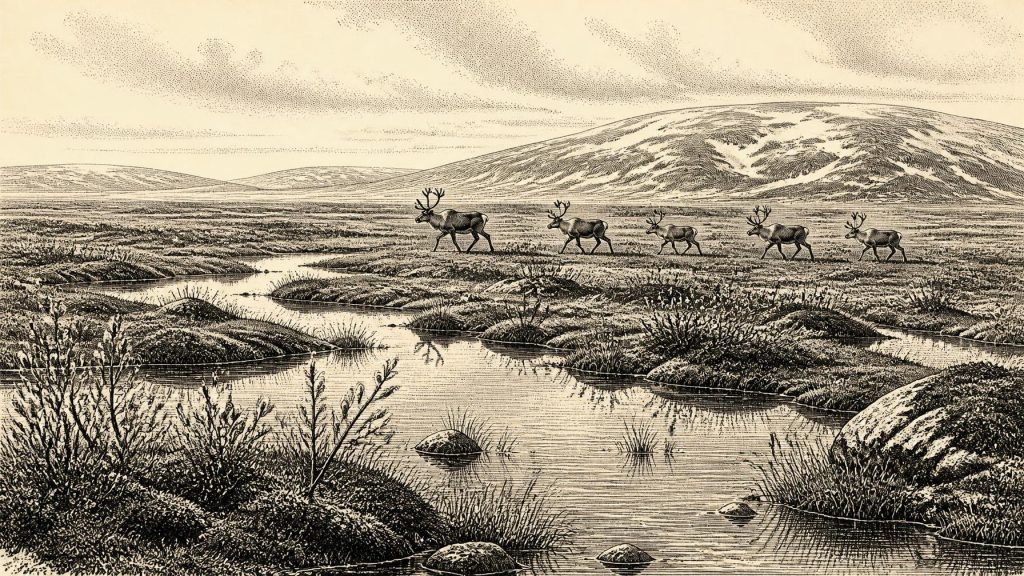
Even so, Derryvree is crucial because it shows what an ice-free or partly ice-free Irish interior could support during a cold phase before the final advance. Plant and animal remains indicate open tundra, not woodland: sedges, mosses, dwarf shrubs and cold-adapted herbs around shallow water, wet ground and exposed mineral soils. Finds including buckbean or bogbean (Menyanthes trifoliata), water-milfoil, willow, mountain avens and other taxa point to a mosaic rather than a lifeless white desert. Such vegetation could briefly flourish in the growing season beside pools and watercourses, while long winters, frozen ground and strong winds placed firm limits on plant growth.
Derryvree must not be converted into a literal weather report for every part of Ireland in 30,261 BCE. It is one stratified locality, with a dated interval older than the nominal year. Its value is evidential: it demonstrates that freshwater habitats and tundra vegetation existed in Ireland during the wider Middle Midlandian. Interpreting that evidence alongside glacial mapping suggests a patchwork country whose habitable ground was shrinking and becoming less reliable as ice accumulated.
Castlepook and the Mammal Record
County Cork’s Castlepook Cave, near Doneraile, provides the strongest evidence for Ireland’s larger Late Pleistocene animals. Collections from its limestone passages include remains attributed to woolly mammoth, reindeer, giant deer, brown bear, wolf, Arctic fox, mountain hare, lemmings and spotted hyaena. A mammoth bone bears damage consistent with hyaena feeding. The assemblage establishes that, over a long span of time, southern Ireland formed part of a cold-stage ecological world that could sustain herbivores, scavengers and predators.
But a cave bone-bed is an archive accumulated over time, not a photograph of one season. Some bones were carried in by carnivores, some may have been moved by water or disturbed during earlier excavation, and not all animals represented need have lived together. Modern redating has also transformed the chronology. A 2020 reassessment concluded that several southern Irish faunal specimens formerly assigned younger ages were considerably older, and that giant deer and spotted hyaena may have disappeared locally before about 40,000 calibrated years ago. Castlepook is thus directly relevant to the period, but cannot safely supply a complete animal list for 30,261 BCE itself.
The reasonable interpretation is more restrained and more interesting. Ireland possessed, during parts of Marine Isotope Stage 3, an intermittently connected cold-open landscape capable of supporting substantial mammals. Reindeer and mammoth imply grazing country somewhere within the regional landscape; hyaenas and wolves imply carcasses and prey. Their presence also reveals that Ireland was not permanently isolated from neighbouring landmasses. It does not reveal stable populations in every generation, and it does not establish that such fauna survived the ensuing ice advance.
The Human Question
There is no securely excavated Irish settlement, hearth, stone-tool workshop, burial or house from around 30,261 BCE. Consequently, there is no responsible basis for describing political affairs, diplomacy, formal conflict, language, religion, art or a settled economy in Ireland at this date. There were no known Irish polities to negotiate with one another, and no surviving evidence for named individuals or communities. Silence in the record is not proof that no person ever entered the island; it is a limit on what can be claimed.
The most provocative possibility is a reindeer femur from Castlepook Cave, identified by zooarchaeologist Ruth Carden as bearing a deep linear mark consistent with fresh-bone cutting by a sharp stone tool. The bone has been publicly reported as about 33,000 radiocarbon years old. If the mark is confirmed as anthropogenic and securely relates to the specimen’s ancient history, it could indicate that a person processed a reindeer in Ireland far earlier than the well-established terminal Pleistocene evidence from Alice and Gwendoline Cave in County Clare, dated to about 12,810–12,590 calibrated years before present.
That conditional language is essential. A date on bone establishes when the animal died, not necessarily the exact moment when a surface mark was made. Nor does one modified bone demonstrate a camp, a resident population or repeated seasonal hunting. No associated lithic assemblage, hearth, dwelling surface or concentration of butchered carcasses has yet been recovered at Castlepook. The femur is best understood as a significant proposed trace of human action, not a licence to populate Ireland with an imagined Upper Palaeolithic society.
Everyday Life Without a Settlement Record
If people did reach Ireland in this broader period, the evidence permits only a minimal inference: they may have made brief, mobile use of a cold landscape, perhaps following animal movements or exploiting a carcass. Comparable groups elsewhere in north-west Europe used stone tools, fire, hides, bone and seasonal knowledge to live in demanding conditions. Those wider comparisons can help explain what was possible, but they are not evidence that the same practices occurred in Ireland. No Irish artefacts of this age identify tool styles, food preferences, clothing, kinship, ritual or exchange networks.
For the same reason, trade should not be projected backwards from later prehistory. There is no evidence for Irish commerce, maritime traffic, imported materials or diplomatic exchange around this point. The meaningful economy was ecological rather than market-based: the availability of grass and herbs for herbivores, carrion and prey for carnivores, freshwater for animals, and sheltered ground for any passing people. In a landscape moving towards extensive glaciation, those resources were probably seasonal and unevenly distributed.
The Coming Ice
The largest development relevant to this date was not a human action but the expansion of ice. Geological reconstructions show that the last Irish Ice Sheet later reached far beyond modern coasts, extending onto Atlantic and Irish Sea shelves. Its growth reshaped valleys, stripped or buried soils, rerouted drainage and destroyed much of the terrestrial evidence that might otherwise record fleeting human visits. This helps explain why archaeological absence should be treated cautiously, while also explaining why robust proof is so hard to obtain.
Ireland around 30,261 BCE therefore belongs to a deep prehistory illuminated chiefly by sediments, plant remains, animal bones, isotope science, cave taphonomy and glacial landforms. Derryvree records an earlier cold freshwater tundra; Castlepook preserves a time-averaged fauna from southern Ireland; ice-sheet research charts the environmental transformation closing in upon both. Together they suggest not an empty stage, nor a known human homeland, but a severe and changing north-western landscape in which animal movements, short summer growth and advancing ice mattered more than any recoverable political history.
Primary Sources
- Middle Midlandian Freshwater Series at Derryvree, Maguiresbridge, County Fermanagh, Northern Ireland
- A Reconsideration of the Radiocarbon Dating of the Marine Isotope Stage 3 Fauna from Southern Ireland
- First Evidence of a Late Upper Palaeolithic Human Presence in Ireland
- New Insights on the Fauna of Ireland's Younger Dryas and Early Holocene from Alice & Gwendoline Cave
- Deglaciation Chronology of the Donegal Ice Centre, North-West Ireland
- Maximum Extent and Dynamic Behaviour of the Last British–Irish Ice Sheet West of Ireland
- Last Glacial Maximum Cirque Glaciation in Ireland and Implications for Reconstructions of the Irish Ice Sheet
- Trimlines, Blockfields and the Vertical Extent of the Last Ice Sheet in Southern Ireland
- Reconstructing the Last Irish Ice Sheet 2: A Geomorphologically-Driven Model of Ice Sheet Growth, Retreat and Dynamics
- Marine Geophysical Evidence for Late Pleistocene Ice Sheet Extent and Recession off Northwest Ireland
- Late Pleistocene Chronostratigraphy and Ice Sheet Limits, Southern Ireland
- The Irish Quaternary Fauna Project
- Pleistocene Vertebrates in the British Isles
- Heritage Artefacts of County Cork
- Our Ancient Landscapes: Hunter-Gatherers in Ireland
- Mammoth Cave, County Cork
- Occurrence of Mammalia Relicts at Site Castlepook Cave
- The IntCal20 Northern Hemisphere Radiocarbon Age Calibration Curve (0–55 cal kBP)
- The IntCal20 Approach to Radiocarbon Calibration Curve Construction: A New Methodology Using Bayesian Splines and Errors-in-Variables
- Anthropogenic Changes to the Holocene Nitrogen Cycle in Ireland
- Origin of British and Irish Mammals: Disparate Post-Glacial Colonisation and Species Introductions
- Phylogeographic, Ancient DNA, Fossil and Morphometric Analyses Reveal Ancient and Modern Introductions of a Large Mammal: The Complex Case of Red Deer in Ireland
- Archaeology Research Excavation Grant 2022: Final Report