Derryvree’s Lesser Clubmoss30247 BCE
Around 30,247 BCE, Ireland cannot be described through annual history or documented society. The Derryvree deposit in County Fermanagh, organic freshwater silts sealed between glacial tills, dates broadly to 36,900–31,700 calibrated years before present. It records locally ice-free, periglacial tundra with pools, wetlands and cold-adapted plants, including bogbean, dwarf willow, mountain avens and lesser clubmoss. Cave finds indicate varied Ice Age fauna, though deposits are not strictly contemporary. No secure evidence establishes human settlement, culture or activity then; disputed clues remain inconclusive. Derryvree instead reveals environmental change before later ice-sheet expansion buried and eroded much of Ireland’s older physical landscape.
Dateline
The label 30,247 BCE gives a useful point of orientation, but it cannot identify an event in Ireland in the way that a later historical year can. No calendar, written record, ruler, settlement sequence or securely dated human activity permits year-by-year history at this depth of time. In archaeological terms, this notional date falls about 32,200 calibrated years before present, within the later part of Marine Isotope Stage 3, a highly variable phase of the last Ice Age. The responsible history of Ireland at this point is therefore an environmental one: a cold northern landscape, changing ice margins, freshwater habitats and mobile animal populations, reconstructed from rare surviving deposits.
A Date With Wide Edges
The closest major Irish archive is at Derryvree, near Maguiresbridge in County Fermanagh. Roadworks in 1969 cut through a drumlin and exposed organic silts and fine sands trapped between two thick layers of glacial till. The deposit was remarkable because later ice had sealed, rather than entirely removed, a former freshwater environment. Eric Colhoun, James Dickson, A. M. McCabe and Frederick Shotton published its principal radiocarbon determination as Birm-166: 30,500 radiocarbon years before present, with a substantial uncertainty of +1,170 and −1,030 years.
Radiocarbon years are not calendar years. Atmospheric carbon-14 has varied through time, so a measurement must be calibrated against independently dated records; near the practical limits of radiocarbon dating, the resulting ranges are necessarily broad. A published calibration for the Derryvree horizon places it approximately between 36,900 and 31,700 calibrated years before present, or roughly 34,950–29,750 BCE. Thus 30,247 BCE lies within the broad span that the deposit can illuminate, but not at a resolvable point within it. The silts cannot tell us what happened in one named year, one season or one generation. They instead provide evidence for conditions in part of northern Ireland during an extended late-Pleistocene interval.
A Freshwater Pocket Beneath Ice
Derryvree’s setting is especially important. The organic layer lay between tills: dense, unsorted material deposited by glacier ice. It records a period when its locality supported standing or slowly moving freshwater before a later advance buried the evidence beneath the material that helped form the drumlin. The sequence is not a miniature history of the entire island. It nevertheless demonstrates that at least one part of Ireland was not continuously overridden by ice during this phase, and that a wetland or shallow-water habitat could develop in a severe periglacial climate.
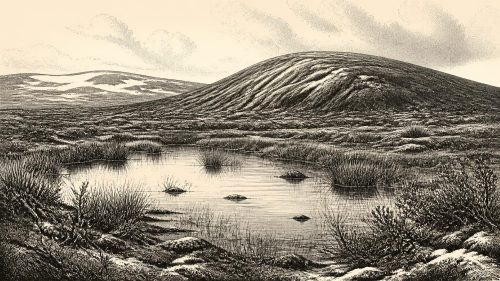
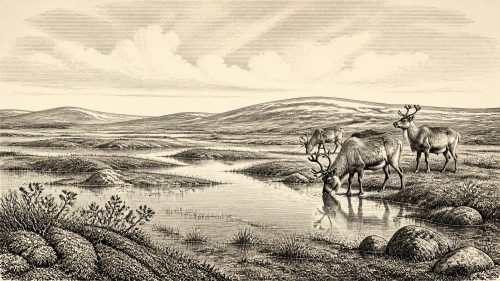
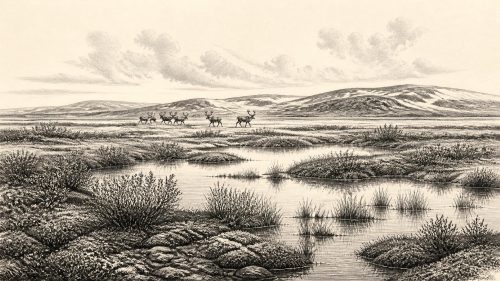
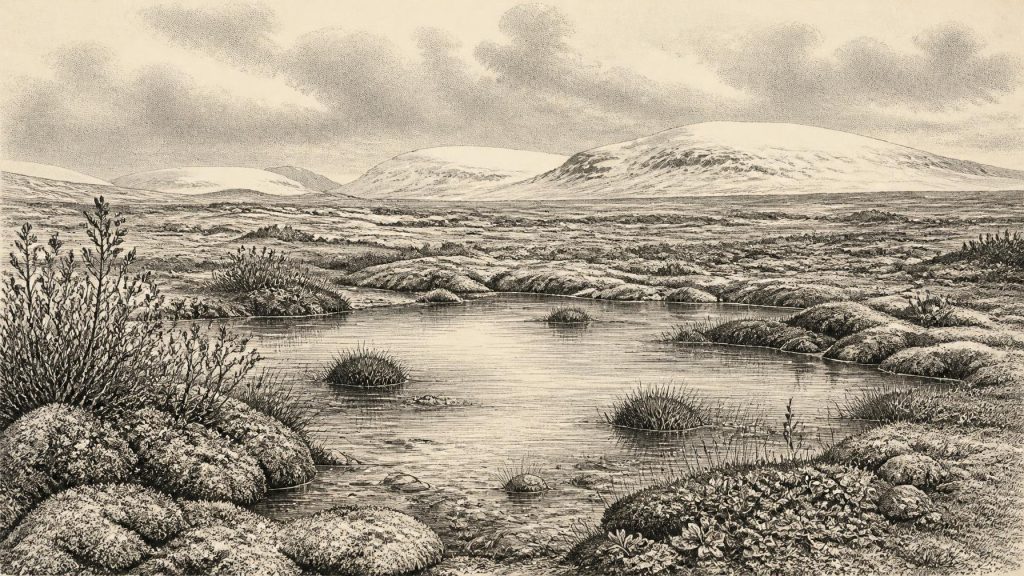
The plant and animal remains point to open tundra rather than forest. Poorly preserved herb pollen, moss macrofossils and aquatic or wet-ground plants indicate a landscape with sparse terrestrial cover and waterlogged hollows. Fossils reported from Derryvree include bogbean, dwarf willow, mountain avens and lesser clubmoss. These are not proof that every nearby slope carried the same plant community. They do, however, support an image of cold-tolerant vegetation exploiting sheltered, moist ground beside open pools, marshy margins and mineral-rich sediment. The insect evidence has been interpreted as consistent with a muskeg-like environment: plant-rich wet ground interspersed with pools.
Such a place would have been seasonally vivid rather than simply white and lifeless. During the growing season, low herbs, mosses and sedges could take advantage of long daylight, meltwater and exposed soil. Winter was another matter. Periglacial conditions imply repeated freezing and thawing, frozen ground, limited tree growth and a short biological season. The word tundra should not conceal local variety: water, snow cover, wind exposure, drainage and the shelter offered by landforms could create sharply different conditions within short distances.
Before the Greatest Advance
Ireland was moving towards, rather than already living through, the fullest expansion of the last British–Irish Ice Sheet. Modern reconstructions show that the ice sheet changed unevenly by region and that its margins were dynamic, responding to climate, sea level, topography and the behaviour of fast-flowing ice streams. Evidence offshore north-west Ireland indicates ice grounded at the Malin Shelf edge around 26,500–26,200 calibrated years before present, several millennia after the Derryvree freshwater interval. The later maximum transformed the island’s physical record: advancing ice eroded bedrock, shifted sediment and buried or destroyed many older surfaces.
That destructive history explains both the value and the limits of Derryvree. A surviving organic seam beneath glacial sediment is exceptional, not ordinary. Absence of camps, hearths or tools from much of Ireland cannot automatically be treated as evidence that nobody ever visited: later glaciation, changing shorelines and the simple scarcity of suitable preserved deposits have all thinned the record. Yet preservation problems cannot be used to manufacture a missing archaeology. At 30,247 BCE there is no securely documented Irish house, camp, stone-tool assemblage, burial, artwork or human skeleton from which to reconstruct a resident community.
Animals in a Changing Island
Cave deposits elsewhere on the island show that Ireland supported a striking cold-stage fauna at various times during Marine Isotope Stage 3. Castlepook Cave, also known as Mammoth Cave, near Doneraile in County Cork has produced remains attributed to woolly mammoth, reindeer, giant deer, brown bear, wolf, Arctic fox, mountain hare, lemmings and spotted hyaena. These finds reveal that suitable habitats and routes for large mammals existed during the wider period. They must not, however, be assembled into a single, perfectly contemporary scene. Cave deposits were accumulated over long periods, were disturbed by animals and excavation, and recent redating has shown that some earlier radiocarbon results from Castlepook were too young.
The safest conclusion is one of repeated ecological opportunity rather than a fixed Ice Age menagerie. Open vegetation could sustain grazing and browsing mammals; predators and scavengers followed prey; caves became traps, dens, shelters or repositories for bones. The fauna also underscores Ireland’s connections to the wider north-west European world. Animal populations did not recognise the later political geography of islands and states. Their movements depended on changing coastlines, ice-free corridors, water crossings and suitable food, not on anything resembling borders or diplomacy.
For people, the evidence is much thinner. A reindeer femur from Castlepook has been discussed as bearing a possible cut made by a sharp stone edge, and it has encouraged renewed interest in whether Upper Palaeolithic visitors reached Ireland. But it is a disputed and isolated clue from an old cave collection, not a securely excavated occupation floor. The strongest presently published evidence for a human presence in Ireland comes far later: cut-marked brown-bear bones from Alice and Gwendoline Cave, County Clare, dating to the terminal Pleistocene, around 12,800–12,600 calibrated years before present. That evidence cannot be projected back around twenty millennia to make 30,247 BCE an established year of settlement.
Society Beyond Recovery
Accordingly, there is no responsible account of Irish political affairs, conflict, diplomacy, religion, learning, trade or social hierarchy for this date. There are no named peoples, chiefs or languages. Nor does the evidence support farming, herding, pottery, metalworking, permanent villages, ceremonial monuments or exchange networks in Ireland. If human parties did enter the island during this broad period, they left no secure material record from which their numbers, origins, duration of stay or practices can be recovered.
It is reasonable, as a general comparison, to note that people elsewhere in Upper Palaeolithic Europe were hunter-gatherers using stone, bone and organic technologies, capable of considerable mobility and cultural expression. But that is continental context, not evidence of an Irish society. The distinction is crucial. Archaeology can infer a tundra wetland from Derryvree’s sediments and fossils; it cannot infer a local clan, hunting party or ritual from absence alone.
The Meaning of Derryvree
Derryvree changes the question from who ruled Ireland to what conditions made life possible there. Its freshwater silts show that the island’s last glacial history was not a simple sequence of total ice cover followed by thaw. During a long, unstable cold phase, ice-free or ice-marginal ground, open water and specialised plants persisted at least locally. That setting could support insects, wetland vegetation and, beyond the deposit itself, wider food webs involving the mammals represented in Irish caves.
The site also gives modern Ireland a deep environmental inheritance. The drumlin landscape of Fermanagh, familiar as rolling ground shaped by ice, contains within it evidence of an older landscape briefly spared from it. At this date, regional change mattered more than any recoverable human event: freshwater sediment accumulated, tundra plants flowered in a short season, animals moved through a shifting northern world, and ice later advanced over the scene. The archive is fragmentary, but its lesson is clear. Around 30,247 BCE, Ireland was not yet a historical society; it was a changing Ice Age landscape whose rare surviving deposits allow us to trace life at the edge of advancing ice.
Primary Sources
- A Middle Midlandian Freshwater Series at Derryvree, Maguiresbridge, County Fermanagh, Northern Ireland
- Palaeoecology: Irish Quaternary Association Field Guide No. 16
- The Irish Quaternary Fauna Project
- A Reconsideration of the Radiocarbon Dating of the Marine Isotope Stage 3 Fauna from Southern Ireland
- Episodic Speleothem Deposition Tracks the Terrestrial Impact of Millennial-Scale Last Glacial Climate Variability in SW Ireland
- Growth and Retreat of the Last British–Irish Ice Sheet, 31,000 to 15,000 Years Ago: the BRITICE-CHRONO Reconstruction
- Timing and Pace of Ice-Sheet Withdrawal Across the Marine–Terrestrial Transition West of Ireland During the Last Glaciation
- The IntCal20 Northern Hemisphere Radiocarbon Age Calibration Curve (0–55 cal kBP)
- First Evidence of a Late Upper Palaeolithic Human Presence in Ireland
- New Insights on the Fauna of Ireland’s Younger Dryas and Early Holocene from Alice & Gwendoline Cave
- Ireland: Submerged Prehistoric Sites and Landscapes
- The Antiquity of Man in Ireland
- BSBI: Menyanthes trifoliata
- BSBI: Salix herbacea
- BSBI: Dryas octopetala
- BSBI: Selaginella selaginoides
- Figure 6: The Subdivision of the Quaternary Period in Ireland
- Growth and Retreat of the Last British–Irish Ice Sheet, 31,000 to 15,000 Years Ago
- Archaeological Heritage of County Cork
- 2022:564 – Castlepook Cave, Castlepook South, Cork