Fermanagh’s Tundra Waterline30231 BCE
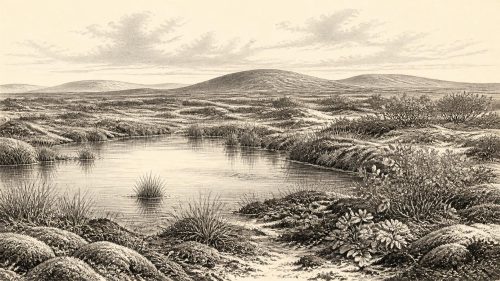
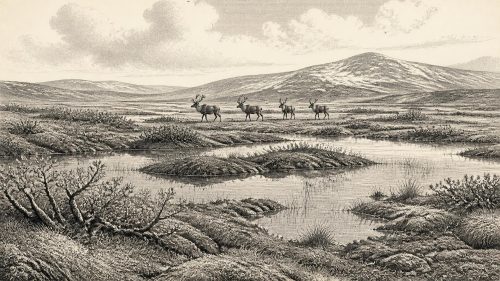
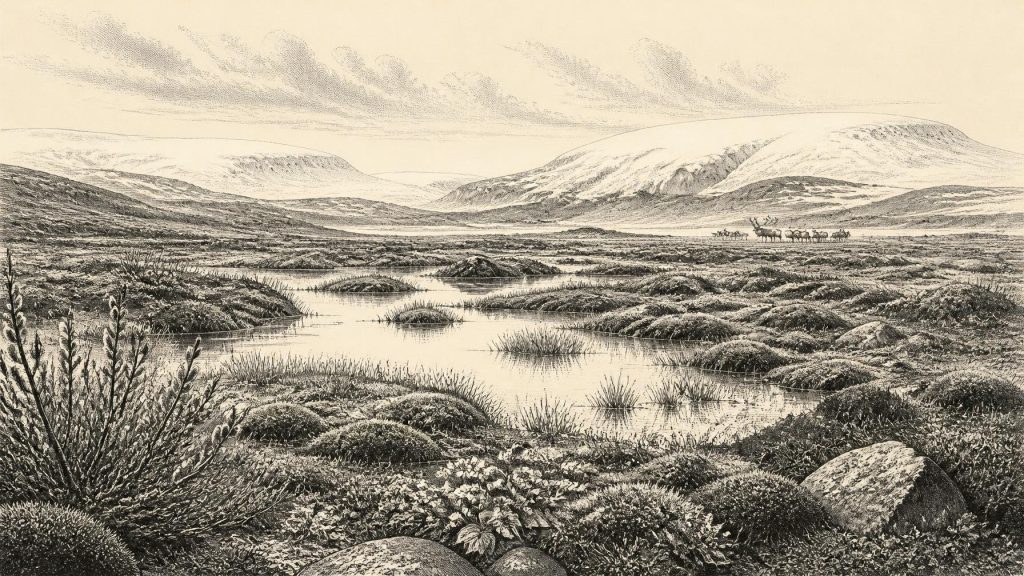
30,231 BCE cannot be treated as a Irish year, but lies within the later Pleistocene, Marine Isotope Stage 3. At Derryvree, County Fermanagh, sediments between glacial tills preserve evidence of a cold, treeless freshwater wetland, with mosses, sedges, insects and hardy plants, during an interval between ice advances. Ireland’s pre-Last Glacial Maximum environment was varied, not uniformly ice-covered, and altered coastlines offered uncertain animal routes. Cave remains indicate cold-adapted mammals, including reindeer and giant deer, reached Ireland. A possible cut-marked reindeer bone suggests human activity, but no secure settlement evidence exists. The period is understood through fragmentary records, not events.
Dateline
A Date Without a Dated Event
30,231 BCE is a modern chronological label, not a year that can be isolated in Ireland’s archaeological record. It falls roughly 32,180 calendar years before AD 1950, the conventional reference point for radiocarbon dating, in the later Pleistocene and broadly within Marine Isotope Stage 3. No Irish document, settlement layer, burial or individual artefact can be assigned to this particular calendar year. The responsible history of Ireland at this distance is therefore a history of deposits, bones, pollen, seeds, insects, cave sediments and ice-made landforms. These sources can illuminate conditions across long intervals; they cannot supply an annual chronicle.
The most important qualification is chronological. A conventional radiocarbon age is not identical to a calendar age, because atmospheric carbon-14 has varied through time. Dates must be calibrated, and their uncertainties widen greatly at this age. The famous organic horizon at Derryvree, near Maguiresbridge in County Fermanagh, produced the determination BIRM-166: about 30,500 radiocarbon years before present, with a large uncertainty. Modern calibration gives it a very broad possible range, approximately 36,900–31,700 calibrated years before present. Thus 30,231 BCE can be discussed in relation to the Derryvree environment, but it cannot be identified as the moment when a particular pool formed, a plant flowered or an animal crossed the landscape.
A Wetland Between Ice Advances
Derryvree is the clearest local environmental archive relevant to this horizon. Roadworks exposed a sequence within a County Fermanagh drumlin: glacial till below, freshwater silts, sands and organic deposits in the middle, and a further thick till above. Till is unsorted debris laid down directly by moving ice. The sequence establishes an order of events rather than a neat timetable. Ice had occupied the site; conditions later allowed freshwater, sediment and plant remains to gather in a basin; ice then returned and sealed the deposit. It is compelling proof of changing local conditions, not proof that the whole island was ice-free at once.
The middle deposits describe a cold but living landscape. Preserved plant macrofossils, pollen and insect remains indicate open ground and shallow or slow-moving freshwater. Mosses and sedges grew at wet margins. Bogbean, water-milfoil, lesser clubmoss, dwarf willow and mountain-avens are among the plants reported from the broader assemblage. Such species are consistent with a treeless, severe setting with a short growing season, not with dense temperate forest. The older word tundra, and comparisons with muskeg or wet heath, are useful shorthand only: Derryvree was a particular ancient wetland, not an exact copy of any modern Arctic habitat.
This was a dynamic periglacial world. Freezing and thawing disturbed soils; water carried fine material into hollows; organic matter accumulated where plants and mosses could establish themselves. Pools, sedge margins and low vegetation would have created ecological patches within a generally exposed country. Insects are especially informative because their distributions respond closely to moisture, ground cover and seasonal temperatures. Yet the evidence remains local. It allows historians to infer harsh winters, cool summers and sparse woody cover in and around one Fermanagh basin during an interlude between ice incursions. It does not yield a nationwide thermometer reading or a fixed shoreline for 30,231 BCE.
The Island in an Unsettled Ice Age
Ireland stood on the approach to the Last Glacial Maximum rather than at its peak. Modern reconstructions place the main maximum extent of the British–Irish Ice Sheet later, broadly between about 27,000 and 21,000 years ago, although the ice sheet’s earlier growth and repeated advances during the last cold stage remain subjects of active research. Evidence from land, offshore sediments and raised-shore records suggests that ice behaviour before the maximum was complex. Some areas may have been ice-covered while others, or the same places at other times, remained exposed or supported freshwater basins. It is misleading to imagine either a wholly white island or a uniformly open one.
At lower global sea levels, the geography of north-west Europe differed markedly from today’s. Ireland’s present coast was not its Pleistocene coast, and the Irish Sea basin was shallower and more extensive in places. But low sea level did not automatically create a simple, permanent land bridge to Britain. Ice margins, glacial lakes, shifting coastlines and changing sea routes all mattered. For animals—and potentially for people—the relevant question is not merely whether dry land existed somewhere, but whether a traversable route, tolerable habitat and connected food resources coincided. Current evidence cannot reconstruct such a route for a single year in the thirty-first millennium BCE.
Animals, Caves and Caution
Irish caves, particularly in the south and south-east, preserve a second vital body of evidence. Their faunal collections include remains attributed to reindeer, woolly mammoth, giant deer, brown bear, wolf and spotted hyaena. These names should not be converted into a single imagined herd moving together across all Ireland. Cave assemblages can accumulate over thousands of years. Carnivores drag in bones, water rearranges sediments, animals die naturally, and many nineteenth- and early twentieth-century excavations did not record layers to modern standards. Taphonomy—the study of what happens to remains after death—is therefore fundamental.
Direct re-dating and re-identification have nevertheless strengthened the case that northern, cold-adapted mammals reached Ireland before the Last Glacial Maximum. Work on south-eastern cave material has shown that several bones once classed as red deer were in fact reindeer, while securely dated large-deer remains demonstrate that cervids were present in Ireland during parts of the pre-maximum cold stage. The safest conclusion is modest but important: patches of Irish landscape could support, or be reached by, sizeable grazing mammals during Marine Isotope Stage 3. Their presence also implies connected ecological corridors at certain times, whether across exposed terrain, coastal routes or short water crossings. It does not demonstrate continuous island-wide populations.
The Human Question
The possibility of people in Ireland at this broad date is more tantalising than secure. A reindeer femur from Castlepook Cave near Doneraile, County Cork, has been reported as bearing a deep mark made by a sharp stone tool while a carcass was being processed. Its age has been presented in heritage publications as around 33,000 years ago. If that interpretation and association are sustained, the bone would be evidence for a brief Upper Palaeolithic human episode in Ireland: not necessarily a hunt at the cave, but human handling of a reindeer somewhere in the animal’s history.
That possibility must not be inflated into a settled society. Castlepook is an old cave collection with complicated depositional and excavation histories. There is no securely associated stone-tool assemblage, hearth, house floor, burial, human skeleton, painted cave wall or stratified camp of this age known from Ireland. Nor do we know whether one person, a small travelling party or repeated visits produced the mark. Carnivores may have carried discarded bone into the cave after human processing elsewhere. The femur is therefore a significant lead, not a licence to invent a resident community, tribal name or migration narrative.
What Cannot Be Written
There were no political affairs, diplomacy or warfare that can responsibly be narrated for Ireland around this date. Archaeology has recovered no evidence for chiefs, territories, alliances, law, formal religion, language or learning. There is likewise no basis for describing farms, fields, domesticated animals, pottery, permanent villages, trade networks or sea-going commerce. A wetland rich in plants was not an agricultural economy; a cave bone was not necessarily food refuse; and a plausible route from Britain or the continent was not an established trading corridor.
Culture is visible only in the most conditional sense. If the Castlepook incision proves to be a butchery mark, it belongs to a wider north-west European world in which Upper Palaeolithic people used stone edges to process animal bodies and moved through landscapes shaped by cold, seasonality and mobile prey. But no Irish lithic tradition has yet been recovered from this horizon. The sophisticated art, ornaments and burial practices known elsewhere in Europe cannot simply be projected westward across the sea. Ireland’s evidence must be allowed to remain sparse.
A Landscape Before Recorded Ireland
The enduring significance of the period lies in environmental survival and instability. Derryvree shows that, between episodes of glaciation, freshwater and hardy vegetation could persist in Fermanagh. Cave faunas show that large mammals reached Ireland during the wider cold-stage interval. The possible Castlepook cut mark raises, but does not settle, the question of human presence. Together these traces replace the old image of an empty, undifferentiated ice-bound island with a more intricate one: an island or near-island of advancing ice, exposed ground, wet hollows, grazing animals and perhaps occasional people.
For 30,231 BCE, then, the most truthful annual overview is deliberately restrained. Modern calendar precision is unavailable. The evidence supports a long, changing Pleistocene landscape rather than an event. Its protagonists are not named rulers but ice, water, sedges, beetles, reindeer bone and the painstaking methods that permit a damaged fragment of ancient Ireland to speak at all.
Primary Sources
- A Middle Midlandian Freshwater Series at Derryvree, Maguiresbridge, County Fermanagh, Northern Ireland
- References and Recommended Reading: Irish Quaternary Association Field Guide
- Regional Pleistocene Geology
- The Irish Quaternary Fauna Project
- A reconsideration of the radiocarbon dating of the Marine Isotope Stage 3 fauna from southern Ireland
- Phylogeographic, ancient DNA, fossil and morphometric analyses reveal ancient and modern introductions of a large mammal: the complex case of red deer (Cervus elaphus) in Ireland
- First evidence of a Late Upper Palaeolithic human presence in Ireland
- New insights on the fauna of Ireland's Younger Dryas and Early Holocene from Alice & Gwendoline Cave
- Extent and timing of the Last Glacial Maximum (LGM) in Britain and Ireland: a review
- The timing and magnitude of the British–Irish Ice Sheet between Marine Isotope Stages 5d and 2
- Growth and retreat of the last British–Irish Ice Sheet, 31,000 to 15,000 years ago: the BRITICE-CHRONO reconstruction
- BRITICE-CHRONO Maps and GIS Data of the Last British-Irish Ice Sheet 31 to 15 ka
- Last Glacial Maximum cirque glaciation in Ireland and implications for reconstructions of the Irish Ice Sheet
- Deglaciation chronology of the Donegal Ice Centre, north-west Ireland
- Late Pleistocene chronostratigraphy and ice sheet limits, southern Ireland
- Trimlines, blockfields and the vertical extent of the last ice sheet in southern Ireland
- Reconstructing the last Irish Ice Sheet 2: a geomorphologically-driven model of ice sheet growth, retreat and dynamics
- The IntCal20 Northern Hemisphere Radiocarbon Age Calibration Curve (0–55 cal kBP)
- Quaternary: Geological Survey Ireland
- Physiographic Units Map of Ireland
- Heritage Artefacts of County Cork
- Castlepook Cave, Co. Cork: Excavation Report 2022
- Advances in Irish Quaternary Studies