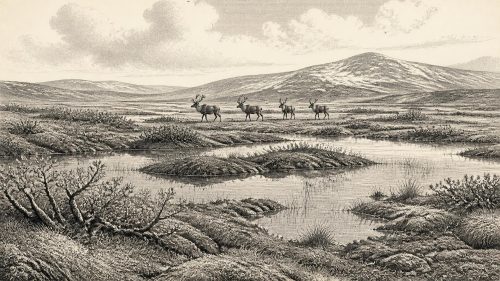
Tundra Pools of Fermanagh30205 BCE
About 30,205 BCE, Ireland lay within the fluctuating cold conditions of Marine Isotope Stage 3, not a precisely datable historical year. At Derryvree, County Fermanagh, freshwater silts between glacial tills preserve an ice-free interval, broadly in the early thirty thousands of years before present. Pollen, plants and insects reveal treeless tundra wetlands of sedges, mosses, herbs and pools amid severe periglacial conditions. Castlepook Cave fauna indicates cold, open habitats and continental connections. A possibly cut-marked reindeer bone suggests, but cannot prove, human visitation. No secure evidence establishes settlement, society or continuous occupation; environmental archives provide the principal record for Ireland.
Dateline
The label 30,205 BCE gives a useful point of reference, but it cannot denote an event in the modern historical sense. No written calendar, settlement sequence or annually resolved archive lets us identify a particular season, person or occurrence in Ireland at this depth of time. In radiocarbon convention, this nominal date is roughly 32,154 calendar years before AD 1950. The responsible approach is therefore to place it within wider calibrated ranges and to describe the Late Pleistocene evidence nearest to it, rather than inventing a year of Irish prehistory.
A Date Within Deep Time
At this horizon Ireland lay in Marine Isotope Stage 3, a fluctuating cold phase of the last Ice Age, often termed the Middle Midlandian in Irish Quaternary studies. It was not yet the fullest extent of the Last Glacial Maximum, when ice covered much or all of the island between roughly 26,000 and 19,000 calendar years ago. But neither was it a stable, benign interval. Ice masses, temperatures, coastlines and habitats were changing on timescales far longer than a human lifetime yet sometimes rapidly enough to transform a region over centuries.
The closest major Irish environmental archive is at Derryvree, near Maguiresbridge in County Fermanagh. Roadworks in 1969 cut through a drumlin and exposed freshwater silts and fine sands sealed between two thick till sheets. Till is debris deposited directly by glacier ice. The sequence therefore records an earlier glaciation, then an interval in which water, plants and small animals occupied the locality, followed by a later ice advance that buried the deposit. It is among the rarest and most informative windows onto Ireland’s pre-Last-Glacial-Maximum environment.
Organic material from the Derryvree freshwater beds yielded a conventional radiocarbon age of 30,500 years BP, with a substantial quoted uncertainty of +1,170/−1,030 years. Such a result is not a calendar date. Atmospheric carbon-14 varied through time, so laboratory ages must be calibrated against independently dated records. Modern calibration and Bayesian ice-sheet modelling place the relevant ice-free phase broadly around the early thirties of thousands of calendar years before present, with uncertainty extending over millennia. The nominal year 30,205 BCE can reasonably be discussed within that broad environmental window, but not assigned to a particular layer, plant or day at Derryvree.
Fresh Water Between the Ice
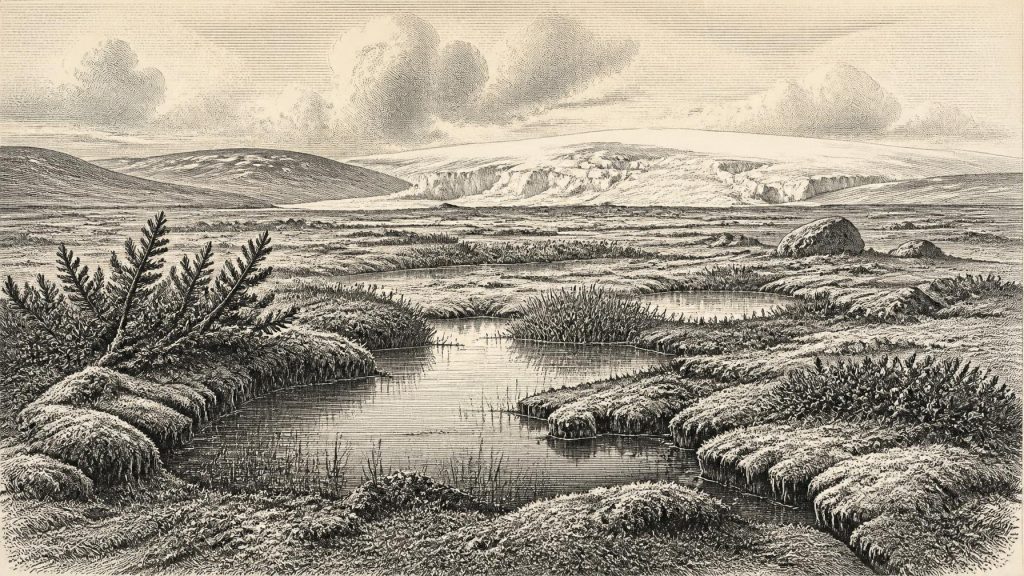
The Derryvree silts do not show a forested Ireland. Their plant macrofossils, pollen and insect remains indicate open, treeless tundra or muskeg: wet ground combining sedges, mosses, herbs and shallow pools, in a harsh periglacial climate. Grasses and sedges were prominent, while juniper and cold-adapted flowering plants occurred among the low vegetation. Mosses grew around waterlogged margins. Water-milfoil and bogbean indicate standing or slow-moving freshwater. The result is an unexpectedly detailed local picture: not a blank white wilderness, but a mosaic of damp hollows, open water, mossy banks and exposed ground.
That landscape should not be mistaken for a pleasant wetland. A periglacial regime brought severe winters, frost disturbance and short growing seasons. The ground could freeze deeply; snow, meltwater and seasonal flooding would have affected where plants rooted and where animals could move. In summer, long daylight might briefly support vigorous plant growth and insects around pools. In winter, biological productivity would have contracted sharply. Derryvree’s value lies precisely in showing that cold-stage Ireland could contain living freshwater habitats even while ice was an overwhelming force in the wider landscape.
Yet the evidence is local. It does not prove that every part of Ireland was ice-free at once, or that a Derryvree pool had equivalents in Cork, the western seaboard or the mountains. Recent reconstructions of the British–Irish Ice Sheet stress that advance and retreat differed from sector to sector. Around this period, ice growth was under way in the wider region, but its exact Irish limits remain debated. Fermanagh’s buried wetland demonstrates an ice-free episode at that site; it does not supply a complete map of the island.
Animals in an Open Country
Caves provide a second, different archive. At Castlepook Cave, near Doneraile in north County Cork, antiquarian excavations recovered a striking assemblage of Ice Age animal remains. Woolly mammoth, reindeer, spotted hyaena, giant deer, brown bear, wolf, Arctic fox, mountain hare and lemmings are among the animals reported from the cave complex and associated collections. Revised radiocarbon work has also shown why caution is essential: old measurements and uncertain excavation contexts can require reassessment as methods improve.
These animals point towards open habitats and ecological connections with north-western Europe. Reindeer and lemmings are especially evocative of cold grassland and tundra conditions; mammoth and giant deer imply extensive feeding grounds in at least some periods; hyaena and wolf reveal a predator and scavenger guild more varied than anything in modern Ireland. But the cave collection is not a photograph of one ancient day. Bones may have accumulated at different times, been dragged in by carnivores, moved by water or recovered without the stratigraphic controls expected of modern excavation. It would be wrong to picture every listed species drinking together beside a Fermanagh pool in 30,205 BCE.
What can safely be said is that parts of Ireland supported, or were accessible to, cold-stage mammals during suitable intervals. Their presence is evidence of animal dispersal and changing habitats, not evidence of a settled human landscape. The later advance of ice would erode, redistribute or conceal many deposits, helping to explain why the Irish record is so fragmentary compared with that of some continental regions.
The Human Question
No securely excavated settlement, hearth, stone-tool assemblage, burial or dwelling of this age has been published from Ireland. Accordingly, there is no basis for naming a people, assigning a language, describing clans or reconstructing political authority. There were no known Irish kingdoms, boundaries, diplomacy or warfare. Nor is there evidence from this horizon for ritual monuments, formal religion, art, teaching traditions, trade networks or a resident economy.
One object nevertheless makes human absence less certain than it once seemed. A reindeer femur from Castlepook has been reported as bearing a deep incision interpreted by palaeozoologist Ruth Carden as a mark made with a sharp stone implement during fresh-bone butchery. Public discussion has associated the bone with an age of roughly 33,000 radiocarbon years before present. If the modification is confirmed as human-made and is contemporaneous with the animal’s death, it could indicate a remarkably early episode of human carcass processing in Ireland during the Upper Palaeolithic.
That conditional wording matters. The object comes from an old cave collection rather than a securely excavated camp floor. A radiocarbon measurement dates the animal bone, not automatically the instant at which a surface mark was made. Even a genuine cut mark would not reveal who made it, whether the reindeer was hunted or found dead, how many people were present, how long they remained, or whether they returned. It certainly cannot demonstrate continuous occupation. The femur is best understood as important proposed evidence for a human visit, not proof of an established Irish population at this date.
If people did reach Ireland during one of these intervals, their everyday concerns would have been immediate and practical: shelter from wind and cold, fuel, workable stone, food, safe routes across difficult terrain and knowledge of mobile animal resources. Such inferences describe the demands of Ice Age survival, not observed Irish social practices. Comparable Upper Palaeolithic communities elsewhere in Europe made sophisticated tools, ornaments and art, but those achievements cannot responsibly be transferred to Ireland without Irish evidence.
Coasts, Movement and Isolation
Sea level was far lower than today because vast quantities of water were held in global ice sheets. Ireland’s coast therefore had a different outline, and areas now beneath the Irish Sea were dry land, shallow water or occupied by ice at different moments. This altered geography may have affected animal and possible human movement, but it did not create a simple, permanent land bridge from Ireland to continental Europe. Ice margins, channels, marshy lowlands and changing sea conditions made routes variable and hazardous.
There is no direct evidence for trade at this date: no imported tools, exchange goods, boats or identifiable quarrying network. “Economy” is meaningful only at the ecological level. Plants converted a short growing season into forage; herbivores moved through the open country; predators and scavengers followed them; freshwater pools sustained specialised small life. Any human visitors would have depended on this unstable food web rather than on farming, herding or stored surplus.
What the Evidence Allows
The most important development around 30,205 BCE was environmental rather than political: Ireland was part of a dynamic Ice Age world in which ice, water, tundra vegetation and animal ranges repeatedly rearranged the possibilities for life. Derryvree preserves a rare interval when a Fermanagh wetland flourished between glacial advances. Castlepook preserves evidence for a richer cold-stage fauna in Cork and a provocative, still limited clue to possible human action.
These records also define the limits of historical imagination. Ireland at this point had no recoverable rulers, institutions or communities in the usual sense. Its history is instead written in till, silt, pollen, seeds, insects and bone. The buried pools of Fermanagh show that even amid the long approach to maximum glaciation, small habitats endured. They are not the remains of a lost civilisation, but they are a durable witness to an Irish landscape poised between intervals of ice.
Primary Sources
- Middle Midlandian Freshwater Series at Derryvree, Maguiresbridge, County Fermanagh, Northern Ireland
- Middle Midlandian Freshwater Series at Derryvree, Maguiresbridge, County Fermanagh, Northern Ireland
- Exploring controls of the early and stepped deglaciation on the western margin of the British-Irish Ice Sheet
- Growth and retreat of the last British–Irish Ice Sheet, 31,000 to 15,000 years ago: the BRITICE-CHRONO reconstruction
- Growth and retreat of the last British–Irish Ice Sheet, 31,000 to 15,000 years ago: the BRITICE-CHRONO reconstruction
- Pleistocene glaciations in Ireland
- Dimensions and chronology of the last ice sheet in western Ireland
- Trimlines, blockfields and the vertical extent of the last ice sheet in southern Ireland
- Timing and pace of ice-sheet withdrawal across the marine–terrestrial transition west of Ireland during the last glaciation
- Deglaciation chronology of the Donegal Ice Centre, north-west Ireland
- The timing and magnitude of the British–Irish Ice Sheet between Marine Isotope Stages 5d and 2
- A reconsideration of the radiocarbon dating of the Marine Isotope Stage 3 fauna from southern Ireland
- The Irish Quaternary Fauna Project
- Irish Pleistocene biostratigraphy
- Figure 6.— The subdivision of the Quaternary Period in Ireland
- Quaternary Geoheritage Activities: Themes
- Introduction to the Late Quaternary and Holocene of Northern Ireland
- The IntCal20 Northern Hemisphere Radiocarbon Age Calibration Curve (0–55 cal kBP)
- New insights on the fauna of Ireland’s Younger Dryas and Early Holocene from Alice & Gwendoline Cave
- Heritage Artefacts of County Cork 2021
- The Mesolithic in Ireland: when was it?
- Ireland Under The Ice
- Stratigraphic and palaeo-geomorphological evidence for the glacial-deglacial history of the last British-Irish Ice Sheet in the north-western Irish Sea
- Anthropogenic changes to the Holocene nitrogen cycle in Ireland