National Museum Reindeer Femur30150 BCE
30,150 BCE denotes an approximate late-Marine Isotope Stage 3 horizon, rather than a recoverable Irish year. Ireland experienced unstable cold conditions before maximum British-Irish ice expansion, with local ice-free intervals indicated by Crag Cave speleothems. Castlepook Cave, County Cork, preserves a fauna including reindeer, mammoth, giant deer, predators and tundra species, demonstrating open habitats. A National Museum reindeer femur, possibly cut by a stone tool and dated around 31,000–33,000 BCE, may indicate Ireland’s human activity. However, disturbed context and explanations preclude proof of settlement. Glaciation and later landscape change destroyed evidence, leaving caves as archives of change and hunter presence.
Dateline
30,150 BCE is a modern chronological label, not a year that can be recovered from Ireland’s archaeological record. No Irish calendar, written testimony, annual settlement sequence or event can be assigned to it. In scientific terms, the point lies roughly 32,100 years before present (where “present” conventionally means 1950), late in Marine Isotope Stage 3, the fluctuating cold interval before the Last Glacial Maximum. The responsible history of Ireland at this depth of time is therefore one of dated ranges, cave deposits, animal remains, ice records and qualified inferences—not kings, peoples or episodes fixed to a particular year.
A Brief Window Before Maximum Ice
The wider environmental setting is clearer than any human story. Ireland lay on the north-western fringe of Europe, where climate repeatedly shifted between severe stadials and relatively milder interstadials on millennial rather than historical timescales. The Last Glacial Maximum, when the British–Irish Ice Sheet covered most of Ireland, came later: ice-sheet reconstructions address its growth and retreat principally across about 31,000–15,000 years ago, with maximum extent around 26,000 years ago. Around 30,150 BCE, therefore, Ireland was approaching a major glacial expansion rather than simply existing beneath one uniform, permanent ice cover.
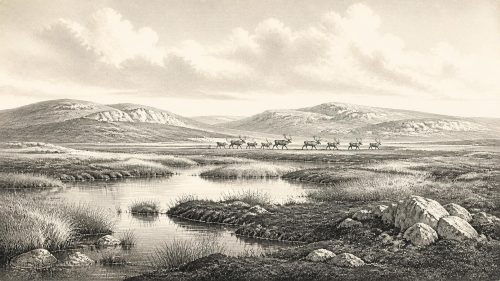
This distinction matters. The island’s landscape cannot safely be painted as either wholly frozen or hospitably wooded. Local conditions varied sharply with altitude, exposure, season and the changing margins of ice. South-west Ireland provides an important, if indirect, clue. Uranium-thorium dating of broken speleothems from Crag Cave, County Kerry, records episodic calcite growth during the last glacial cycle. Because flowing water and unfrozen ground conditions are needed for such dripstone growth in this shallow cave system, these deposits demonstrate intervals when at least parts of south-western Ireland were not locked beneath continuous permafrost or ice. The record is best read as evidence for climatic instability and local environmental opportunity, not as a weather report for one year or for the entire island.
That same caution applies to dates. Scientific papers may give ages in calibrated thousands of years before present, such as 31–29 ka, or in radiocarbon years, which are not identical to calendar years. A calendar translation into BCE is necessarily approximate. The date in this article should consequently be understood as a point within a broad late-Pleistocene horizon, perhaps centuries or millennia wide in the resolution of the available evidence.
Open Country in North Cork
The richest Irish evidence relevant to this horizon comes from Castlepook Cave, also known historically as Mammoth Cave, near Doneraile in north County Cork. Its limestone passages overlook the Awbeg valley below the Ballyhoura Hills. Excavations, especially those conducted by the naturalist Richard Ussher and his collaborators in the early twentieth century, recovered a remarkable but difficult collection of Pleistocene animal remains. Later study and radiocarbon dating have shown that the assemblage accumulated over a very long period; it must not be treated as a single living community or one neatly dated occupation.
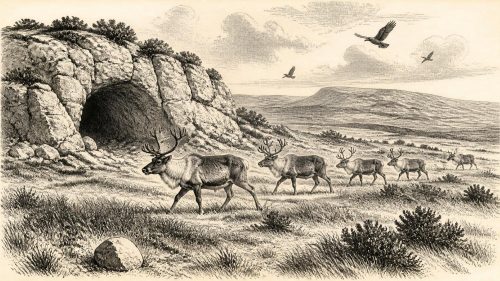
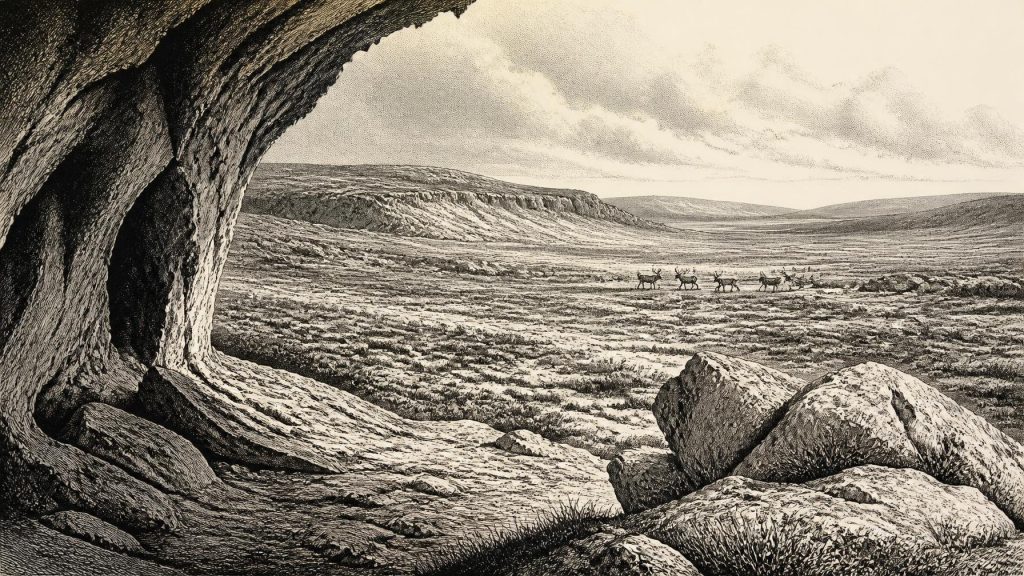
Nevertheless, Castlepook establishes that Ireland was intermittently accessible to a distinctive Ice Age fauna before the later maximum of the ice sheet. The collection includes reindeer, woolly mammoth, giant deer, brown bear, wolf, Arctic fox, mountain hare, lemmings and spotted hyaena. Not all species necessarily overlapped in time or used the cave in the same way. Some animals may have died nearby; carnivores could have dragged carcass parts inside; flowing water, collapse and early excavation could move material between contexts. Yet the broad ecological signal is firm: at different points during the middle and later part of the last glaciation, open, cold landscapes existed in or near southern Ireland and supported large grazers, smaller tundra mammals and formidable predators.
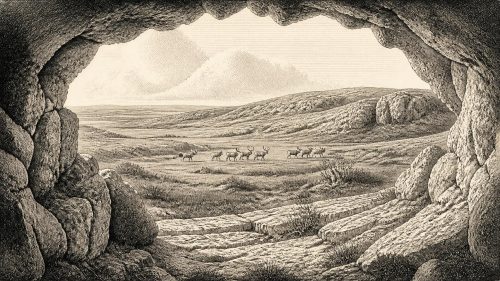
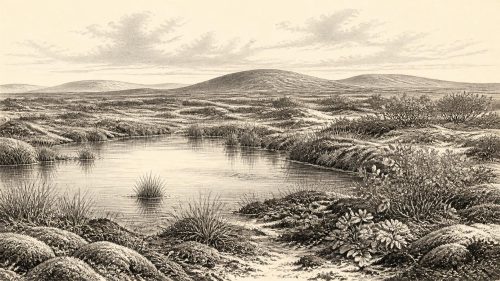
For a scene around 30,150 BCE, the most defensible reconstruction is therefore not a forested island but a patchwork of sparse grassland, herb-rich open ground, exposed soils, frost-shattered rock, wet hollows and perhaps sheltered scrub in favourable places. Reindeer and horse would have found forage in this kind of country; mammoth and giant deer belong to the larger faunal picture, though it would be unsafe to put every recorded Castlepook species beside one another on the same day. Hyaenas and wolves indicate predator and scavenger networks, while lemmings and Arctic fox point to conditions considerably colder and more open than modern Ireland.
The Reindeer Femur Question
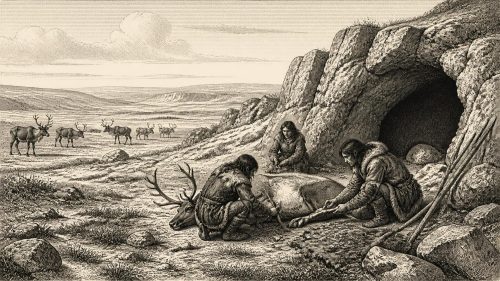
One object gives this date unusual importance in Irish prehistory: a reindeer femur from Castlepook, held in the National Museum of Ireland’s natural-history collections. County Cork heritage publications and public reporting have associated it with roughly 31,000–33,000 BCE and identify a deep linear mark which zooarchaeologist Ruth Carden has interpreted as damage from a sharp stone tool during carcass processing. If that reading is upheld through continuing specialist study, it represents potentially the earliest evidence for people in Ireland—far earlier than the long-established terminal-Pleistocene evidence from County Clare.
The implications are striking but limited. A marked reindeer bone could indicate that one or more people used a lithic edge to remove meat, hide, sinew or marrow, perhaps after a hunt or after finding a carcass. It does not demonstrate where the animal was killed, whether butchery occurred at the cave, how many people were present, how long they stayed, or whether they had a home territory in Ireland. Nor does it prove a permanent population, a named ethnic group, a language, a religion or descent from later inhabitants. A radiocarbon date measures the age of the animal bone; it does not automatically date the surface modification or establish the identity of its maker.
Context is equally important. The femur derives from an older cave collection rather than a modernly excavated occupation floor containing securely associated tools, hearths and food debris. No published Upper Palaeolithic house, hearth, burial, human bone, art assemblage or stratified lithic workshop of this age is known from Ireland. Carnivore teeth, trampling, sediment abrasion, excavation damage and other natural processes must always be considered when marks on ancient bone are assessed. The responsible conclusion is that Castlepook offers a serious and potentially transformative indication of human activity around this broad period, but not yet proof of a settled Irish society.
Life, Movement and Material Culture
There is consequently no evidence from which to reconstruct political affairs, diplomacy or organised warfare in Ireland at this date. There are no known territorial boundaries, leaders, monuments, fortifications or exchange networks. Nor is there evidence for farming, herding, pottery, metalwork, weaving, writing or permanent villages. Those absences are not merely gaps awaiting colourful speculation: they define what can responsibly be said.
If people did reach Ireland during a milder opening within this cold period, they would have been highly mobile hunter-gatherers, dependent on intimate knowledge of animal movements, edible plants, weather and shelter. That is an inference from the possible butchery evidence and from the wider Upper Palaeolithic world of north-west Europe, rather than a directly excavated Irish camp. Sharp stone tools, fire, clothing and transportable equipment would be plausible expectations for such people, but none has yet been securely recovered from Ireland in association with the Castlepook femur. Their connection with Britain or continental Europe is also unresolved. Lower sea levels altered coastlines and exposed shelves, but the precise routes, water crossings, ice barriers and dry-ground connections available at any particular time remain subjects of palaeogeographical debate.
Culture and learning are almost invisible archaeologically here. There is no Irish evidence at this date for figurative art, decorated objects, ritual architecture or burial practice. It would be mistaken, however, to infer an absence of culture. Mobile foragers elsewhere in Upper Palaeolithic Europe possessed sophisticated technical knowledge, social ties, story traditions and ways of teaching that normally leave little trace. In Ireland, the evidence is too slight to assign particular beliefs or cultural affiliations. The cave is more securely a record of animals, sediments and changing climates than a record of ceremonies.
Caves, Ice and an Interrupted Record
The environmental history after this horizon helps explain the archaeological silence. The growing British–Irish Ice Sheet eventually transformed much of the island, eroding landscapes and burying others beneath glacial sediment. Later deglaciation, rising seas, soil formation and human land use further altered or destroyed ancient surfaces. Caves such as Castlepook and Crag Cave are exceptional because they can preserve protected pockets of bone, sediment and mineral growth across otherwise destructive cycles. Even there, their records are incomplete and often disturbed.
At 30,150 BCE, then, Ireland was not the settled island of later prehistory. It was a climatically unstable north-western landscape whose open habitats intermittently sustained Ice Age animals. Castlepook gives a tangible regional archive of that world; Crag Cave shows that glacial conditions could relax enough for underground waters to resume depositing calcite. The cut-marked reindeer femur may add a fleeting human encounter: perhaps a carcass processed by mobile hunters and later carried or scavenged into a cave. That possibility is historically important precisely because it remains small. The evidence illuminates an Ice Age threshold, not a calendar-year event, and the strongest story is still one of changing environments and carefully measured uncertainty.
Primary Sources
- A reconsideration of the radiocarbon dating of the Marine Isotope Stage 3 fauna from southern Ireland
- The Irish Quaternary Fauna Project
- First evidence of a Late Upper Palaeolithic human presence in Ireland
- New insights on the fauna of Ireland's Younger Dryas and Early Holocene from Alice & Gwendoline Cave
- Episodic speleothem deposition tracks the terrestrial impact of millennial-scale last glacial climate variability in SW Ireland
- Spatio-temporal dynamics of speleothem growth and glaciation in the British Isles
- Growth and retreat of the last British–Irish Ice Sheet, 31,000 to 15,000 years ago: the BRITICE-CHRONO reconstruction
- Extent and timing of the Last Glacial Maximum (LGM) in Britain and Ireland: a review
- Pattern and timing of retreat of the last British-Irish Ice Sheet
- Radiocarbon constraints on the age of the maximum advance of the British-Irish Ice Sheet in the Celtic Sea
- The Island of Ireland: Drowning the Myth of an Irish Land-Bridge?
- The problem of a late quaternary landbridge between Britain and Ireland
- Castlepook Caves
- Archaeological Heritage of County Cork
- Heritage Artefacts of County Cork
- Geology of Ireland
- Quaternary Geology of Ireland
- Ireland Through Geological Time
- Radiocarbon Dates from the Oxford AMS System: Archaeometry Datelist 31
- The IntCal20 Northern Hemisphere Radiocarbon Age Calibration Curve (0–55 cal kBP)
- A stratigraphic framework for abrupt climatic changes during the Last Glacial period based on three synchronized Greenland ice-core records
- A new Greenland ice core chronology for the last glacial termination