Newman, Donnelly and the Count1851 CE
In 1851, Ireland’s census recorded 6,552,385 inhabitants, a decline of 1,659,330 since 1841, exposing famine mortality, disease, eviction and emigration while imperfectly distinguishing deaths from departures. Losses were greatest in western and southern potato-dependent districts, accelerating the disappearance of poor cabins and weakening Irish-speaking communities. Emigration remained immense, reshaping families and local economies. Estate sales under the Encumbered Estates Act, limited tenant-improvement legislation and Tenant Right agitation intensified land questions. The Medical Charities Act expanded dispensary provision. John Henry Newman’s appointment advanced plans for a Catholic university. Meanwhile, Ulster linen exhibitors at the Great Exhibition displayed industrial strength amid devastation.
Dateline
In 1851 Ireland was being counted while it was still being remade by catastrophe. The census taken on 30 March did more than record households: it exposed the scale of a social rupture produced by famine, epidemic disease, eviction and emigration. Its published total, 6,552,385 people, was 1,659,330 below that of 1841. This was not simply a decade of demographic decline. Much of the loss had occurred in only a few terrible years after the potato failure of 1845. Yet 1851 was not merely an aftermath. New laws, continuing departures, arguments about land, a reorganisation of medical relief, religious controversy and efforts at industrial display all showed Ireland moving into a distinctly post-Famine order.
A Census Amid Absence
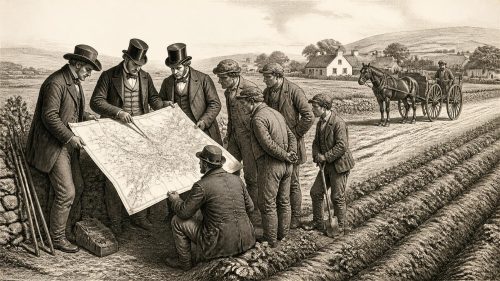
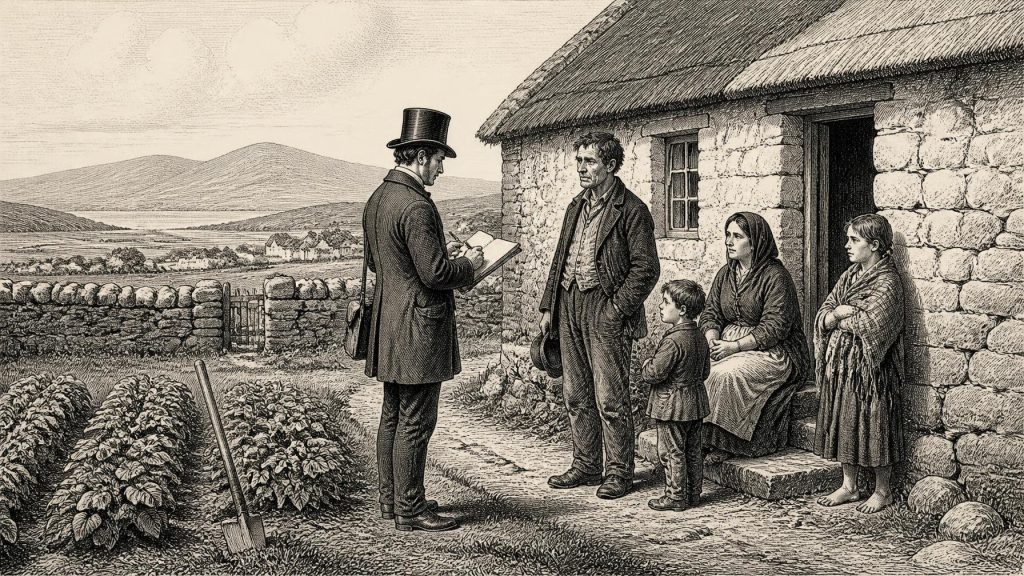
The census night of Sunday, 30 March 1851 supplied the year’s clearest fixed point. William Donnelly, the Registrar-General of Marriages, directed the census operation, while the surgeon and antiquary William Wilde played a prominent role in its intellectual and statistical work. Enumerators and householders recorded the people who remained in each dwelling, their ages, occupations, literacy and other characteristics. The census also gathered information on houses, schools, agriculture, disease and disability. Its ambition reflected the expanding Victorian belief that social problems could be made legible through numbers.
But the numbers were unusually haunted by those who could no longer answer. The headline total represented a fall of just over one fifth since 1841, reducing Ireland below its population of 1821. It did not, by itself, distinguish precisely between those who had died and those who had left. Later census investigations attempted to reconstruct deaths since 1841 by asking surviving families about relatives lost during the intervening decade. These returns remain indispensable evidence, but they must be treated with care: Ireland had no comprehensive civil registration of deaths in 1851, memories were imperfect, and entire households had vanished. The census was therefore both an extraordinary attempt to measure disaster and an incomplete record of it.
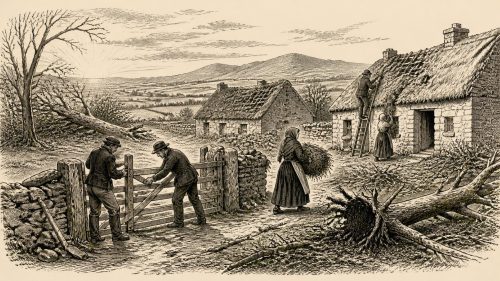
The decline was profoundly uneven. Western and southern districts, where smallholders and labourers had depended most heavily on the potato and where poor housing had been widespread before the blight, suffered especially severe losses. The earlier census classification of fourth-class houses – single-room, mud-walled cabins – had already mapped acute vulnerability. By 1851 many such cabins had disappeared, sometimes because their inhabitants had died or emigrated, sometimes because holdings had been cleared and dwellings levelled. A reduction in the number of the poorest homes was not necessarily an improvement in the lives of those who had occupied them.
The inquiry nevertheless preserved glimpses of daily life. Agriculture remained the principal occupation across much of the island, although the old relationship between dense population, minute plots and subsistence potatoes had been broken. Literacy was still far from universal: the later general report calculated that 46.8 per cent of those counted fell into the category of being unable to read or write. The census also posed an important question concerning knowledge of Irish. Its results would show that Irish remained a major spoken language, particularly along the western seaboard, but that the communities in which it was strongest had endured some of the heaviest human losses. The language’s contraction was not caused by one census year, but 1851 provided a grim statistical landmark in that longer change.
Departure as a Continuing Fact
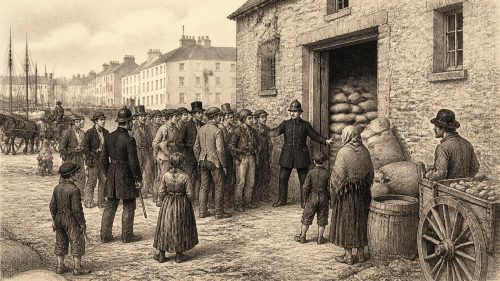
The famine was often described as ending around 1851, but that description risks implying a clean recovery. Departure continued on a vast scale. Transatlantic emigration from Ireland reached a peak in 1851, when just under a quarter of a million people left for destinations across the Atlantic. Others crossed the Irish Sea to Britain. For many families, the decision was made under pressure rather than in conditions of genuine choice: savings had been exhausted, work was scarce, rents remained due, and relatives abroad might be the only reliable source of money for passage.
Not every migrant travelled under the same circumstances. Some paid their own way or were assisted by kin already established overseas. Others were helped, or pressed, by landlords seeking to reduce the burden of poor rates and remove tenants from unprofitable holdings. Poor Law unions also used assisted emigration. Such schemes could offer an escape from the workhouse, but they also transferred vulnerable people from a devastated countryside to uncertain futures in British cities, North America or Australia. The scale of voluntary and assisted movement alike meant that a household recorded in March could soon be divided between an Irish townland and distant ports, factories or settlements.
The census therefore counted a society whose connections extended far beyond the island. Remittances, letters and chain migration increasingly affected local decisions. Emigration could relieve immediate pressure on food, employment and overcrowding, but it also removed young adults and altered the age and sex balance of communities. In many places the empty house, abandoned field and absent sibling were as significant to everyday experience as any official measure of recovery.
Land, Rates and a Smaller Countryside
Land remained the central political and economic question. The Encumbered Estates Act of 1849 had created a court empowered to sell indebted Irish estates with a title intended to be secure for purchasers. By 1851 the court was actively handling sales. Its process offered creditors a route to recover money and allowed new buyers – merchants, professionals, investors and established landlords – to acquire land. It did not automatically protect tenants. Indeed, the reorganisation of estates could encourage consolidation, the ending of small tenancies and a shift towards larger grazing farms requiring fewer labourers.
Parliament also passed the Landlord and Tenant Act in July 1851. It improved the position of agricultural tenants who, with their landlord’s written consent, had erected buildings, engines or machinery: such improvements could be removed at the end of tenancy, subject to conditions and to a landlord’s option to purchase them. This was limited protection rather than a general guarantee of tenure, compensation or fair rent. Consent remained crucial, and the Act did not meet the wider insecurity felt by tenants after the famine.
That insecurity gave continuing force to the Tenant Right movement founded in 1850. Its advocates sought the principles later remembered as fair rent, fixity of tenure and free sale. In 1851 this was a live effort to unite tenants across denominational and provincial lines, not yet the later Land League. Its existence signalled a significant change in political language: land occupation was increasingly presented not merely as a private contract between owner and occupier, but as a national question requiring public remedy.
Relief Becomes Medical
Workhouses remained an unavoidable part of the post-Famine landscape. The Poor Law, expanded in the emergency years, was still administered through local unions financed by rates on property. Admissions had fallen from the worst famine peaks, but poverty, sickness and destitution had not disappeared when the potato crop improved. Boards of guardians faced the continuing costs of indoor relief, orphaned children, infirm people and families with no viable holding or employment.
A notable legislative development came with the Poor Relief (Ireland) Act 1851, commonly called the Medical Charities Act. It brought the dispensary system more firmly within Poor Law administration and enabled unions to be divided into dispensary districts, each intended to provide medical attendance and medicines for the poor. This was no modern national health service, and implementation varied greatly with local resources and administration. Still, it recognised that relief after famine could not be confined to food, lodging and the workhouse. The disease environment exposed by the famine required more regular local medical provision.
Faith, Education and Newman’s Mission
Religion remained inseparable from public life. The Established Church of Ireland, serving a Protestant minority while supported by tithes and state connection, retained legal privilege. In August Parliament passed the Church of Ireland Act 1851, consolidating and amending law on the erection and endowment of churches and chapels. For the Catholic majority, however, the year’s more resonant religious development concerned higher education.
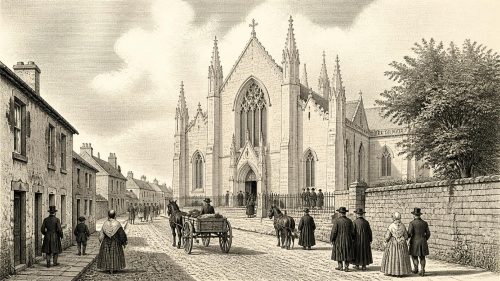
The Catholic hierarchy opposed the non-denominational Queen’s Colleges, which had opened at Belfast, Cork and Galway in 1849. Their objection was not to education itself but to what bishops regarded as religiously unsafe “mixed” education, separated from Catholic pastoral authority. Archbishop Paul Cullen of Armagh therefore sought advice in April 1851 from John Henry Newman, the English Catholic convert and theologian, on a proposed Catholic university in Dublin.
Newman travelled to Ireland on 30 September. At Thurles in early October he worked with Irish colleagues on a plan for the institution; after further discussion with Cullen at Drogheda, the university committee confirmed his appointment on 12 November. The Catholic University would not open until 1854, so it would be wrong to place its teaching in 1851. Yet the year securely belongs to its conception. Newman’s involvement connected Irish Catholic educational aspirations to one of the foremost religious intellectuals of the Victorian world, while also revealing how denominational division shaped access to learning.
Linen at the Crystal Palace
Ireland’s condition was not uniform. While rural districts struggled with depopulation and insecurity, Belfast and its hinterland possessed a powerful industrial and commercial economy centred on flax and linen. The Great Exhibition opened in London’s Crystal Palace on 1 May 1851. Its official catalogue listed Irish exhibitors offering linen, damask, handkerchiefs, yarn, flax seed and machinery-related products. Belfast, Lurgan, Banbridge, Waringstown, Coleraine and other Ulster centres appeared in a global display intended to celebrate manufacture, trade and technical improvement.
Such exhibits did not erase the island’s crisis; rather, they demonstrated its contrasts. Linen production joined rural growers, hand workers, bleach greens, merchants and increasingly mechanised mills to markets beyond Ireland. The Crystal Palace gave this northern industry international visibility at the very moment when the census revealed the extraordinary fragility of much of rural Ireland.
A Year of Reckoning
By the end of 1851, Ireland had not recovered from famine; it had entered a changed world. The census named the scale of loss, even if it could not recover every lost life. Emigration continued to reorder families. Estate sales and tenant-right agitation pointed towards a long contest over land. Medical charities acknowledged enduring illness and poverty. Newman’s appointment foreshadowed a Catholic educational institution, while Ulster linen advertised productive capacity abroad. Together these developments make 1851 a year not of closure, but of reckoning with a country permanently altered.
Primary Sources
- Census 1851
- The Census of Ireland for the Year 1851
- General Table (Population, Housing, Occupations, Education)
- History of Irish Census Records
- Official Census Returns and Census Substitutes
- The Census of Ireland for the Year 1851: Tables of Death
- The Greatest Ravages: The 1851 Census and Famine Mortality
- The Panicked Flood: Emigration and the Great Famine
- Atlas of the Great Irish Famine 1845–1852
- Fourth Annual Report of the Commissioner for Administering the Laws for Relief of the Poor in Ireland, 1851
- The Poor Relief (Ireland) Act 1851
- The Establishment of the Poor Law System
- Poor Law Unions and Their Records
- Landlord and Tenant Act, 1851
- Encumbered Estates Court Sale Reports, 2 January 1851
- Church of Ireland Act, 1851
- John Henry Newman
- Papal Aggression—Ecclesiastical Titles—Adjourned Debate
- Official Descriptive and Illustrated Catalogue: Great Exhibition of the Works of Industry of All Nations, 1851
- The Way We Wore
- The Industrial Resources of Ireland, Part 8
- The Census of Ireland 1851: Dublin
- Census 1926 Volume 8: Irish Language
- Census of Ireland for the Year 1911: General Report