Rocque Survey1756 CE
John Rocque’s four-sheet Exact Survey of Dublin, completed in September 1756, provided an exceptionally detailed record of the capital’s streets, buildings, yards and commercial spaces. Prepared after his 1754 arrival and presented to the Lords Justices, it demonstrated Dublin’s growing administrative and economic importance. The map did not encompass Ireland or alter its entrenched inequalities. Daily life remained shaped by small-scale agriculture, unequal landholding, an expanding linen trade, Catholic disabilities and Protestant landlord power. Nevertheless, 1756 also saw political control shift in Dublin and war with France proclaimed in Ireland, exposing inherited structures to international pressure and closer governmental scrutiny.
Dateline
In 1756 Ireland acquired an unusually sharp image of its capital. John Rocque’s An Exact Survey of the City and Suburbs of Dublin, engraved on four large sheets, recorded streets, lanes, courts, houses, warehouses, churches, yards and public buildings with a precision then exceptional for an Irish town. It did not describe the whole island, and it did not resolve the inequalities of the kingdom it depicted. Yet it provides an apt point of entry into a year in which Dublin’s political machinery changed hands, war with France was proclaimed in Ireland, and the city’s commercial and administrative importance became still more evident.
The year should not be mistaken for a moment of wholesale transformation. Much of what mattered in daily life—dependence on small-scale agriculture, unequal landholding, the expanding linen economy, religious disabilities imposed on Catholics, and the authority of Protestant landowners—was inherited from earlier decades. But firmly dated developments of 1756 reveal how those conditions were being administered, mapped and tested at a time of international danger.
A Capital Measured
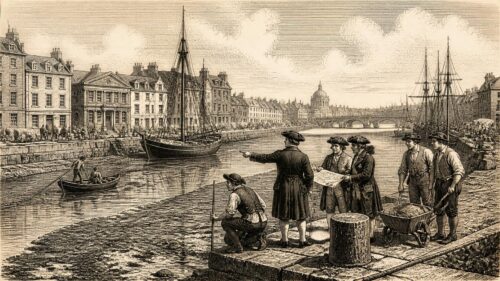
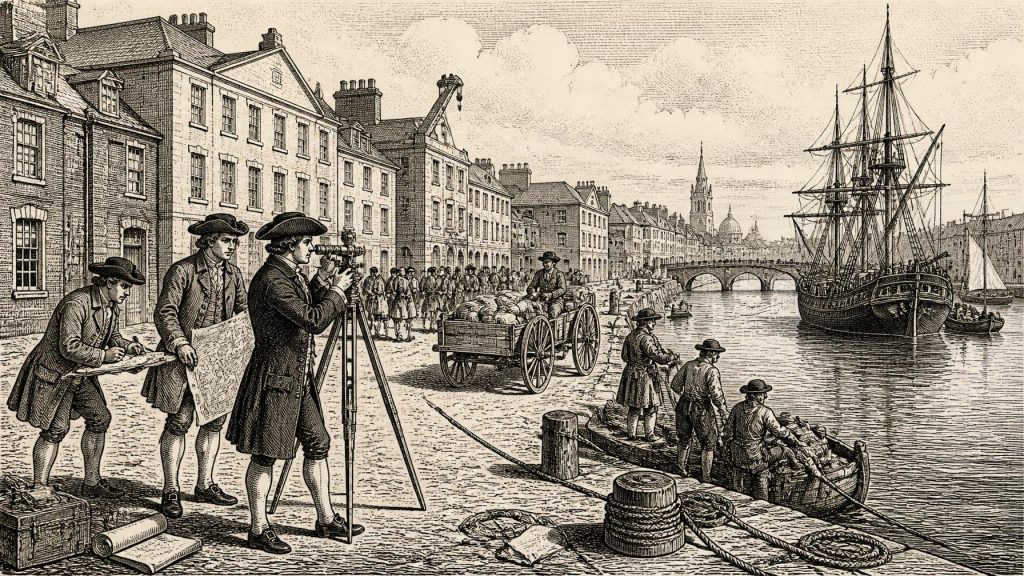
Rocque, a surveyor and engraver from a Huguenot family, had arrived in Dublin in August 1754 to survey the city and had premises on Lower Ormond Quay. His great plan was completed by September 1756, when he presented it to the Lords Justices. Its title was ambitious but literal: it sought to show the ground-plots not merely of grand institutions but of dwellings, warehouses, stables, courts and yards. The resulting four-sheet survey remains one of the most revealing primary sources for mid-Georgian Dublin.
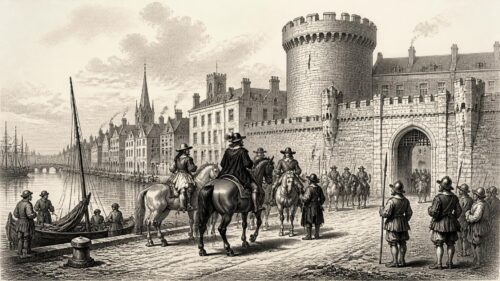
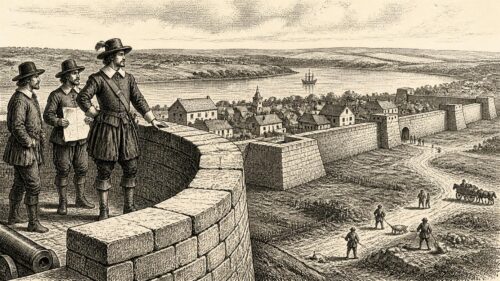
The map makes clear that Dublin was both a seat of government and a working port-city. The River Liffey divided the built-up area while joining it to the quays, shipping and overseas commerce on which merchants, craftsmen and labourers depended. Around the older core were expanding streets and suburbs, but also irregular lanes and tightly occupied plots. Such detail matters. It prevents a view of eighteenth-century Dublin made only of fine façades, Parliament House and aristocratic houses. Behind and beside those landmarks lay workshops, storage yards, service spaces and densely inhabited streets.
Rocque’s achievement also signals the growing practical value of measurement. Landlords commissioned estate surveys to manage rents, boundaries and agricultural improvement; civic and commercial interests needed dependable knowledge of roads, property and urban growth. The map was therefore an instrument as well as an attractive printed object. It made the capital intelligible to officials, investors, visitors and residents who could afford it, while preserving a rare visual record of the city in the very year its political balance shifted.
Boyle Leaves the Chair
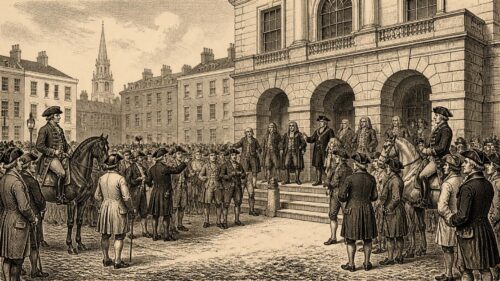
The most consequential domestic political change occurred on 17 April. Henry Boyle, Speaker of the Irish House of Commons since 1733 and one of the kingdom’s dominant political managers, left the Commons for the House of Lords. He was created Baron Castle-Martyr, Viscount Boyle of Bandon and Earl of Shannon, and received a pension of £2,000 a year for thirty-one years. The honours marked a negotiated retirement after the prolonged money-bill dispute that had exposed tension between Dublin Castle, the Irish administration and powerful parliamentary interests.
Boyle’s authority had rested not simply on eloquence or office but on what contemporaries called “undertaking”: the ability of a great political manager to deliver parliamentary support through family connections, borough influence, patronage and personal alliances. His move to the Lords therefore changed more than one man’s rank. It ended a twenty-three-year speakership and acknowledged that the older, comparatively stable arrangement between government and a single commanding Commons manager had become more difficult to sustain.
John Ponsonby was elected Speaker unopposed in 1756. His accession did not create representative democracy: the Irish Parliament was dominated by a Protestant political elite, electoral rights were sharply restricted, and the Dublin legislature remained constitutionally subordinate to the Crown and Westminster. Nevertheless, the succession was important. It brought Ponsonby to the centre of parliamentary management just as the kingdom faced the demands of war. The session that had begun in October 1755 ended on 8 May 1756; Parliament was then repeatedly prorogued rather than called immediately to new business. Politics continued through office-holding, correspondence, patronage and the executive’s proclamations.
War Proclaimed in Ireland
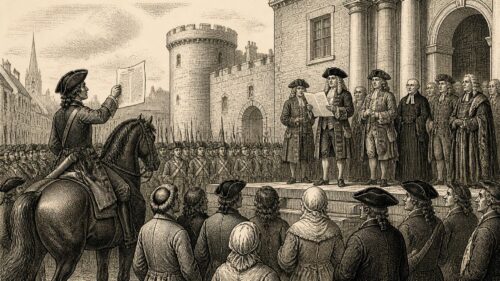
The wider crisis arrived unmistakably in May. Great Britain formally declared war on France on 17 May 1756, opening the conflict conventionally known as the Seven Years’ War. A proclamation publishing the royal declaration of war in the Kingdom of Ireland followed on 24 May. For an island on the western approaches to Britain, with memories of earlier French-assisted Jacobite landings and rebellions, war was not an abstraction. It raised immediate questions about coastal security, shipping, soldiers, arms and loyalty.
Ireland’s militia was called out in 1756 in response to the French threat. This was not a national force in a modern sense. Under the prevailing system, Catholics and Presbyterians were excluded from bearing arms in the militia; defence was formally linked to the Protestant political order. That exclusion demonstrates the contradiction at the heart of official security policy. The Catholic majority was expected to live peaceably under Hanoverian rule, yet it was denied equal civic standing and was viewed through the lens of possible foreign or Jacobite danger.
Legislation from the preceding parliamentary session had particular force in this wartime year. The 1755 Act against Irish subjects serving the French king made the return to Ireland of such officers, soldiers or mariners a felony unless they surrendered by 1 August 1756 and took the prescribed oaths. Its terms reveal official anxiety about military migration and French influence. They do not, by themselves, prove a mass movement of Irishmen to France in 1756; rather, they show how the state attempted to regulate an old and politically sensitive connection.
War also reached civilian life through maritime administration. In March an embargo on ships and vessels in the kingdom was lifted. In April, vessels arriving from Algiers were ordered to undergo forty days’ quarantine. These measures arose from different dangers, but together they show the degree to which Irish ports were governed through an imperial system concerned with naval preparedness, disease control and the movement of goods and people. No French invasion landed in Ireland in 1756. The year’s significance lay in precaution, mobilisation and apprehension rather than battle on Irish soil.
Churches Under Constraint
In the Roman Catholic Church, 1756 brought an administrative change of lasting local significance. Ardagh and Clonmacnoise were united, creating the diocese thereafter known as Ardagh and Clonmacnoise. Augustine Cheevers, an Augustinian who had been bishop of Ardagh, was confirmed as bishop of Meath on 7 August. Anthony Blake was confirmed as bishop of the united see on 11 August. The union was connected to the poverty and small resources of Ardagh, and it joined territories extending across parts of the Irish midlands.
The episode is a useful corrective to the idea that Catholic life had vanished beneath the penal laws. Catholic diocesan structures, clergy, worshippers and networks continued, even while the legal order was designed to privilege the established Church of Ireland and restrict Catholics’ political, educational and property rights. The degree of enforcement varied by place and period, but international war could sharpen official suspicion. The careful management of episcopal appointments in 1756 therefore belonged to a lived religious world that was both resilient and insecure.
For the Church of Ireland, the constitutional establishment remained embedded in local government, tithes and the political qualifications of the ruling class. Presbyterians, particularly numerous in parts of Ulster, occupied another constrained position: Protestant, but outside the established church and excluded from the militia system called out that year. Ireland was thus not divided simply between a governing Protestant minority and a Catholic majority. Its religious landscape included several communities, each affected differently by law, locality, wealth and access to power.
Print, Song and the Wider Island
Irish cultural life in 1756 cannot be reduced to Dublin’s English-speaking elite. In May, the Irish-born Isaac Bickerstaffe published Leucothoé, his first work, a dramatic poem intended for the stage. It made little immediate impact, but it was the beginning of the career of a writer who would later become prominent in English comic opera. Its appearance points to the connections between Irish writers, London publishers and the commercial world of print.
At the other end of the cultural map lies Cathal Buí Mac Giolla Ghunna, the Irish-language poet of south Ulster, whose death is conventionally placed about 1756 but cannot be dated precisely. His songs circulated primarily through memory, performance and manuscript rather than the metropolitan print trade. His best-known surviving piece, An bonnán buí, carried across Ulster, Connacht and north Leinster. The uncertain year of his death should be stated cautiously, but his presence reminds us that Irish-language creativity remained vigorous in communities often poorly represented in official records.
Rocque’s four sheets, Boyle’s peerage, the war proclamation and the union of Ardagh with Clonmacnoise all belong securely to 1756. Taken together, they show a kingdom closely connected to imperial war and British political structures, yet unmistakably shaped by its own institutions, confessional divisions, regional cultures and commercial life. Ireland entered the Seven Years’ War without a battlefield campaign at home, but with its capital newly surveyed, its parliamentary leadership rearranged and its social order exposed by the very measures intended to defend it.
Primary Sources
- Boyle, Henry
- Ponsonby, John
- Blake, Anthony
- Mac Giolla Ghunna, Cathal ‘Buí’
- John Rocque
- Historic Maps of Dublin
- Section of Rocque's Map of Dublin City
- John Rocque’s Exact Survey of the City and Suburbs of Dublin, 1756: an art historical and archaeological analysis
- Two maps of 18th century Dublin and its surroundings by John Rocque
- The Irish Militia
- Security
- Statute Law Revision Act 2015
- The Twenty Ninth Year of George II – Chapter V
- Introduction
- Historical Reference: Merging Together – The Diocese of Ardagh And Clonmacnois
- Ardagh (and Clonmacnois) Diocese
- The Dublin Gazette, Number 583: Saturday, 27 March 1756 to Tuesday, 30 March 1756
- The Dublin Gazette, Number 639: Saturday, 9 October 1756 to Tuesday, 12 October 1756
- History of the Commercial and Financial Relations between England and Ireland from the Period of the Restoration
- Famine and Economic Change in Eighteenth-Century Ireland
- Religion, Law, And Power: The Making of Protestant Ireland 1660–1760
- The Penal Laws: Origins, Purpose, Enforcement and Impact
- Some queries relative to the present state of popery in Ireland
- Leucothoé
- Dictionary of National Biography, 1885–1900: Bickerstaffe, Isaac
- The Seven Years War