Great Frost1741 CE
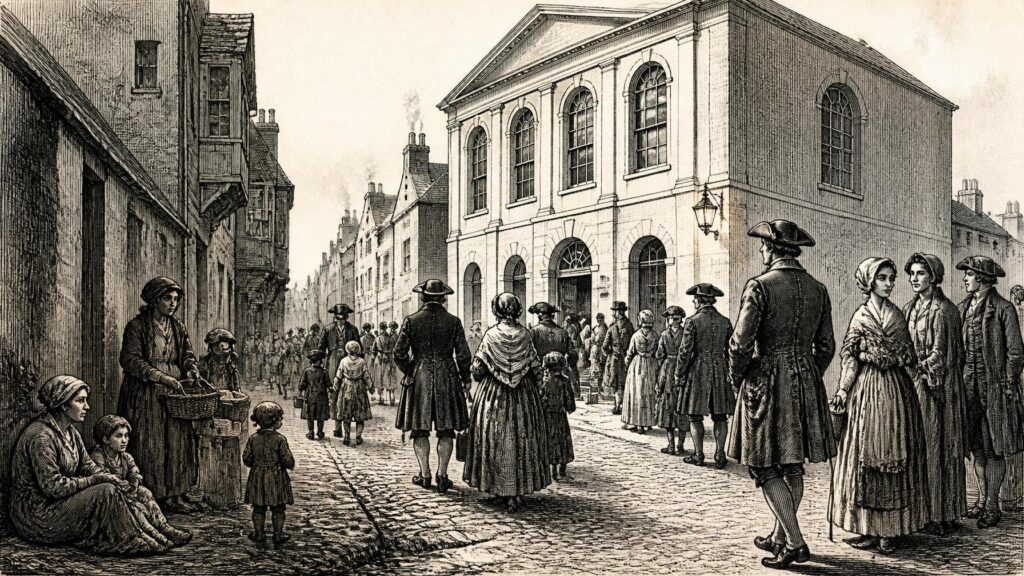
In 1741, Ireland endured the deadliest phase of the 1740–41 Great Frost famine, or Bliain an Áir. Freeze, drought, crop and livestock failures, lost employment and soaring prices caused widespread hunger, while fever and dysentery devastated weakened populations. Estimated deaths across the crisis reached 310,000–480,000, though records remain incomplete. Relief was fragmented, relying on local charity, imports, employment schemes and municipal action. An improved harvest and falling prices eased scarcity late in the year, but disease and hardship persisted. Amid extreme inequality, Dublin opened Fishamble Street’s Music Hall and welcomed Handel, while Killiney Hill relief works commemorated suffering and employment.
Dateline
In 1741 Ireland endured the culminating year of a catastrophe later remembered in Irish as Bliain an Áir, the ‘Year of Slaughter’. The famine conventionally called the Great Frost or the famine of 1740–41 was not confined neatly to one calendar year: its roots lay in the extraordinary freeze and drought of 1740, while sickness and demographic consequences outlasted the harvest of 1741. Yet this was the year in which hunger, fever and dysentery pressed most severely upon communities, and in which signs of eventual recovery appeared alongside new cultural activity in Dublin.
The Kingdom of Ireland was ruled by George II, with the Anglican Church of Ireland established by law and a parliament whose political nation was overwhelmingly Protestant. The Catholic majority lived under the continuing constraints of the penal system, though its operation varied locally and over time. These inequalities did not make hunger a solely Catholic experience: food shortage, disease and rising prices crossed confessional lines. But wealth, landholding, access to credit and connections to town authorities shaped who could buy food, find work or obtain charity when ordinary household reserves failed.
The Famine’s Deadliest Season
The immediate origins of the disaster belonged chiefly to the preceding year. The exceptional frost beginning in late 1739 and continuing into 1740 damaged stored potatoes, interrupted labour and transport, and was followed by drought and failures in tillage and livestock. Ireland’s poorer households did eat potatoes, but they also depended heavily on oats and other grains, dairy produce and seasonal work. The crisis was therefore broader than a potato failure. It was a compound collapse in food, fuel, fodder, employment and purchasing power.
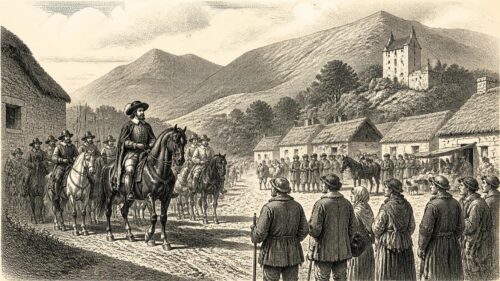
By the opening months of 1741, the accumulated effects were devastating. Contemporary and later accounts consistently place the worst pressure of famine between January and April. People who had exhausted supplies in 1740 faced another lean season before a new harvest could be gathered. Begging and movement towards towns increased, bringing distressed rural people into places already struggling with high prices and inadequate relief. Such movement was a desperate survival strategy, not evidence that towns were secure refuges; it also made crowding, exposure and contagion more dangerous.
Exact death totals cannot be recovered. Ireland had no civil registration, surviving parish burial records are incomplete, and hunger, fever and dysentery were difficult to separate in the evidence. Modern reconstructions from hearth-tax and other demographic material nonetheless indicate an immense loss across the 1740–41 crisis: commonly cited estimates range from roughly 310,000 to 480,000 deaths out of a population of about 2.4 million. Those figures are estimates for the wider catastrophe, not a count of deaths in 1741 alone. Their uncertainty should not obscure their central message: the island suffered one of the gravest demographic shocks of eighteenth-century Europe.
Hunger Became Disease
Starvation seldom worked alone. Weakness made people more vulnerable to infection; displacement and crowded lodgings assisted transmission; and families without food could not sustain ordinary care for children, older people or the sick. Fever and dysentery, often termed ‘flux’ in contemporary language, became the fatal companions of scarcity. John Rutty, the Dublin Quaker physician whose weather and medical chronicle is an indispensable contemporary source, recorded the formidable prevalence of disease during this period. Later medical writers attempted numerical totals, but these should be treated cautiously rather than repeated as precise national statistics.
The summer brought a cruel ambiguity. Better weather and an improved grain harvest could promise relief, and by July grain prices were reported to be falling. Grain imports reaching Galway in June also show that sea-borne supply formed part of the response. But a hotter summer did not restore health to people already weakened through two bad seasons. Disease continued to claim lives even as the immediate food shortage eased. Recovery from famine was thus uneven: a household might see bread or meal reappear in the market yet still lose a parent, child or wage-earner to illness.
Regional experience was not uniform. Towns were supplied through markets and ports, but also received hungry newcomers; rural districts could be isolated from both imported food and organised charity. Evidence is strongest for the broad national crisis rather than for a neatly ranked map of suffering in every parish. What can safely be said is that the famine exposed the fragility of an economy in which many labouring families lived close to subsistence and had few reserves to withstand a prolonged weather shock.
Authority, Worship and Relief
Government was present, but its means were limited and its actions fragmented. During much of 1741 Ireland was administered by Lords Justices; William Cavendish, third duke of Devonshire, returned as lord lieutenant on 23 September. The Irish parliament met in October, but there was no national poor-law system capable of feeding the destitute. Assistance instead came through a patchwork of municipal measures, subscriptions, parochial efforts, private almsgiving, imported food, employment schemes and occasional regulation. These could relieve particular places; they could not reliably reach the whole island.
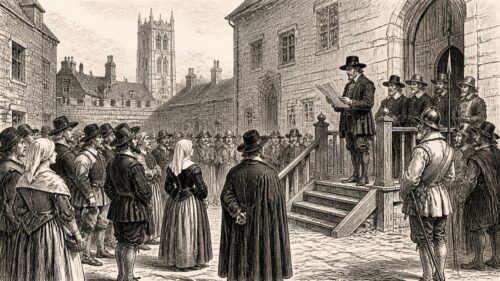
Religion offered both a language for interpreting calamity and a framework for collective action. An official proclamation appointed 4 February 1741 as a day of public fasting. In an age that commonly understood extraordinary weather and epidemic illness in providential terms, fasts and sermons could express penitence and communal alarm. They did not themselves provide grain or medicine. The contrast is revealing: the established institutions of church and state could call a kingdom to worship, while practical survival still depended heavily on local resources and private initiative.
One enduring physical reminder of such initiative stands on Killiney Hill south of Dublin. John Mapas employed poor people on walls, walks and an obelisk associated with relief during the hard years. The dating requires care. The monument bears an inscription dated June 1742 referring to the preceding hardship, while catalogues and later accounts differ over when particular work began. It should therefore not be presented as a monument completed in 1741. Its secure connection to 1741 is as a memorial to, and product of, the employment relief prompted by that year’s distress.
At the same time, elite building continued. Powerscourt House in County Wicklow, rebuilt for Viscount Powerscourt to designs by Richard Cassels, is conventionally dated as completed in 1741. The great Palladian house, with its costly interiors and commanding landscape, makes a sharp visual counterpoint to the famine. It does not mean that every landowner was indifferent, nor that all wealthy households were untouched by crisis. It does show that Ireland’s social world contained great disparities in security and display even at a moment of mass want.
A New Hall in Dublin
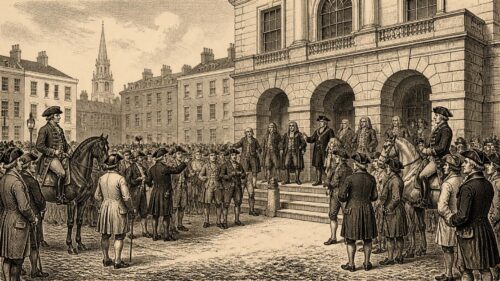
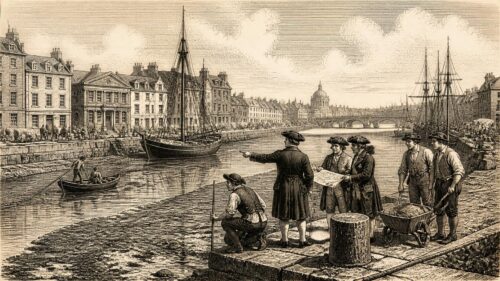
Dublin’s cultural life also produced a firmly dated landmark. On 2 October 1741 the new Music Hall in Fishamble Street opened with a concert for members of the Charitable and Musical Society. Built under Richard Cassels’s supervision and linked to the Bull’s Head musical circle, the hall gave the city a substantial purpose-built venue for concerts, assemblies and charitable performances. Its opening does not cancel the misery beyond the city’s better-supplied streets. Rather, it illustrates the coexistence of catastrophe, sociability, philanthropy and urban consumer culture within the same year.
On 18 November George Frideric Handel arrived in Dublin. His visit was immediately important to the city’s musical world, but its most celebrated outcome belongs to the following year: the first performance of Messiah took place in Fishamble Street on 13 April 1742. Keeping that distinction matters. In 1741, Dublin gained the hall and welcomed Handel; the famous charitable performance lay ahead. The connection was nevertheless already forming between the new venue, public music and fundraising for Dublin’s charitable institutions.
The year also saw the births of figures whose later careers would enrich Irish and British cultural life: the Shakespeare scholar Edmond Malone, born on 4 October, and the painter James Barry, born on 11 October. Such details cannot balance the suffering of the majority, but they are reminders that a calendar year contains beginnings as well as loss. For newborn children of poor families, however, 1741 was a time of exceptional danger, as hunger and epidemic disease raised the ordinary risks of early life.
An Uneven End to Crisis
By the end of 1741, an improved harvest and falling prices had begun to end the acute food emergency. That was not an instant restoration. Bereavement, weakened bodies, lost livestock, debts and disrupted work endured into subsequent years. Nor should later plenty be read backwards as proof that relief had been adequate when it mattered most. The famine’s scale entered memory precisely because normal seasonal hardship had become an island-wide disaster.
For Ireland, 1741 remains a year best understood through this double perspective. It was the terrible climax of a climate-driven subsistence and disease crisis, shaped by unequal resources and limited welfare institutions. It was also the year in which Dublin opened a music hall that would soon host one of the best-known works in Western sacred music. Fishamble Street’s new public culture and the hunger remembered on Killiney Hill were not separate histories. Together they reveal an Ireland of striking achievement, severe hierarchy and extraordinary human vulnerability.

Primary Sources
- The Irish famine of 1740–1741: famine vulnerability and ‘climate migration’
- Famine in Ireland, 1300–1900
- Arctic Ireland
- A Chronological History of the Weather and Seasons, and of the Prevailing Diseases in Dublin
- Historic Sketch of the Causes, Extent, and Mortality of Contagious Fever Epidemic in Ireland in 1741
- The Irish Crisis
- Coping with Crisis: The Response to the Famine of 1740–41
- Climate
- The 1841 census—do the numbers add up?
- Statute Law Revision Act 2015
- Pre-Union Irish Statutes: 1741
- Distress For Rent Act, 1741
- George II: Proclamations and Orders in Ireland, 1740–1741
- Cavendish, William
- Introduction: Irish Penal Laws
- State Papers Ireland 1509–1782: government papers on Irish affairs
- Fish-Shamble Street, St. John’s Lane and Copper Alley
- Killiney Obelisk
- Obelisk
- Dublin, Killiney Hill, Obelisk
- Inspiration from the Landscape
- The History of the Irish Famine