Boulter Inquiry1732 CE
In 1732, Irish institutions revealed tensions within a Protestant-governed, predominantly Catholic society. Hugh Boulter’s Lords’ inquiry counted extensive Catholic clergy, worship, schools and religious houses, prompting renewed enforcement of penal laws, while also exposing uneven local practice. Parliament reduced the maximum interest rate to six per cent, reflecting an expanding but unequal commercial economy. Trinity College Dublin’s Burgh-designed Library was completed, symbolising privileged Protestant learning. George Grierson became king’s printer, but Constantia Grierson’s death diminished Dublin letters. In Paris, Begley and MacCurtin published the first comprehensive English–Irish dictionary. Dublin also published Berkeley’s Christian defence, Alciphron, illustrating religious and intellectual debate.
Dateline
In 1732, Ireland’s governing institutions produced an unusually revealing set of records. In March, the Irish House of Lords received a report on what it called the ‘state of popery’: an official Protestant investigation into Catholic worship, clergy, religious houses and schools. That same year saw a statutory reduction in the maximum lawful rate of interest, the completion of Trinity College Dublin’s great new library building, and important publications in Dublin and Paris. None was a single event capable of transforming the island overnight. Taken together, however, they expose the central tensions of Ireland under George II: a Protestant state attempting to oversee a predominantly Catholic society; a growing commercial economy; and a learned culture sustained in English, Latin and Irish, both within Ireland and through continental networks.
A Survey of Catholic Ireland
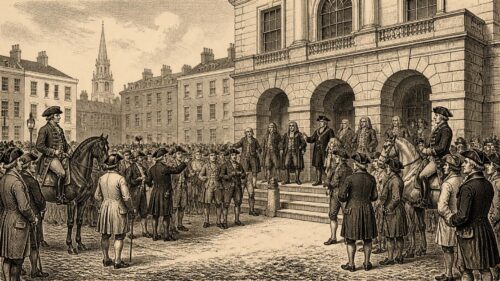
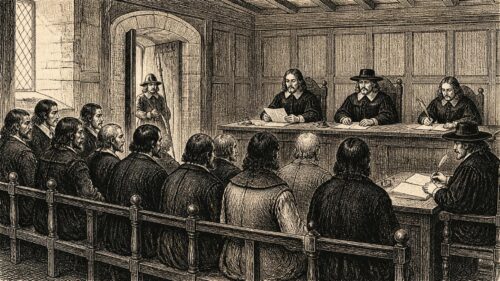
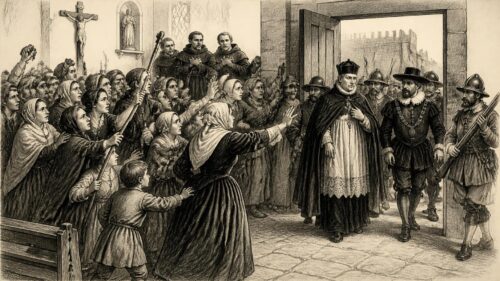
The most firmly dated political-religious development came on 8 March, when the Lords’ committee report on the ‘state of popery’ was presented. The inquiry had been set in motion during 1731 under Hugh Boulter, Church of Ireland archbishop of Armagh and primate of all Ireland. Its title and stated purpose make its standpoint plain. It was not a neutral religious census, but an instrument of a Protestant political order concerned by what it regarded as the numerical strength and institutional persistence of Catholicism.
Returns had been sought through county sheriffs, town magistrates, bishops and parish clergy. They counted Catholic priests, friars, nuns, Mass houses, private chapels and schools. The compiled figures were striking: 892 Mass houses, 54 private chapels, 1,445 priests, 51 friaries containing 254 friars, nine nunneries and at least 549 Catholic schools. Yet the numbers must be read critically. They were supplied largely through hostile official and clerical channels; coverage and definitions varied from place to place, and the report was designed to prompt policy, not simply to describe society. It nevertheless demonstrates beyond doubt that Catholic worship, education and religious community were organised widely and visibly despite the penal code.
For ordinary Catholics, legal disability and religious life did not map neatly onto one another. The laws restricted Catholic political power, property transmission, education and clerical activity, but enforcement differed sharply by locality and moment. The report itself shows formal chapels and schools alongside friaries and more concealed activity. In parts of Ulster, for example, contemporary returns recorded Mass celebrated in open fields as well as in chapels. The state’s anxiety arose precisely because Catholic practice had not disappeared. Five days after the Lords’ report, a proclamation of 13 March ordered the enforcement of the popery laws, connecting the inquiry to executive action even if it did not inaugurate a wholly new campaign of repression.
Law, Credit and Authority
The parliamentary session ended on 10 March 1732. On that date an act reduced the statutory maximum interest rate on loans to 6 per cent. This was a technical measure, but credit touched many layers of life: landlords refinancing estates, merchants financing cargoes and stock, traders settling accounts, and families attempting to meet obligations in a cash economy. A legal ceiling did not mean that every borrower could obtain money at that rate, still less that small borrowers gained easy access to credit. Security, social standing, place and personal connections remained decisive. Even so, the change points to a government concerned with the terms on which capital circulated in Ireland.
The act belonged to an economy increasingly oriented towards markets, exports and money payments. Ireland’s expanding linen output was especially important in the north, while livestock products, provisions and imported consumer goods linked other regions to Atlantic and British commerce. Such growth did not dissolve inequalities of landholding or confession. Rather, it developed within them. The parliament that adjusted interest rates was an institution dominated by Anglican elites, and its legislation reached people unevenly. Its proceedings also remained constrained by constitutional arrangements that gave the British government decisive influence over Irish legislation.
A Library Completed in Dublin
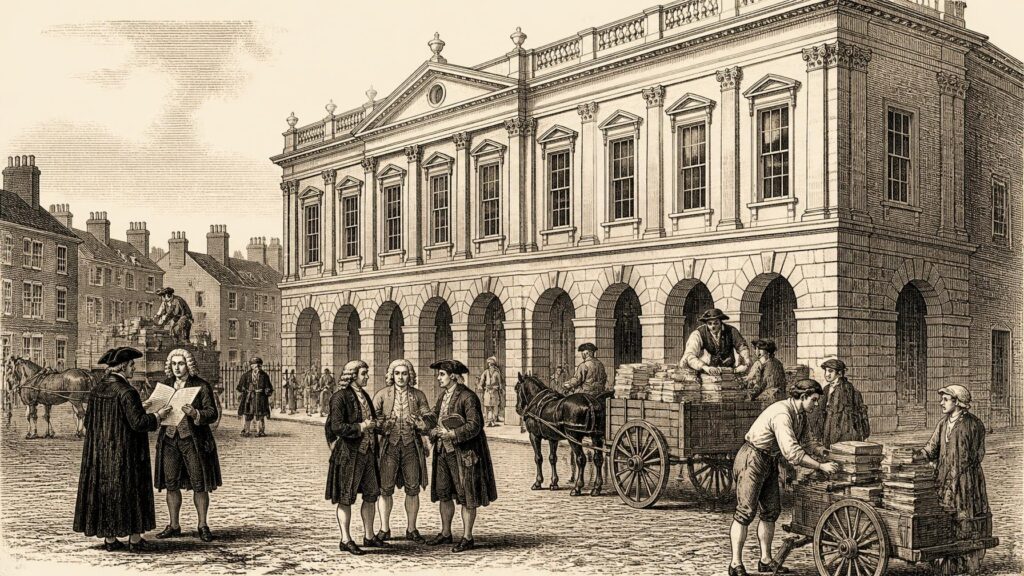
In Dublin, another long project reached completion. Trinity College’s new Library, designed by the soldier-engineer and surveyor-general Thomas Burgh, was finished in 1732. Burgh had died in 1730, so he did not see the completed building. Its dark calp-limestone arcade, built by the mason Moses Darley, formed part of the architectural setting of the college. Books and manuscripts were transferred from the older library, although the building was not ready for use until the end of 1733 and its shelves initially occupied only a portion of the ample new space.
The completed structure was an assertion of institutional confidence. Trinity was central to the education of the Protestant governing class and to the intellectual life of the established church. Its library preserved manuscripts and printed books that would later become fundamental to the study of Irish history and language. But in 1732 it was not a public library in the modern sense. Access followed the hierarchies of college, church, gender and social rank. The imposing building therefore represented both learning’s durability and its confinement within a privileged institution.
Print, Scholarship and a Dublin Loss
Print made those hierarchies visible, but it also created connections beyond them. George Grierson, the Dublin printer and bookseller, succeeded to the patent of king’s printer after Andrew Crooke’s death in July 1732. The office brought the valuable monopoly of printing Bibles, prayer books and other devotional works for the established church. Grierson’s press had already become known for carefully produced editions of classical authors, work in which his wife Constantia Grierson played an exceptional part as editor and corrector of the press.
Constantia Grierson died on 2 December 1732, probably from tuberculosis, and was buried at St John’s, Drumcondra. Born into a poor Kilkenny family, she had acquired formidable learning in Hebrew, Greek, Latin, French and mathematics. Her editions of Terence and Tacitus, and her poetry, secured admiration in Dublin’s literary circles. Her death was a genuine loss to the city’s world of letters and to the Grierson business. It also offers a corrective to any picture of eighteenth-century Irish learning as exclusively male, aristocratic or university-bound.
An Irish Dictionary from Paris
The year’s most consequential Irish-language publication appeared not in Dublin but in Paris: The English Irish Dictionary: An Foclóir Béarla Gaoidheilge, associated with Conor Begley and Aodh Buí Mac Cruitín, or Hugh MacCurtin. It was printed in 1732 by Seamus Guérin. Begley was probably a priest connected to the Irish community in Paris; MacCurtin, a Clare-born poet, scholar and antiquarian, had moved through scholarly circles in Dublin and the Low Countries. Their work was the first comprehensive English–Irish dictionary to be printed.
The dictionary incorporated a grammar, adapted from MacCurtin’s earlier Louvain publication, and used a newly made Gaelic typeface. Its production abroad was itself historically significant. Continental Irish colleges, clerics and exiles supplied resources, contacts and presses unavailable or difficult to command at home. The book defended the worth of Irish and drew upon older learned traditions, while its English headwords addressed readers moving between languages. It should not be treated as evidence that Irish was safe from social and political pressure; rather, it records purposeful intellectual labour to maintain and systematise a language that remained deeply embedded in everyday life across much of the island.
Berkeley and the Arguments of Faith
Dublin also issued George Berkeley’s Alciphron, or the Minute Philosopher in March 1732, through the Dame Street booksellers George Risk, George Ewing and William Smith. Berkeley, an Irish philosopher and Anglican cleric, framed the work as a series of dialogues defending Christianity against fashionable freethinking and scepticism. Its publication belongs to the same broad climate as Boulter’s report, though the two were very different in method. The report classified people and institutions as dangers to Protestant security; Berkeley sought to answer intellectual challenges to revealed religion through philosophical argument.
1732 consequently left no single dramatic turning point in Irish politics or war. Its importance lies in a denser record of institutions at work: a Lords’ inquiry measuring a religious majority through the lens of fear; financial law adjusting the formal cost of credit; a major college library completed in stone; and printers and scholars preserving, contesting and circulating knowledge. Ireland’s languages, confessions and social orders did not occupy equal ground. Yet the year’s books, buildings, laws and returns show a society more interconnected, more literate and more resilient than the narrow assumptions of its rulers allowed.

Primary Sources
- A report made by His Grace the Lord Primate [H. Boulter] from the Lords Committees appointed to enquire into the present state of popery
- Appendix V: Report on Popery in Ireland, 1731
- Statute Law Revision Act 2015
- The Impact of Interest Rates in Eighteenth Century Ireland
- The Impact of Interest Rates in Eighteenth Century Ireland: A Preliminary Investigation
- A Great Many Choice Books: The New Library
- An Old Library Catalogue
- Why publish an English—Irish dictionary in Paris in 1732? Part 2
- Conor O'Begly: The English Irish Dictionary: An focloir bearla gaoidheilge
- Paris et le premier dictionnaire anglais-irlandais
- Tracing Inspiration in Proverbial Material: From 'The Royal Dictionary' (1699 & 1729) of Abel Boyer to 'The English-Irish Dictionary' (1732) of Begley-McCurtin
- Hugh MacCurtin (c.1680–1755) and the Importance of Print
- Mac Cruitín, Aodh ‘Buí’ (MacCurtin, Hugh)
- Grierson (Crawley), Constantia
- Grierson, George
- Berkeley, George
- Works of George Berkeley
- Philosophical Theology (1732—1735)
- The Irish Trade
- Introduction: Ireland in the Early Modern World
- Penal Days in Clogher
- The Population of Ireland in the Eighteenth Century
- Eighteenth-Century Irish Population: New Perspectives from Old Sources
- Premiums and Progress—How the Dublin Society Shaped Eighteenth-Century Ireland