Avoca Weaving1723 CE
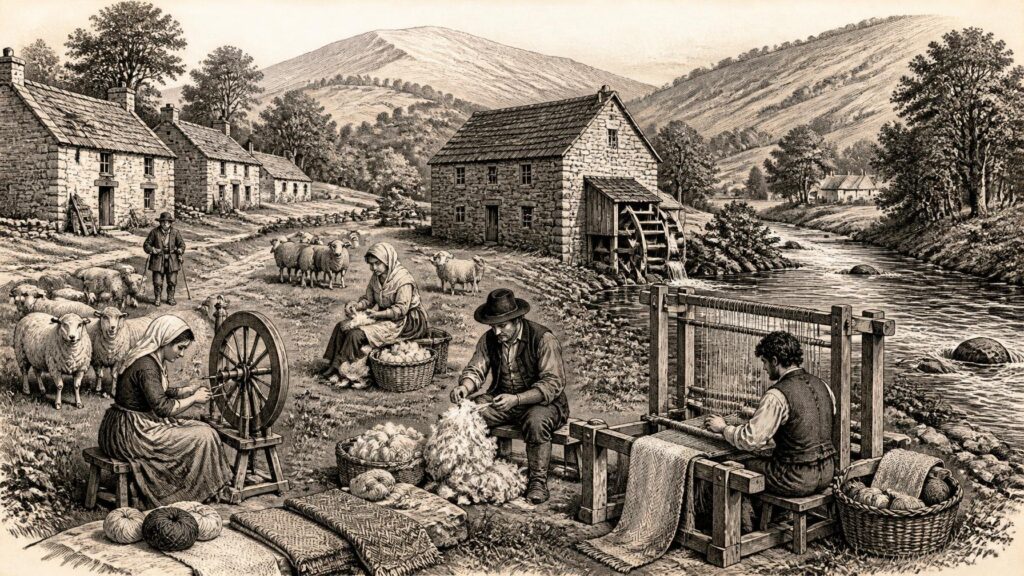
In 1723, Avoca in County Wicklow established a co-operative weaving mill where farmers brought wool for spinning, dyeing and weaving, alongside corn-grinding. Powered by the river and serving local households and mining communities, it illustrates rural adaptation despite restrictions on Irish woollen exports. Prolonged hot, dry weather brought relative agricultural stability, though drought posed risks. Ireland’s restricted Protestant Parliament considered revenue, manufacture, policing and trade. Wood’s English-minted copper coinage provoked anxieties over consent and commerce. Catholic Archbishop Bernard O’Gara’s appointment demonstrated institutional resilience under penal laws. Claims that Dr Steevens’ Hospital opened that year are unsupported; it opened in 1733.
Dateline
In 1723, a small initiative on the River Avoca in County Wicklow acquired a significance far beyond its original scale. Avoca’s own institutional history dates the establishment of a co-operative weaving mill there to this year: local sheep farmers could bring wool to be spun, dyed and woven into clothing and blankets, while the same site also offered corn-grinding. It was not a factory in the later industrial sense, nor evidence that Ireland had escaped the constraints of its eighteenth-century economy. Rather, it was a local arrangement joining pastoral farming, household craft, water power and a nearby mining district. Yet its survival in the historical record makes it an unusually clear window onto how work and exchange could be organised in rural Ireland.
Wool, Water and Local Work
The Avoca valley was well suited to such a venture. Sheep supplied wool; the river supplied dependable power for a mill; and the district’s mining communities provided a local market for hard-wearing cloth. The work involved many hands. Wool had to be washed, carded, spun, dyed, woven and finished. Much of this labour could be undertaken in homes or small workshops before yarn and cloth reached the mill. The co-operative model described by Avoca’s later history should therefore be understood as a practical rural resource, not a modern workers’ co-operative with elected committees and formal industrial relations.
Its importance lies partly in what it reveals about adaptation. Irish woollen manufacture had long been hampered by English commercial policy, which favoured English producers and encouraged Ireland’s role as a supplier of raw materials. These restrictions did not erase Irish skill or demand. They pushed much production towards local consumption, limited legal outlets and, at times, illicit trade. A modest Wicklow weaving concern could thus serve neighbours and miners even when large-scale export manufacture faced serious obstacles. The year’s event is not evidence of a national textile boom; it is evidence that rural people continued to find uses for wool, water and specialised craft.
A Dry, Productive Year
Weather shaped the possibilities of that local economy. A modern study of Isaac Butler’s Dublin weather diary identifies a prolonged drought from May to October 1723. A broader reconstruction characterises spring as exceptionally hot and dry, followed by an unusually hot, dry summer and autumn, and then a relatively open winter. Such descriptions must not be converted into a simple tale of universal plenty: drought could inconvenience pasture, streams and household water supplies as well as favour harvesting. Nevertheless, compared with the variable seasons and poor harvests that had troubled parts of Ireland earlier in the decade, 1723 appears to have offered a measure of agricultural stability.
For most inhabitants this mattered more immediately than grand politics. Ireland remained predominantly rural. Rent, wages, fuel, food stores, livestock and seed depended on the annual cycle. A favourable harvest could reduce the pressure on households and local relief, while a dry spell could also expose communities whose resources were already narrow. The Avoca enterprise belongs in this agricultural setting: weaving was a supplement and a means of turning local wool into useful goods, not a replacement for farming.
A Parliament of Limited Reach
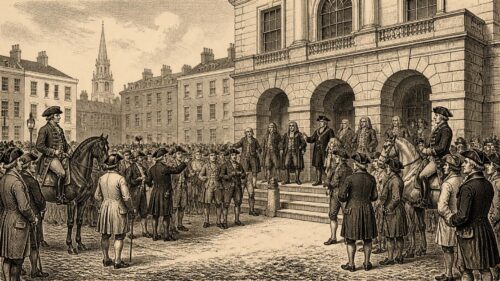
At the constitutional level, Ireland was the Kingdom of Ireland under George I. Its Parliament met in Dublin, but its freedom of action was curtailed by the constitutional settlement that placed Irish legislation under British control. The fifth session of George I’s Irish Parliament opened on 29 August 1723 and continued into February 1724. Its calendar is revealing. A revenue measure received royal assent on 24 December 1723, continuing duties on commodities including drink, tobacco, tea, coffee and cocoa and taxing salaries, offices and pensions.
Measures introduced in this session, though not finally assented to until February 1724, addressed flax and hemp manufacture, parish watches, Dublin’s watch, highways, mines, parish organisation, Quaker affirmations, export provisions and livestock markets. That agenda shows a governing class concerned with revenue, policing, productive improvement, urban order and tradeable goods. It did not mean that all residents possessed an equal voice in making policy. The House of Commons was Protestant in membership. Catholics could still vote in parliamentary elections in 1723, but could not sit, and the established church’s sacramental tests also restricted Protestant Dissenters’ access to office and corporations. The franchise itself would be taken from Catholics in 1727.
One aristocratic development illustrates the relationship between Irish titles and British political power. On 12 March 1723 Henry Temple was created Baron Temple of Mount Temple, County Sligo, and Viscount Palmerston, County Dublin, in the Irish peerage. Temple was an Anglo-Irish landowner and office-holder, but his parliamentary career was conducted in Britain. The creation of an Irish title did not therefore enlarge Irish self-government. It was a royal reward embedded in the wider patronage networks of the Hanoverian state.
Copper Coinage and Uneasy Authority
The year also saw a controversy taking material form outside Ireland. William Wood held a royal patent, granted in 1722, to make copper halfpence and farthings for Irish circulation. In January 1723 newspapers reported that he had begun the Irish coinage; the minting operation was in England, with a facility at Bristol associated with the Irish issue. Surviving accounts record substantial consignments from June onwards. The coins bore George I on one side and Hibernia, seated with her harp, on the other: a striking Irish emblem on money produced beyond the kingdom.
The later Wood’s halfpence crisis should not be projected wholesale backwards into 1723. Jonathan Swift’s first Drapier’s Letter was not published until 1724. Yet 1723 was plainly the year in which the proposed currency became an immediate practical and political concern. Objections focused on the quantity of copper, the terms of a patent obtained without Irish consultation, and fear that a flood of low-value coin would damage trade and displace gold and silver. Opposition print was already appearing by the autumn. What began as a question of small change was developing into a potent argument about consent, commerce and the constitutional status of Ireland.
Churches Under Constraint
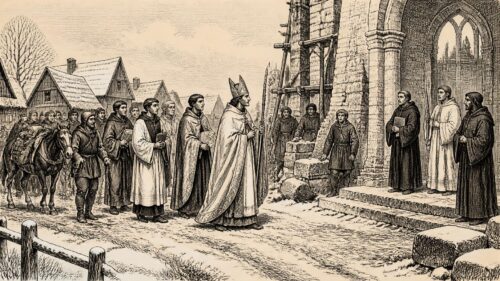
Religion remained inseparable from public power, but the visible institutions of the established Church of Ireland did not encompass the whole population. The Catholic majority maintained religious life under penal restrictions whose enforcement varied by place and period. The resilience of Catholic organisation is visible in a precisely dated ecclesiastical succession. Bernard O’Gara was selected to succeed Francis Burke as Roman Catholic Archbishop of Tuam on 14 December 1723 and was confirmed by papal brief on 23 December. A Stuart Papers record dated 15 December preserves a related nomination to the papacy.
O’Gara was not consecrated until May 1724, a distinction worth preserving. His selection in 1723 did not signal legal equality for Catholics, but it demonstrates that the Catholic hierarchy continued to replenish itself and sustain links across Ireland and Europe. For ordinary believers, worship, baptisms, marriages, kinship and informal local authority persisted beneath a political system designed to privilege the established church.
Correcting the Record at Kilmainham
One attractive Dublin story requires caution. Some short chronologies place the first opening of Dr Steevens’ Hospital at Kilmainham in 1723, perhaps because part of the building was sufficiently advanced to accommodate Grizelda Steevens. The hospital’s specialised historical project, however, dates the opening of its doors for the curable poor to July 1733. It would be misleading to make a functioning public hospital a firm event of 1723. The decade did see sustained charitable planning and fundraising under Grizelda Steevens, but the institution properly belongs to the story of 1733.
Thus 1723 was neither a year of spectacular war nor a simple turning point. Its evidence is more revealing in miniature: wool worked beside a Wicklow river; dry weather influenced a farming society; a restricted Parliament pursued revenue, order and improvement; copper minted in England prompted Irish unease; and a Catholic archdiocese secured a successor under discrimination. The Avoca co-operative brings these threads together. It was a local enterprise, but one rooted in the land, labour, markets and unequal political world of eighteenth-century Ireland.

Primary Sources
- Our History
- Avoca's 300 Year Anniversary
- Daily weather in Dublin 1716–1734: the diary of Isaac Butler
- Climate
- James Francis Edward Stuart to Pope Innocent XIII
- Archdiocese of Tuam
- Temple, Henry (1673?–1757)
- The Coinage of Ireland in Copper, Tin, and Pewter
- Table of the Amount Coined by Wood 4 June 1723 to 28 March 1724
- Detailed Report on the Trial at London of Wood's Copper Coinage for Ireland
- Jonathan Swift’s Allies: The Pamphlets and Broadsides against Wood's Halfpence
- Wood's Halfpence, 1724
- Jonathan Swift (1667–1745)
- List of Acts of the Parliament of Ireland, 1721–1730
- Pre-Union Irish Statutes
- Irish Parliamentary Elections, 1727–68
- Religion, Law, And Power: The Making of Protestant Ireland 1660–1760
- The Penal Laws: Origins, Purpose, Enforcement and Impact
- Foundation: Dr Steevens’ Hospital
- Patients: Dr Steevens’ Hospital
- History of the Commercial and Financial Relations between England and Ireland from the Period of the Restoration
- The Linen and Wool Industries in Britain and Ireland
- Statute Law Revision Act 2015
- Jonathan Swift: Freeman of Dublin