

Shinrone’s Geraldine Siege1533 CE
In 1533, Ireland was governed through competing crown, Gaelic and Anglo-Irish powers rather than uniform Dublin rule. Lord Deputy Gerald FitzGerald aided Ferganainm Ó Cearbhaill, capturing Shinrone Castle in Éile, yet a rival claimant soon emerged, exposing Geraldine dependence on alliances and rivalry with the Butlers. Annals record night seizures of Sligo and Ardnaree, punitive raids, executions and violent successions across Moylurg, Firceall and Clannaboy. These conflicts disrupted communities but lordship also rested on hospitality, learning, agriculture and church organisation. Kildare’s Dublin parliament regulated corn disputes within limited crown territory. Ireland remained Catholic, although Henry VIII’s changing position foreshadowed rupture.
Dateline
In 1533, Ireland was not a single political arena governed evenly from Dublin. Authority was layered, negotiated and often violently contested: Henry VIII was lord of Ireland; Gerald FitzGerald, ninth earl of Kildare, served as lord deputy; towns and the Pale upheld crown institutions with varying effectiveness; and Gaelic and Anglo-Irish lordships exercised power through kinship, clientage, castles, tribute, armed followings and local law. The year’s surviving record is unusually vivid in its dispersal. Annals place killings, successions, raids, betrayals and castle seizures from Moylurg and Sligo to Firceall, Clannaboy and Éile. It was a year in which the realities of regional power mattered at least as much as decrees from Dublin or London.
A Deputy in Éile
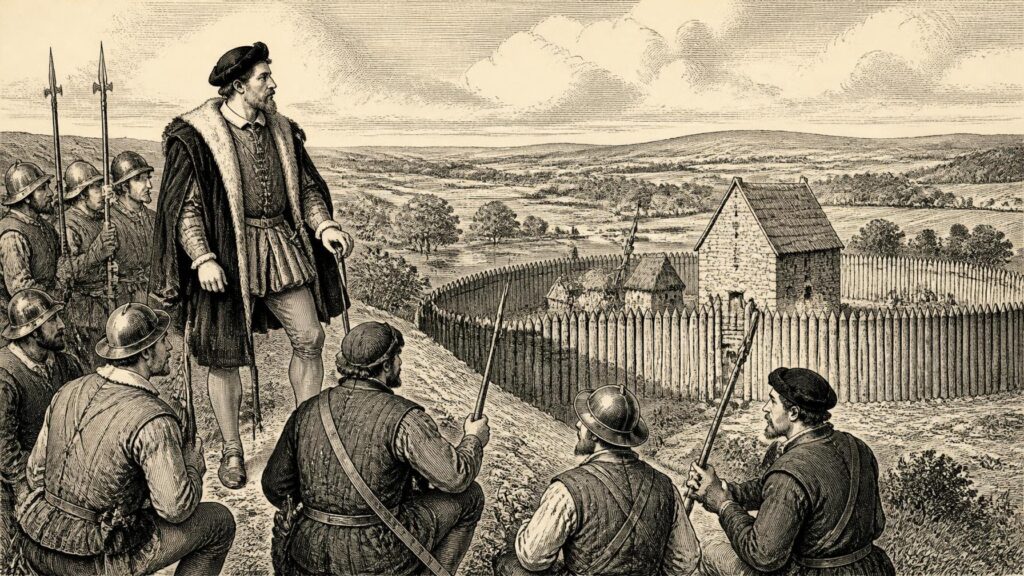
The most direct intervention by the Dublin administration recorded for 1533 was Kildare’s second expedition into Éile Uí Chearbhaill, the lordship centred on modern south Offaly and north Tipperary. The Annals of the Four Masters state that the earl came to aid Ferganainm Ó Cearbhaill, besieged a castle at Suí an Róin, now Shinrone, lost a notable constable from his following, took the fortress and returned home. The same entry says that Uaithne Carrach, son of Seán, was then proclaimed Ó Cearbhaill in opposition to Ferganainm, producing internal dissension in Éile.
This was no straightforward operation of crown law against a rebel. Kildare’s authority rested heavily on alliance. Ferganainm was connected to the Geraldine interest by marriage, and the deputy’s campaign put crown-backed military power at the disposal of one claimant within a Gaelic lordship. The capture of a castle could alter the balance between rival branches by controlling a residence, stores, dependants and a defensible point in the landscape. Yet the fact that an opposing Ó Cearbhaill could be ‘styled’ chief immediately afterwards shows the limits of conquest. Taking a fort did not settle a lordship whose legitimacy depended on kin, supporters and the ability to command them.
Shinrone also lay in a sensitive corridor between the Pale’s southern approaches, Ormond influence and the Gaelic midlands. Kildare’s expedition therefore belonged to the wider rivalry between the FitzGerald and Butler affinities. In 1533 Richard Butler was involved in fighting on the Kilkenny–Upper Ossory frontier with the Mac Giolla Phádraigs, who were allied to Kildare. The consequences of such conflicts were personal as well as political: Thomas Butler, Richard’s younger brother, had been killed in the preceding struggle, and the Butlers continued to assemble accusations against Kildare. The Geraldine deputy remained powerful, but his position was increasingly exposed to hostile reports reaching Henry VIII.
Castles, Night Attacks and Lordship
In the north-west, the annals record two striking nocturnal coups. Tadhg Óg Ó Conchobair captured Sligo Castle after members of its garrison offered guidance and surrender. On the same night, according to the Annals of the Four Masters, the sons of Thomas Burke took Ard na Ríagh, or Ardnaree, from the sons of Ó Dubhda. The independent Annals of Connacht also date the seizures of Sligo and Ardnaree to 1533. Such agreement makes their placement in this calendar year secure, though neither source provides a day or month.
These were not marginal incidents. Sligo was a strategic settlement at the mouth of the Garavogue, linking lordship in north Connacht with sea routes and land communications into Ulster. Ardnaree lay beside the Moy in Tirawley. Their capture illustrates a recurrent feature of sixteenth-century Irish warfare: masonry alone did not guarantee security. A castle needed loyal warders, food, munitions and a dependable surrounding affinity. Treachery, negotiation and local knowledge could make a night assault more decisive than a prolonged siege.
The same region saw Manus Ó Domhnaill impose his authority through punitive action. He made a major raid upon Ó hEaghra Buí, apparently for disobedience, while Niall Mac Suibhne was killed on the bridge at Sligo. Manus also hanged Muircheartach, son of Feidhlim and grandson of Toirdelbach Carrach Ó Conchobair, at the green of Annagh Castle after the captive’s sons and kinsmen refused to surrender the place in exchange for him. The episode demonstrates both the coercive character of lordship and the importance of castles as bargaining assets. A prisoner’s life could be weighed against a stronghold; his relatives’ refusal had irrevocable consequences.
Succession and the Cost of Division
Across Ireland, the year’s annalistic notices repeatedly turn on contested succession within ruling families. Diarmaid Mac Diarmata of Moylurg was treacherously killed by the sons of Eóghan son of Tadhg Mac Diarmata, and Eóghan assumed the lordship. The Annals of Connacht memorialised the dead Diarmaid as a generous patron of poets, children, the poor and people who had suffered loss. The language is formulaic in part, but it is important evidence of what a successful lord was expected to provide: protection, redistribution, hospitality and patronage of learning, not simply military prowess.
In Firceall, Domhnall Caech Ó Maolmhuaidh was killed by his brother Cú Choigriche and nephew Art at the green of Lann Eala, modern Lynally; their brother Cathaoir was then proclaimed Ó Maolmhuaidh. In Clannaboy, Feidhlim Bacach Ó Néill died, while other members of the wider Ó Néill kindred suffered violent deaths: two sons of Feidhlim son of Ruaidhrí Bacach were killed by Manus Ó Domhnaill, and Éamonn, descended from Conn, Niall and Art Ó Néill, was killed by the sons of Mag Uidhir. These were not random acts of disorder. In a political system where seniority, capacity, backing and descent could all shape succession, the death or displacement of a lord opened both opportunity and danger.
Such violence bore heavily on ordinary communities. Raids meant the seizure of cattle, horses, food and portable goods; the movement of armed men imposed demands for lodging and provisions; and insecure roads and river crossings disrupted travel. Yet Ireland in 1533 was not merely a landscape of destruction. The same sources preserve the titles of learned men, church officers and local rulers because lordship still depended on settled households, agricultural surplus, ecclesiastical sites and networks of service. Cormac Mac Cochláinn, lord of Clann Chonchobhair, died during the year, as did Cathaoir Mac Cochláinn, erenagh of Clonmacnoise. The latter office, held by a hereditary church steward, indicates the continuing local organisation that sustained one of Ireland’s most venerable religious centres.
Dublin’s Limited Parliament
Kildare held a parliament in Dublin in 1533. Its proceedings are poorly preserved, so its scale and detailed business should not be overstated. One measure associated with it addressed the taking or ‘leasing’ of corn: it penalised people who claimed sheaves as harvest payment and thereby stole grain, while also protecting tithe income. The legislation offers a rare view of a practical concern beneath high politics. Harvest labour, grain wages, gleaning and ecclesiastical dues were contested matters, and theft or disputed customary claims could damage both cultivators and the church.
It does not follow that this act describes conditions throughout Ireland. Parliament legislated most effectively in the crown’s reduced jurisdiction, above all the Pale and those communities connected to it. Still, the measure shows that grain production and the regulation of labour mattered to the political class gathered at Dublin. It also sits tellingly beside the year’s raids and castle warfare: harvests and stores were the resources that made lordship, military service and urban life possible.
Religion Before the Irish Reformation
1533 is often remembered in English history for Henry VIII’s marriage to Anne Boleyn, the annulment of his marriage to Catherine of Aragon in May, and Anne’s coronation in June. These were firmly dated English events with serious implications for Ireland, but they did not yet constitute an Irish religious settlement. The lordship’s relationship with the papacy was becoming politically precarious, while Irish bishops, religious houses, parish clergy and lay communities remained within the western Catholic church. The parliamentary measures that formally extended royal supremacy and curtailed appeals to Rome in Ireland belonged to later years.
For contemporaries in Ireland, the immediate religious landscape was therefore still shaped by established churches, monasteries, pilgrimage, hereditary ecclesiastical offices and a culture in which political legitimacy was expressed in Christian terms. The death of Clonmacnoise’s erenagh belongs in that setting. So does the commemoration of Diarmaid Mac Diarmata’s support for poets and vulnerable people: learning, hospitality and faith were woven into the public reputation of rulers.
By the close of 1533, Kildare remained deputy and the familiar structures of Irish lordship still stood. But their stability was deceptive. His intervention at Shinrone displayed the reach of Geraldine power; the feuds around Éile, Ossory and the north-west revealed its dependence on local alliances; and the changing religious and diplomatic position of Henry VIII made Irish politics more consequential at court. The following year would bring a rupture. In 1533, however, the evidence is of a country governed through many centres of power, where a castle gate opened at night, a rival was proclaimed chief, or a harvest dispute reached parliament could matter as much as decisions made across the Irish Sea.
Primary Sources
- Annals of the Four Masters, Part 4
- Annals of the Four Masters: CELT Digital Edition
- Annals of the Four Masters: Original Irish Text, Volume 5
- Annála Connacht: English Translation
- Annála Connacht: Irish Text
- The Annals of Ulster
- FitzGerald, Gerald (Gearóid Óg, Garrett McAlison)
- FitzGerald, Thomas (‘Silken Thomas’)
- FitzGerald, Elizabeth
- Butler, Richard
- Butler, James
- FitzGerald, Gerald (Gearóid Mór)
- Cromwellian Reform and the Origins of the Kildare Rebellion, 1533–34
- Ireland in the Reign of Henry VIII
- Ireland under the Tudors, Volume I
- Annals of the Kingdom of Ireland, Volume V
- A Topographical Dictionary of Ireland
- Pre-Union Irish Statutes Affected
- Statute Law Revision Act 2007
- Statute Law Revision Act 2015