Protestant Militia1715 CE
In 1715, Ireland avoided a Jacobite rising despite rebellion in Scotland and northern England, but Hanoverian authorities governed amid anxiety. Officials disarmed Catholics, enforced penal laws, monitored clergy, travellers and supplies, and reinforced ports and garrisons, although evidence of conspiracy was lacking. Troops were sent to Britain, prompting plans for a Protestant militia that lacked sufficient weapons and ammunition. The new Protestant parliament funded defence through renewed and additional taxes, while asserting control over public finance. Anti-Jacobite measures also targeted Ormond’s influence. Dublin’s theatre remained active. Ireland stayed peaceful, yet surveillance, sectarian exclusion and military expenditure deepened under imperial insecurity.
Dateline
In 1715 Ireland did not rise for the Stuart claimant, James Edward Stuart, despite the Jacobite rebellion that broke out in Scotland and spread into northern England. Yet the absence of an Irish battlefield should not be mistaken for tranquillity. The crisis reshaped government behaviour in Ireland: arms were searched for and seized, troops were moved to vulnerable ports and towns, Catholic clergy and laypeople came under intensified suspicion, and a new parliament was convened to fund defence. The year exposed both the anxieties of the new Hanoverian regime and the practical machinery through which the Protestant political elite governed a predominantly Catholic country.
A New King’s Uneasy Kingdom
George I had succeeded Queen Anne in August 1714, under the Protestant succession established by the Act of Settlement. His accession was contested by Jacobites, who regarded the Catholic James Edward Stuart as the rightful king. Ireland had been central to the earlier Williamite–Jacobite war of 1689–91, and the memory of that conflict remained sharp. Dublin Castle therefore treated rumours of a Stuart restoration not as distant British politics but as a possible prelude to invasion, rebellion and a renewed struggle for land, office and religion.
There were grounds for official concern, but also a great deal of official exaggeration. In the opening months of 1715, twenty-one people convicted of recruiting Irishmen for the Pretender’s service were transported to the West Indies; a further group awaited trial. This was evidence of continuing Jacobite connections, not evidence of a general insurrection. Senior Protestant figures, particularly Archbishop William King of Dublin, nonetheless interpreted disorder and rumour through the lens of Catholic conspiracy. Their correspondence repeatedly imagined a Catholic rising that, in fact, did not occur in Ireland during the year.
The government’s immediate difficulty was also financial. The additional customs and excise duties that supported much of the Irish establishment had lapsed in 1714 after parliamentary deadlock. Revenue fell, army pay arrears grew, and merchants had taken advantage of the gap by importing goods, notably tobacco, before duties could be restored. The end of the War of the Spanish Succession had meanwhile left Ireland as the location of the largest part of the reduced British army. Maintaining a peacetime establishment of about 12,000 men, including returning soldiers and new barracks, was expensive even before the Jacobite emergency sharpened the demand for troops and weapons.
Disarming and Watching
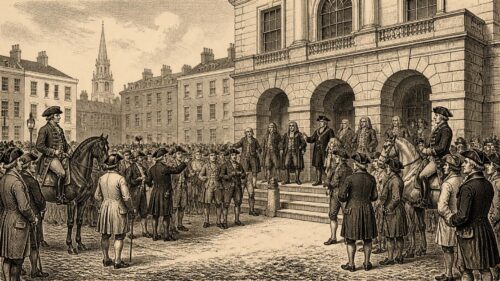
Firmly dated proclamations show how that unease translated into daily administration. On 18 March the Irish authorities ordered the disarming of Catholics. On 21 March another proclamation regulated the making and use of butter cases, a modest but revealing reminder that government also concerned itself with the standards of ordinary commercial goods. In May, a reward was offered for information about people uttering seditious words. Such measures placed political loyalty, policing and economic regulation side by side in the work of magistrates, sheriffs and local officers.
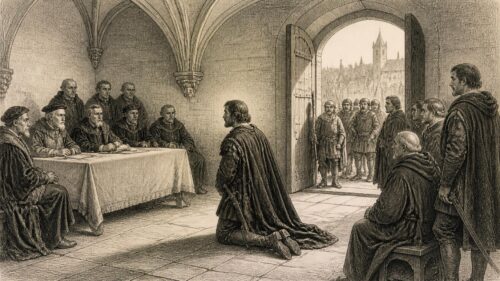
By the summer, reports of Jacobite preparations made the response more severe. On 29 July local officials were instructed to disarm Catholics and enforce the penal laws. Magistrates were expected to tender oaths to Catholics and other suspected persons, search for arms, ammunition and serviceable horses, and report local stocks of warlike stores. They were also asked for information about lodgers, strangers and other residents. For Catholic households, the threat was therefore not merely abstract legislation from Dublin: it could mean searches, the surrender of weapons or horses, scrutiny by local Protestant officeholders, and the risk that a priest or neighbour might be denounced.
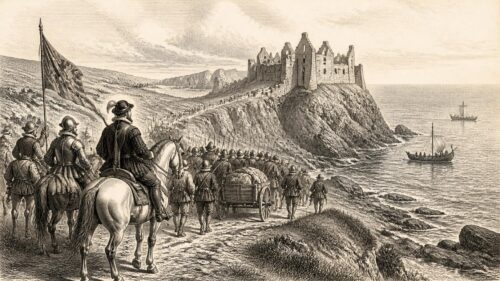
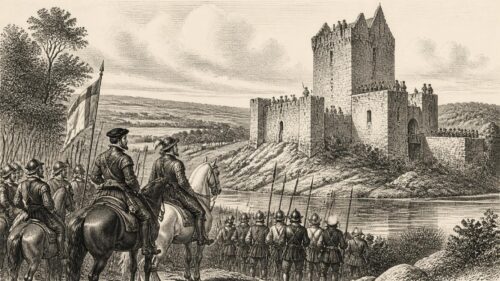
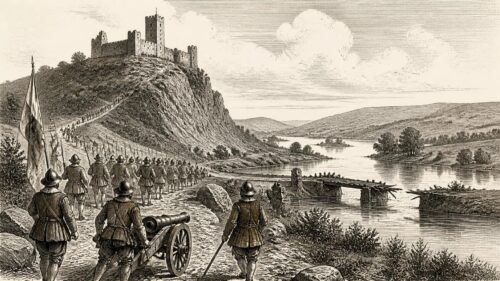
These policies rested on collective suspicion. Government correspondence commonly assumed that Catholics vastly outnumbered Protestants and might rise if a foreign landing gave them the opportunity. Such estimates were political calculations as much as demographic observations, designed to secure arms, troops and money. The important fact for 1715 is that Ireland remained peaceful despite these fears. The administration strengthened garrisons at Galway, Limerick, Cork and Kinsale, while regiments were dispatched from Ireland to Scotland and England. By autumn, twelve regiments had been drawn away from the Irish establishment. The security of ports and provincial strongholds consequently mattered as much as events in Dublin.
The Scottish Rising and Irish Responses
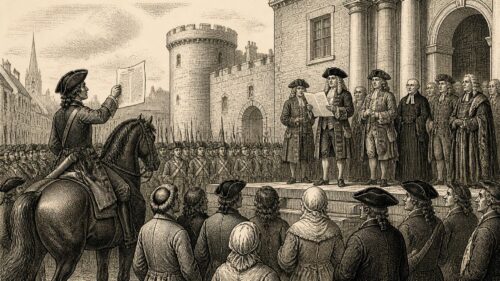
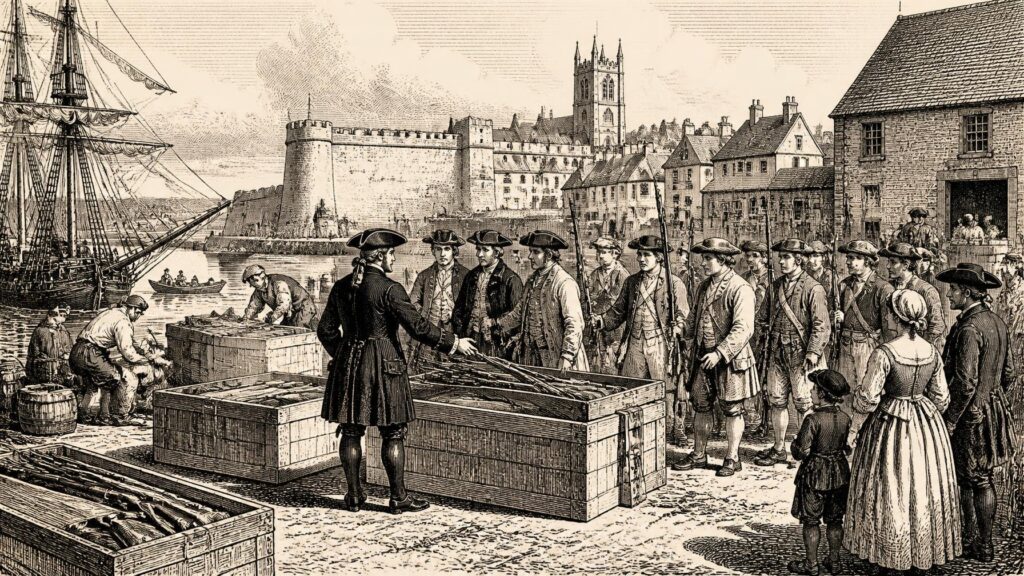
The Jacobite standard was raised in Scotland in September. The rebellion’s progress gave Irish authorities a more immediate reason to fear contact across the North Channel and the western sea routes. By early November, the government had issued commissions for a Protestant militia of up to 30,000 men, although it possessed arms for only about 15,000 and lacked adequate ammunition. The figures demonstrate ambition rather than a fully equipped force. Ireland was to be defended by a mixture of regular soldiers, locally organised Protestant militia and the deterrent force of the penal code.
Official policy tightened after the new parliament met. A proclamation of 11 November offered a reward for those involved in the rescue of James Kilkenny, a Franciscan friar. On 23 November, authorities prohibited the sending of provisions to, and contact with, Jacobites in Scotland, offered rewards for the apprehension of Catholic priests, and separately enforced restrictions on Catholics in Galway and Limerick. On 17 December they ordered the apprehension of disaffected people travelling to Scotland. These measures reveal the government’s chief anxieties: movement of people, supplies and news; the influence of regular clergy; and the possibility that coastal Ireland might sustain rather than merely observe the rebellion.
The language of these orders should not be allowed to erase the distinction between fear and proof. There was no corresponding Irish rising in 1715. The authorities’ own reports could describe the country as quiet even while demanding more arms and warning of a dangerous Catholic ‘spirit’. The result was a familiar pattern of the penal era: a Catholic majority held responsible for a hypothetical rebellion, while political authority and organised military service were made explicitly Protestant.
Parliament Meets at Dublin
A new Irish parliament assembled on 12 November under the joint lords justices, Charles FitzRoy, duke of Grafton, and Henri de Massue de Ruvigny, earl of Galway. It was an entirely Protestant legislature, and William Conolly was chosen Speaker of the Commons without opposition. The lords justices opened by stressing that Ireland was currently calm but must be placed in the best posture of defence. This was an appeal for money, but it was also a careful constitutional argument: Ireland’s own parliament was asked to finance its own security while troops were being used elsewhere in the king’s dominions.
The Commons responded quickly. On 14 November it prepared loyal addresses to the king and the lords justices. The following day it ordered heads of bills to attaint James Butler, second duke of Ormond, the former lord lieutenant then abroad, and to strengthen the crown against the Pretender and his supporters. Ormond’s political eclipse had particular Irish significance because of his immense landed influence. The parliamentary session begun in 1715 would eventually produce, in June 1716, legislation extinguishing the ancient palatine liberties of Tipperary and bringing them into closer crown control. That outcome belongs to 1716, but its origins lay in the security politics and anti-Ormond action of this session.
Parliamentary loyalty did not mean submission on every point. Members passed the government supply bill rapidly, but then attempted to protect the Commons’ customary role over taxation. They required that, in future, no money bill should be read before the House had received a report from its committee of public accounts. The dispute was technical, yet important: under Poynings’ Law, Irish bills required prior approval in England, and Irish MPs guarded what influence they retained over public finance.
The Price of Defence
Security nevertheless carried the argument. On 6 December the Commons asked for arms and ammunition for the militia; the government replied that the king had already ordered 10,000 muskets and ammunition from England. On 12 December the House resolved upon a supply of £187,587 12s. 4d. Its committees then considered continuing existing duties and imposing new ones on wine, strong waters and spirits, alongside a levy on salaries, fees, profits and pensions received by absentee government officeholders. The proposed tax on absentees reflected a persistent Irish grievance: money raised in Ireland could be drawn away to people living in England, while Irish trade remained constrained.
Before the Christmas recess, the Commons had prepared the heads of the necessary revenue measures for transmission to London. This was not simply a story of deference. Country gentlemen, officeholders and rival political interests bargained intensely over pensions, accounts and taxation. Yet the Scottish rebellion made resistance to military expenditure appear hazardous. Fear of Jacobitism helped secure funds that might otherwise have proved much harder to obtain.
Dublin’s Stage and Ireland’s Divided Public Life
Political emergency did not suspend urban culture. The first secure record of the future novelist and playwright Eliza Haywood places “Mrs Haywood” at Dublin’s Smock Alley Theatre in 1715, performing in Thomas Shadwell’s adaptation of Timon of Athens, or The Man-Hater. The surviving notice is slight, but it confirms that the theatre continued to connect Dublin with the wider theatrical world even as government correspondence dwelt on invasion and sedition.
By the end of 1715, then, Ireland had avoided war but paid a political price for imperial insecurity. The state had expanded its surveillance, intensified anti-Catholic enforcement, armed for a contingency that never materialised, and drawn parliament into a larger military and fiscal commitment. The muskets requested for the militia symbolise the year’s central reality: Ireland was not a theatre of the Fifteen, but it was governed as a kingdom that might become one.

Primary Sources
- Securing the Hanoverian Succession in Ireland: Jacobites, Money and Men, 1714–16
- Securing the Hanoverian Succession in Ireland: Jacobites, Money and Men, 1714–16
- Statute Law Revision Act 2015
- Statute Law Revision Act 2015 (PDF)
- The Second Year of George I – Chapter IX: An Act to Make the Militia of this Kingdom More Useful
- Statutes in Chronological Order: The Reigns of King George I and II
- An Act to Make the Militia of This Kingdom More Useful
- Acts and Statutes Made in a Parliament Begun at Dublin, the Twelfth Day of November, Anno Dom. 1715
- Acts and Statutes Made in a Parliament Begun at Dublin, the Twelfth Day of November, Anno Dom. 1715
- Journals of the House of Commons of the Kingdom of Ireland
- Butler, James
- Fitzroy, Charles
- Massue de Ruvigny, Henri
- Ormond Papers: Additional Collection List
- Statute Law Revision Act 2007
- Statute Law Revision (Pre-Union Irish Statutes) Act, 1962: Schedule
- The 1715 Rebellion
- Jacobite Rebellion of 1715
- Jacobite Risings
- The Making of the Irish Protestant Ascendancy
- Eliza Haywood
- The Yale Shakespeare: Timon of Athens