Dundalk Camp1689 CE
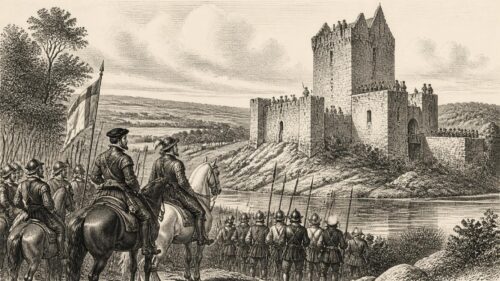
In 1689, deposed James II made Ireland the central theatre of his struggle against William of Orange, supported by Tyrconnell, Catholics and French aid. While Jacobite forces advanced, Protestant resistance at Derry and Enniskillen endured. James’s Dublin parliament funded war, asserted Irish legislative independence, repealed land settlements and passed an extensive Act of Attainder, alongside liberty of conscience. Naval relief ended Derry’s 105-day siege, while Enniskillen’s victory at Newtownbutler weakened Jacobite control in Ulster. Schomberg’s multinational Williamite army landed in August, but its autumn camp at Dundalk suffered devastating disease, exposure and supply failures, leaving the war unresolved that winter.
Dateline
A Kingdom Re-entered
In 1689 Ireland became the principal battlefield in the struggle unleashed by the overthrow of James II in England. The conflict was not simply an Irish religious war, although religious allegiance mattered profoundly. It joined disputes over monarchy, land, law, local security and the international contest between William of Orange and Louis XIV. In Ireland, James still possessed a substantial base of support, particularly among Catholics who had gained influence under his lord deputy, Richard Talbot, earl of Tyrconnell, and who expected a more durable redress of the land settlement imposed after the Cromwellian conquest.
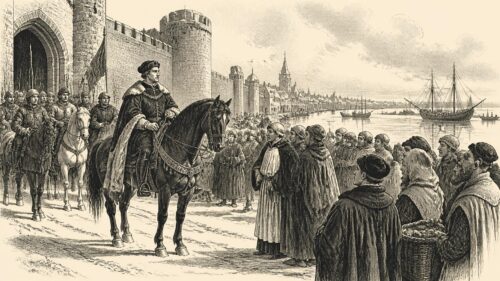
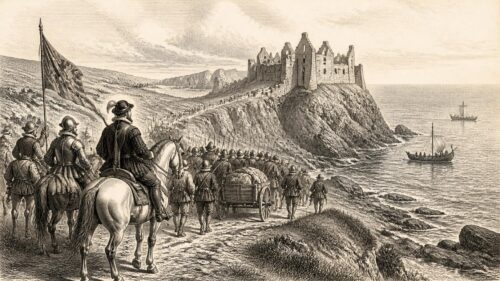
James landed at Kinsale on 12 March, accompanied by French support, arms, money and a small body of troops and officers. His arrival gave a visible royal centre to a government which Tyrconnell had been trying to hold together through the crisis of 1688–89. James proceeded through Cork and entered Dublin on 24 March. Much of the island acknowledged him, but not all of it. Protestant resistance remained entrenched at Derry and Enniskillen, while many Protestant proprietors, clergy and officeholders had fled or were preparing to leave. Ireland was therefore at once a refuge, a military base and a contested kingdom for the deposed monarch.
Ulster’s Divided Spring
The war’s first campaigning season revealed the unstable character of power on the ground. Jacobite forces moved through Ulster under Lieutenant-General Richard Hamilton, breaking local Protestant resistance at Dromore in March and pressing north-westwards. Yet possession of roads and towns did not automatically produce obedience. Communities had access to weapons, local leaders and inherited fears shaped by the violence and confiscations of the preceding decades. Rumours of intended massacres, whether credible or not, sharpened alarm and encouraged armed self-defence among Protestants.
Derry became the most consequential point of resistance. Its gates had been shut against troops in December 1688, but its position remained precarious in the spring. Robert Lundy, the governor, doubted that the city could be supplied or defended successfully. After Jacobite advances near the River Finn and the arrival of English regiments that soon departed again, divisions within the town became acute. Lundy escaped on 19 April. Henry Baker and the Anglican clergyman George Walker were then selected as joint governors, while Adam Murray emerged as an energetic military leader among the defenders.
James personally appeared before Derry in April. When terms were rejected, the operation developed into a protracted siege rather than a rapid submission. Jacobite troops and artillery surrounded a settlement protected by early-seventeenth-century walls, while the defenders made sorties, repaired damage and attempted to preserve order. The siege was never merely a contest between professional armies. Townspeople, refugees, clergy, artisans and soldiers were all caught within its daily demands. Food became steadily scarcer; animals were consumed, sickness spread and civic routines were subordinated to guard duty, rationing and the fear of bombardment.
Parliament at King’s Inns
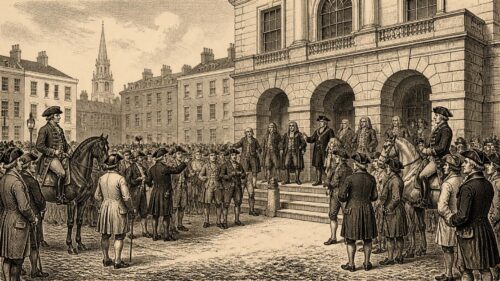
While fighting continued in Ulster, James summoned an Irish parliament, which met in Dublin from 7 May until 20 July. It was the first Irish parliament since 1666 and the only one opened in person by a reigning English and Irish monarch before the institution’s abolition in 1800. Richard Nagle, a Catholic lawyer and Tyrconnell associate, served as Speaker of the Commons. The assembly has often been called the ‘Patriot Parliament’, a later and contested label which can conceal its divisions and the extraordinary wartime conditions under which it sat.
Its legislation shows that the Jacobite administration was attempting both to fund a war and to remake the constitutional and proprietorial order. The surviving acts included measures recognising James’s title, raising supply for the army, granting liberty of conscience, addressing tithes and ministerial provision, regulating aspects of trade and finance, and asserting that the English parliament could not bind Ireland. Most consequentially, parliament repealed the Acts of Settlement and Explanation, the Restoration statutes which had confirmed much Protestant and Cromwellian landholding after 1660. The repeal held out the prospect of restoring land to many Catholic families dispossessed after the mid-century wars.
That prospect was inseparable from insecurity for those who held the estates. The Act of Attainder targeted a very large number of alleged rebels and absentees, threatening their lives and property unless they returned and submitted by specified deadlines. Later polemic made the act a central emblem of Jacobite intolerance; its scale and coercive purpose require no embellishment. At the same time, the parliament’s act for liberty of conscience complicates any simple reading of its programme. It offered formal religious liberty more broadly than the established arrangements it displaced, even as war, flight and confiscation made legal assurances difficult to separate from the unequal power of the moment.
Sea Power and a Broken Siege
Ireland’s crisis was tied directly to the sea. French naval assistance enabled James to reach Ireland and brought desperately needed material support. In May, an Anglo-Dutch and French naval encounter in Bantry Bay underlined that Irish waters had become part of a wider European war. Neither side could treat the island as an isolated theatre: supplies, reinforcements, intelligence and political survival depended upon maritime routes.
At Derry, relief from the sea became decisive. Williamite ships reached Lough Foyle in June but initially hesitated to force the river barrier, or boom, which the besiegers had placed across the Foyle. On 28 July the merchant vessel Mountjoy, assisted by the Phoenix and naval fire, broke the boom. Supplies entered the city. The Jacobite siege was lifted three days later, on 31 July. Derry had endured for 105 days. Its survival preserved a northern foothold for William’s cause and ensured that the war would continue on a larger scale.
Enniskillen and Newtownbutler
Enniskillen was the other major Ulster centre that resisted James. Its defenders were not a conventional field army at the beginning of the year: they were a locally raised Protestant force, mixing garrison soldiers, volunteers and armed civilians. Their position mattered because Enniskillen sat near routes between Ulster and Connacht and could threaten Jacobite communications in the west.
On 31 July, near Newtownbutler in County Fermanagh, Enniskillen forces commanded by Colonel William Wolseley defeated a Jacobite army led by Justin McCarthy, Viscount Mountcashel. The scale of casualties remains disputed in the partisan accounts, and later narratives often magnified the drama. The result itself is firm: Mountcashel’s force was routed, he was wounded and captured, and Jacobite control in western Ulster was badly weakened. Coming on the same day that Derry’s siege was abandoned, the defeat was a severe strategic and psychological blow to James’s Irish administration.
Schomberg’s Northern Landing
William responded with a major expedition commanded by Frederick Herman von Schomberg, a veteran continental soldier and Huguenot exile. Schomberg landed in Belfast Lough on 13 August with an army that included English, Dutch, Huguenot and Ulster troops. This international composition was a reminder that Ireland’s future was being contested by forces recruited and financed across Europe. It did not, however, guarantee an efficient campaign. Many of the English and Ulster units were recently raised; transport, medical provision and supply arrangements were inadequate.
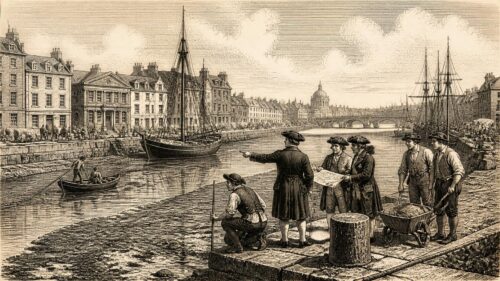
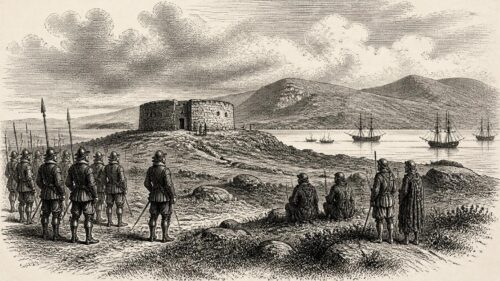
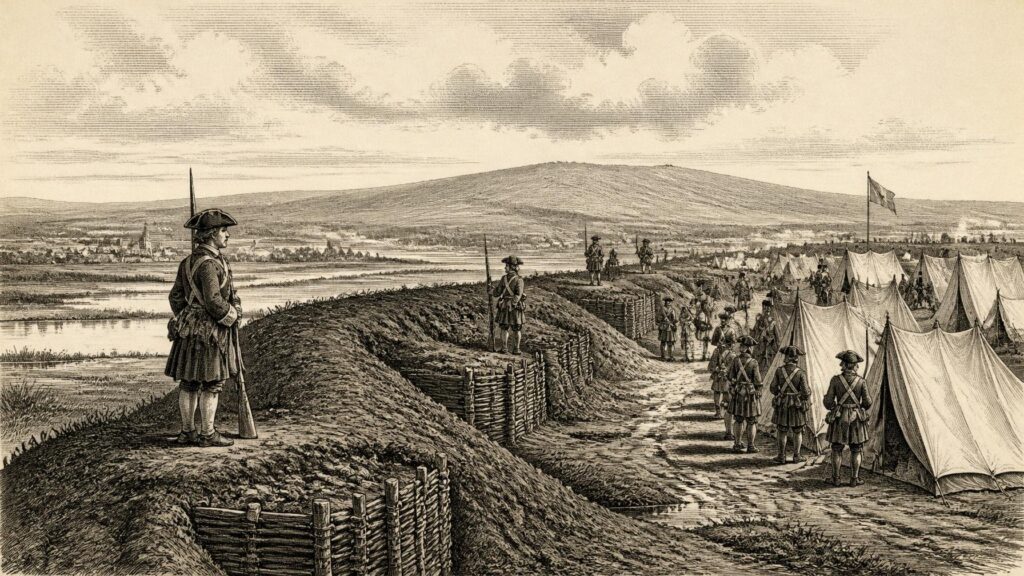
Schomberg captured Carrickfergus after a siege, then moved south through a landscape from which provisions had been removed or destroyed. Newry had been burned before his arrival. He reached Dundalk on 7 September and entrenched his army on low ground near the town. James’s forces camped nearby around Ardee and the River Fane. The two armies faced one another in September, but neither commander chose a costly assault on the other’s position. James withdrew his principal army to winter quarters in early November; Schomberg followed soon afterwards.
The apparent stalemate concealed a disaster in the Williamite camp. Rain, cold, exposure, poor food, inadequate shelter and contagious illness produced a catastrophic mortality. Contemporary and later estimates differ, but thousands of Schomberg’s men died during the autumn and early winter. Dundalk demonstrated a hard lesson of seventeenth-century warfare: armies could be defeated by disease and logistics even without a pitched battle. The camp’s suffering also affected the surrounding district, which had to bear requisitions, troop movements, hospital needs and the disruption of ordinary cultivation and trade.
Government, Money and Daily Strain
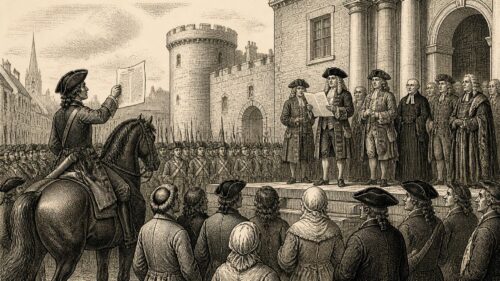
War altered government far beyond the battlefields. James’s administration issued proclamations against abuses by soldiers in June, an acknowledgement that armed men could prey upon the population they were meant to defend. It also addressed illegal imprisonments, militia service, the disarming of ‘disaffected’ Protestants and restrictions on their movement. Such orders reveal a state trying to mobilise men and resources while managing distrust within its own territory.
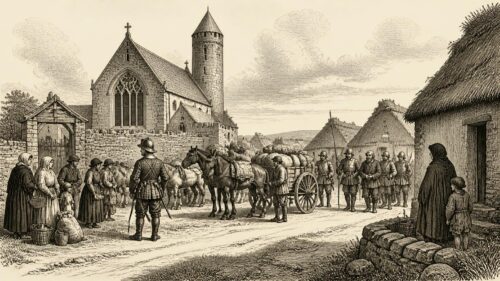
Money was another immediate problem. With silver scarce and military expenditure pressing, the Dublin government experimented with additional copper and brass coinage. Parliamentary legislation also considered shipping, commerce and the encouragement of settlers and craftsmen. These were ambitions for a reconstructed kingdom, but the circumstances were hostile to normal economic life. Roads were dangerous, livestock and grain could be requisitioned, ports were vulnerable to blockade, and displaced households had little certainty that property, rents or debts would be protected.
By the close of 1689, James retained Dublin and most of Leinster, Munster and Connacht, but the year had transformed the balance of the war. Derry and Enniskillen had survived; Schomberg had established a Williamite army in the north; and both political settlements proposed in Dublin and military authority in the countryside remained provisional. Ireland entered the winter not at peace, but as the central arena in a contest that would determine landholding, confessional power and allegiance for generations.

Primary Sources
- The Acts of James II’s Irish Parliament of 1689
- The Acts of James II’s 1689 Parliament (sample PDF)
- Talbot, Richard
- William III
- Schomberg (Schönberg), Frederick Herman von
- Lundie (Lundy), Robert
- A Jacobite Narrative of the War in Ireland
- The Journal of John Stevens, Containing a Brief Account of the War in Ireland, 1689–1691
- The Irish Parliament of James II
- Statute Law Revision Act 2015
- Two Letters of Lord Tyrconnell to the Duke of Hamilton and the Earl of Perth
- The Actions of the Enniskillen-men from their First Taking Up Arms in 1688
- Plan of Dundalk, 1689
- Schomberg at Dundalk, 1689
- Schomberg at Dundalk, 1689
- The War of the Three Kings, 1689–91
- Battle of Newtownbutler
- The Landing of James the Second at Kinsale in 1689, with an Account of his Subsequent Entry into Cork
- Colonel Adam Murray
- Tour of Derry’s Walls
- History of the Guildhall
- Unhappy Campers: Dundalk (1689) and After
- History, Historical Investigations and Interpretations: Ireland 1685–1714
- The Landing of James II at Kinsale and the Ballinvinny South Coin Hoard