

Galway’s Punished Jury1636 CE
In 1636, Thomas Wentworth’s administration intensified royal control in Ireland through land, religion, economic regulation and culture. Galway jurors who rejected the Crown’s Connacht title were fined and imprisoned, demonstrating the coercive defence of plantation policy. Although Wentworth departed for England in July, trusted officials maintained his programme with royal support. Linen regulations sought to standardise rural spinning and promote exports. In Ulster, Bishop Henry Leslie silenced five ministers refusing Anglican canons, narrowing religious latitude. Meanwhile, the Four Masters completed their Irish annals, and Dublin’s Werburgh Street theatre flourished. These developments revealed an apparently peaceful kingdom under mounting centralised pressure.
Dateline
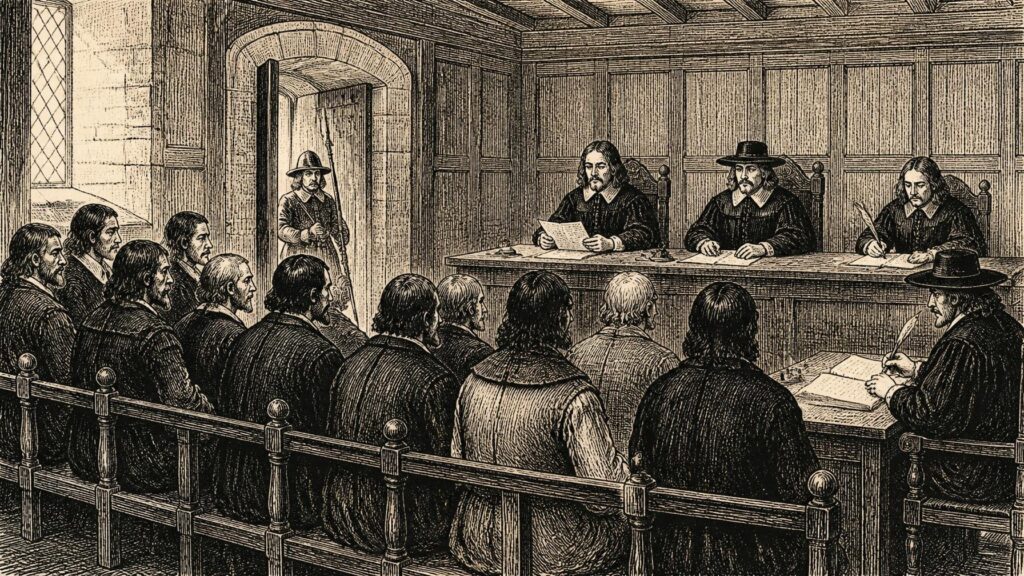
In 1636 Ireland was not at war, yet the year exposed how forcefully the government of Charles I could reach into landholding, worship, work and public culture. Thomas Wentworth, the lord deputy, had made Dublin Castle the centre of an unusually assertive administration. His programme promised orderly government, fuller royal revenue and economic improvement; to many who experienced it, especially where land and religion were concerned, it also meant coercion. The most revealing episode of the year concerned twelve Galway jurors whose refusal to endorse the Crown’s title to their county’s land became a test of whether a jury could resist the king’s deputy.
A Jury Under Pressure
The dispute had begun in 1635, when Wentworth pressed the ancient royal claim to Connacht. By treating the medieval grant of the province to Lionel of Antwerp as a continuing title in the Crown, officials sought verdicts that would clear the way for a new plantation. Juries in Roscommon, Mayo and Sligo found for the king. County Galway did not. Its jurors rejected the Crown’s claim, in a county where the political weight of the Catholic Earl of Clanricarde and the interests of old landowning families made the proposed settlement particularly threatening.
The repercussions belonged squarely to 1636. On 27 and 28 May the Galway jurors faced proceedings in Dublin’s Court of Castle Chamber, the prerogative court that Wentworth used to discipline opposition. They were accused of having improperly combined to obstruct royal justice. Contemporary and later accounts agree on the essentials: severe fines were imposed and the jurors were imprisoned until they acknowledged wrongdoing. Traditional accounts put the fine at £4,000 for each juror, an enormous and ruinous figure; whatever the precise enforcement of those penalties, the punishment was intended as a public warning well beyond Galway.
This was not an ordinary quarrel over a boundary or a private inheritance. A verdict on title could determine whether a county’s existing proprietors retained their estates or were required to surrender a large share for colonisation. Wentworth regarded resistance as dangerous precedent. Galway’s landholders saw it as a challenge to property that could not fairly be answered by reviving remote claims. Their agents had already sought redress in London, and the contest therefore joined local landholding to court politics across the Stuart kingdoms.
By December the jurors submitted. Their formal acknowledgement of the Crown’s title followed in February 1637, so it should not be claimed that the whole legal business ended in 1636. Nor did a Connacht plantation immediately transform the countryside that year. Surveying and projected schemes lay ahead, while wider crises eventually overtook Wentworth. But the submission marked a decisive moment in the year: resistance to the deputy’s land policy had been broken through judicial punishment rather than persuasion.
Government From Dublin and London
On 3 July Wentworth left Ireland for England. Adam Loftus, Viscount Loftus of Ely and lord chancellor, and Sir Christopher Wandesford, master of the rolls, were sworn as lords justices during his absence. This was not a relaxation of government. Wandesford was Wentworth’s trusted collaborator, and correspondence from the summer shows the deputy giving detailed direction on patronage, ecclesiastical livings, plantation business, trade and the army. Administration continued from Dublin, but its most important decisions remained closely tied to the deputy’s access to Charles I.
Wentworth’s journey enabled him to defend his conduct before the king against enemies alarmed by his methods. Charles backed him. A renegotiation of the customs farm increased the Crown’s share of its proceeds, while Wentworth retained his own interest in the arrangement. The episode helps explain the confidence with which the Irish administration acted during the year. It was not simply the authority of a forceful governor: it was power confirmed at Whitehall and exercised through courts, councils, commissions and favoured servants.
Such government also rested on information. Titles were scrutinised, rents and customs watched, and local officers expected to implement policy. The planned Connacht surveys, whose surviving descendants preserve valuable evidence of ownership and land use, belonged to this administrative world. For tenants and smaller occupiers, the immediate experience of these policies was often indirect: a landlord’s anxiety, new demands for documentation, official visitors, or uncertainty over the security of a holding. Yet the Galway affair showed that questions of title could rapidly become questions of liberty and livelihood.
Yarn, Flax and Regulation
Economic policy reached into households as well. A proclamation of 31 May regulated the reeling of yarn. It formed part of Wentworth’s attempt to make linen manufacture more regular, marketable and profitable. Linen was not invented by the deputy: flax, yarn and cloth had long been made and traded in Ireland, and spinning was widespread domestic work. But the government hoped to impose standards of size and quality, encourage better cultivation and retain more of the value of production within the kingdom.
Wentworth reported in 1636 that he had obtained flax seed from the Low Countries, recruited skilled workers and established several looms. His claim that Irish linen could compete with continental cloth should be read as an administrator’s hopeful prospectus rather than proof of an instant industrial transformation. The May proclamation nevertheless matters because it reveals the practical scale of policy. Spinning was commonly undertaken by women in rural homes; regulating yarn therefore touched labour performed alongside farming, food preparation and childcare, not merely a specialised urban trade.
The same policy contained a tension that would recur in Irish economic history. Standardisation might improve buyers’ confidence and create outlets for cloth, but inspection, seizure and prescribed methods could burden producers who worked with limited tools and cash. In 1636 the linen initiative was still an ambitious experiment, not the later northern industry with which Irish linen is often associated. It is best understood as a government-led effort to reshape an existing rural craft for export and revenue.
Conformity in Ulster
Religious discipline produced another firmly dated confrontation. Henry Leslie, Church of Ireland bishop of Down and Connor, had required clergy to subscribe to the canons adopted by the Irish convocation in 1634. Those canons strengthened conformity with episcopal church order and ceremonial practice. Several ministers serving Ulster congregations, many of them Scottish in background and Calvinist in conviction, refused. They were not yet members of a separate Presbyterian church in the later institutional sense; they held benefices within the established Church of Ireland while dissenting from episcopal requirements.
A public disputation took place at Belfast on 11 August. James Hamilton of Ballywalter spoke for the ministers before a large gathering, but the debate was not allowed to reach a settlement. On 12 August Leslie passed sentence on five non-subscribers: Edward Brice of Ballycarry, Henry Calvert, James Hamilton, John Ridge and Robert Cunningham. They were deposed or silenced within the diocese. Brice, elderly and in frail health, died later that year.
The Belfast proceedings mattered far beyond five parishes. They made clear that a degree of latitude which had previously allowed Presbyterian-leaning ministers to serve Ulster congregations was narrowing sharply. Some of the silenced clergy moved to Scotland, and members of their congregations contemplated emigration. It would be misleading to treat the event as the creation of Irish Presbyterianism in a single day. Its importance lies instead in defining a boundary: the state church, backed by bishops allied with Wentworth and Archbishop William Laud, would demand outward conformity.
Writing Ireland’s Past
Amid these contests over obedience, a very different kind of authority was being assembled in the Irish language. On 10 August, according to the completion note traditionally associated with the work, Mícheál Ó Cléirigh and his collaborators completed Annála Ríoghachta Éireann, the Annals of the Kingdom of Ireland, now generally called the Annals of the Four Masters. The compilation had begun in 1632 under the patronage of Fearghal Ó Gadhra of Coolavin.
Ó Cléirigh worked with Cú Choigcríche Ó Cléirigh, Fearfeasa Ó Maol Chonaire and Cú Choigcríche Ó Duibhgeannáin, drawing together annals, genealogies, saints’ lives and other learned materials into a continuous chronicle reaching to 1616. Older accounts locate completion in the Franciscan convent at Donegal; modern manuscript scholarship places the friars’ principal working base at the Franciscan refuge of Bundrowes near Bundoran. The distinction is worth preserving, but both point to north-western Franciscan networks sustaining Irish scholarship despite the insecure position of Catholic religious life.
The annals were not a neutral modern history. Their chronology, selection and interpretation reflected inherited learning, Christian universal history and the concerns of Gaelic aristocratic culture. Yet their completion was an extraordinary act of preservation. At a time when official government was testing titles and remaking authority in English legal forms, scribes and scholars completed a vast record of Irish kings, churches, families, conflicts and deaths in Irish. The contrast is striking, but not simple: seventeenth-century Ireland contained overlapping political, religious and cultural worlds, not two sealed communities.
A Theatre and an Uneasy Calm
Dublin also acquired a new cultural possibility. John Ogilby’s Werburgh Street theatre, close to Dublin Castle, was certainly operating by 1636 and was the first purpose-built professional theatre in Ireland. Later in the year, after plague had shut London’s theatres, the prominent playwright James Shirley accepted Wentworth’s invitation to come to Dublin. He would become closely associated with Ogilby’s company, though the better-documented productions of his Irish plays belong mainly to 1637 and after. Thus 1636 was the year of Shirley’s move and the theatre’s consolidation, rather than a year to assign to it a specific Shirley premiere without qualification.
The playhouse expressed the courtly and metropolitan side of Wentworth’s programme: a Dublin capable of displaying English-language professional drama under viceregal patronage. It stood in marked contrast to the Franciscan scholarly labour in the north-west, while the Galway jury and Belfast ministers showed the penalties faced by those who resisted official policy. Ireland in 1636 was therefore neither tranquil nor openly rebellious. It was a kingdom being pressed towards a more centralised model of rule, even as its communities preserved, contested and adapted the older loyalties that would soon make that apparent calm impossible to sustain.
Primary Sources
- Wentworth, Sir Thomas
- Wandesforde, Christopher
- The Lord Deputy’s Deputy: Christopher Wandesford’s Role in Sir Thomas Wentworth’s Irish Administration of Charles I’s Reign
- Annals from 1504 to 1639
- Statute Law Revision Act 2015
- Part 8 of History of the Commercial and Financial Relations between England and Ireland from the Period of the Restoration
- CalmView: Record — Reforming the Spinners of Linen Yarn in Ireland
- Wentworth’s Economic Policy
- Brice (Bryce), Edward
- Leslie, Henry
- The Eagle Wing 1636
- Dictionary of National Biography: Ridge, John
- Dictionary of National Biography: Hamilton, James (d. 1666)
- MS A 13: Annals of the Four Masters
- Annals of the Four Masters
- Annals of the Four Masters
- Ogilby, John
- Shirley, James
- Wentworth, Shirley, and Werburgh Street
- The Irish Plays of James Shirley, 1636–1640
- Irish Warrants—Hidden Treasures from the East (Riding)
- Cartography: ‘Ireland’s True Survay’, 1630s
- Quit Rent Office
- Ireland Under the Stuarts, Volume I