

18th Century Ireland CE
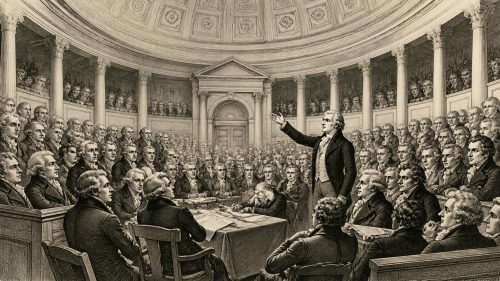
College Green’s Last Session
Archived: 11 October 2026
In 1800, Ireland remained a separate kingdom with its own parliament, courts and administration, but the Acts of Union passed in Dublin and London, ending its legislature from 1 January 1801. Cornwallis and Castlereagh secured support amid patronage, compensation and opposition led by Henry Grattan. The Union transferred limited Irish representation to Westminster, preserved the established Protestant church, and left Catholic emancipation unresolved. Post-rebellion repression continued, including Roddy McCorley’s execution, while food scarcity prompted controls on distilling and exports. Parliament also regulated trade, institutions and local improvements. Dublin retained political activity yet faced loss of its resident legislature and disruption.
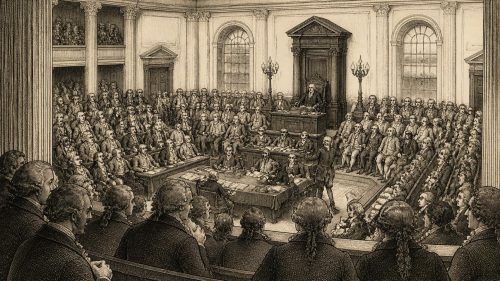
Foster’s Defiant Majority
Archived: 11 October 2026
In 1799, post-rebellion Ireland remained militarised and insecure as Cornwallis and Castlereagh sought legislative union with Great Britain. Their proposal was defeated in the Commons, where Speaker John Foster led a narrow anti-union majority, although the Lords approved it. Public celebrations reflected resistance, but the unrepresentative Dublin parliament excluded Catholics. During the pause, government prepared to rebuild support through patronage. Courts martial, disturbed-district proclamations, prosecutions and transportation continued, tempered by Cornwallis’s commutations. Catholic bishops considered state oversight of appointments, while lay Catholics opposed union. Autumn rains damaged potatoes, raising subsistence fears amid wartime financial disruption. Ireland nevertheless faced constitutional change.
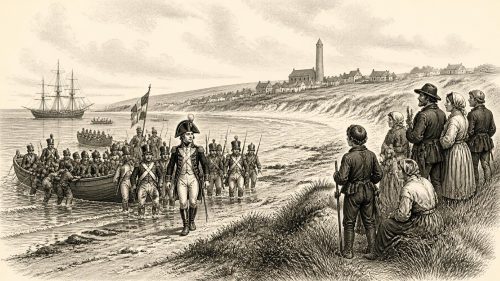
Vinegar Hill and Killala
Archived: 11 October 2026
In 1798, the United Irishmen attempted a national revolution against British rule, seeking a representative Irish republic uniting Catholics, Presbyterians and reforming Anglicans with French support. Arrests, coercion and weak coordination fragmented the rising into regional conflicts. Wexford rebels captured Enniscorthy and Wexford town, but atrocities including Scullabogue accompanied fighting before defeat at Vinegar Hill. Ulster risings at Antrim and Ballynahinch failed. In August, General Humbert’s French force landed at Killala, won at Castlebar, then surrendered at Ballinamuck. Repression, executions and transportations followed. The rebellion’s violence and French intervention strengthened arguments for union, reshaping Irish politics and leaving divisive legacy.
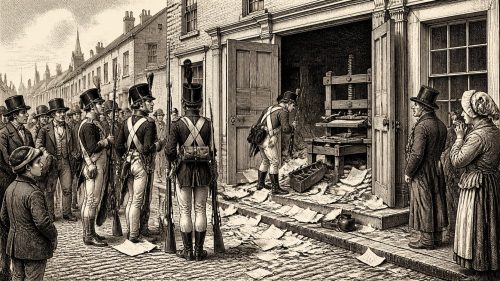
Orr and the Northern Star
Archived: 11 October 2026
In 1797, Ireland faced mounting tension between the clandestine United Irishmen and a government anticipating rebellion and French invasion. General Gerard Lake’s Ulster disarmament campaign seized weapons, intimidated communities and weakened northern radical networks. After Monaghan militiamen implicated in United Irish activity were executed at Blaris, fellow soldiers destroyed Belfast’s Northern Star, silencing a major radical newspaper. Arrests also disrupted Cork organisers, while calls for constitutional conciliation gained little ground. William Orr’s contested conviction and hanging made him a powerful martyr. Meanwhile, parliamentary limitations and bank restrictions exposed wider political and economic insecurity, foreshadowing the 1798 rebellion in Ireland itself.
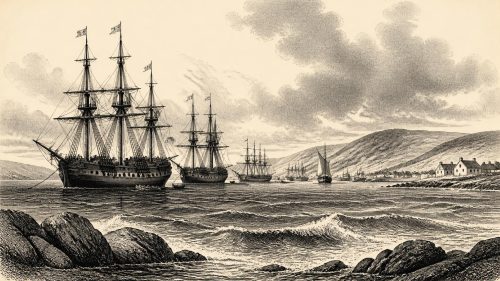
Bantry Bay’s Unlanded Army
Archived: 11 October 2026
In 1796, Ireland faced an attempted French invasion that exposed the convergence of revolutionary politics, sectarian tension and wartime insecurity. Theobald Wolfe Tone helped secure French support for an expedition under General Hoche, but storms, dispersal and confused command prevented its 14,000 troops from landing at Bantry Bay. Dublin Castle answered unrest with the Insurrection Act and newly established yeomanry, while Orange organisation strengthened Protestant loyalism. Catholic responses varied, exemplified by Bishop Francis Moylan’s anti-revolutionary pastoral. Meanwhile, the Royal Canal reached Kilcock and Edward Bunting published Irish harp music. The failed invasion intensified repression, mobilisation and republican hopes before 1798.
Maynooth, Diamond and Recall
Archived: 12 October 2026
In 1795, wartime Ireland experienced reform, concession and sectarian conflict within its subordinate relationship to Britain. Lord Fitzwilliam’s arrival encouraged Catholic hopes of parliamentary admission, but London recalled him and defeated Grattan’s bill, undermining constitutional reform. United Irish leaders consequently moved further towards clandestine republicanism; Wolfe Tone departed for America seeking French support. Parliament nevertheless founded St Patrick’s College, Maynooth, to train Catholic clergy domestically. In County Armagh, the Battle of the Diamond confirmed Protestant dominance and prompted the formation of the Orange Order, followed by expulsions of Catholics. Routine infrastructure, legal and trade measures continued amid insecurity and polarisation.
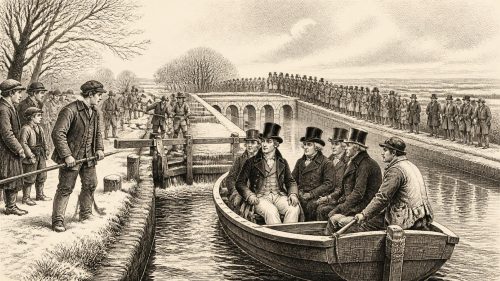
Lagan Waterway and Dublin Trials
Archived: 12 October 2026
In 1794, Ireland combined commercial development with intensifying political repression. The Lagan Canal’s completion linked Belfast to Lough Neagh, improving Ulster’s transport connections, while a gunpowder enterprise at Ballincollig reflected wartime industrial demand. Dublin’s United Irishmen publicly advocated parliamentary reform, but official alarm over French links led to raids and suppression; William Drennan’s acquittal for seditious libel nevertheless encouraged reformers. Rural violence involving Defenders, militia and local grievances demonstrated wider insecurity, though Defenders remained distinct from United Irishmen. Fitzwilliam’s appointment as Lord Lieutenant raised hopes of Catholic concessions. Mary Leadbeater’s educational publication also testified to continuing cultural and moral debate.
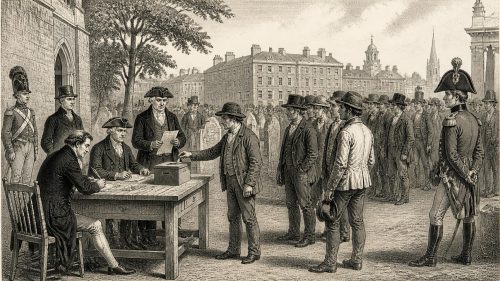
Keogh, Franchise and Ballot
Archived: 12 October 2026
In 1793, Ireland combined Catholic relief with intensified state control amid war with revolutionary France. Following John Keogh’s Catholic Convention petition, the Roman Catholic Relief Act enfranchised qualified Catholic forty-shilling freeholders and opened certain employment and educational opportunities, while retaining exclusion from parliament, senior offices and Trinity fellowships. The Gunpowder Act regulated weapons, while the Irish Militia Act introduced parish enrolment and ballots, incorporating Catholics and Presbyterians into government service. The Convention Act restricted representative political assemblies, constraining reformers and United Irishmen. Economic pressures, militia obligations and print culture shaped daily life. The year broadened participation whilst strengthening coercive administration.
Back Lane and Belfast Harps
Archived: 12 October 2026
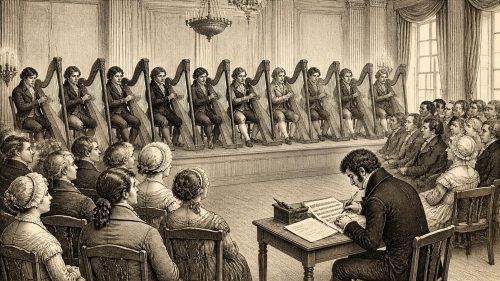
In 1792, Irish politics was shaped by Catholic relief, reform agitation and anxiety after the French Revolution. The Catholic Relief Act eased restrictions on education, law and mixed marriage but withheld voting and parliamentary rights. December’s Back Lane Convention demonstrated Catholic national organisation and petitioned for constitutional participation. In Belfast, United Irishmen and Volunteers promoted reform, religious unity and sympathy with France, prompting repression. The Belfast Harp Festival preserved a musical tradition through Edward Bunting’s transcription. Economic measures supported linen, fisheries, navigation, roads and enterprise while export embargoes revealed insecurity. Together these developments enlarged Ireland’s public sphere without producing revolution.
The Belfast Declaration
Archived: 12 October 2026
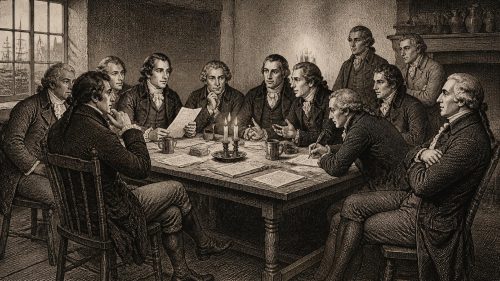
In 1791, Irish politics became organised without delivering constitutional change or Catholic emancipation. Belfast’s Bastille commemoration and the founding of the Society of United Irishmen linked parliamentary reform, Catholic inclusion and civic unity across religious divisions, influenced by Theobald Wolfe Tone. Dublin radicals, including John Keogh, Edward Byrne, James Napper Tandy and William Drennan, strengthened Catholic and reform movements, provoking divisions with conservative Catholic elites. The Dublin Custom House symbolised both commercial ambition and state authority, while the Grand Canal’s Barrow link improved transport to Waterford. Amid rural inequality, print, association and infrastructure widened horizons, marking transition towards popular politics.


