

Falkland’s Deferred Parliament1628 CE
In 1628, Charles I’s government negotiated the Graces with Irish Catholic and Old English elites, exchanging reforms for £120,000 towards the army. The package sought security of land titles, limits on martial law, billeting, monopolies and administrative abuses, and relief from Catholic disabilities. Lord Deputy Falkland prepared an Irish parliament to ratify these measures, but procedural defects under Poynings’ Law caused its October deferral, leaving guarantees unconfirmed. Official proclamations revealed concern over grain supply, poverty and disorder. Catholic life gained an Irish College in Rome, while William Daniel died. The unresolved settlement deepened tensions over land, religion and Crown authority.
Dateline
In 1628, Ireland’s most important development was not a battle or a completed law, but a bargain whose promised settlement failed to arrive. Charles I’s government, represented in Dublin by Lord Deputy Henry Cary, Viscount Falkland, sought money for the standing army and security for a kingdom whose Catholic majority remained subject to a Protestant-established state. In return, leading Irish Catholics and Old English landowners pressed for the concessions later remembered as the Graces. Their negotiations reached a decisive stage in England during the spring. Yet the parliamentary meeting intended to give the agreement statutory force was deferred before it could sit. That failure left Ireland temporarily quiet, but made the year a hinge between post-conquest accommodation and the sharper antagonisms of the 1630s.
A Price for Royal Favour
The Graces were not a single act of toleration, nor did they promise equality between confessions. They were a package of requested remedies, shaped by Catholic landowners, lawyers and peers who wished to remain loyal subjects while protecting their property, civic standing and religious practice. The demand for secure land titles was central. Across Ireland, and especially among Old English Catholic families in the Pale and Connacht, land could be vulnerable to Crown inquiry because of technical flaws in old conveyances, disputed inheritances or earlier changes in tenure. In a kingdom recently transformed by plantation and confiscation, uncertainty over title was a political as well as an economic danger.
The proposed concessions also addressed the use of martial law in peacetime, soldiers’ billeting, official fees, monopolies, the operation of the Court of Castle Chamber, and restrictions affecting Catholics. Their breadth reveals that the negotiations concerned ordinary government as much as formal worship. Landowners resented costs imposed by troops; merchants and townsmen disliked monopolies and impediments to trade; litigants complained of expensive and intrusive administration. For Catholics, the issue was whether loyalty to Charles I could bring practical security without requiring them to abandon their faith.
On 24 May 1628, royal instructions were issued to Falkland after the English negotiations. The Crown accepted a revised body of concessions in exchange for a substantial contribution towards the Irish army, conventionally described as £120,000 to be paid over three years. The arrangement reflected calculation on both sides. Charles needed dependable revenue at a time of war and financial strain. Irish Catholic elites recognised that they had an opening to obtain written safeguards from a monarch who feared foreign-assisted instability in Ireland. Sir William Talbot of Carton represented Catholic Leinster interests in London; men such as Richard Nugent, earl of Westmeath, Nicholas Netterville and Sir Lucas Dillon belonged to the wider network of peers and gentry whose money, influence and local authority made the compact possible.
It is important not to turn this into a straightforward Catholic victory. The concessions were royal favours, conditional on payment and dependent on implementation by officials who did not necessarily welcome them. Protestant office-holders and beneficiaries of plantation had reasons to resist measures that might restrain future confiscations or lessen the disabilities of Catholics. The Graces therefore exposed a division within the governing world of Ireland: between those who regarded compromise as the best means of securing revenue and loyalty, and those who regarded it as a threat to Protestant ascendancy and colonial expansion.
The Parliament That Did Not Meet
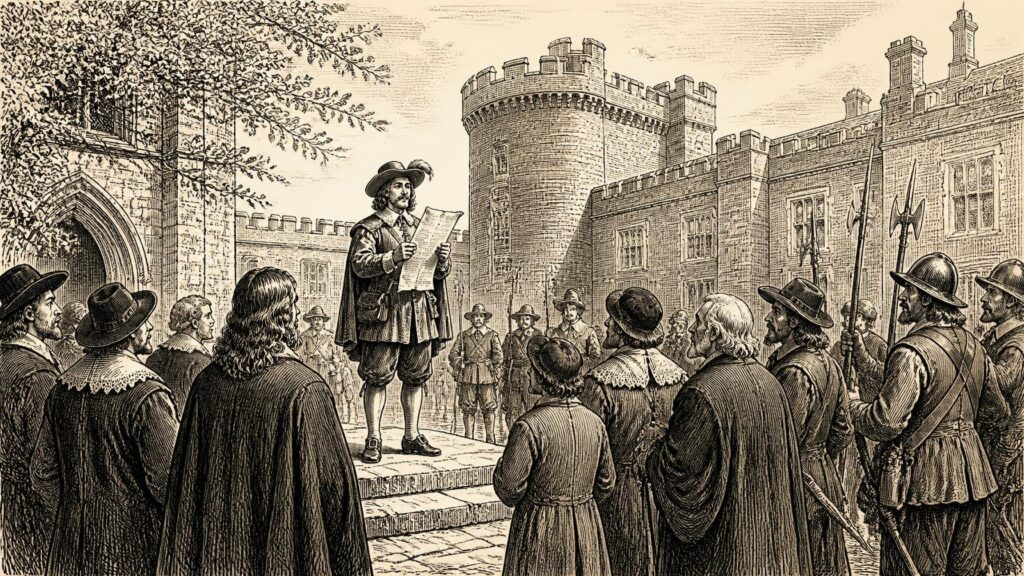
Falkland moved to call an Irish parliament to confirm the settlement. This was essential because the most valuable protections, particularly those touching land and law, needed statutory authority rather than an assurance which could be withdrawn by executive discretion. But the preparations ran into the constitutional machinery of Poynings’ Law, under which proposed Irish legislation required prior approval in England. The writs and procedure were found defective. Rather than allow a doubtful assembly to proceed, the administration put it off.
A proclamation of 20 October deferred the planned assembly so that the requirements of Poynings’ Law could be observed. Thus 1628 ended without the parliament that had been held out as the means of ratifying the bargain. This was more than a bureaucratic mishap. It created a gap between what Catholic negotiators believed had been purchased and what the Irish state was prepared to enact. Some concessions could be observed administratively, and enforcement of religious penalties was in practice uneven during these years. But the guarantees most likely to restrain Crown claims to land remained insecure.
The postponement also demonstrated the limits of political participation. Ireland possessed a parliament, county institutions, borough corporations and a growing body of common-law practice, but access to effective decision-making still depended upon the Crown, the Dublin administration and English approval. The leading Catholic negotiators had pursued redress through loyal petition, payment and courtly diplomacy rather than rebellion. Their frustration in 1628 did not immediately produce conflict. It did, however, preserve grievances which would become far more dangerous when confidence in the Crown collapsed after 1640.
Order, Grain and Official Anxiety
The surviving official notices of 1628 offer brief but revealing glimpses of conditions beyond high politics. On 27 June, the Dublin government issued a proclamation concerning the bringing of corn to market and the punishment of “sturdy beggars”. The order should not be treated as proof of a nationwide famine in that particular year. It does show official concern about food supply, market provision and mobile poverty. Grain shortages, seasonal dearth and high prices could quickly unsettle communities in a predominantly rural society where many households depended on small-scale tillage, grazing and local exchange.
The association of corn with beggars is equally telling. Authorities often treated poverty as a problem of movement and disorder, distinguishing the supposedly deserving poor from people described as vagrants. Such language tells us more about the assumptions of government than about the lives of those targeted. Labourers, displaced tenants, servants between employments and people travelling in search of food or work could all be caught in official suspicion. For the better-off inhabitants of towns and market centres, the arrival of hungry strangers could appear a threat to order; for poorer people, movement was often a necessary means of survival.
On 23 August another proclamation addressed people who committed outrages in the expectation of a general pardon. Again, the evidence does not warrant imagining a general insurrection. It does indicate that violence, local feuding, robbery and resistance to authority remained concerns in parts of the kingdom. The Tudor and Jacobean conquest had extended Crown institutions enormously, but it had not eliminated the social consequences of dispossession, private armed followings or contested local power. The state’s language of “rebellious persons” could cover a wide range of conduct, from organised defiance to smaller-scale lawlessness.
Churches Across Ireland and Europe
Religion remained inseparable from these political questions. The Church of Ireland was the legally established church, supported by tithes and Crown authority, but most of the population continued to identify as Catholic. Catholic worship and clerical organisation persisted through networks of priests, religious orders, patrons and households. The relatively cautious enforcement of recusancy laws in the later 1620s gave room for Catholic expectations, while also alarming militant Protestants who feared that accommodation would weaken the Reformation settlement.
A firmly dated event connects Ireland’s religious life to Rome. On 1 January 1628, six students entered the newly established Irish College in Rome, in a rented house near St Isidore’s on the Pincio. The project had been promoted by the Waterford-born Franciscan scholar Luke Wadding and supported by Cardinal Ludovico Ludovisi, protector of Irish interests. Its opening did not mean that priestly education had ceased within Ireland, but it supplied an important continental route for the formation of secular clergy at a time when Catholic institutions at home lacked legal security. The college also embodied the international character of Irish Catholicism: Irish students, clerics and exiles drew on patrons, schools and religious houses in Rome, Spain, the Spanish Netherlands and France.
That international setting had political implications. Irish soldiers served in continental armies, while exiled Gaelic and Catholic interests could appear to foreign governments as potential instruments against the Stuart monarchy. Owen Roe O’Neill, then abroad in Spanish service, had recently been involved in ambitious but unrealised schemes for intervention in Ireland. Charles’s willingness to offer concessions in 1628 cannot be separated from this wider European pressure. The Crown sought not simply money but the reassurance that Irish Catholics would have reasons to prefer negotiated loyalty to foreign-backed ventures.
Within the established church, 11 July brought the death at Tuam of William Daniel, or Uilliam Ó Domhnaill, Church of Ireland archbishop of Tuam since 1609. Daniel’s career represented a different, though also Irish-speaking, response to religious change. He had helped complete and translate the Irish New Testament published in 1602 and translated the Book of Common Prayer into Irish, printed in 1608. His death marked the passing of a scholar-clergyman who had sought to make Protestant worship intelligible in the vernacular. The survival and repeated use of his translations show that religious change was not merely imposed through English: it also involved argument, print and pastoral work in Irish.
A Settlement Deferred
For most inhabitants, the constitutional negotiations of Whitehall and Dublin Castle would have mattered chiefly where they affected rents, tithes, local justice, soldiers, markets and security of tenure. Ireland in 1628 was not politically still. Plantation altered settlement and ownership in Ulster and elsewhere; market towns linked rural producers to ports; and English, Irish and Scots communities lived under unequal laws and competing religious loyalties. Yet the year was not one of general war. Its significance lies in the attempt to convert loyalty into a durable settlement.
That attempt remained incomplete. The Irish College at Rome opened its doors; a royal programme of concessions was agreed; and an Irish parliament was prepared but deferred. These were tangible developments, not merely later omens. Still, their unfinished quality mattered. By leaving the Graces unconfirmed in 1628, Falkland’s administration ensured that questions of Catholic trust, land security and the proper limits of Crown power would remain unresolved at the heart of Irish public life.
Primary Sources
- Cary, Henry
- O’Neill, Owen Roe (Ó Néill, Eoghan Rua)
- Talbot, Sir William
- Netterville, Nicholas
- Nugent, Sir Richard
- Bathe (Bath), Sir John
- Dillon, Sir Lucas
- Wadding, Luke
- Suggestions of the catholics of Ireland to Charles II. with animadversions. Instructions of the King to Viscount Falkland, May 24, 1628.
- Statute Law Revision Act 2015
- About Pontifical Irish College Rome
- Calendar of seventeenth- and eighteenth-century Irish College Rome archival material
- Irish College (Rome)
- The Irish College, Rome
- Tuam rebuilt
- ‘Desirous to be delivered’: prophecy, printing and Puritanism beyond the Pale
- Early Stuart Irish Warrants, 1623–1639: The Falkland and Wentworth Administrations
- Calendar of the State Papers Relating to Ireland of the Reign of Charles I (and Commonwealth), 1625–1660
- Colonialist intervention in a metropolitan revolution: reconsidering A remonstrance of divers remarkeable passages
- The Early Modern Economy, 1600–1780
- Ireland-Bristol Trade in Sixteenth century – Research
- Harvest Crises in Early Seventeenth-Century Ireland
- Decies LXIII