Foyle Garrison1566 CE
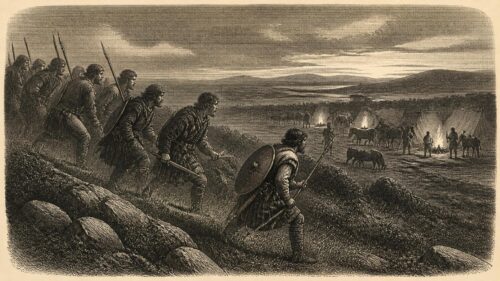
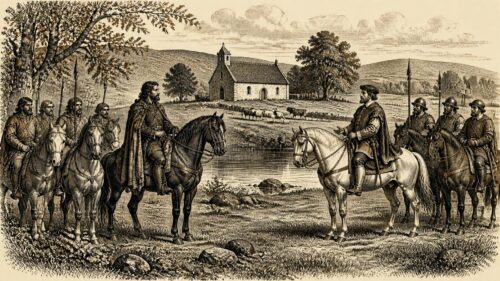
In 1566, conflict between Shane O’Neill and Elizabethan government made Ulster Ireland’s principal political and military crisis. O’Neill sought French aid, managed fraught relations with Scottish MacDonnells, was proclaimed traitor, and burned Armagh’s cathedral, a religious site also militarily contested. Lord Deputy Sir Henry Sidney campaigned through Ulster while Colonel Edward Randolph established a garrison at Derry to pressure O’Neill; Shane’s forces killed Randolph in November, exposing royal weakness. Deaths and successions among O’Donnells and Maguires reshaped regional alliances and prompted renewed raiding. The year demonstrated that crown expeditions, Gaelic lordship, local warfare, logistics, learning and landscape remained inseparably linked.
Dateline
A northern crisis becomes a war
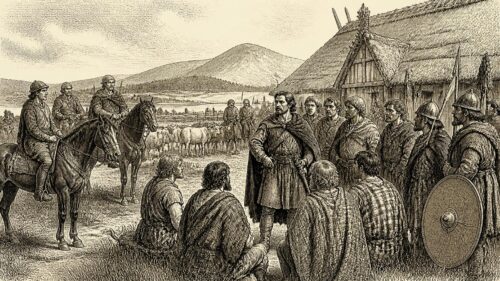
In 1566, Ireland’s most dangerous political contest lay in Ulster. Shane O’Neill, lord of Tír Eoghain, had spent years building a power that troubled both neighbouring Gaelic rulers and Elizabeth I’s government in Dublin. He was not simply a local rebel against a settled state. His authority rested on the military following, client families, tribute and cattle wealth of an exceptionally powerful Gaelic lordship, enlarged through hard campaigning and alliances with Scottish mercenaries. Yet it also rested on an unstable balance: O’Neill had enemies in Tír Chonaill, Fermanagh, Oriel and the Scottish-settled districts of north-east Ulster, while the crown increasingly regarded him as an obstacle to any wider programme of government.
The arrival of Sir Henry Sidney as lord deputy brought that confrontation to a head. Sidney had been confirmed in office in October 1565 but began his Irish administration in January 1566 with ambitious instructions: improve the machinery of government, reform finance and garrisons, sustain the plantations already begun in Leix and Offaly, and extend royal influence beyond the Pale. In practice, O’Neill’s power made Ulster the immediate test. The planned reform of Ireland could not proceed smoothly while its strongest northern lord could dictate terms to neighbours, hold rival chiefs captive or displaced, and frustrate government communications and military movement.
Appeals, declarations and divided loyalties
Diplomacy did not disappear when preparations for war began. On 25 April, Shane wrote to Charles IX of France seeking armed assistance against the English. Such an appeal was serious political theatre as well as a request for help. It placed an Irish conflict within the international rivalries of the Reformation age, when England feared that France, Spain or the papacy might exploit Ireland as an exposed western flank. No French intervention followed. Nevertheless, the letter showed that O’Neill understood the value of foreign recognition and that the Dublin government had reason to view an apparently provincial war through a European lens.
At the same time, O’Neill’s relations with the MacDonnells of Antrim remained central. Their Scottish kindred brought fighting men and sea connections across the North Channel, but Shane held Sorley Boy MacDonnell captive after his victory at Glentaisie in 1565. During 1566 there were negotiations involving the fifth earl of Argyll over Sorley Boy’s captivity. This was not a simple Irish-versus-Scottish divide: Gaelic Ulster, the Hebrides and western Scotland formed an interconnected political world, in which marriages, mercenary service, hostages, cattle-raids and seaborne movement all mattered. Shane’s ability to bargain with some MacDonnells while retaining their kinsman as a hostage demonstrates both his reach and the grudges that later endangered him.
By early August the crown abandoned any lingering hope that accommodation alone would contain him. Shane was proclaimed a traitor, with a reward offered for his capture or killing. The proclamation declared a constitutional verdict; it did not itself remove his local power. In much of Gaelic Ireland, allegiance was judged through protection, kinship, tribute and success in war as much as through documents issued at Dublin Castle. The hard question for communities in Ulster was therefore practical and immediate: which lord could protect herds, tenants, churches and routes of travel when armies arrived?
Armagh and religious authority
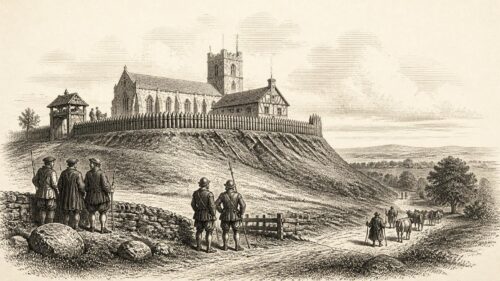
That question was sharply visible at Armagh. During August, Shane destroyed St Patrick’s Cathedral by fire. The episode has sometimes been reduced to a clash between a Catholic chief and a Catholic archbishop, Richard Creagh, but its setting was more complicated. Creagh was a Roman Catholic primate whose religious standing did not make him politically acceptable to O’Neill. He urged civil loyalty to Elizabeth, while the cathedral had also been used and fortified by crown forces in the preceding struggle. For Shane, the building was therefore a potential military foothold for his enemies as well as the chief church of Armagh. Its burning was an act of war with grave religious consequences, not evidence that confessional labels straightforwardly determined political allegiance.
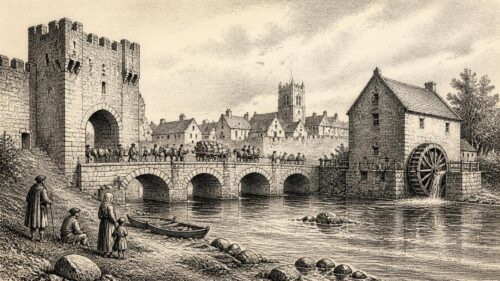
The destruction also reveals the vulnerability of ordinary sacred and settled places in sixteenth-century conflict. Cathedrals, monasteries, tower houses, bridges and market settlements could be refuges, storehouses, meeting points or fortified positions. Once armed men used them, their inhabitants and fabric were exposed. The loss at Armagh symbolised a wider reality: campaigns were sustained not only through battles but through the seizure of food, livestock, shelter, hostages and defensible sites. For farmers and townspeople, military strategy could mean emptied byres, disrupted harvests and uncertainty over where worship, trade or local justice could safely continue.
The march to Lough Foyle
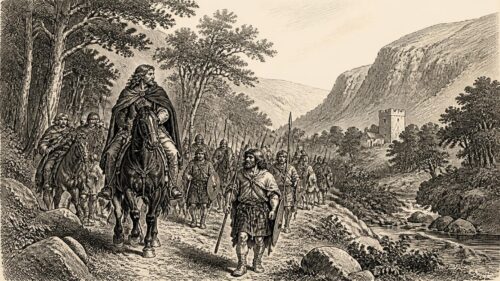
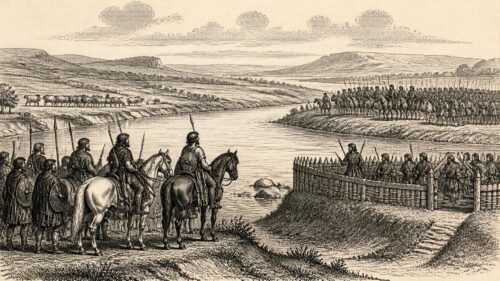
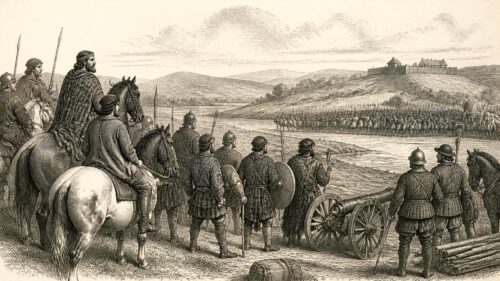
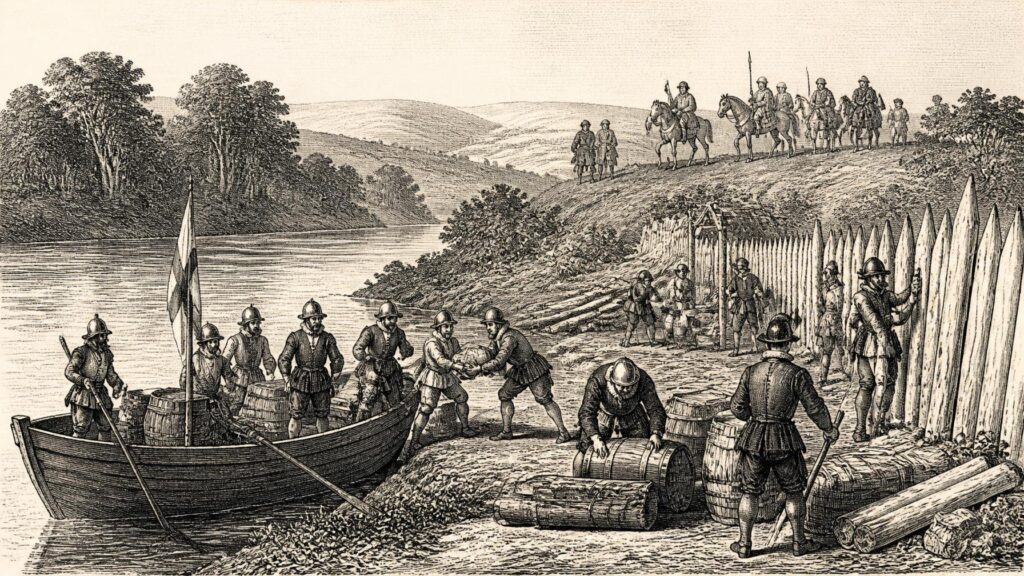
Sidney’s response was a major expedition. On 6 September Colonel Edward Randolph sailed from Bristol for Lough Foyle with troops intended to establish a position on O’Neill’s north-western flank. Sidney himself campaigned from 17 September to 12 November through Armagh, Tír Eoghain and Tír Chonaill. His army reached Derry on 12 October. The point was not merely to win a dramatic field battle, which O’Neill carefully avoided. It was to penetrate territory that royal armies found difficult to hold, support O’Neill’s rivals, demonstrate the crown’s logistical capacity and create a permanent garrison at the Foyle.
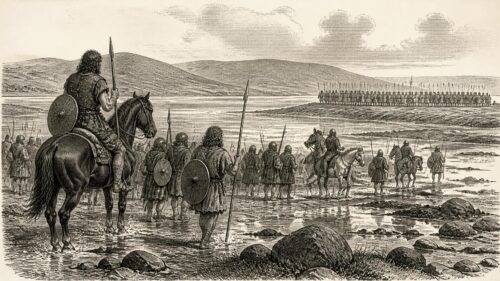
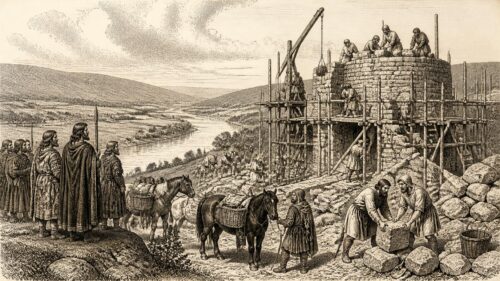
This was arduous campaigning. Roads were few, weather and boggy ground shaped movement, and an army had to carry or seize provisions while protecting its supply lines. Tudor commanders counted forts, bridges, ports and waterways as strategic assets because a force could not live indefinitely by marching. Derry’s position, at the meeting of river and sea routes, made it attractive as a base from which to pressure Tír Eoghain and influence Tír Chonaill. But the very remoteness that made the post strategically valuable made it hard to supply and defend. Sidney’s march displayed royal force; it did not make northern lordship disappear.
Randolph’s garrison soon exposed that limitation. In November Shane attacked at Derry and Randolph was killed. The loss deprived the crown of a determined field commander and badly weakened the immediate purpose of the Foyle enterprise. The garrison survived the winter, but its destruction by an accidental explosion in April 1567 would confirm how precarious the position had been. In 1566, then, the government had achieved an entry into the north but not a durable settlement. Its expensive campaign had compelled attention and rearranged alliances, while leaving the decisive struggle unresolved.
Succession in Tír Chonaill and Fermanagh
Events within Gaelic lordships were as consequential as the government’s advance. Calvagh O’Donnell, lord of Tír Chonaill and Shane’s long-standing rival, died suddenly on 26 October, after returning from England. The Annals of the Four Masters place his death on the road between Ballyshannon and Rathmullan, reporting that he fell dead from his horse. The detail is striking, though the annals’ memorial language should not be read as neutral biography. What is certain is that the death came at a critical moment, just as Sidney hoped to use Calvagh as a counterweight to O’Neill.
Calvagh’s half-brother Aodh mac Maghnusa succeeded as O’Donnell. The transition was not an administrative formality. Tír Chonaill contained competing branches and interests, and succession depended upon acceptance by leading kin, military followers and client lords. Aodh nevertheless moved quickly enough to lead a winter hosting into Tír Eoghain, taking prey and returning safely. That raid, securely assigned by the annals to the winter of 1566, signalled that the new ruler would not be merely an English-sponsored instrument. He had his own dynastic claims, political needs and reasons to strike across the border.
Fermanagh likewise saw upheaval. John Maguire died on 29 September while with the government army, having been driven from his country by O’Neill, according to the Four Masters. His brother Cú Chonnacht was inaugurated in his place. The succession underlines Shane’s regional influence: pressure from Tír Eoghain could shape who governed Fermanagh, while Maguire rivals looked towards Dublin for assistance. Hugh Boy O’Rourke was also killed by the Kinel-Connell at Baile an Tochair in the contest for Breifne. Far from being a two-sided war, the northern crisis was a chain of connected local struggles in which every death, hostage and inauguration could alter the balance.
Learning, lordship and an uncertain landscape
The year’s annalistic notices preserve glimpses of concerns beyond armies. Melaghlin Modardha O’Madden, who died in 1566, was praised as a reader of Latin and Irish and as a protector of women, poor people and those unable to fight. Such formal praise cannot be treated as a social survey, but it identifies values publicly associated with lordship: learning, hospitality, protection and the defence of territory. These were not ornaments separate from power. Learned households, clerics, poets and legal specialists helped maintain status, memory, negotiation and authority in a society where lineage and reputation had practical political force.
The Four Masters also record a shower of fish in Tír Chonaill. Whether understood as an extraordinary natural occurrence, a report carried through local memory, or an annalistic marvel, it belongs to the year’s contemporary record without allowing historians to build wider environmental conclusions from it. More securely, the campaigning, raids and succession disputes of 1566 show a landscape in which rivers, coasts, mountain passages and seasonal conditions directed human choices. Ireland was not yet governed as a single integrated kingdom in practice. Sidney’s march and Randolph’s garrison were attempts to change that fact; O’Neill’s survival through the year showed how incomplete that attempt remained.

Primary Sources
- Calendar of State Papers, Ireland, Tudor Period, 1566–1567
- Calendar of State Papers, Ireland, Tudor Period, 1566–1567 (PDF)
- Annals of the Kingdom of Ireland by the Four Masters, Volume 5 English Translation
- O'Neill, Shane (Seaán)
- Sidney, Sir Henry
- O'Donnell (Ó Domhnaill), Sir Aodh mac Maghnusa
- O'Donnell, Hugh McHugh Dubh (Aodh Ó Domhnaill)
- Mág Uidhir (Maguire), Cú Chonnacht Óg (‘an Comharba’)
- Letter of Sir W. Cecil to Sir T. Smith on the Troubles in Scotland and the Dangers in Ireland Occasioned by the Rebellion of O'Neal, 26 March 1566
- Building History: St Patrick’s Cathedral, Armagh
- Sir Henry Sidney’s Memoir of His Government
- Calendar of the State Papers Relating to Ireland of the Reigns of Henry VIII, Edward VI, Mary, and Elizabeth, Volume 1
- Calendar of State Papers, Foreign Series, of the Reign of Elizabeth: 1566–1568
- Richard Creagh
- The Last Years of Archbishop Creagh of Armagh
- Reform on Contract: The Viceroyalties of Sir Henry Sidney, 1566–1578
- The Elizabethan Conquest of Ireland: A Pattern Established, 1565–76
- Annals of Loch Cé A.D. 1014–1590
- Shane O’Neill and the Scots in Ulster
- The Elizabethan Court Day by Day—1566