

Kinard’s Unfinished Advance1531 CE
In 1531, Sir William Skeffington’s government, supported by the earl of Kildare and Aodh Dubh O’Donnell, campaigned in Tír Eoghain against Conn Bacach O’Neill after O’Donnell’s submission at Drogheda. The coalition devastated territory and halted at Kinard, but failed to secure O’Neill’s defeat or lasting royal control. Ulster remained divided: O’Donnell faced conflict with his son Manus, while lordship disputes, raids, captivity and fosterage shaped local power. Skeffington’s authority also weakened as relations with Kildare deteriorated and parliament rejected a subsidy. Annalistic obituaries nevertheless record medical learning, hospitality and patronage, underscoring a society sustained by networks of care alongside warfare.
Dateline
In 1531, Ireland’s most consequential fighting was not a straightforward contest between an expanding English state and a united Gaelic resistance. It was an unstable web of bargains, rival dynasties and local campaigns. Sir William Skeffington, Henry VIII’s lord deputy, and Gerald FitzGerald, ninth earl of Kildare, led a government-backed host into Tír Eoghain. Yet that army marched at the prompting of Irish allies, most notably Aodh Dubh O’Donnell of Tír Chonaill and rivals of Conn Bacach O’Neill. It devastated parts of Tyrone, but it did not defeat O’Neill or impose a settlement. At Kinard the advance stopped. The army turned home, leaving the northern balance of power unresolved.
That limited expedition offers a useful view of Ireland in this year. Crown authority remained strongest around Dublin and the Pale, but its practical reach depended on magnates such as Kildare and on negotiated alliances with Gaelic lords. In Ulster, political power rested upon lordships with their own kinship ties, military followings, castles, fosterage networks and claims to tribute. The same year also exposed fractures within the O’Donnell lordship itself, while a parliament summoned by Skeffington showed how constrained the deputy could be even within the English-held polity.
Dating a Difficult Year
The principal Irish narrative sources organise many incidents under the year 1531, but usually do not give a day or month. They must therefore be read as annalistic year-notices rather than as modern chronological diaries. The Annals of Ulster, the Annals of the Four Masters and Annála Connacht agree on the broad sequence of northern conflict, although their emphases differ. English administrative material supplies one unusually firm date: Aodh Dubh O’Donnell’s submission at Drogheda on 6 May. Elsewhere, it is safer to say that an event occurred during the year than to assign it an invented season or day.
The political vocabulary also needs care. Irish annalists called Skeffington the English justiciary or the ‘Saxon’ justiciary, while English official usage styled him lord deputy. Neither description meant that he commanded Ireland as a coherent territorial state. His government had resources, artillery and legal institutions, but it relied heavily on the co-operation of the earl of Kildare and other local power-holders. The campaign of 1531 demonstrated both those assets and those limits.
Drogheda and O’Donnell’s Submission
On 6 May, at Drogheda, Aodh Dubh O’Donnell formally acknowledged Henry VIII’s authority through Skeffington. The agreement was not a simple act of conquest. O’Donnell pledged loyalty and assistance against the king’s enemies, while expecting protection and aid in return for himself and associated lords. Such an arrangement made political sense. Aodh Dubh’s principal northern rival was Conn Bacach O’Neill, lord of Tír Eoghain, whose ambitions and alliances threatened O’Donnell interests in disputed regions, including Inishowen and the wider Ulster borderlands.
The submission was therefore diplomatic leverage. O’Donnell could seek the deputy’s military support without surrendering the practical structures of his lordship; Skeffington could claim a conspicuous extension of royal obedience while acquiring a powerful ally. The language of submission should not conceal that mutual calculation. Its immediate consequence was not tranquillity but a coalition campaign against Conn Bacach and his territory.
For the crown, this was cheaper and more realistic than attempting permanent direct occupation of Ulster. For O’Donnell, it was a way to deploy government force against a regional opponent. Kildare’s participation was equally important. The FitzGerald earl was both a great magnate and a former deputy, deeply embedded in Irish politics and capable of bringing Anglo-Irish and Gaelic associates into the field. The expedition consequently crossed customary political labels: the annals describe Kildare, the deputy and the leading ‘English of Ireland’ marching alongside Irish allies whose interests had set the operation in motion.
The Halt at Kinard
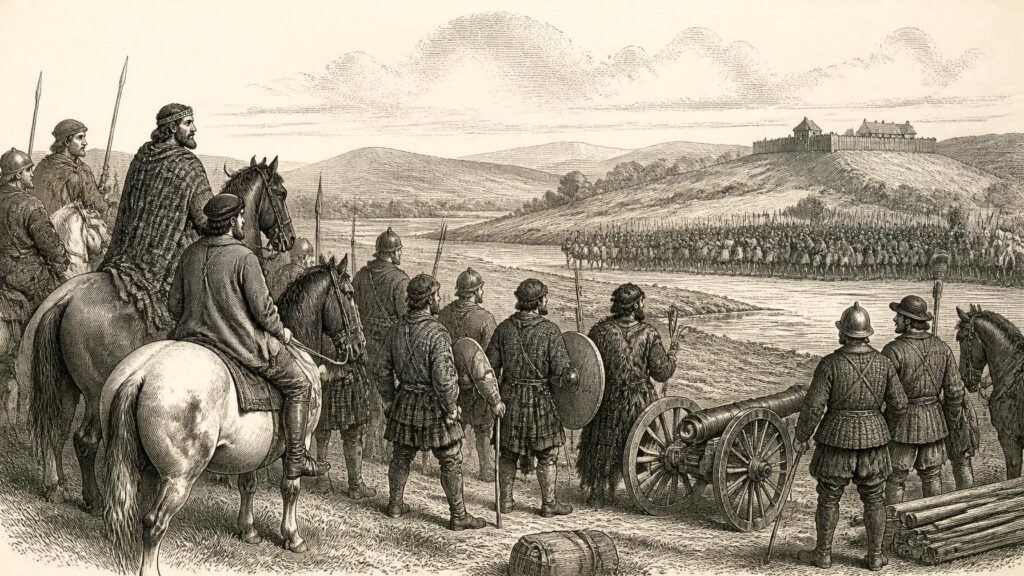
During 1531, this coalition entered Tír Eoghain. The Annals of Ulster and the Four Masters describe serious destruction: territory was burned from Dungannon southwards towards the Blackwater; the new castle at Port-an-Fhaileagain was demolished; Brian na Moicheirghe’s district was raided and burned; and Monaghan was abandoned on the army’s approach. These were not incidental details. Burning crops, houses and stores, carrying away livestock, and breaking castles attacked the material basis of lordship: food, shelter, movable wealth and the capacity to protect dependants.
O’Donnell and Niall Óg O’Neill, a rival within the wider O’Neill kindred, joined the host at Kinard and helped demolish its castle. But Conn Bacach stood nearby with what the annalist called a host too numerous to count. The government army and its allies did not press farther into Tír Eoghain. Instead, the forces dispersed to their homes, while Conn Bacach had made neither peace nor truce with them. The expedition had inflicted damage and made a statement of alliance, yet it had not displaced the dominant lord of Tyrone.
Its outcome is significant precisely because it was incomplete. The deputy could reach into Ulster with a composite army, but he could not turn a destructive raid into durable control. Conn Bacach’s ability to remain in the field, avoid a decisive encounter and deny terms made clear that the political centre of Tír Eoghain still lay beyond Dublin’s effective command. The campaign also deepened local enmities that would continue to shape Ulster politics.
Conflict Within Tír Chonaill
O’Donnell power was itself far from settled. The annals record that Hugh Buidhe O’Donnell captured Belleek Castle, causing major disturbance in Tír Chonaill. More seriously, Aodh Dubh and his son Manus came into open conflict. Annála Connacht records ‘great war’ between them: Aodh Dubh assembled a large force, entered Manus’s district and devastated it. Maguire forces, drawn in at Aodh Dubh’s request, also raided Manus’s lands.
At Scairbh Beag, near Castlefinn and the River Finn, Manus’s mounted men and sons attempted to meet the attackers. They were defeated by Maguire and Hugh Buidhe O’Donnell, and driven back towards the castle. Turlough Maguire received a mortal spear wound in the action and died after three nights. This was a family and succession struggle, but it affected whole communities. The Annals of Ulster specifically notes the raiding and burning of houses, corn, cattle, horses and other property. Dynastic conflict was experienced by ordinary households through lost animals, ruined crops and insecurity around settlements.
The episode also cautions against treating the O’Donnells as a single bloc in the campaign against Tír Eoghain. Aodh Dubh could negotiate with Skeffington and help instigate an attack on Conn Bacach while facing a dangerous challenge from Manus at home. Manus’s later reputation as a learned ruler and patron should not be projected backwards as though his position in 1531 were already secure.
Captivity, Fosterage and Local Power
Other annalistic notices reveal the social mechanisms beneath high politics. Conn Bacach imprisoned Tuathal, son of Art son of Conn, and also took Ruaidhri Gallda, another kinsman. Niall Óg O’Neill assaulted the settlement of Ó Donnghaile, broke its castle, seized a foster-son of O’Neill and carried off horses and chattels. Modern biographical scholarship identifies that foster-child with the young Shane O’Neill. Fosterage was not merely domestic custom: it created binding relationships between leading families, and the seizure of a foster-child could become a potent act of coercion and insult.
Violence was similarly close to home in Fermanagh and Oriel. Cormac Maguire raided Cenél Fearadhaigh, defeated the pursuing party and killed the son of Brian O’Neill among others. Conn Mac Mahon was killed by rival Mac Mahons and their allies; Eóghan Maguire was killed by his brother Edmond. These notices do not amount to a general civil war across Ireland. They do, however, show how readily disputes over lordship, inheritance and local authority produced lethal conflict.
Parliament and a Deputy’s Weakness
Skeffington’s troubles were not confined to Ulster. By July his relationship with Kildare had deteriorated sharply. Their co-operation had been essential to the year’s military enterprise, but the old FitzGerald–Butler rivalry was reviving and Kildare was able to mobilise allies on the Irish council and at the English court. The lord deputy’s nominal authority could not easily overcome the influence of Ireland’s greatest magnate.
Skeffington summoned a parliament which met in Dublin and, briefly, in Drogheda during September and October. Under Poynings’ Law, proposed Irish legislation required prior approval from the king and council in England; parliament was not an independent modern legislature. Even so, it retained important fiscal, judicial and petitionary functions. In 1531 it still included clerical proctors as a third parliamentary body for the voting of clerical subsidies. Skeffington sought a subsidy, but the assembly refused the bill in October. He resorted instead to scutage on tenants owing knight service.
The refusal mattered. It showed that a deputy facing military costs could not simply order political society to fund him. The failure also sharpened Skeffington’s dependence on Kildare, at the very moment their partnership was breaking apart. In 1531, then, the English administration could launch a damaging northern expedition but could neither compel Conn Bacach’s submission in the field nor secure its preferred financial settlement in parliament.
Learning, Hospitality and Loss
Amid conflict, the annals preserve evidence of institutions valued far beyond warfare. Illann Buide Mac an Leagha, described as a distinguished medical scholar, died during the year. The death of Ó Síaghail, physician-ollam of Inis Eoghain, was also recorded. Their notices point to professional learned lineages sustaining medical expertise in Gaelic Ireland. The death of Donnchadh O’Brien, tánaiste of Thomond, and of Domhnall Mac Carthaigh Reagh, lord of Carbery, marked losses among Munster’s ruling families. The Connacht annalist praised Mac Carthaigh as a generous patron of poets and people of every craft, one who had offered a ‘school invitation’ to the men of Ireland.
Several obituaries commend hospitality and the keeping of guest-houses. Such praise was not empty ornament. Hospitality was a practical obligation of elite status, supporting travellers, clients, clerics, learned people and political allies. In a year when armies consumed or destroyed provisions, the annalists’ attention to generous households and skilled practitioners is a reminder that Irish society rested on networks of care, learning and exchange as well as on castles and armed retinues.
By year’s end, no settlement had followed at Kinard, Tír Chonaill had been shaken by internal war, and Skeffington’s political position had weakened. The events of 1531 did not determine Ireland’s future in a single stroke. They did, however, reveal a governing system in which alliances were transactional, warfare was ruinous for local communities, and the strongest claims of royal authority still depended upon Irish consent, partnership and compromise.
Primary Sources
- The Annals of Ulster: Year U1531
- Annals of the Four Masters: Annal M1531
- Annála Connacht: Annal 1531
- Calendar of the State Papers Relating to Ireland, 1509–1573
- Skeffington, Sir William
- FitzGerald, Gerald (Gearóid Óg, Garrett McAlison)
- O’Neill (Ó Néill), Conn ‘Bacach’
- O’Donnell, Manus (Ó Domhnaill, Maghnas)
- O’Neill, Shane (Seaán)
- O’Donnell (Ó Domhnaill), An Calbhach
- Butler, Piers (‘Piers Ruadh’)
- O’Brien (Ó Briain), Conchobhar
- State Papers Ireland 1509–1782: Government Papers on Irish Affairs
- The Reemergence of English Policy as a Major Factor in Irish Affairs, 1520–34
- The Parliament of Ireland
- Poynings’ Law
- Statute Rolls of the Irish Parliament
- Statute Rolls of the Parliament of Ireland: National Library of Ireland Catalogue
- Tudor Re-Conquest in County Kildare
- Ireland Under the Tudors; With a Succinct Account of the Earlier History