

Manus O’Donnell’s Columba1532 CE
In 1532 Gerald FitzGerald, ninth earl of Kildare, regained the deputyship, yet royal authority remained dependent on alliances with Anglo-Irish and Gaelic lords. Campaigning in Ulster, disputed in date between 1531 and 1532, devastated Tír Eógain through burning, plunder and cattle seizure. In Ely, Kildare supported his son-in-law Ferganainm Ó Carroll during the Birr succession struggle, where he was seriously wounded by gunfire. Feuds continued across Ossory, Connacht and the north-west, occasionally violating sanctuary. Amid violence, Manus Ó Domhnaill compiled Betha Colaim Chille at Lifford, affirming Catholic learning, Irish vernacular culture, dynastic prestige and Colum Cille’s regional importance, lasting significance.
Dateline
In 1532, Ireland’s politics were shaped by the restoration of Gerald FitzGerald, ninth earl of Kildare, to the Dublin deputyship; by violent contests among Gaelic and Anglo-Irish lordships; and by an important act of Irish literary and religious culture in the north-west. The year does not yield a single national event. Instead, its surviving records show a country of overlapping jurisdictions, in which royal authority, magnate power, ecclesiastical institutions and learned families all remained active, often in close proximity to war.
Kildare Restored
Gerald FitzGerald, known in Irish as Gearóid Óg, was again appointed lord deputy by Henry VIII on 5 July 1532. The office made him the king’s chief governor in Ireland, but it did not give him uncomplicated command of the island. Royal administration was strongest in and around Dublin and the Pale, while beyond it the crown depended heavily on negotiation with great lords, Gaelic rulers and churchmen. Kildare was uniquely fitted to operate in that world: a Tudor courtier with English aristocratic connections, he was also head of a dynasty whose estates, tenants, military following and alliances reached far beyond the Pale.
The Irish annals describe his return with a forceful shorthand: the Annals of Ulster say that he came to Ireland in the spring carrying Henry VIII’s authority for ten years, after which William Skeffington, the outgoing English justiciar, was recalled in disgrace. That account should not be read as a securely dated itinerary. The formal appointment is dated to 5 July in the administrative chronology, while the annal’s “spring” may preserve a different stage in Kildare’s restoration. What is certain is that 1532 marked the final return of Kildare to the deputyship.
His recovery of office was the outcome of a long struggle. In April, leading figures from the Irish administration had been summoned to England amid accusations over the conduct of Skeffington, Kildare and Piers Butler, earl of Ossory. John Rawson, prior of Kilmainham and treasurer of Ireland, supported Kildare’s case and criticised Skeffington’s government. Yet the rivalry between Kildare and Ossory was not solved by the change of deputy. It remained the central fault-line among the great Anglo-Irish powers of the south and east.
A Northern Campaign in Uncertain Dating
Accounts entered under 1532 in the northern annals also record a major intervention in Tír Eógain. Aodh Dubh Ó Domhnaill and Cú Chonnacht Óg Maguire met Skeffington at Drogheda, made terms with him, and joined an expedition against Conn Bacach Ó Néill. The Annals of Ulster depict a coalition of men from Meath and several Gaelic forces advancing as far as Dungannon. They describe the town’s buildings, fortifications and household goods being wrecked, and the surrounding territory being burned and plundered.
There is an important qualification. The Annals of the Four Masters place a closely comparable expedition in 1531 rather than 1532. Annalistic year headings can differ from one compilation to another, and the precise season should therefore not be forced. What can responsibly be said is that the conflict belongs to the immediate 1531–32 crisis in Ulster which framed Kildare’s return. It demonstrates that the Dublin government could still assemble substantial forces, but only by collaborating with Irish rulers who pursued their own rivalries and interests.
The annals’ imagery also captures the material consequences of campaigning. Cattle were driven away in great numbers; one account says beef was available in the English camp at the exceptionally low price of a groat. This was no incidental detail. Herds were movable wealth, sustenance for armies and a means of imposing ruin on an opponent. Raiding, burning and seizure of livestock were instruments of politics as much as acts of war.
Birr and the Wounded Deputy
The most vivid episode associated with Kildare’s restored deputyship occurred in Ely, in the country around Birr. Maolruanaidh Ó Carroll, lord of Ely, died during 1532. The Annals of the Four Masters date his death to the feast of St Matthew, 21 September, and praise him in the expansive language reserved for an outstanding Gaelic patron: generous to poets, clergy, exiles and learned men, and a protector of his people. His son Ferganainm succeeded him, but the transition brought danger. The rival descendants of Seán Ó Carroll seized Birr Castle and ravaged the district.
Kildare intervened in support of Ferganainm, who was his son-in-law. The annalistic narrative has the deputy and the new Ó Carroll taking nearby castles before investing Birr itself. During the siege, a projectile fired from the castle struck Kildare in the side. A later account places the wound in mid-December; the annals do not supply a day, but make clear that the missile remained lodged through the winter before emerging from the other side in spring. Birr was eventually taken.
The episode matters for more than its dramatic detail. It shows a royal deputy acting through family alliance inside a local succession dispute, rather than enforcing an impersonal state order. It also reveals the growing importance of firearms in Irish warfare. The projectile that disabled Kildare was not merely an exotic weapon: guns feature elsewhere in the year’s accounts, including the seizure of Ossory’s firearms after a defeat at a ford in Ely. Castles still mattered, but their walls and garrisons now operated in a military landscape altered by gunpowder.
Kildare’s injury had lasting consequences. Although he remained deputy, it weakened him physically and increased his dependence on relatives and retainers for campaigning. By the end of 1532, therefore, his restoration had brought neither durable peace nor a simple recovery of authority. The deputy’s position remained inseparable from the fortunes of the FitzGerald affinity.
Feuds, Castles and Sanctuary
Elsewhere, the year’s notices reveal a patchwork of smaller but consequential conflicts. Thomas Butler, son of Piers Butler, was killed in Ossory by Diarmait Mac Giolla Phádraig. Diarmait’s own brother subsequently surrendered him to Ossory, who had him fettered in retaliation. The killing sharpened the political realignment of the Mac Giolla Phádraigs and Butlers, and illustrates how kinship could both generate violence and provide the means to contain it.
In Connacht, the sons of Ó Dubhda captured Ardnaree Castle from a Burke claimant, beginning a war marked by killing and raiding on both sides. In the north-west, Maghnus Ó Domhnaill made raids in Cúil Mhac Thighearnáin, while internal conflict continued among the Ó Néills, Maguires and their associates. One especially stark entry records Eoghan Ó Ruairc being killed by the Ó Maoil Mhiadhaigh family in the Franciscan friary at Dromahair. Another describes violence in the church at Dunboe. Such reports should not be taken to mean that churches were routinely battlefields; rather, they underline how intensely political feuds could override the protection normally expected from sacred places.
A Life of Colum Cille
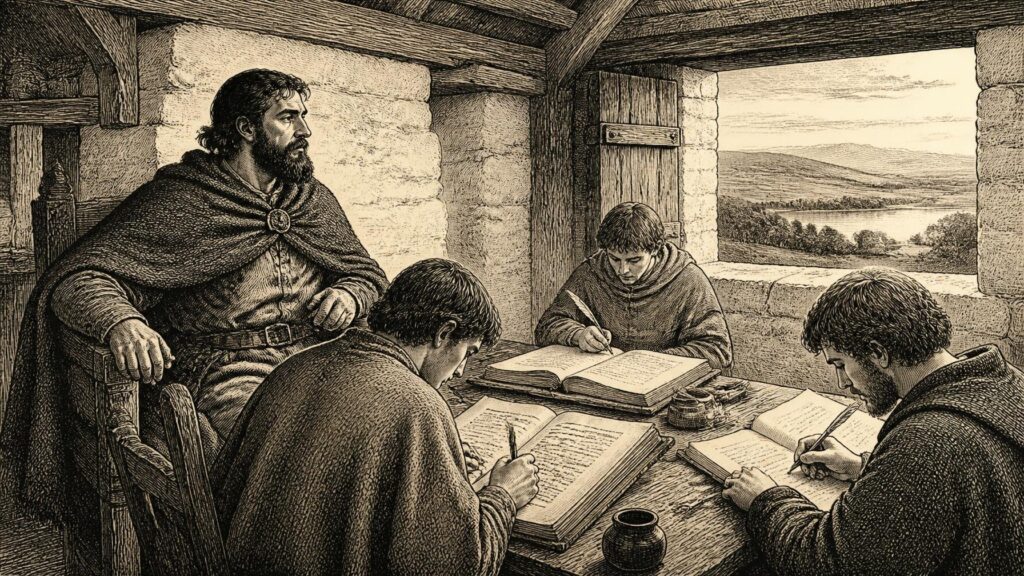
Against this background, 1532 also produced one of the outstanding works of late medieval Irish learning. Maghnus, or Manus, Ó Domhnaill compiled his Betha Colaim Chille, the Life of St Colum Cille, at Port na dTrí Namhad near Lifford. He was not yet lord of Tír Chonaill: his father Aodh Dubh still held that position. But Manus was a leading dynastic figure, scholar and political actor, and the work linked family prestige, regional identity and devotion to Colum Cille, the patron saint closely associated with the Cenél Conaill.
The text was far more than a simple retelling. Manus gathered material from older books, had Latin and difficult Irish sources rendered into accessible Irish, and oversaw a substantial vernacular synthesis. Its composition demonstrates that learned labour survived and flourished amid warfare. It also shows the value attached to Irish as a language of religion, history and political memory. A saint’s life could instruct readers, honour a patron, preserve inherited learning and articulate the claims of a ruling kindred.
Faith, Learning and Local Order
Religion in Ireland during 1532 remained institutionally Catholic. Henry VIII’s break with papal authority was developing in England, but the Irish parliamentary religious programme associated with the later 1530s had not yet begun. The year’s Irish evidence instead points to the continuing authority of local ecclesiastical offices and foundations. The deaths of the coarb of Fenagh and the herenagh of Aghavea were recorded alongside those of secular rulers. These hereditary or customary church offices connected landholding, pastoral responsibility and local status.
The annals also mourned Torna Ó Maolchonaire, described as the foremost ollamh of the Síol Muireadhaigh. His successor was proclaimed, though he died soon afterwards. This brief notice is a reminder that professional learned families maintained systems of genealogy, history, law and praise-poetry essential to lordship. Maolruanaidh Ó Carroll’s obituary and Manus Ó Domhnaill’s book offer complementary evidence: patrons supplied protection and resources, while scholars and clerics made reputation endure.
Thus 1532 was a year of restoration without settlement. Kildare regained the deputyship, but the conflicts of Ely, Ossory, Ulster and Connacht showed how little authority could be exercised without alliances and force. At Lifford, meanwhile, Manus Ó Domhnaill created a work of lasting devotion and learning. Together, the gunshot at Birr and the writing of the Betha Colaim Chille reveal the violence, resilience and cultural richness of Ireland on the eve of profound Tudor change.
Primary Sources
- The Annals of Ulster: Year U1532
- Annála Connacht: Annal 1532
- Annals of the Four Masters: Annal M1532 (English translation)
- Annals of the Four Masters: Annal M1532 (Irish text)
- Gerald FitzGerald (Gearóid Óg, Garrett McAlison)
- Skeffington, Sir William
- O'Donnell, Manus (Ó Domhnaill, Maghnas)
- Colum Cille (Columba)
- O'Neill (Ó Néill), Conn ‘Bacach’
- Mág Uidhir (Maguire), Cú Chonnacht Óg (‘an Comharba’)
- MacGillapatrick, Brian
- Cowley (Colley), Walter
- Rawson, John
- Fitzgerald, Joan
- Fitzgerald, Thomas
- Betha Choluim Chille
- Betha Colaim Chille: Life of Columcille
- The Reemergence of English Policy as a Major Factor in Irish Affairs, 1520–34
- Annals of the Four Masters
- Annála Connacht
- Annales Breves Hiberniae
- Notarial Deed by Cornelius O'Kenedy of an Agreement Made at Toomevara, 6 April 1532