

Lifford’s Summer Castle1527 CE
In 1527, Ireland remained divided among the Dublin administration, Anglo-Irish magnates and Gaelic lordships. Gerald FitzGerald, earl of Kildare, and James Butler travelled to England amid rivalry, while fighting continued between Desmond and Butler interests in Munster. Manus O’Donnell completed Lifford Castle during war with Con Bacach O’Neill, strengthening a contested Ulster frontier. O’Donnell’s coalition ravaged Moylurg and captured several castles; Castlereagh later surrendered after a prolonged siege and famine. Successions in Fermanagh and Tirerrill demonstrated contested lordship. Annals also commemorated scholars, physicians, charitable women and Edmund Butler’s consecration as archbishop of Cashel, revealing cultural and ecclesiastical institutions amid warfare.
Dateline
In 1527, Ireland’s political map was not remade by a single national event. Instead, the year survives through a revealing cluster of campaigns, successions, building works, journeys and deaths. They show several centres of power operating at once: the Dublin administration around the English Pale; the rival Anglo-Irish houses of FitzGerald and Butler; and the great Gaelic lordships of Ulster, Connacht and beyond. The most tangible achievement was the completion of Manus O’Donnell’s fortress at Lifford, built while war with Con Bacach O’Neill continued. Yet the year’s annals also preserve the destruction of crops and castles in Moylurg, a hard-fought siege in Roscommon, and the continued importance of learned, religious and hospitable households.
A Deputy Leaves for England
The most important development in the government of the lordship was the departure for England of Gerald FitzGerald, ninth earl of Kildare and the king’s lieutenant in Ireland. Annála Connacht records that Kildare and James Butler, son of Piers Butler, earl of Ormond, travelled to England because of their “jealousy and mutual accusation”. The phrase is the annalist’s concise judgement on a rivalry with deep roots. Kildare’s FitzGerald affinity and the Butler lordship were competing powers in Leinster and Munster, while the dispute over the Ormond inheritance gave their conflict an especially sharp connection to Henry VIII’s court.
In Kildare’s absence, Richard Nugent, Baron Delvin, replaced Sir Thomas FitzGerald as deputy during September 1527. This was a difficult appointment rather than a simple transfer of authority. Delvin’s jurisdiction centred on the exposed western edge of the Pale, and the resources available to the Dublin government were narrow. The annual record is therefore a useful corrective to any impression that royal government covered Ireland evenly. Its officials exercised greatest authority in and around the Pale; elsewhere they depended upon negotiation, alliances, local military power and the willingness of magnates to co-operate.
The absence of Kildare did not suspend the FitzGerald–Butler struggle. In December, James fitz Maurice FitzGerald, eleventh earl of Desmond, invaded Butler territory. He was driven back towards Dungarvan, where Piers Butler’s son James, Lord Butler, and Desmond’s uncle Thomas fitz Thomas FitzGerald besieged him. This was a precisely dated late-year escalation in the contest for influence in Munster. It also demonstrates how misleading a neat division between “English” and “Irish” can be for 1527: rival earls of English-descended families pursued local lordship through alliances that crossed linguistic, cultural and regional boundaries.
Manus O’Donnell’s Frontier Fortress
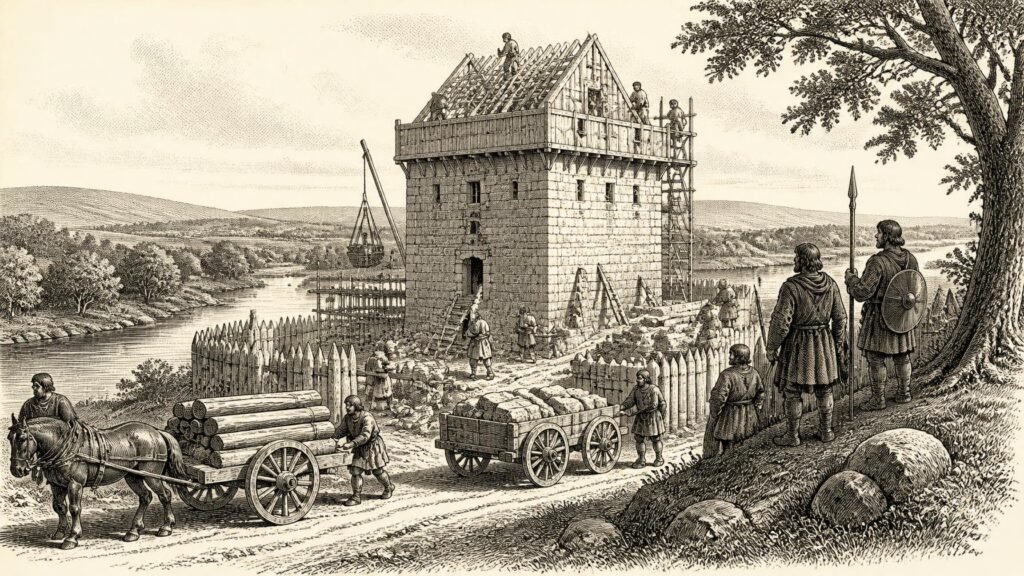
Far to the north-west, Manus O’Donnell completed the castle recorded as Leithbhir, conventionally identified with Lifford Castle or Port na dTrí Namhad, the “fort of the three enemies”. The Annals of the Four Masters state that its works were of stone, wood and boards. Annála Connacht offers a more exact building notice: Manus began on the Wednesday after St Brendan’s Day and finished when part of the summer had passed. The annal does not warrant a modern calendar date for either stage, but it firmly places completion in the summer of 1527.
The construction was no ornamental residence. Manus was the leading son and political lieutenant of Aodh Dubh O’Donnell, lord of Tír Chonaill, and he had spent years in conflict and negotiation with Con Bacach O’Neill of Tír Eógain. Lifford lay in the contested borderland of Cinél Móen, by the River Finn and opposite the approaches to Strabane. A fortified base there could control movement through an important corridor between the O’Donnell and O’Neill spheres. The annals explicitly say that O’Neill was at war with Manus during the work. Building quickly in timber as well as masonry was therefore militarily practical: a defensible structure had to be made ready before an enemy could prevent it.
The castle’s completion is a rare, sharply dated glimpse of construction in a Gaelic lordship. It required skilled labour, timber, stone, transport, food for workers and the authority to command these resources. It also expresses a wider reality of sixteenth-century warfare. Fortified places were no longer merely inherited symbols of lordship; they were active instruments in a landscape where raids, firearms, siege engines and shifting alliances could quickly alter the balance of power.
War in Moylurg
That balance was contested well beyond Ulster. During 1527, Aodh Dubh O’Donnell led an army into Moylurg, the Mac Dermot country around present-day north Roscommon. The Four Masters name a formidable coalition: O’Boyle, O’Doherty, the three branches of Mac Sweeney, the newly installed Maguire and the rising-out of Fermanagh, alongside chiefs of Lower Connacht. The terminology of a “rising-out” evokes the mobilisation of a lordship’s fighting men, not a small private retinue.
The consequences for the people of Moylurg were severe. The annals say that O’Donnell’s force destroyed corn and buildings, then besieged Castlemore. This was not incidental damage. Destroying standing grain and farm buildings attacked a district’s capacity to feed itself, sustain a garrison and meet the demands of its rulers. At Castlemore, the annalist stresses the strength of the defences: provisions were stored inside and the fortress possessed cannon and other weapons described as among the best then found in Ireland. Even allowing for the conventional exaggeration of annalistic narrative, the notice is important evidence that artillery and specialised defensive equipment had become integral to conflict among Irish lordships.
Castlemore fell despite those preparations. The campaign also captured Meenadaw, Callow Castle, Cavetown and Castlereagh, which were demolished after capture according to the Four Masters. A member of O’Donnell’s force, Aodh Buí son of Dubhaltach O’Gallagher, was killed near Ballaghboy. The separate mention of a single horseman is characteristic of the annals’ concern with status and kinship, but it also reminds us that these campaigns consisted of individual losses as well as grand claims of conquest.
Castlereagh and Hunger
Conflict at Castlereagh did not end simply with O’Donnell’s advance. Annála Connacht records a later siege lasting five or six weeks, undertaken by a coalition drawn from branches of Mac Diarmata, Mac Dubgaill and several O’Conor kindreds. The besiegers built what the annal calls a remarkable “sow”: a covered siege engine of oak beams, mounted on four wheels, intended to approach the defences while sheltering those beneath or behind it.
The defenders broke the engine, and men on both sides were killed around the settlement. But courage and engineering did not settle the siege. Hunger did. The annalist, in a striking phrase, calls it the destroyer of every plan and the attack that cannot be resisted. The garrison surrendered when food ran out; their lives were spared. This episode gives 1527 an unusually clear view of the physical experience of warfare: weeks of enclosure, the need to protect supplies, exposure around a fortified town, and the ultimate vulnerability of all walls to a blockade.
Lordship, Learning and Charity
Deaths and successions recorded in 1527 show that political stability rested on personal authority. Conor Maguire died, and Cuconnacht Maguire, described as coarb Maguire, was installed in his place by O’Donnell. The intervention mattered: choosing or recognising a new lord could bind Fermanagh more closely to a powerful neighbour. In Tirerrill, the death of Cormac Mac Donough produced a dispute within Clann Donnchada until Eoghan son of Donnchad was proclaimed Mac Donough. In both cases, succession was a contested political process, not an automatic inheritance by eldest son.
The annals also preserve a different kind of authority. Gilla Riabhach Ó Cléirigh, praised as an adept in history, poetry and literature, died in the Franciscan habit on 8 March. His obituary connects learning, wealth and social standing, and indicates the continuing prestige of hereditary learned families. Donnchadh Ó Duinnshléibhe, a physician described as a doctor of medicine and learned in other sciences, died on 30 September. He maintained a house of general hospitality. Such notices should not be read as neutral biographies; they are commemorations shaped by elite ideals. Nevertheless, they show that medical expertise, scholarship, patronage and the feeding of guests were understood as public achievements.
Women appear in the record through the same language of kinship and generosity. Caitilín, daughter of Conn O’Neill and widow in turn of an O’Reilly and an O’Rourke, died after unction and penance. Mór Mac Cába, wife of Ó hAinlige, was remembered as foster-mother to poets and exiles and as a giver of food and clothing to people in need. Her burial at Elphin under the protection of St Francis tied charitable reputation to monastic commemoration. Meanwhile, Edmund Butler was consecrated archbishop of Cashel during the year, ending a delay after his papal provision in 1524. His elevation illustrates that ecclesiastical office, family power and royal politics remained closely entwined.
A Year of Strongholds
By the close of 1527, no authority had imposed a single order on Ireland. Kildare’s departure exposed the fragility of Dublin’s reach; the fighting around Dungarvan showed rivalry among the great southern houses; and the campaigns in Moylurg revealed the destructive scale that Gaelic alliances could command. Yet the year is best remembered through the castle completed at Lifford. Built amid war with O’Neill, it embodied a practical response to insecurity: gather labour, secure a frontier and make a durable claim upon contested ground. Alongside it, the annals preserve another Ireland—of physicians, poets, friars, fosterage and hospitality—whose institutions continued even as armies burned corn, besieged castles and rearranged lordships.
Primary Sources
- Annála Connacht: Annal 1527
- Annals of the Four Masters, Part 3
- Annals of the Four Masters
- The Annals of Ulster
- O'Donnell, Manus (Ó Domhnaill, Maghnas)
- O'Neill (Ó Néill), Conn ‘Bacach’
- FitzGerald, Gerald (Gearóid Óg, Garrett McAlison)
- Butler, Piers (‘Piers Ruadh’)
- Butler, James
- FitzGerald, James fitz Maurice
- Butler, Edmund
- Nugent, Richard
- Defending the English Pale: the viceroyalty of Richard Nugent, third baron of Delvin, 1527–8
- Fasti Ecclesiae Hibernicae: The Succession of the Prelates and Members of the Cathedral Bodies in Ireland, Volume I
- State Papers Published under the Authority of His Majesty's Commission: King Henry the Eighth, Volume II
- Letter from the Earl of Kildare to Henry VIII concerning payment of monies to Ormond. Deposition of F. O'Carroll concerning Ormonde, 17 Hen. VIII (1525–6)
- Letters Patent of Henry VIII Granting Certain Reservations to the Earl of Ormonde in Relation to the Appointment of the Earl of Kildare as Lord Deputy
- Calendar of Ormond Deeds, 1172–1603
- Donegal Annual / Bliainiris Thír Chonaill, Vol. 1, No. 4
- Dictionary of National Biography, 1885–1900: O'Donnell, Manus
- Cotton MS Titus B XI: British Library Archives and Manuscripts Catalogue
- Ireland under the Tudors; with a Succinct Account of the Earlier History, Volume II
- The History of the County of Mayo to the Close of the Sixteenth Century
- Annals of the Kingdom of Ireland: Table of Contents