

Dublin’s Failed Great Council1525 CE
In 1525, Gerald FitzGerald, ninth earl of Kildare and lord deputy, convened a great Dublin council between Conn Bacach Ó Néill and Aodh Dubh Ó Domhnaill, but failed to resolve their Ulster rivalry over Inishowen. Ó Domhnaill subsequently raided Tír Eoghain, before autumn arbitration by Kildare and Manus Ó Domhnaill produced a temporary peace. Kildare also faced conflict with Piers Butler, while Waterford defended its privileges amid anticipated parliamentary action. The murder of Bishop Maurice Doran of Leighlin prompted brutal reprisals. Annals recorded deaths, hospitality, learning and religious observance, demonstrating that Dublin’s authority depended upon negotiation with powerful autonomous lordships.
Dateline
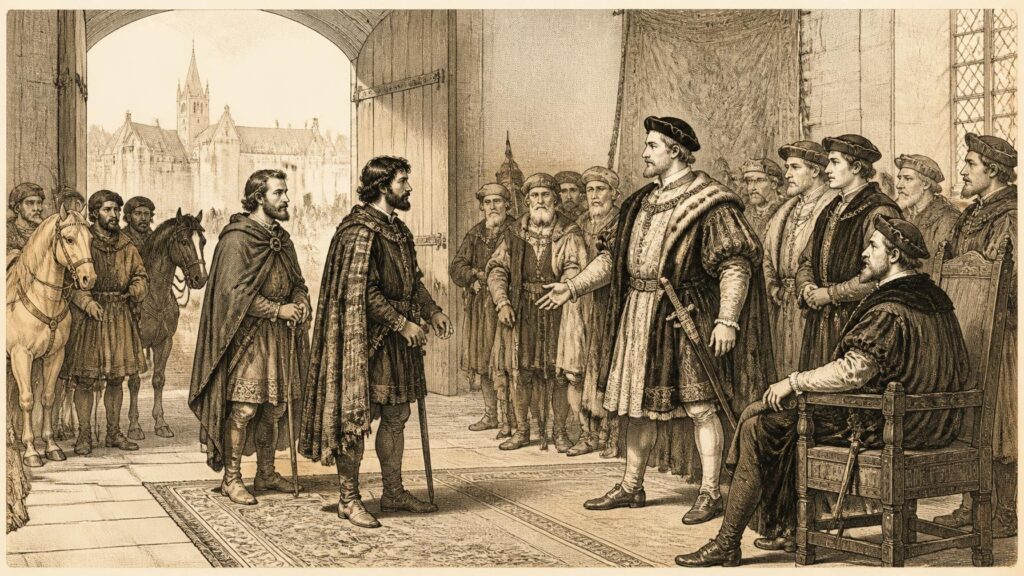
In 1525, Ireland’s most revealing public event was not a pitched battle or a royal statute but a failed attempt to make peace. At a great council in Dublin, Gerald FitzGerald, ninth earl of Kildare and lord deputy, brought together leading figures from the English lordship and the Gaelic political world. Conn Bacach Ó Néill of Tír Eoghain and Aodh Dubh Ó Domhnaill of Tír Chonaill attended in person. The meeting was impressive in scale, yet its failure exposed the limits of government from Dublin: the deputy could convene powerful rulers and offer arbitration, but could not compel them to abandon a contest rooted in territory, kinship and military reputation.
A Council of Gaels and English
The Annals of the Four Masters place the gathering in Dublin and describe the attendance of earls, barons, knights and many of the principal Irish and English men of the island. Annála Connacht similarly calls it a great council held at the beginning of the year before the justiciar. The two terms, lord deputy and justiciar, referred in this context to Kildare’s position as the king’s chief governor in Ireland. Their language should not be mistaken for proof that every lord in Ireland was subject to Dublin. Rather, the assembly shows that Kildare’s authority depended on personal connections, negotiation and the willingness of magnates to appear.
The immediate problem was the rivalry between Conn Bacach Ó Néill, lord of Tír Eoghain, and Aodh Dubh Ó Domhnaill, lord of Tír Chonaill. Their struggle concerned supremacy in Ulster and, especially, the contested lands around Inishowen. Both men commanded substantial followings, drew on networks beyond their core territories and had reason to treat alliance with Kildare as useful. Conn was a Fitzgerald kinsman through his mother, while Kildare had already intervened in northern affairs. Yet such links did not turn either Gaelic lord into a subordinate official. The council heard arguments over earlier covenants and obligations, with supporters from both the Irish and English communities taking part. No settlement could be achieved.
The failure mattered because it converted an attempt at public reconciliation into a licence for renewed private war. The Four Masters say that Ó Néill and Ó Domhnaill returned home still at strife. Aodh Dubh then entered Tír Eoghain twice during 1525, burning and ravaging the country through which his forces passed. The annals stress that he met no battle or resistance on either expedition. That does not mean the campaigns were harmless. Raiding armies took livestock and portable goods, destroyed food stores and crops where possible, and imposed fear on settlements along their route. Avoiding battle may have been prudent for Ó Néill, but it left his rival able to proclaim dominance.
An Autumn Arbitration
By the beginning of autumn, the antagonists had made peace, at least provisionally. The terms were to be determined by the arbitration of Kildare and Manus Ó Domhnaill, Aodh Dubh’s son and leading lieutenant. This arrangement is significant. It restored Kildare to the role of broker, but paired him with a member of the Ó Domhnaill dynasty. The peace was therefore not simply an order issued from Dublin Castle; it was a negotiated settlement framed through the authority of both the king’s deputy and an Ulster lordship.
Nothing in the surviving notices justifies calling this a permanent resolution. The wider Ó Néill–Ó Domhnaill competition continued through the following years. Still, the autumn agreement offers a clear view of how politics worked in 1525. Formal government, aristocratic lordship and Gaelic customary power met in a single process. Dublin was an important venue and Kildare an influential mediator, but neither displaced the political institutions of Tír Eoghain or Tír Chonaill.
Kildare’s position was itself precarious. He had resumed the deputyship in August 1524 after a period of English royal intervention intended to restrain his power and reconcile him with Piers Butler, claimant to the earldom of Ormond. The old rivalry had not disappeared. State papers from 1525 include a royal letter of 20 May concerning a subsidy for Ormond, articles advanced by Kildare against his rival, and Kildare’s August reply to Henry VIII. The correspondence demonstrates that disputes among the greatest Anglo-Irish houses remained a matter for the king and Cardinal Wolsey. It also helps explain why Kildare had reason to display his usefulness as a peacemaker among the Gaelic lords.
Local violence sharpened these factional tensions. Annales Breves Hiberniae records that Robert Talbot of Pollygard, a friend of Piers Butler, was killed near Ballymore by James FitzGerald. It attributes the murder to suspicion that Talbot was collecting material that could be used against Kildare. That explanation comes from a later annalistic account and should be treated cautiously, but the entry is valuable evidence that the contest between Kildare and Butler reached beyond formal petitions and royal correspondence into dangerous local antagonisms.
Towns, Privilege and Limited Government
A letter from the mayor and citizens of Waterford, dated 14 January 1525, adds an urban perspective. The corporation had heard that Kildare was seeking authority to summon and hold a parliament, and asked Henry VIII to ensure that Waterford’s charters would remain intact. The letter proves that a parliament was anticipated; it does not by itself prove that one was held. Its importance lies in the town’s anxiety about privilege. Waterford’s merchants, civic officers and householders depended upon corporate liberties, jurisdiction and trading rights. A parliament controlled by a powerful deputy might confirm those protections, alter them, or create new obligations.
This was a reminder that the lordship of Ireland was not divided simply between an English Pale and an undifferentiated Gaelic countryside. Walled towns such as Waterford had their own legal identities and commercial interests. Dublin supplied the setting for high politics, but other ports watched its decisions closely. The documentary record for 1525 does not allow a confident reconstruction of trade levels, harvests or prices. It does, however, show civic government alert to the consequences of national politics.
A Bishop Murdered at Leighlin
The year was also marked by a grave ecclesiastical crime in Leinster. Maurice Ó Deóradháin, usually rendered Maurice Doran, bishop of Leighlin, was murdered while in the company of Maurice Kavanagh, the archdeacon of the diocese, and others. The Four Masters call it a foul and treacherous deed undertaken under an appearance of friendship and charity. Annales Breves gives a more precise local tradition, placing the killing between Kilnane and Cloghruish and connecting it to the bishop’s effort to correct misconduct. The underlying circumstances cannot now be recovered with certainty, but the murder itself is firmly placed in 1525.
The reaction attributed to Kildare was severe. Annála Connacht and the Four Masters state that those implicated whom he captured were taken back to the scene and subjected to an exceptionally brutal exemplary punishment. The accounts were written down later and their detail cannot be independently checked, but they agree on the essential point: Kildare made the bishop’s murder a public demonstration of his authority. The episode was not a sign that religious life had ceased; it was evidence that church office, local kinship and secular power could collide violently.
It is especially important not to project the later Henrician Reformation backwards onto this year. Doran had been appointed bishop in January 1524 and consecrated at Rome in March. In 1525, papal provision remained the normal framework for such appointments, while the English crown retained major political influence over Irish ecclesiastical affairs. The crisis at Leighlin belonged to the final decade before the crown’s formal breach with Rome, not to a reformed Irish church.
Learning, Hospitality and Lordship
Other deaths recorded in 1525 reveal institutions that sustained society beyond war. Toirdelbach Ó Briain, bishop of Killaloe, died during the year. Annála Connacht praises him as a man of wealth, generosity and humanity, able to retain a large armed following and a patron of those who practised the arts. This is not a neutral modern biography: it is an obituary shaped by elite values. Yet it shows that a bishop in Thomond could be remembered not merely as a sacramental figure but as a landlord, military patron, provider and supporter of learning.
The same annals commemorate the dean, son of Brian Ruadh Mac Conmidhe, who maintained an open guest-house, as well as his son Cerball. Hospitality was a serious social obligation among clerical and learned households. A guest-house offered food, shelter and status; its loss was therefore worth recording. The Mac Conmidhe name also evokes the hereditary learned families whose poets, jurists and teachers preserved and circulated Gaelic scholarship.
At Donegal, Caiterfina Ó Duibhgeannáin died after receiving unction and penance on the feast of St Columba, 9 June, and was honourably buried in the Franciscan monastery. Her notice is brief, but it locates one woman within a major religious and cultural centre of the north-west. The Donegal friary was associated with the learned world that later produced the Annals of the Four Masters. In 1525 it was already a place of burial, devotion and connection for prominent Gaelic families.
Violence also touched the north-western lordships. Seán Ó Catháin was killed by kinsmen on the eve of Lammas, 31 July. Such notices, alongside the larger war between Ó Néill and Ó Domhnaill, underline the insecurity created by contested succession and faction within ruling lineages. Yet 1525 was not only a year of endings. On 28 February, probably at Maynooth Castle, Elizabeth Grey gave birth to Gerald FitzGerald, Kildare’s younger son. He would survive the destruction of much of his family after 1534 and eventually recover the earldom. In 1525, however, he was simply the newest member of the most powerful dynasty in the English lordship.
The surviving evidence makes 1525 a year of conference, raids, killings, religious observance and elite patronage. Its central lesson is restraint. Dublin’s great council was real, broad and politically important, but it did not bring Ireland under a single obedient order. The peace it failed to make at the opening of the year had to be patched together again in autumn, through arbitration between powers that remained independent, armed and watchful.
Primary Sources
- Annála Connacht: Annal 1525
- Annals of the Kingdom of Ireland: Annal M1525
- Annales Breves Hiberniae: Annal 1525
- Annales Hiberniae
- FitzGerald, Gerald (Gearóid Óg, Garrett McAlison)
- O'Neill (Ó Néill), Conn ‘Bacach’
- O'Donnell (Ó Domhnaill), Sir Aodh Dubh
- Fitzgerald, Gerald
- O'Neill (Ó Néill), Matthew (Feardorcha)
- State Papers, Ireland 1509–1547 (SP 60/1–12)
- Calendar of the State Papers Relating to Ireland, 1509–1573
- State Papers Published Under the Authority of His Majesty's Commission: King Henry the Eighth, Volume II
- State Papers Ireland 1509–1782: Government Papers on Irish Affairs
- Calendar of State Papers, Ireland, Tudor Period 1509–1547
- Ireland Under the Tudors, Volume I
- One World: The Communities of the Southern Dublin Marches
- A Church ‘in Decline’? The Pre-Reformation Irish Church
- Kildare: Irish Historic Towns Atlas
- English Lordship of Ireland and the Irish Sea World: Re-assessing the Origins of the Kildare Ascendancy, c.1390–c.1513
- Bishop Maurice Doran, O.P.
- Annales Breves Hiberniae: Introduction
- Note 109 for Annales Hiberniae