Killeigh Patronage1451 CE
For Ireland, 1451 is not a year dominated by one island-wide campaign or governmental act. Its surviving record is instead a set of sharply local episodes: the death of a renowned midland patron, a fire in a Franciscan friary at Cavan, a return from Rome, murders and hostage agreements, and the building of a castle in Connacht. Read together, they show an Ireland of overlapping lordships rather than a single political community: Gaelic rulers, Anglo-Irish families, religious houses and learned networks all exercised authority in particular places. The evidence has limits.
Dateline
For Ireland, 1451 is not a year dominated by one island-wide campaign or governmental act. Its surviving record is instead a set of sharply local episodes: the death of a renowned midland patron, a fire in a Franciscan friary at Cavan, a return from Rome, murders and hostage agreements, and the building of a castle in Connacht. Read together, they show an Ireland of overlapping lordships rather than a single political community: Gaelic rulers, Anglo-Irish families, religious houses and learned networks all exercised authority in particular places.
The evidence has limits. The principal narratives were written or compiled in monastic and learned settings, and privilege deaths, lordship, warfare, ecclesiastical affairs and notable benefaction. They tell us very little directly about harvests, ordinary housing, prices or the routines of most families in 1451. They are nevertheless unusually revealing about what contemporaries thought gave a person standing: hospitality, learning, religious patronage, military protection and the capacity to make and enforce agreements.
A Death Remembered Across Leinster
The year’s most resonant Irish obituary is that of Mairghréag Ní Chearbhaill, or Margaret O’Carroll, wife of Calbhach Ó Conchobhair Fáilghe, lord of Uí Fhailghe. The Annals of Ulster place her death about the feast of St Brigid, early in the year; the Annals of the Four Masters state that only one night separated her death from that of her son Feidhlim. Both agree that she died in 1451 and that Feidhlim was the heir to the Uí Fhailghe lordship. The Annals of Connacht, whose notice is the fullest, identifies her father as Tadhg Ó Cearbhaill, king of Éile, and says that she died from a cancer of the breast. It describes Feidhlim’s fatal illness in terms modern readers should treat carefully: the annalist names leprosy, but medieval diagnostic language did not map neatly onto modern medicine.
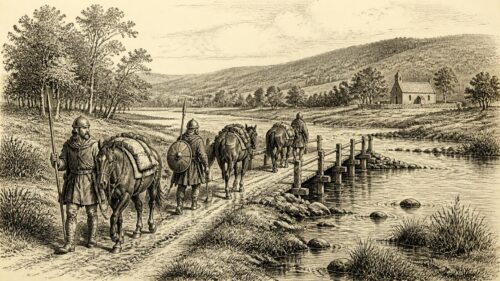
Margaret’s death mattered because of a lifetime of patronage. The annalist credits her with causeways, churches, books, chalices and other things needed for church service. This is retrospective testimony, not a claim that all were commissioned in 1451; yet it explains why her passing became an event of wider importance. Roads and causeways improved movement through a landscape in which travel was often difficult. Liturgical vessels and books sustained worship, while gifts to churches and religious houses created spiritual obligations and advertised a ruling family’s resources. Such patronage was practical as well as devotional.
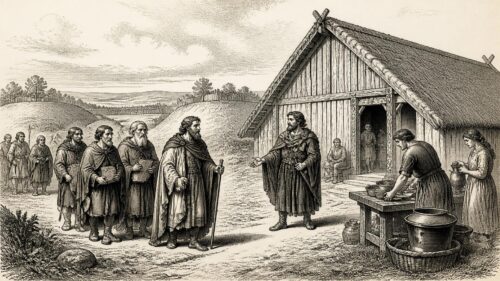
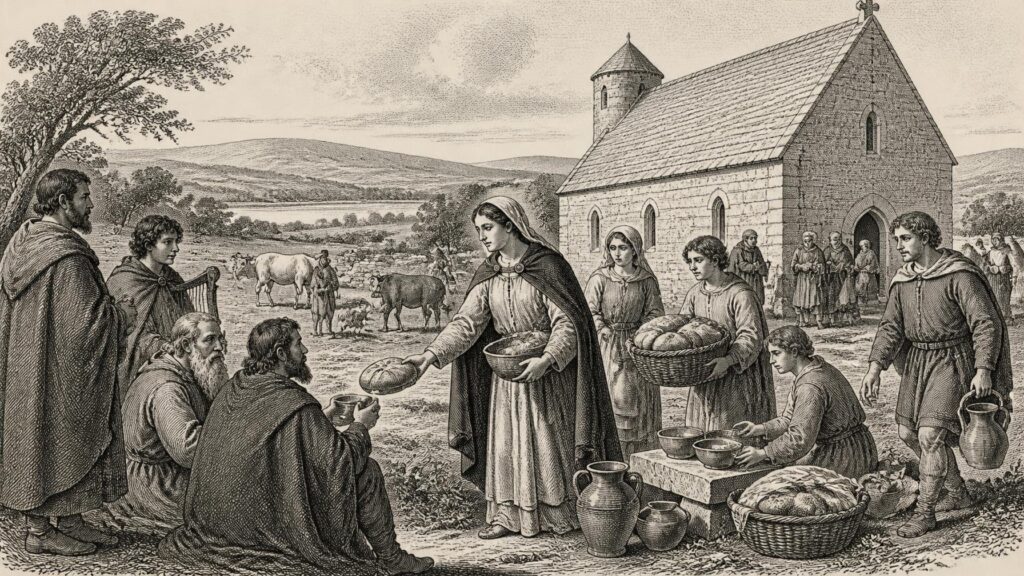
Her reputation rested equally on hospitality. The annals remembered two ‘general invitations’ issued in one earlier year, at Killeigh and Rathangan, to those seeking support. These were not private dinners. In Gaelic aristocratic society, the feeding and rewarding of poets, clerics, legal specialists, pilgrims and dependants was a public demonstration of honour and political reach. It converted movable wealth—especially cattle, food, cloth and precious objects—into reputation, alliances and lasting praise. The language used for Margaret is emphatic and gendered: she is called the best of the women of the Gaels in her time. But the scale of the commemoration also shows that an aristocratic woman could be an active political and religious patron in her own right.
Feidhlim’s death immediately widened the loss from household grief to succession anxiety. He was not simply Margaret’s son but the expected successor of Uí Fhailghe, a lordship spanning parts of the central midlands and facing the English lordship’s frontier. His absence did not end Ó Conchobhair Fáilghe power, but it altered the calculations of kin, clients and neighbours. The paired obituary is therefore one of the year’s clearest windows into the intimate connection between family health and public politics.
Fire in the Cavan Friary
Further north, the annals record that the monastery of Cavan burned around the feast of St Brendan. The bare notice in the Annals of the Four Masters gives no cause. The Annals of Ulster preserves a damaged entry, but an alternative manuscript reading printed alongside it attributes the blaze to Friar Ua Mothláin, who, after drinking wine, took a candle to his chamber and fell asleep. That vivid explanation should be presented as a manuscript variant rather than as an indisputable fact; the firm point is that a serious fire at the Cavan friary belongs to 1451.
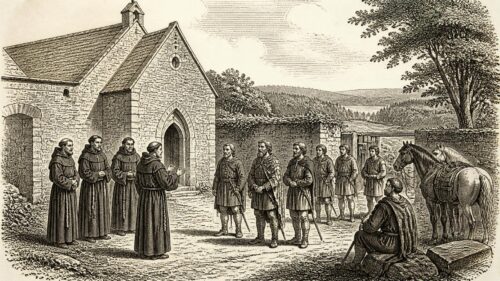
The loss was significant beyond the friars’ own precinct. Cavan’s Franciscan house stood near the Ó Raghallaigh, or O’Reilly, stronghold and the settlement’s river crossing and market area. It was embedded in the political, commercial and devotional life of east Bréifne. Franciscan communities depended on gifts and alms, but they also offered burial places, preaching, prayer and a setting for lordly commemoration. A fire endangered buildings, books, vestments, stores and the community’s ability to receive travellers. In a town where timber roofs, rushes, open flames and candles were commonplace, fire was a persistent material risk.
The episode should not be exaggerated into evidence that Cavan itself was destroyed in 1451: the annals specify the monastery. Yet its prominence demonstrates the friary’s importance. The house had already benefited from O’Reilly patronage and had suffered disruption in earlier regional conflicts. Repair after the fire would have required labour, timber, food and cash or credit—resources gathered through the relationship between friars, townspeople and their lordly patrons.
Rome, Pilgrimage and Prestige
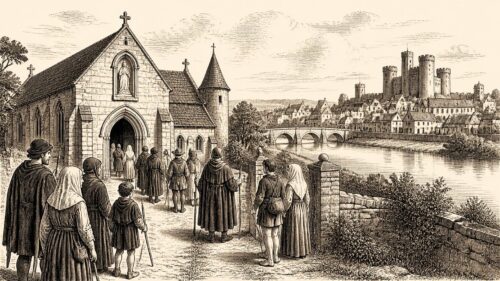
Rome also appears in the year’s Irish record. The Annals of Ulster state that Thomas junior Mag Uidhir, son of Thomas, returned from Rome at the beginning of 1451. The annalist says that both ‘Foreigners’—the Irish usage normally applied to people of English or Anglo-Irish background—and Gaels, as well as learned companies and pilgrims, rejoiced at his return. The wording is striking. It places a Fermanagh dynasty within networks that crossed linguistic and political boundaries, and it treats a Roman journey as a distinction shared and recognised across Ireland.
His return followed the Roman Jubilee of 1450, a year in which Irish travellers are recorded going to the city for indulgence and pilgrimage. It would be unsafe to assume that every named traveller undertook precisely the same journey or had the same purpose. What the entries securely show is regular contact between Irish lordly and clerical society and the wider Latin church. Travel to Rome was arduous, costly and dangerous, but it carried spiritual benefits and enhanced status on return.
Another Rome-related death underscores this connection. Redmond Mac Feorais Bermingham died while travelling home after obtaining the bishopric of Tuam. The notice does not tell us how far he had travelled or whether he was formally consecrated, but it shows that episcopal advancement could depend on access to papal authority. Irish ecclesiastical politics were local in their landed bases but international in their legal and devotional horizons.
Violence, Hostages and Building
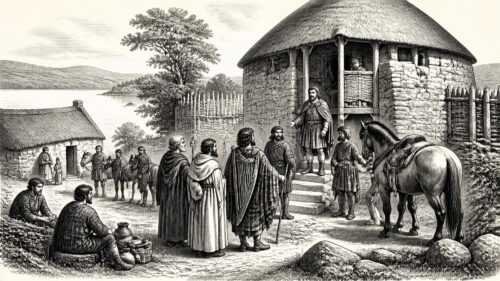
Political affairs in 1451 remained intensely regional. In Meath, the Annals of Connacht records the treacherous killing of Raymond Tyrrell, lord of Fertullagh, at Baile Sigmainn by James Nugent, son of the Baron of Delvin, and the sons of Garrett Boy Tyrrell. The brief entry does not permit a reconstruction of motive. It does, however, reveal the dangers within the Anglo-Irish aristocratic world, where lordships, inheritances and local alliances could turn relatives and neighbours into enemies.
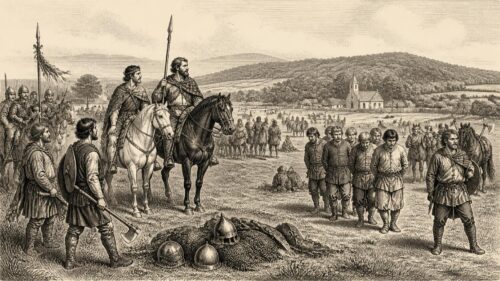
The same annals report the killing of three sons of Máel Sechlainn Ó Birn by a coalition of rival kindreds. Elsewhere, the Four Masters describes a major war among the Uí Mháine. Ó Conchobhair Don intervened to protect Ó Ceallaigh, who delivered his son and two other hostages as security for an annual payment of twenty marks and for obligations linked to disputed land and the war. This was politics conducted through guarantees. Hostages were not incidental captives: they were living pledges designed to make tribute, peace or service enforceable. The specified payment in marks also reminds us that coin and money-of-account worked alongside cattle, land and military force in lordly economies.
In Connacht, Mac William of Clanricarde erected the castle of Coradh-finne. The annal gives neither its exact form nor a detailed rationale, so it should not be turned into a precise architectural narrative. Still, the decision to record its construction is meaningful. A castle concentrated lordly power: it protected people and goods, served as a residence and storehouse, and proclaimed a family’s claim to rule a district. Across fifteenth-century Ireland, fortified residences and defended enclosures were part of the changing material landscape of both Gaelic and Anglo-Irish lordships.
An Island of Many Authorities
At the widest level, Henry VI remained lord of Ireland, while Richard, duke of York, still held the lieutenancy in title. York had left Ireland in September 1450, and the annals for 1451 record no new nationwide intervention by him. It would therefore be misleading to make the English administration the main actor of this particular year. Its authority was strongest in and around the Pale and depended elsewhere on negotiation with magnates and Gaelic rulers. The year’s Irish evidence instead centres on Uí Fhailghe, Bréifne, Fermanagh, Meath and Connacht.
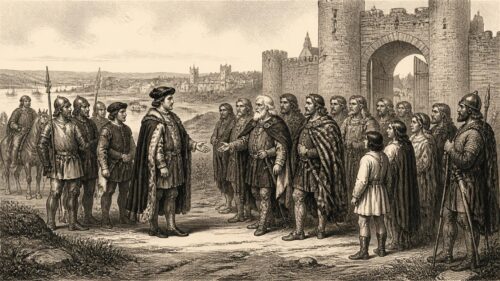
1451 was consequently a year in which public life was made visible through obituaries, fires, journeys, hostages, violence and construction. Margaret of Killeigh’s remembered generosity, the Cavan friary’s disaster and the welcome for a traveller from Rome reveal the importance of church, learning and hospitality. The killings and agreements of the midlands and Connacht reveal a harder reality: local power rested on kinship, force, wealth and enforceable promises. The surviving sources do not offer a complete portrait of Ireland’s people, but they preserve a convincing picture of a society whose local institutions were deeply connected—to Rome, to Scotland, to neighbouring lordships and to the reputations made by giving, protecting and remembering.
Source References
Hover over a number to see the source. Select it to open the source.

- [1] Annála Connacht: Annal 1451
- [2] Annála Connacht
- [3] Annals of the Four Masters: Annal M1451
- [4] Annals of the Four Masters
- [5] Annals of the Four Masters: Irish Text, Annal M1451
- [6] The Annals of Ulster: Year U1451
- [7] The Annals of Ulster
- [8] O'Carroll (Ní Chearbhaill), Mairghréag
- [9] Richard of York
- [10] Butler, James
- [11] FitzGerald, Thomas ‘fitz Maurice’
- [12] FitzEustace, Roland
- [13] Cavan Franciscan Friary
- [14] Franciscan Friars (OFM)
- [15] Exploring the Irish Annals
- [16] CELT: Corpus of Electronic Texts
- [17] The Annals of Ulster: Bibliographic and Editorial Information
- [18] Annála Connacht: Bibliographic and Editorial Information
- [19] Annals of the Four Masters: Bibliographic and Editorial Information
- [20] Moymlough
Primary Sources
- Annála Connacht: Annal 1451
- Annála Connacht
- Annals of the Four Masters: Annal M1451
- Annals of the Four Masters
- Annals of the Four Masters: Irish Text, Annal M1451
- The Annals of Ulster: Year U1451
- The Annals of Ulster
- O'Carroll (Ní Chearbhaill), Mairghréag
- Richard of York
- Butler, James
- FitzGerald, Thomas ‘fitz Maurice’
- FitzEustace, Roland
- Cavan Franciscan Friary
- Franciscan Friars (OFM)
- Exploring the Irish Annals
- CELT: Corpus of Electronic Texts
- The Annals of Ulster: Bibliographic and Editorial Information
- Annála Connacht: Bibliographic and Editorial Information
- Annals of the Four Masters: Bibliographic and Editorial Information
- Moymlough