Waterford’s Vanishing King1399 CE
In 1399 Richard II landed at Waterford to subdue Art Mac Murchadha Caomhánach, whose Leinster forces avoided pitched battle, strained royal supplies and prevented a settlement. The expedition exposed the limited reach of English lordship beyond defended centres. While Richard campaigned, conflicts continued in Connacht and Ulster, and John fitz Gerald, earl of Desmond, drowned amid a Munster feud, leaving a minor heir. Annals note deaths of churchmen, rulers and Mac Egan legal scholars. Henry Bolingbroke’s English invasion forced Richard’s July departure. Art remained unconquered, and Henry IV’s accession by September ended Richard’s reign, leaving Irish divisions and weakness unresolved.
Dateline
In 1399 Ireland became the setting for the last campaign of Richard II, king of England and lord of Ireland. His expedition was directed above all against Art Mac Murchadha Caomhánach, the formidable Leinster ruler whom English and Anglo-Irish authorities regarded as the greatest immediate threat to their lordship. Yet the year’s significance lies not simply in a royal army moving through Leinster. Richard’s inability to compel Art’s submission exposed the limits of royal military power in Ireland; meanwhile, events in England forced the king away and brought a change of dynasty whose consequences reached across the Irish Sea.
The surviving evidence needs careful handling. The annals record Irish deaths, raids and political changes under the year 1399, but annalistic year-beginning conventions can differ, and later compilations sometimes preserve material under a shifted year. For the central royal expedition, however, several sources agree on the essentials: Richard landed at Waterford at the turn of May and June, campaigned unsuccessfully in Leinster, and departed suddenly in July.
A King Returns to Waterford
Richard had visited Ireland once before, in 1394–5. That earlier progress had produced many formal submissions from Gaelic rulers, but its apparent settlement did not last. The immediate background to the second expedition was the killing of Roger Mortimer, earl of March and the king’s lieutenant in Ireland, in June 1398 during fighting in Carlow. Mortimer’s death demonstrated that the authority claimed by the crown and its Anglo-Irish allies could not simply be projected beyond defended towns, lordly estates and major routes.
Richard’s target was therefore precise. Art Mac Murchadha, ruler of a powerful Leinster polity based among the wooded uplands and river valleys south of Dublin, had refused to accept the position intended for him in the king’s Irish order. His own claims were tied to land, lordship and kinship as much as to a general rejection of English rule. Art’s marriage to Elizabeth le Veel, an heiress with rights in the Kildare area, had sharpened conflict with the colonial establishment. His following included Gaelic allies and men able to operate effectively across difficult country where mounted armies and supply trains were exposed.
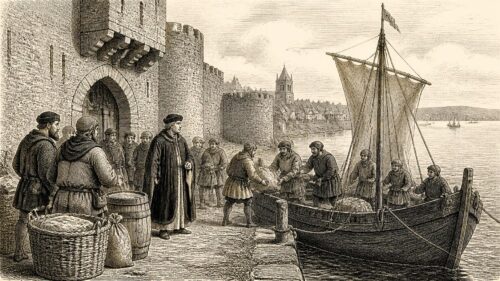
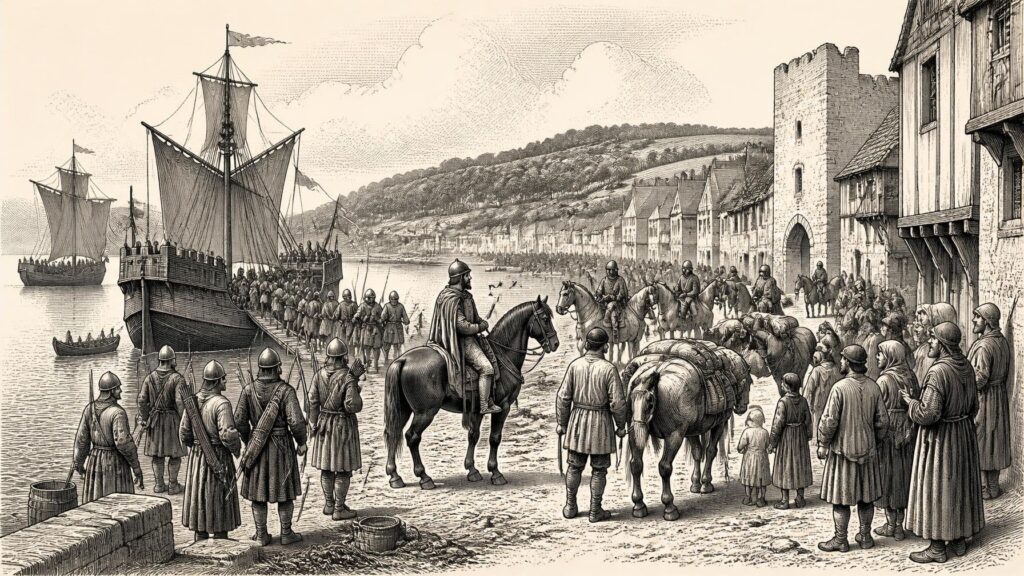
An Irish annal written from within the English lordship records that Richard entered Ireland for the second time on the last day of May. Modern reference works place his landing at Waterford on 1 June. The one-day discrepancy is not worth disguising: it is safest to say that the royal fleet reached Waterford at the very end of May or opening of June. What is clear is that Waterford again served as the gateway for a king who hoped to display authority in person. The arrival was not a visit of ceremony alone. It brought a large royal household, English magnates, soldiers, horses, shipping and the substantial logistical demands of an expeditionary court.
Leinster’s Unwon War
From Waterford the king moved into the political and military landscape of south Leinster. Kilkenny, the centre of Butler power, was an important stopping point, but the campaign’s purpose lay beyond the security of the walled town and its castle. Richard sought to bring Art Mac Murchadha to terms or battle. Instead, the Leinster ruler declined to offer the kind of encounter that an army of armoured men, archers and cavalry could readily exploit.
This was not passivity. Avoiding a pitched battle could itself be an effective strategy. Art’s forces knew the country, could withdraw through woods and uplands, and could threaten communications and provisions. Royal armies depended upon regular food, fodder, transport and information; a hostile landscape became more dangerous when local communities did not supply them freely. Later accounts associate the expedition with a hard pursuit towards the Wicklow–Leinster frontier and with severe difficulties in feeding the army. The precise sequence of marches is not secure enough to turn into a day-by-day itinerary, but the outcome is plain: Richard did not capture Art, and he did not obtain a durable submission.
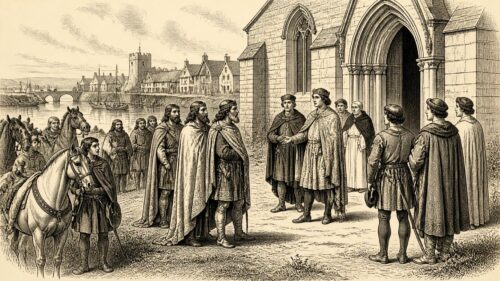
One near-contemporary witness to the wider crisis was the French courtier Jean Creton, who had been sent to accompany Richard in 1399. A manuscript of his verse account includes an image of Mac Murchadha approaching a royal envoy. Its survival is useful for more than its striking scene: it shows that the Leinster conflict was understood at the royal court as central to the expedition. Yet the image should not be mistaken for a photographic record. It belongs to a carefully made courtly manuscript, completed after the king’s fall, and must be read beside annals and administrative evidence.
The campaign thus demonstrated an awkward fact about lordship in Ireland. Richard could land at a major port and move with a powerful force through territories where Anglo-Irish magnates had castles and estates. He could not thereby convert the whole region into governable royal ground. In Leinster, political authority was negotiated through local power, hostages, alliances, land claims and the ability to protect dependants. Art Mac Murchadha’s survival at liberty was itself a substantial success.
Other Wars, Other Lordships
The king’s presence did not suspend the rest of Irish politics. The Annals of Ulster tersely note that “the king of the Saxons came to Ireland”, then turn at once to a Connacht conflict. Ó Conchobair Ruadh and the Clann Donnchaidh Mac Diarmata made raids around Magh Tuiredh, but were overtaken and defeated; Somairle Mac Domnaill the Tawny was killed with his people. Such entries are a reminder that Connacht lordships pursued their own rivalries rather than functioning as mere spectators in Richard’s Leinster war.
In Ulster, the Annals of the Four Masters place a raid by Niall Ó Néill against “the English” in 1399, reporting that many were plundered and expelled. The same annals record a separate expedition by the sons of Henry Ó Néill against the English of Traghbhaile, near Dundalk. On that occasion the English assembled, routed the attackers, captured Donnchadh son of Henry, and killed many of his followers. The chronicler adds that the prisoner was sent to England in the following year after a ransom was refused. These notices do not describe a single national war. Rather, they reveal several shifting frontiers where Gaelic lords, towns, colonial landholders and regional dynasties tested one another’s strength.
Munster also experienced a politically consequential death. John fitz Gerald, fourth earl of Desmond, drowned while crossing the Suir in October 1399. The annals identify Ardfinnan ford; biographical evidence adds that he was returning from a retaliatory raid against James Butler, earl of Ormond. John had succeeded his father only in 1398. His death left the earldom to his fourteen-year-old son Thomas, creating a minority at the head of one of the great Anglo-Irish lordships. The episode illustrates how readily local aristocratic conflict could proceed alongside, and independently of, royal campaigning.
Departure and a New English King
While Richard’s army struggled to impose its purpose in Ireland, Henry Bolingbroke returned from exile and landed in Yorkshire on 4 July. Initially claiming his Lancastrian inheritance, Henry gathered support with remarkable speed. News reached Richard in Ireland and transformed the campaign’s priorities. The expedition left Waterford on 27 July, according to the Dictionary of Irish Biography; other medieval chronicle traditions differ over the king’s subsequent movements and dates in Wales, but agree that the Irish venture had been abruptly abandoned.
For Ireland, Richard’s departure mattered more than the personal drama of an absent monarch. His expedition had consumed political attention and military resources without settling Leinster. Art Mac Murchadha remained unbroken. The English lordship was left to confront its persistent financial weakness, reliance on local magnates and inability to secure wide obedience by a single royal demonstration of force.
By 29 September, Henry IV had been made king of England, an event entered in the Annals of the Four Masters. The change did not alter the legal language by which the English crown claimed Ireland, but it removed the king who had personally attempted to enforce that claim. Richard’s Irish campaign had not caused his deposition by itself; the political crisis in England had deeper roots. Nonetheless, his absence on campaign gave Henry an opportunity which Richard could not reverse once he had sailed home.
Law, Learning and Loss
The year’s annals preserve quieter losses that illuminate Irish society. Conor Mac Cormaic, bishop of Raphoe, died. Cu-Uladh Ruadh Ó Néill died of plague, a brief but important indication that epidemic disease continued to shape households and succession as well as armies. The annals also record the death of John Ó Fearghail, lord of Annaly, praised as an intellectual and learned man as well as for hospitality and prowess. Such praise reflects a political culture in which a ruler’s standing was measured not only by military success but by generosity, learning and the maintenance of dependants.
Most revealing are the deaths of Boethius Mac Egan and Gilla-na-naev Mac Egan. The former was remembered as highly skilled in Fenechus, the learned corpus commonly called Brehon law, and in music, while maintaining a celebrated house of hospitality. Gilla-na-naev was described as arch-ollam, or chief master, of that legal tradition. Their obituaries show that legal expertise, performance, teaching and hospitality could be closely joined in a hereditary learned family. Even in a year dominated by a king’s failed invasion, Ireland’s political world depended on scholars who interpreted law, trained pupils, advised patrons and sustained the social obligations of elite households.
Thus 1399 was not a simple confrontation between an invading king and an isolated Irish opponent. It was a year in which Waterford received a royal host, Leinster resisted conquest by refusing its terms, regional wars continued from Ulster to Connacht, a Munster earl drowned amid local feud, and renowned legal scholars died. Richard II departed with Art Mac Murchadha still beyond his control. Before the year ended, Richard himself had lost his crown.
Primary Sources
- The Annals of Ulster
- Annals of the Four Masters
- Part 3 of Annals of the Four Masters
- Annales Hiberniae
- Annála Connacht
- MacMurrough Kavanagh (Mac Murchadha Caomhánach), Art Mór | Dictionary of Irish Biography
- Richard II | Dictionary of Irish Biography
- FitzGerald, John | Dictionary of Irish Biography
- Harley MS 1319, ff 1r-78v: Jean Creton, Histoire rimée de Richard II
- Cotton MS Titus B XI
- The Deposition and Death of Richard II (1399)
- An English Chronicle of the Reigns of Richard II, Henry IV, Henry V, and Henry VI
- Richard II's Departure from Ireland, July 1399
- Three Armies in Britain: The Irish Campaign of Richard II and the Usurpation of Henry IV, 1397–1399
- Jehan Creton’s ‘Prinse et mort du roy Richart d’Angleterre’
- Richard II in Ireland 1394–5 and Submissions of the Irish Chiefs
- King Richard II's Two Visits to Kilkenny (1393 & 1399)
- King Richard II Leads a Military Expedition to Ireland and Visits Kilkenny Castle
- Arklow Castle CMF22-1-WI002
- Irish Kings and English Rulers: Delving Deeper
- Richard II and the Wider Gaelic World: A Reassessment
- English Lordship of Ireland and the Irish Sea World: Re-assessing the Origins of the Kildare Ascendancy, c.1390–c.1513