Blackford’s Captured Armour1404 CE
In 1404, Ireland remained politically fragmented between the English lordship, Anglo-Irish magnates and Gaelic rulers. At Blackford in Laigis, Gilla Pátraic Ó Mórdha defeated forces identified as English, capturing horses, weapons and armour. Connacht saw Mac Diarmata succession struggles, regional deaths and warfare, while Domnall Ó Néill claimed Ulster’s kingship amid continuing rivalry. Bishop Tomás Barrett died, Nicholas Fleming was appointed to Armagh, and widespread lectual sickness was reported. Maritime conflict occurred in Munster. The deaths of several ollamhs, or learned masters, highlighted the vulnerability of hereditary cultural institutions. Annals also record household figures, local violence and uncertain chronology throughout.
Dateline
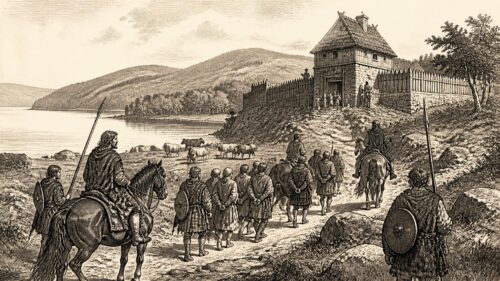
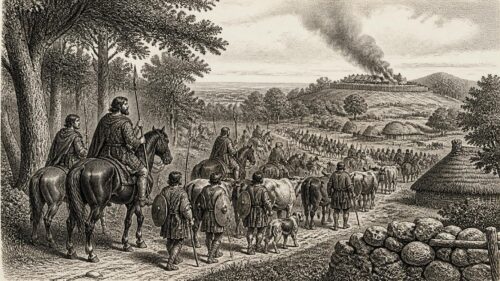
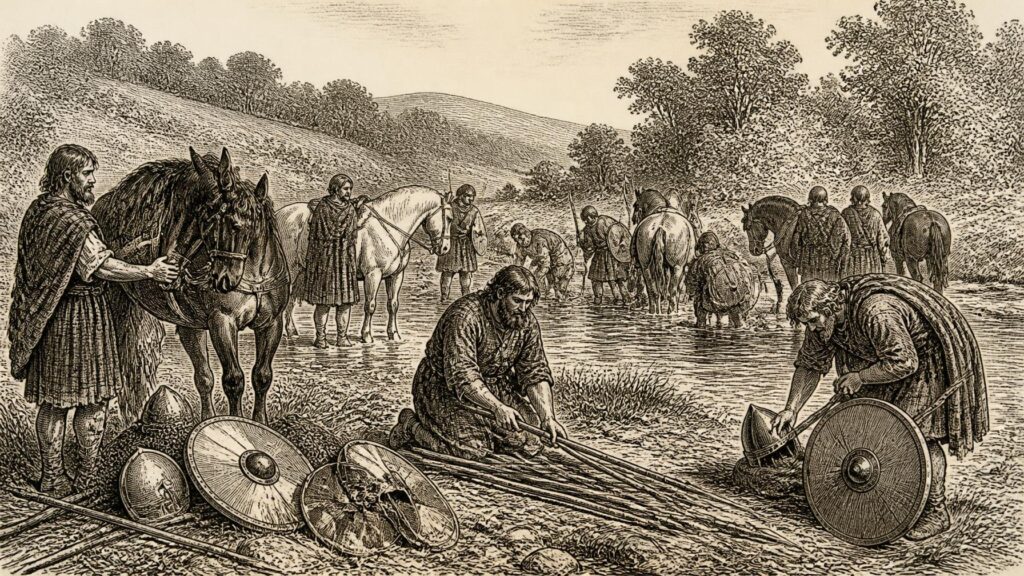
The most vivid military notice for Ireland in 1404 is not a royal campaign or a siege of a great town, but a local victory at Ath Dubh, Blackford. There, according to Annála Connacht, Gilla Pátraic Ó Mórdha, king of Laigis, routed the Galla—rendered in one later annalistic translation as “the English”. Many men were killed, and the victors took substantial quantities of horses, weapons and armour. The entry has no day or month, and Blackford’s precise location remains less secure than the political meaning of the encounter. It nevertheless records a hard fact of life in southern Leinster: a Gaelic lord could defeat armed forces associated with the English lordship and turn their costly military equipment into booty.
Ireland in 1404 was neither governed nor experienced as a single political unit. The English crown retained its lordship and institutions, especially in Dublin and the eastern settlements, but royal reach varied sharply. Gaelic kings and lordly lineages governed most of the island through their own territories, followers, alliances and rivalries. Anglo-Irish magnates held extensive estates and exercised their own local authority. The year’s surviving notices therefore concern several regions at once: Laigis, Connacht, Ulster, the church provinces of Elphin and Armagh, and the maritime world of south-western Munster.
What Can Be Dated
The strongest year-specific evidence comes from Annála Connacht, whose annalist explicitly opened 1404 with a calendrical notice: 1 January fell on a Tuesday. The record dates some events only by season or church time. Tomás Barrett, bishop of Elphin, died in spring and was buried at Errew on Lough Conn. Máel Sechlainn Mag Oirechtaig, chief of Muinter Raduib, died on Mid-Lent Sunday and was buried at Roscommon. Conchobar Óg Mac Diarmata, king of Moylurg, died between Michaelmas and Samhain, roughly the period from late September to early November; about Samhain, Tadc Mac Diarmata assumed the kingship.
Such formulations are valuable precisely because they define their limits. They do not licence a modern historian to invent a precise battle-date, a route of march or a death toll. Nor should every annalistic heading be treated uncritically as a modern calendar date. The death of the third earl of Ormond, for example, appears under 1404 in some annalistic compilations, but independent evidence places James Butler’s death in September 1405. It is consequently part of the immediate background to this period, not an event to be assigned to 1404.
Blackford and Laigis
Gilla Pátraic Ó Mórdha’s victory was important because horses, arms and armour were the material basis of lordly warfare. Horses offered speed in raiding, pursuit and communication; armour was expensive, durable and reusable; weapons could arm dependants or be redistributed to allies. The annalist’s decision to enumerate the captured equipment indicates that it mattered as much as the killing. The word Galla conventionally marked people regarded as foreigners, often English or Anglo-Irish, rather than supplying a modern ethnic description of every combatant. Yet the Annals of the Four Masters likewise call the defeated force “the English”, confirming the conflict’s frontier character.
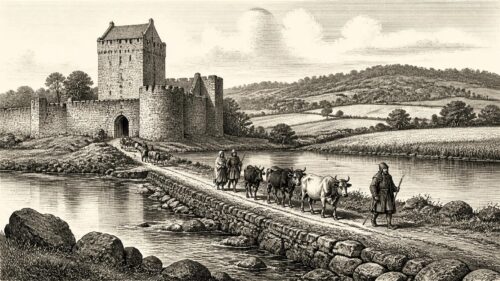
Laigis lay in the contested middle ground of Leinster, west of the more densely settled English lordship and close to routes connecting Dublin, Kildare, Meath and Munster. A defeat there could expose travelling parties, weaken local claims to tribute or protection, and advertise Ó Mórdha strength to neighbours. It did not expel the English crown from Ireland, nor did it settle Leinster permanently. Rather, Blackford shows how the balance of power was repeatedly made and remade through short campaigns, cattle and horse-taking, ambushes, negotiated submissions and the possession of fortified places.
Successions in Connacht and Ulster
In Connacht, 1404 brought loss and succession within the Mac Diarmata lordship of Moylurg, centred in the area around modern north Roscommon. Conchobar Óg Mac Diarmata’s death in autumn was followed by Tadc’s inauguration or acceptance as king. The annalist also recorded the killing of Cormac Mac Diarmata during an incursion into Clanricarde, at the hands of cavalry from Clanricarde and Thomond. The entries connect a succession to active warfare, but do not prove that Cormac’s death caused the change of ruler. Their language—Cormac was the “drop before a shower” for Moylurg—does suggest that contemporaries expected further trouble.
The wider Connacht record is crowded with the deaths of regional rulers and retainers: Cathal Mac Donnchada died in his stronghold at Portinch; Feidlim Ó Tuathail, king of Uí Muiredaig, died; and violence within the Ó Cennétig kindred of Ormond claimed Tomás Ó Cennétig, described as a half-king of Ormond. One captive, Donnchad son of Ó Cennétig Donn, died while held by his own brothers. These are reminders that political authority depended on kin groups whose internal rivalries could be as consequential as war with an external enemy.
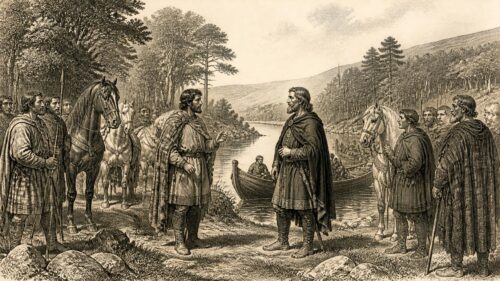
In Ulster, Domnall son of Énrí Ó Néill assumed the provincial kingship. This was a major claim, not an uncontested command over all of Ulster. Domnall Bog Ó Néill had recently emerged from imprisonment in Dublin after hostages were supplied for his release, while the death of his rival Niall Óg Ó Néill and then of Niall’s successor created an opening. His assertion of kingship in 1404 belonged to an ongoing contest among branches of the Ó Néill, the rising O’Donnell power in Tír Chonaill and neighbouring lordships. The year marks a shift in that contest, not its conclusion.
Church, Illness and Household Life
Two ecclesiastical developments give the year a different scale. In spring, Bishop Tomás Barrett of Elphin died and was buried at Errew, on Lough Conn. The annals praise his learning in theology, testimony to the standing that scholarly clerics could command in a diocese spanning parts of Connacht. In April, after Archbishop John Colton resigned, Nicholas Fleming was provided by Pope Boniface IX to the archbishopric of Armagh. Fleming’s consecration was delayed, but his provision established the beginning of an episcopate that would last until 1416. The appointment linked an Irish primatial see to papal administration during the continuing Western Schism, while also beginning a career conducted amid weak English governmental power in Ireland.
More ominously, Annála Connacht reports “many diseases in Ireland this year, and especially the lectual sickness”. The term cannot safely be translated into a modern diagnosis, and the entry supplies neither symptoms nor numbers. Still, it is direct evidence that contemporaries perceived widespread illness rather than isolated deaths. Sickness would have reached beyond the prominent people named in chronicles: it could disrupt agricultural labour, travel, domestic service, military musters and the capacity of religious houses and lordly households to provide food and hospitality.
The annals preserve a rare glimpse of a prosperous non-ruling household through the death of Donnchad Mac Shanly, described in the Four Masters as a wealthy brughaidh and trusted servant of Ruaidrí Ó Conchobair. A brughaidh was associated with provisioning and hospitality, a role of real political weight in a society where a lord’s reputation relied upon feeding retainers, guests, clerics and learned people. His notice is a small corrective to a record otherwise dominated by kings, bishops and warriors.
Sea Conflict and Learned Loss
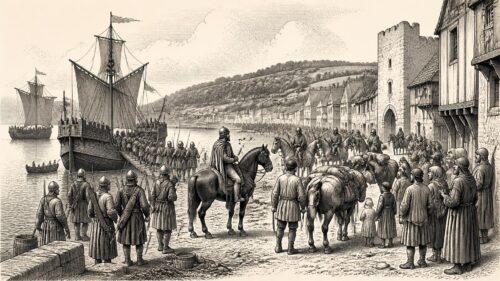
War also extended to the coast. The Connacht annalist reports conflict between Mac Carthaig, Ó Súilleabháin Buí and the sons of Diarmait Mac Carthaig. Toirrdelbach the Stout Mac Mathgamna, serving as Mac Carthaig’s sea-captain, met the opposing force at sea. Ó Súilleabháin was drowned, while two Mac Carthaig men were captured. No harbour or shoreline is named, so the encounter cannot be mapped with confidence. Its inclusion nonetheless demonstrates that lordship in south-west Munster involved seaborne mobility and conflict as well as control of land.
1404 was also a year of conspicuous bereavement among Ireland’s professional learned families. Donnchad Baccach Ó Maol Chonaire, ollamh of Síol Muiredaig in history, died; Gilla Duibín Mac Cruitín, ollamh of Thomond in history, died; Cerball Ó Dálaigh, ollamh in poetry for Corcomruadh, died; and Flann Óg Ó Domnalláin, ollamh in poetry of Síol Muiredaig, also died. The Four Masters add William Ó Deoradhain, an ollamh of Leinster in jurisprudence, to this sequence of losses.
An ollamh was not simply a gifted individual. The title denoted the highest recognised grade in a learned discipline, sustained by training, hereditary schools and aristocratic patronage. Historians, poets and jurists preserved genealogies, composed praise and satire, advised on customary law, and gave political relationships a language of precedent and legitimacy. Their deaths in one year did not extinguish those traditions, but they show how vulnerable the cultural institutions of Gaelic and Gaelicised Ireland were to mortality. In 1404, battles, sickness, episcopal change and learned loss all formed part of the same unsettled social landscape.
Primary Sources
- Annála Connacht: Annal 1404
- Annála Connacht
- Annals of the Four Masters: Annal M1404
- Annals of the Four Masters, Volume 4: English Translation
- Annals of the Four Masters, Volume 4: Irish Text
- The Annals of Ulster
- The Annals of Ulster: CELT Project Documentation
- Annales Breves Hiberniae
- O'Neill (Ó Néill), Domhnall Bog
- Fleming, Nicholas
- Butler, James
- Richard II
- Former Archbishops of Armagh
- The Register of Nicholas Fleming, Archbishop of Armagh, 1404–1416
- The Register of Nicholas Fleming, Archbishop of Armagh 1404–1416
- Richard II and the Submissions of Gaelic Ireland
- CIRCLE: Irish Chancery Letters of Henry IV, 1399–1413
- Patent Roll 6 Henry IV (1404–1405), Item 32
- Calendar of Ormond Deeds, Volume II, 1350–1413
- Exploring the Irish Annals
- The Annals of the Four Masters: Irish History, Kingship and Society in the Early Seventeenth Century
- Holdings: A Discourse of Ireland Collected Out of the Records Concerning Richard II’s Irish Submissions
- Irish Chancery Letters, c.1244–1509
- The Butlers