Roger Mortimer’s Last Campaign1398 CE

Dateline
In 1398, the political settlement imposed after Richard II’s first Irish expedition was visibly coming apart. The year’s most consequential firmly dated event was the death on 20 July of Roger Mortimer, earl of March and Ulster, the king’s lieutenant in Ireland. Mortimer was a major lord in his own right, an heir presumptive to the childless Richard II, and the Crown’s foremost military representative in Ireland. His death in a Leinster campaign exposed how limited English authority remained beyond the better-defended lordship towns and lordly estates.
That did not make 1398 a simple national contest between ‘English’ and ‘Irish’. Warfare joined Gaelic lordships, Anglo-Irish magnates, town communities, hired soldiers and local kindreds in shifting combinations. The annals record fighting from Wicklow and Carlow to Donegal, Sligo, Roscommon and Munster; they also record churches burned, food stores moved, hostages taken, learned men dying and plague reported. Together, these notices show a society in which lordship rested on the ability to protect people, livestock, harvests, monasteries and routes of movement.
A Lieutenant Killed in Leinster
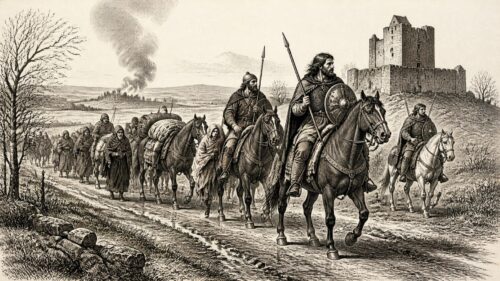
Mortimer had returned to Ireland in April 1398 after time in England. He inherited extensive Irish interests through the Mortimer–de Burgh connection and had sought, with uneven success, to enforce the rights of the earldom of Ulster and the Dublin administration. His campaigns of the previous years had already antagonised powerful Gaelic interests. In Leinster he faced a landscape in which Art Mac Murchadha Caomhánach, king of Leinster, and allied kindreds such as the Uí Bhroin (O’Byrnes) and Uí Thuathail (O’Tooles) could use the wooded uplands and local networks to resist mounted expeditions from the lordship.
The Irish annals agree on the essentials of the July disaster: O’Byrne and O’Toole forces defeated the English and Mortimer, earl of March, was slain. A Latin annal gives an unusually detailed but partisan list of opponents, naming O’Nolan, O’Byrne, MacDavid Mór and Murtagh Mac Lochlainn, captain of Mac Murchadha’s kern. Later tradition and modern discussion have associated the encounter with Kellistown, south-east of Carlow; medieval sources preserve variant place-names, however, so the exact battlefield should not be treated as certain. Nor should Art Mac Murchadha be presented as personally killing Mortimer. His political and military world plainly supplied the resistance, but the surviving notices do not securely establish his personal presence.
The effect was immediate. Mortimer’s death deprived the Crown of an experienced lieutenant at a moment when it was already hard to finance campaigns and retain military obedience. It also removed a figure whose position combined royal office, great landed power and a claim to leadership in Ulster. Richard II’s second expedition, which landed at Waterford on 1 June 1399, belongs to the following year; it was prompted in large part by the crisis Mortimer’s death revealed. Some annalistic material places King Richard in Ireland under 1398, but that chronology cannot override the securely documented landing of 1399. It is a useful warning that annual entries must be read critically rather than treated as precise diaries.
Captivity, Fire and Lordship
Leinster’s instability was not confined to Mortimer’s fatal expedition. The Annals of the Four Masters report that Gerald FitzGerald, earl of Kildare, was captured by Calvagh O’Conor and Offaly cavalry, then handed to Murrough O’Conor. An earl taken prisoner was both a military reverse and a bargaining opportunity: captives could secure ransom, political concessions or temporary restraint from an opponent. It underlines the reach of Uí Fhailghe power along the western approaches to the English lordship.
Glendalough was burned during the summer. The Connacht annals say that Englishmen and Irish Galls—people of the colonial, Anglo-Irish world—burned it again; another annal simply assigns the burning to the English. The discrepancy matters less than the shared fact of destruction at one of Ireland’s most resonant ecclesiastical sites. The attack was not proof that Glendalough had ceased to matter. On the contrary, churches and monasteries retained stores, buildings, symbolic authority and strategic value, making them vulnerable in war. For clergy and laypeople alike, the burning would have meant disruption to worship, shelter, food and local memory as well as material loss.
In Munster, the death of Gerald FitzGerald, third earl of Desmond—Gearóid Iarla—marked another change in a great lordship. The annals praise him for knowledge of Irish language, poetry, history and learning. This was not empty ornament: his career demonstrates how a leading Anglo-Irish magnate could operate within both colonial and Gaelic political cultures. He had served in the defence and administration of Munster while also becoming a known Irish-language poet. His son John succeeded in 1398; reports that John drowned in the Suir belong to 1399, not to this year.
Ulster’s Unfinished War
Far to the north, Niall Óg O’Neill and Toirdhealbhach Ó Domhnaill fought for influence across Tír Eoghain, Tír Chonaill and their neighbouring lordships. This was not a peripheral quarrel. Control of Ulster depended upon alliances, tribute, hostages and the capacity to assemble a hosting across difficult terrain. During 1398 Niall Óg’s army, joined by the sons of Henry O’Neill, marched against Ó Domhnaill as far as Assaroe at Ballyshannon. The force plundered the monastery’s wealth and herds and devastated Tírhugh before returning to Tyrone.
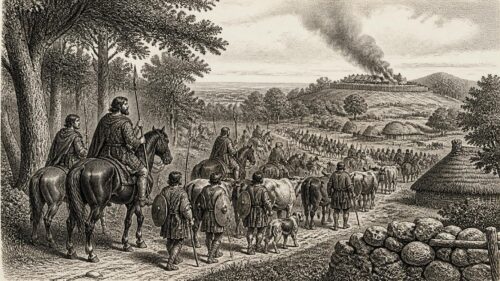
The campaign shows the practical texture of medieval war. Herds were mobile wealth, usable as provisions and as a public declaration of dominance; monasteries possessed food, animals and valuables; and an army’s route could ruin a district’s capacity to recover. At the same time, political allegiance was far from fixed. The annals say that many of Ó Domhnaill’s own chiefs and followers abandoned him, while Niall Garbh Ó Domhnaill and other kinsmen raided Fanad, taking a MacSweeny prisoner. After Mortimer’s death, English and Irish interests in Ulster, with Ó Domhnaill excepted, gave Niall Óg hostages and pledges. Such submissions were significant, but they were not a modern transfer of sovereignty: they were personal, negotiated acknowledgements that had to be sustained by continuing power.
Late in the year, the sons of Henry O’Neill, the sons of John Ó Domhnaill and men of Fermanagh again assembled against Ó Domhnaill. Two armies faced one another, then dispersed without a notable battle. That anticlimax is historically important. A hosting was costly, and commanders could judge that a pitched engagement offered too much danger. The ability to keep men in the field, deny food to an enemy, take hostages or force withdrawal could matter as much as battlefield victory.
Connacht’s Ravaged Districts
Connacht’s annalists provide some of the year’s clearest evidence for the burden carried by ordinary communities. Thomas Burke, identified as lord of the Galls of Connacht, joined Toirdhealbhach Ruadh O’Conor, Feidhlim son of Cathal Óg O’Conor, the O’Dowdas and O’Haras in an assault on Tírerrill. Their force ruined “grass and corn, lake, church, stronghold, mountain and moor”: rhetorical totality, certainly, but rooted in a campaign intended to strip an opposing territory of food, pasture, shelter and defensible resources.
In Moylurg, Maelruanaid Mac Diarmata removed provisions from Boyle monastery to the Rock of Lough Key, seeking to keep them from an approaching enemy. His pursuers followed the track to Aughrim, burned the church over the defenders, killed men, captured Maelruanaid and seized horses and armour. Food supplies, lake strongholds, churches and mounted equipment all feature in a single episode. It is a sharp reminder that religious houses were integrated into the regional economy and that communities could find themselves caught between competing rulers.
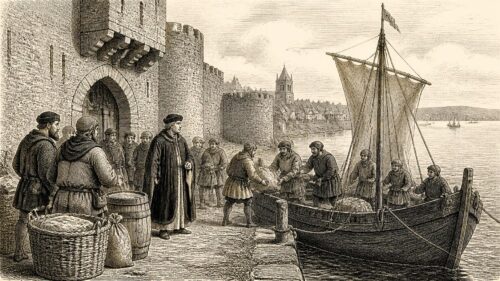
Sligo, a significant settlement and port on the north-western seaboard, was attacked, burned and completely sacked by MacWilliam Burke and the sons of Cathal Óg O’Conor. The town had suffered warfare before, but its renewed destruction in 1398 illustrates the vulnerability of urban places outside the narrower English lordship. Elsewhere, a raid towards Ballyshannon ended in the killing of Aodh Ó Duirnín after his wounded horse threw him into the reach of his enemies. Such entries preserve the contingent reality of warfare: campaigns could turn upon local pursuit, terrain and the fate of a horse.
Learning, Faith and Illness
Violence did not exhaust the year’s history. Thomas Mac Morrissy, bishop of Achonry, died. David Ó Duibhgeannáin, described as an eminent professor of history and a learned man, also died early in the year. His obituary points to the continuing importance of hereditary learned families, who preserved and produced history, genealogy and other specialised knowledge for patrons and communities. The death of Gearóid Iarla similarly reveals that literary activity crossed linguistic and political boundaries.
Annála Connacht records “a great plague” in 1398, while another annal notes the death of O’Brien Maol from plague in the English Pale. The evidence warrants caution: it confirms serious disease in the annalists’ horizon, but does not allow a precise national death toll or a claim that every region was equally affected. In a year already marked by burned crops, displaced provisions, raids and captives, epidemic illness could deepen insecurity, though the surviving sources do not let us measure that impact.
Thus 1398 was a hinge year rather than a settled turning point. Mortimer’s death damaged royal and colonial authority in Leinster; Niall Óg strengthened his hand in Ulster; Connacht and Sligo endured destructive competition; and churches remained both sacred centres and exposed repositories of wealth. Richard II would return in 1399, but the events of 1398 had already demonstrated that authority in Ireland depended less on proclamations than on alliances, supplies, hostages and the local capacity to fight—or refuse to fight.
Primary Sources
- Annals of the Four Masters, Part 3: Annal M1398
- The Annals of Ulster: Annal U1398
- Annála Connacht: Annal 1398
- Mac Carthaigh's Book: Annal MCB1398
- Annales Breves Hiberniae
- MacMurrough Kavanagh (Mac Murchadha Caomhánach), Art Mór | Dictionary of Irish Biography
- Mortimer, Roger | Dictionary of Irish Biography
- O'Neill (Ó Néill), Niall Óg | Dictionary of Irish Biography
- O'Donnell (Ó Domhnaill), Toirdhealbhach | Dictionary of Irish Biography
- O'Donnell (Ó Domhnaill), Niall Garbh | Dictionary of Irish Biography
- O'Neill (Ó Néill), Domhnall Bog | Dictionary of Irish Biography
- FitzGerald, Gerald fitz Maurice (‘Gearóid Iarla’) | Dictionary of Irish Biography
- FitzGerald, John | Dictionary of Irish Biography
- Richard II and the Wider Gaelic World: A Reassessment
- The Rise and Fall of the Clann Éinrí Aimhréidh Uí Néill: Dynastic Feuding and Geopolitics in the Late Medieval Irish Sea World
- King Richard II's Two Visits to Kilkenny (1393 & 1399)
- In the Footsteps of a King
- Mortimer, Roger, fourth earl of March and sixth earl of Ulster (1374–1398) | Oxford Dictionary of National Biography
- The 4th Earl | Mortimer History Society
- Kellistown / Cill Osna | logainm.ie
- Annals of the Kingdom of Ireland, Volume IV
- Mac Carthaigh's Book | CELT Project
- Annála Connacht | CELT Project