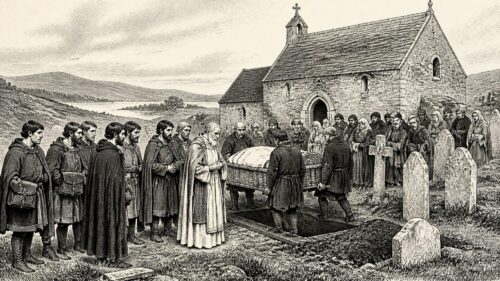
Murbach Burned1419 CE
In 1419 Ireland experienced overlapping conflicts rather than a single national crisis. Eóghan Ó Néill, backed by northern allies, expelled Domnall Ó Néill from Tyrone, while Connacht forces burned Murbach and devastated Tírhugh. A major Connacht invasion of Clanricard ended in defeat at Bél Átha Lige, with heavy losses, captures and plunder. English lieutenant John Talbot’s administration seized Leinster’s Donnchadh Mac Murchadha, while Calbach Ó Conchobair escaped captivity. Succession disputes disturbed Breifne. Plague killed the scholar Dauid Ó Maolconaire; an unusually hot summer brought drought but abundant harvests. Deaths of poets, rulers and clerics highlighted patronage, learning and religious life.

Dateline
A Year of Overlapping Wars
The evidence for 1419 presents Ireland not as a country moving to a single political rhythm, but as a field of several connected yet distinct struggles. The Irish annals place a major succession war in Tyrone, destructive campaigning in Tirhugh, a large Connacht expedition into Clanrickard, contests in Breifne and Fermanagh, and sharp interventions by the English administration in Leinster and Offaly. Their notices are generally arranged under the year 1419, though the Annals of Ulster add an alternative year-numbering note after their principal entries. It is therefore safest to treat the events as belonging to the annalists’ 1419, without pretending that every raid, death or journey can be assigned to a particular modern date.
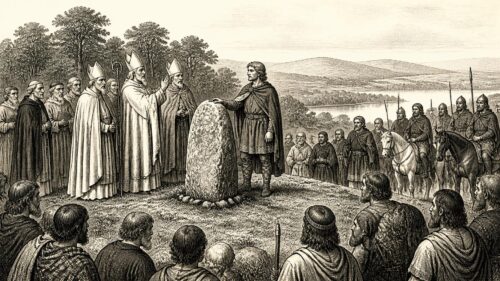
The largest political change occurred in Ulster. Domnall, son of Henry Ó Néill, faced Eóghan, son of Niall Óg Ó Néill, in what the annals call a “great war”. Eóghan’s cause gained formidable backing: Toirdelbach Ó Domhnaill of Tír Chonaill, Brian Mac Mathghamhna of Oriel and Tomás Mag Uidhir of Fermanagh. Their combined host entered Tír Eoghain and devastated it. Domnall Ó Néill was expelled with dishonour, the Annals of Connacht saying that the Gaels of Ulster escorted him under protection into the territory of the Ulster English. The wording matters. This was not simply a duel between two kinsmen; it was an act of collective political exclusion, achieved by a coalition of neighbouring lordships.
The victors’ alliance also reveals the character of late medieval Gaelic politics. Lordship depended upon family entitlement, but survival required military followers, fostered ties, marriages, hostages and alliances which could cross traditional boundaries. Eóghan Ó Néill’s supporters included the ruler of Tír Chonaill to the west, the Mac Mahon lord of Oriel to the south-east, and the Maguire ruler of Fermanagh. Their intervention in Tyrone was a declaration that an Ó Néill succession was a matter for the wider north. The annals later describe Eóghan as a future overking of Ulster, but that is retrospective language: in 1419 his position still had to be made by armed agreement.
Fire in Tírhugh
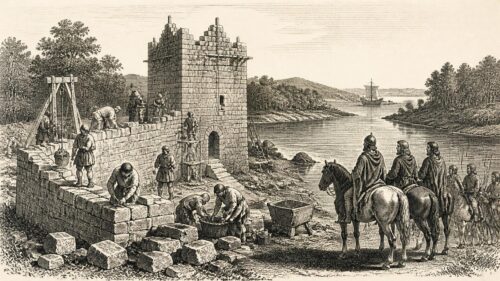
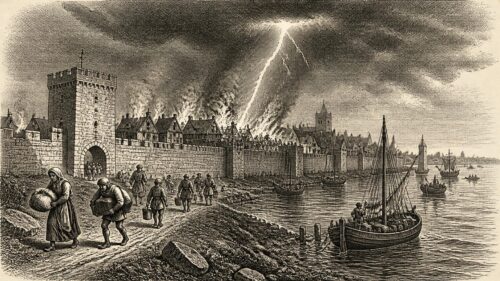
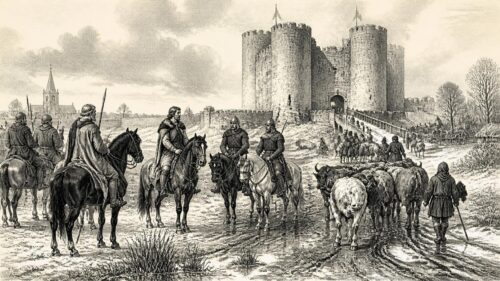
War spread beyond the immediate contest. Brian, son of Domnall Ó Conchobair, led a large hosting from north Connacht into Tírhugh, the north Donegal territory associated with the Ó Domhnaills. The Annals of Ulster record that Murbach, an Ó Domhnaill stronghold, was burned and that all Tír Áeda was destroyed on the expedition. The fuller Connacht account specifies the methods and stakes: Brian’s force included drovers and many gallóglaigh, and it destroyed corn, hay and buildings between Áth na nGall and Ballyshannon.
This was warfare directed at the means by which lordship functioned. A raid which burnt a residence was also an attack on its ruler’s capacity to shelter dependants, collect food renders and receive visitors. The inclusion of drovers indicates that livestock seizure was integral to the campaign, while the destruction of stored fodder and standing crops made recovery harder after the army had withdrawn. Gallóglaigh—professional heavily armed infantry maintained by Gaelic and Gaelicised lords—gave such expeditions a hard military core. Yet the annals’ attention to crops, hay, houses and cattle also brings the conflict down to the experience of farming households, tenants, labourers and servants whose food and shelter lay in its path.
These northern operations were not necessarily a single coordinated war. Brian Ó Conchobair’s attack on Ó Domhnaill territory could exploit the disruption in Tyrone without being identical to Eóghan Ó Néill’s coalition. That distinction is important. The annalists record alliances in action, not an all-Ireland bloc. Political authority remained local and personal, and a lord could be partner in one struggle while pursuing a separate interest against a neighbour.
The Rout at Bél Átha Lige
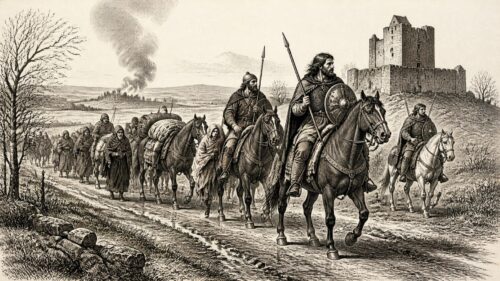
Connacht and the Shannon-side lordships saw an even larger collision. Uilliam Ó Ceallaigh assembled an expedition against Clanricard with Walter Mac William Burke, Donnchadh Ó Ceallaigh of Uí Maine, Cathal Dubh Ó Conchobair, Tomaltach Mac Diarmata of Moylurg and contingents of gallóglaigh under Alexander Mac Dubhghaill and Toirdelbach Mac Domnaill. The stated purpose was to bring Raymond, son of Hubert Burke, into Clanricard for war; he did not appear. The host nevertheless proceeded south-west, burning as it went.
At Bél Átha Lige, or the mouth of Ath-liagáin, Mac William of Clanricard caught the raiders with Tadc and Mathgamain Ó Briain, the Clann Chuiléin, troops connected with the descendants of an Ó hAnracháin woman, and Domnall Mac Suibhne’s gallóglaigh. The attacking Connacht cavalry were forced back upon their infantry. The gallóglaigh resisted, but were pressed from front and rear. Alexander Mac Dubhghaill and his two sons were killed with their followers; Toirdelbach Mac Domnaill was captured; his son and most of his men were killed; and leading Ó Ceallaigh figures were taken. The Annals of Ulster emphasise the haul of horses, clothing, valuable hostages and other goods gained by Clanricard and its Munster allies.
The battle shows why a medieval Irish hosting was at once a political assembly, a military force and a moving economic burden. Lords arrived with their own fighting men and with paid soldiers; cavalry and infantry had different tactical roles; success produced captives and movable wealth as well as territory. It also shows the risk of campaigning far from home. The coalition was powerful on paper, but an absent ally, hostile terrain and a counterattack by regional rivals turned an intended invasion into a costly defeat.
Captivity, Succession and English Power
In Leinster and the midlands, 1419 brought conspicuous captures. Donnchadh Caomhánach Mac Murchadha, whom the annals call king of Leinster, was seized by the Galls and taken to the king of England. Modern biographical research identifies his captor as John Talbot, Lord Furnival, the king’s lieutenant in Ireland, and places Donnchadh’s subsequent imprisonment in the Tower of London. The capture removed the immediate leader of a dynasty whose power in the south-east had long frustrated the English colony. It did not, however, erase that dynasty or its local following; the very need to transport him across the sea indicates the significance attached to his custody.
Calbach Ó Conchobair, ruler of Uí Fhailghe, was likewise taken through treachery by a son of Libined de la Freyne. Here the accounts differ in detail. The Annals of Ulster state that he was sold to Furnival and that a man fettered with him escaped to his own house. Annals of Connacht instead says Calbach escaped through a castle window and rejoined his followers. Both agree on the essentials: a prominent Irish ruler was seized within the shifting political world around the Butlers and the lieutenant, and captivity could be overturned by personal daring, assistance or a failure of custody.
Talbot’s government was not merely an outside force acting upon a passive country. Its officers bargained with, imprisoned and employed Irish and English-Irish magnates; its political rivalries touched the Butlers, Kavanaghs and Uí Fhailghe alike. At the same time, the Gaelic titles used by the annals—king of Leinster, king of Uí Fhailghe, king of Tír Chonaill—express a political vocabulary that neither vanished nor was reducible to the lord lieutenant’s authority.
Breifne offers another example of contested succession. Aodh Buidhe Ó Ruairc died in his own stronghold after a reign of only about a year and a half. Tadc Ó Ruairc was made king by one section of the kindred, while another constituency raised Art Ó Ruairc. The dispute immediately produced camps, raids and burnings around Carrigallen and Cill Déamáin. The division was geographical as well as dynastic: one annal distinguishes support west of Sliabh an Iarainn from backing east of it. The death of one lord thus released a contest over people, places and the right to command them.
Plague, Heat and Learned Households
Violence was not the only danger recorded in 1419. Annals of Connacht reports much plague in both England and Ireland. It gives a particularly close notice of Dauid, son of Tanaide Ó Maolconaire, an ollamh—a learned master—of the Síl Muiredaig, who died of plague at his own house at Kilmore after unction and penance. He was buried with honour at the monastery of St John the Baptist in Trim in the autumn. The notice provides firm evidence of disease reaching a learned household and of a burial linking Connacht scholarship to an important ecclesiastical centre in the English lordship. It cannot, by itself, measure national mortality or identify the disease with certainty.
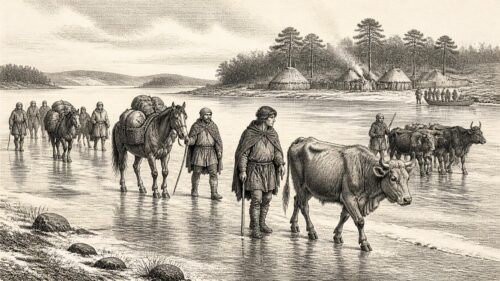
The same annal calls 1419 the year of the hot summer. It describes waters ebbing away, grass and leaves withering, cracks or openings appearing in the ground, and an exceptional yield of fruit and crops despite the heat. The Annals of Ulster independently remembers a hot summer and an abundant harvest of nuts. Such reports should not be turned into modern meteorological statistics, but they securely preserve an extraordinary season in contemporary memory. For rural communities, drought could threaten pasture and water, while a plentiful harvest could ease the shortage of grain after war and disease. The coexistence of environmental stress and abundance is not contradictory: its effects varied with land, access to water, storage and security.
Several deaths point to the cultural institutions sustained by lordship. Fercert Ó hUiginn, described as an excellent poet, died; the annals praise him as a man who kept a general house of hospitality for the men of Ireland. Muirchertach Ó Flaithbheartaigh, ruler of west Connacht, also died and was remembered as a general protector of the learned retinues and companies of Ireland. These formulae are more than polite obituary. They show poets, scholars and travelling learned people depending on aristocratic patronage and open-handed households. Aodh Ó Flannagáin, prior of Daimhinis, died on 11 November, another precise reminder of religious communities embedded in the same world of kinship, learning and territorial politics.
At Sligo, a smaller annalistic vignette joins religion and recreation. Donnchadh Ó Conchobair fell on the flagstone before Sligo castle during cavalry sports on St Mary’s day in early autumn, broke his leg, and died a week later. The Sligo indulgence was proclaimed that day. Even in a year of burnings, plague and political overthrow, people gathered at a castle-side religious occasion where spiritual privilege, elite display and horsemanship met.
Thus 1419 was not defined by one decisive national event. It was a year in which coalitions expelled an Ó Néill, fire and plunder remade local calculations, a major Connacht army was broken, rulers were seized or replaced, and plague and heat tested ordinary resilience. Its annals preserve both the scale of lordly ambition and the material realities—fodder, crops, houses, hospitality, sickness and water—on which power rested.
Primary Sources
- The Annals of Ulster: Year U1419
- Annals of Loch Cé: Annal LC1419
- Annála Connacht: Annal 1419
- Annals of the Four Masters: Annal M1419
- Annals of the Four Masters
- Annala Uladh: Annals of Ulster otherwise Annala Senait, Annals of Senat
- Annála Connacht
- Annals Of Loch Cé Vol II
- MacMurrough Kavanagh (Mac Murchadha Caomhánach), Art Mór
- MacMurrough, Donnchadh
- Preston, Christopher
- O'Rourke (Ó Ruairc), Tadhg (d. 1434/5)
- O'Rourke (Ó Ruairc), Tadhg (d. 1376)
- O'Rourke (Ó Ruairc), Donnchadh
- O'Rourke (Ó Ruairc), Tighearnán Mór
- The Background to the Arrest of Sir Christopher Preston in 1418
- Annals of the Kingdom of Ireland by the Four Masters, from the Earliest Period to the Year 1616
- Annála Rioghachta Éireann III–VI
- Royal Irish Academy Annual Review 2007–2008
- A Chronology of Ireland