Lough Mask’s Fatal Stone1338 CE
Dateline
A Killing That Changed Connacht
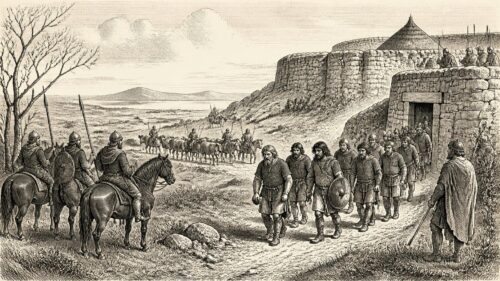
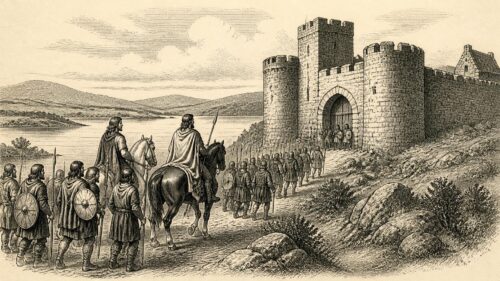
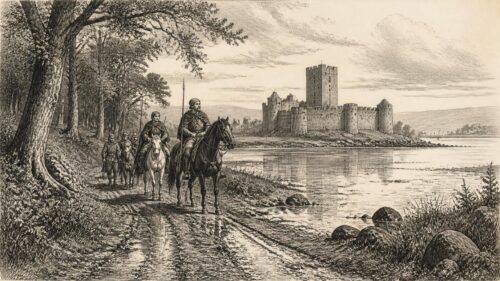
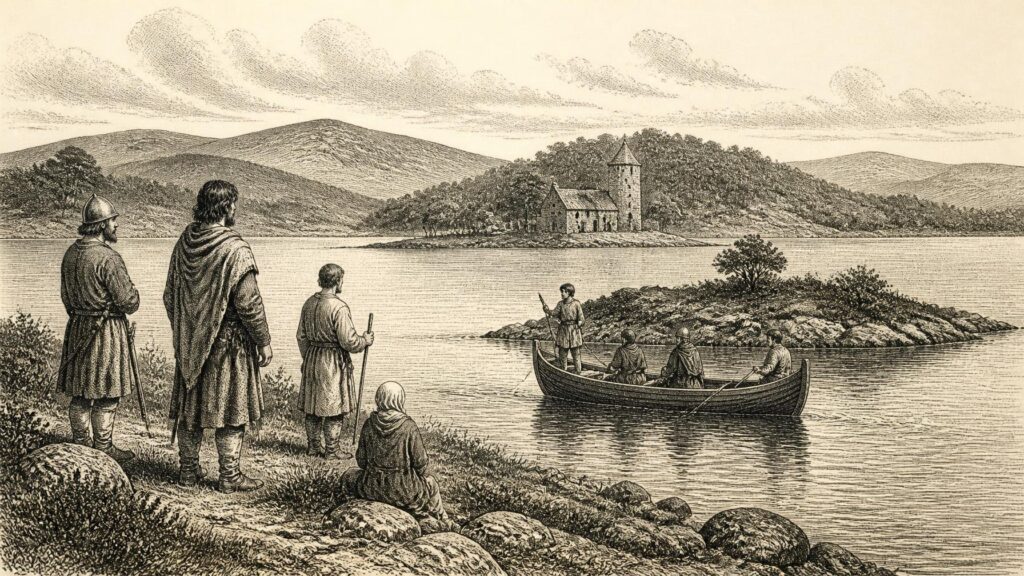
The most consequential Irish event securely placed in 1338 was the killing of Sir Edmund de Burgh, known in the annals as the son of the Earl of Ulster. He was captured by his kinsman Edmund Albanach de Burgh, had a stone tied about his neck, and was cast into Lough Mask. The stark formula occurs in both the Annals of Connacht and the Annals of Loch Cé. Neither supplies a day or month, and none should be invented; but both place the killing firmly within their annal for 1338.
Its importance lay not merely in the brutality of the deed. Sir Edmund was a son of Richard de Burgh, the powerful second earl of Ulster, and had become a leading defender of the interests of the de Burgh inheritance after the murder of his nephew, Earl William, in 1333. That inheritance had once joined the earldom of Ulster to an immense Connacht lordship. By 1338, however, the family was divided into armed and competing branches, while the young heiress Elizabeth de Burgh was beyond Ireland in royal custody. Sir Edmund and Edmund Albanach were cousins, but their rivalry had become part of a wider struggle over land, castles, clientage and authority in Connacht.
The annalists themselves made an unusually large historical claim for the death. They said that it brought about the destruction of the Galls of Connacht and of Edmund Albanach’s own kindred. In this setting, Galls, often translated as ‘Foreigners’, does not simply mean recent arrivals from overseas. It was a political and cultural label applied to the descendants and followers of the Anglo-Norman settlers, many of whom had long been Irish-born and were entangled in Irish-speaking society. The wording nevertheless conveys the collapse of the old de Burgh-led political order in much of the province.
Power After the Lake
The immediate sequence reported by the annals is revealing. Toirdelbach Ó Conchobair, king of Connacht, ‘assumed the sway’ of the province after the killing. Edmund Mac William de Burgh was expelled, while churches and territories in western Connacht were despoiled. The same account says that he gathered a substantial fleet of ships and boats and remained among the western islands for a long time. This was not a neat transfer of government from one ruler to another. It was a violent redistribution of power, in which lake shores, river routes and the Atlantic seaways could offer refuge, communication and a base for renewed raiding.
The annals also associate the upheaval with Luighne and Corann, districts spanning parts of present-day south Sligo and north-east Mayo. These lands were said to have been wasted and ‘depopulated’, after which their native Gaelic lords resumed lordship following the expulsion of their Foreigners. Such language should not be read as a census statement: medieval annalists commonly used it to register devastation and displacement. Yet it makes clear that political change was experienced on the ground through plundering, abandoned holdings, ruined estates and insecurity for religious communities as well as lay households.
Later history confirms that no single authority replaced the old Connacht lordship. Edmund Albanach established a durable power base in Lower Connacht, especially in Mayo, while another de Burgh line would develop in Upper Connacht. Ó Conchobair influence revived, but the province remained contested. Thus 1338 was not the end of de Burgh power, nor the end of the English lordship in every Connacht town and castle. It was, rather, a decisive stage in the fragmentation of a great lordship whose leading families would increasingly operate as regional Irish lordships in their own right.
Captivity and Retaliation
Conflict elsewhere in Connacht and Breifne showed how quickly local contests could turn on prisoners. Donnchad, son of Ruaidhrí Ó Conchobair, was killed during the year. Tadc, son of Ruaidhrí and grandson of Cathal Ruad Ó Conchobair, called Bratach Righin, was captured by Tomás Mag Samradáin; many of Tadc’s followers were killed. Mag Samradáin then went to Ó Conchobair’s house. On his return journey, the Clann Muirchertaig and Muintir Eolais gathered against him, captured him in turn and killed several of his men.
These notices are brief, but their pattern is important. Warfare did not consist only of set battles between large hosts. It involved ambushes, pursuit, the seizure of prominent men and rapid retaliation by neighbouring kin-groups. A captive might be a bargaining counter, a means of extracting submission, or the trigger for a fresh round of violence. The recorded reversal suffered by Mag Samradáin gives a glimpse of a political landscape in which travel between a lord’s residence and one’s own territory could be dangerous, particularly after a successful raid or arrest.
Derbail, daughter of Cathal Mac Murchada and wife of Donnchad son of Aed Óg, also died in 1338. The annals offer no further detail. Her notice nevertheless reminds us that dynastic history was made through households as well as armies: marriages linked ruling families, and the deaths of women of high status mattered to the chroniclers who tracked those networks.
Sheep Losses Across Ireland
A second nationwide notice is among the year’s most striking: almost all the sheep of Ireland died, ‘excepting a few’ in the fuller wording of the Annals of Loch Cé. The cause is not recorded. It would be irresponsible to name a particular disease, weather event or husbandry failure as fact. Modern environmental historians have proposed possibilities, but the evidence for 1338 itself establishes only the reported scale of the mortality.
The loss nevertheless had serious potential implications. Sheep supplied meat, skins and wool; wool and woollen goods formed a significant part of Ireland’s medieval export economy, particularly in the colonial towns and lordships of the east and south. Sheep also had a place in mixed rural farming beyond the ports, providing manure as well as fibre and food. The annal’s island-wide phrasing may be conventional, but it signals that contemporaries regarded the murrain as far more than a local misfortune. For herders, tenants, cloth workers, estate managers and traders, a collapse in flocks could diminish food, raw materials, rents and saleable produce at once.
The entry must not be confused with a severe frost, cattle losses, crop destruction and famine which the annals assign to 1339. Those later conditions may help explain why the late 1330s became a difficult period, but they are not evidence for conditions in 1338. Keeping that chronological boundary matters, especially when a dramatic animal mortality tempts later readers to join every subsequent hardship to it.
Patronage on Lough Erne
In Fermanagh, Ruaidhrí Mag Uidir, described as king of Fermanagh and Lough Erne, died. His obituary is unusually revealing. It calls him the greatest giver, in his time, of money, cattle and clothing to the poets and ollavs of all Ireland. An ollav was a highly trained learned professional: depending on the context, a master of poetry, history, law or another branch of hereditary learning. The tribute paid to such people was not ornamental generosity alone. Learned men preserved genealogies, composed praise poetry, advised elites and helped articulate a ruler’s standing among rival dynasties.
The goods listed by the annalist also illuminate the material basis of patronage. Cattle remained a principal measure of wealth; clothing could be both practical sustenance and a prestigious gift; money connected Gaelic lordly society to monetised exchange. Ruaidhrí’s death therefore marked a political succession in Fermanagh, but also the loss of a patron whose household had supported cultural and intellectual work reaching well beyond Lough Erne.
Dublin Government and a Wider War
In the Lordship of Ireland, the royal administration changed hands. John de Charleton, lord of Powys, had arrived in 1337 as justiciar with Welsh military support, while his brother Thomas, bishop of Hereford, served as chancellor. John was removed from office on 15 May 1338 and left Ireland in June after a dispute over finance and administration. Thomas was appointed to succeed him as justiciar. The change did not resolve the structural weakness of royal government: the Dublin administration still depended on the co-operation of magnates whose local interests could outweigh royal commands.
The Connacht crisis demonstrated that limitation vividly. A government centred on Dublin could issue orders, hold courts and maintain castles, but it could not easily prevent a powerful kin-group from reshaping the west by force. The annals’ brief notice of war between the kings of England and France belongs to the same year and places Ireland within Edward III’s wider dominions. Yet the Irish record for 1338 is not chiefly a story of continental war. It is a story of an internal Connacht killing, rural loss, regional patronage and the difficulty of imposing durable authority across the island.
For Ireland, 1338 was therefore a year in which one stone cast into Lough Mask became a symbol of a fractured provincial order. Around it, the annals preserve a wider world: captives taken and retaken, sheep dying in exceptional numbers, poets sustained by lordly gifts, and a Dublin government changing its chief officer while its reach remained uncertain.
Primary Sources
- Annála Connacht: Annal 1338
- Annals of Loch Cé
- The Annals of Ulster
- Burgh, Sir Edmund de
- Burgh, Sir Edmund Albanach de
- Charlton (de Charleton, de Cherleton), Thomas
- Charlton, John
- Inquisitions and Extents of Medieval Ireland
- Climate, Disease and Society in Late-Medieval Ireland
- A Cattle Panzootic in Early Fourteenth-Century Europe
- The Zooarchaeology of Medieval Ireland
- The Medieval Irish Wool Trade, 1169-c.1400
- Gaelic Society and Economy
- The Archaeology of Livestock and Cereal Production in Early Medieval Ireland, AD 400-1100
- Animals and the Economy of Medieval Ireland: A Zooarchaeological Analysis of the Faunal Remains from Caherconnell Cashel, Co. Clare
- Ballinrobe Augustinian Friary
- The Templars and the Mysterious Holy Rood of Ballinrobe
- Loughs Carra, Mask and Corrib: Resources, Borders and Passageways
- Exploring the Irish Annals
- Annals of Dublin from 1173 to 1500