Ballymote Peace1340 CE
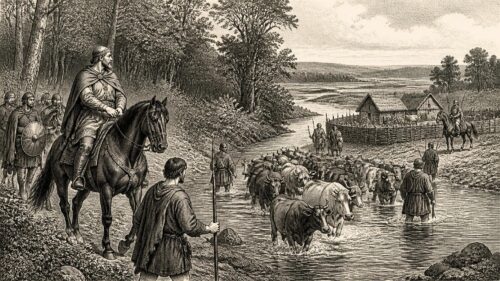
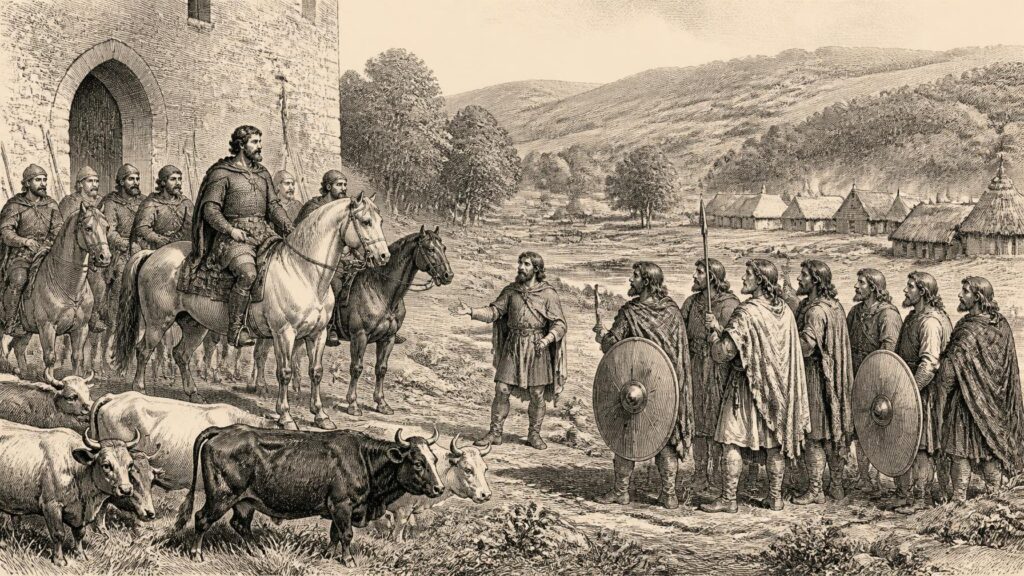
In 1340, Connacht lordship was contested through dynastic intervention, captivity, raiding and negotiated settlement. Toirdelbach Ó Conchobair installed a ruler in Uí Maine, but resistance killed his appointee; his imprisonment of a nephew provoked Mac Diarmata opposition and a peace at Ballymote. Breifne warfare over cattle killed Domnall Ó Ruairc, while prisoners were exchanged to restore political advantage. Other kin-group killings exposed fragile local rule. Edward III pardoned Edmund Albanach and Reymund de Burgh, seeking accommodation and military service. Cill Rónáin burned, and learned men died. Sources caution against misdating Ulster entries and a supposed Franciscan foundation in later annals.
Dateline
The surviving notices for 1340 show an Ireland in which authority was intensely local, mobile and precarious. The year’s clearest events lie in Connacht and its borderlands: a provincial king imposed his choice upon Uí Maine, imprisoned a dangerous kinsman, faced retaliation from the Mac Diarmata of Moylurg, and was forced into a peace after being driven into Ballymote. Elsewhere, predatory warfare in Breifne killed a leading O’Rourke; a ruler of Uí Fhiachrach Aidhne was slain by his own followers; and the royal government in England made terms with a powerful de Burgh lord. These were not fragments of one national war. They were connected contests over cattle, dependants, fortresses, kinship and the right to command.
A Connacht Overlordship Tested
Toirdelbach Ó Conchobair, king of Connacht, was at the centre of the year’s most closely recorded struggles. His power rested not on a uniform state but on alliances, tribute, military followings and the ability to intervene in the affairs of lesser lordships. In Uí Maine, the broad territory east of the Shannon associated with the Ó Cellaig kindred, he had installed Tadhg son of Tadhg Ó Cellaig as ruler. That intervention brought Toirdelbach directly into an internal dynastic dispute.
William, son of Donnchad Muimnech Ó Cellaig, was expelled from Uí Maine. The pursuing party seems to have expected a straightforward removal of a rival, but William turned on his pursuers. Donnchad son of Áed Ó Cellaig was killed, while Tadhg, Toirdelbach’s appointee, was captured and wounded. Tadhg later died from those wounds. The annal does not preserve the battlefield’s location or the size of either force, and it would be wrong to supply them. What it does make plain is that a provincial king’s nomination did not settle succession. It could instead make a family quarrel a test of Connacht’s wider political order.
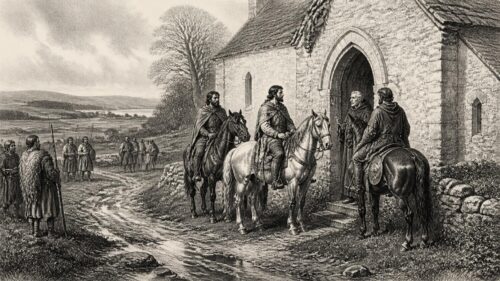
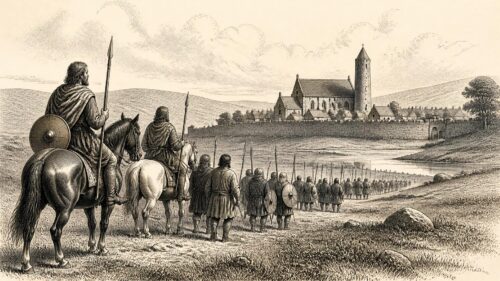
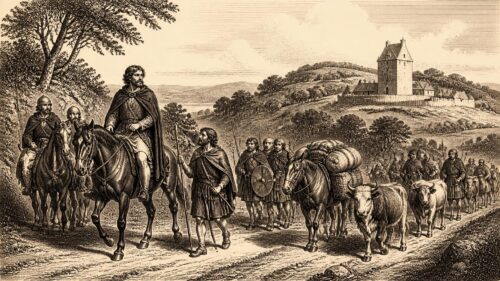
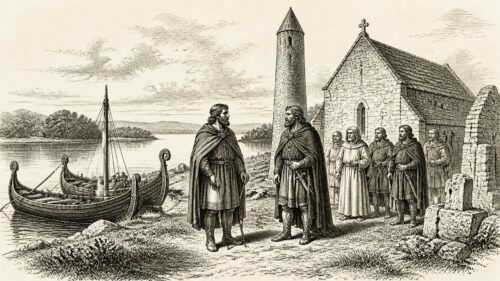
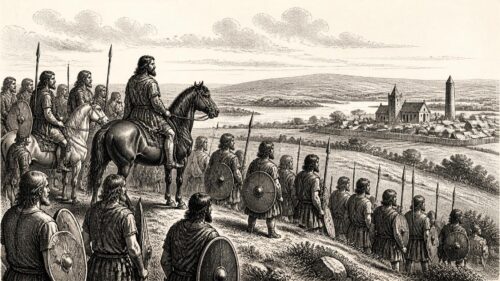
Toirdelbach also seized his paternal nephew, Áed son of Fedlimid Ó Conchobair, and confined him in Roscommon castle. A castle was more than a defensive building in such circumstances: it was a place in which a captive claimant could be held, guarded and displayed beyond the immediate reach of his followers. The arrest provoked a serious breach with the Mac Diarmata, the dominant family of Moylurg in north-east Connacht. Their forces put Toirdelbach in danger in Corran and drove him, against his will, into Ballymote. There the sides made peace.
That settlement should not be mistaken for a lasting resolution. The annal’s emphasis on destroyed property points to the material burden of such warfare: herds carried off, food stores consumed or seized, households displaced and local labour diverted from cultivation. Nor was violence confined to the confrontation around Ballymote. Cathal Mac Diarmata Gall, praised as an outstanding Connacht prince for courage and strength, was killed by Donnchad Riabach Mac Diarmata at Lis Selbaig in Clann Chonchobair. The notice calls the killing per dolum, by treachery. It preserves no fuller explanation, but the death reveals division within a leading kindred even while that kindred confronted the king of Connacht.
Uí Maine and Breifne in Conflict
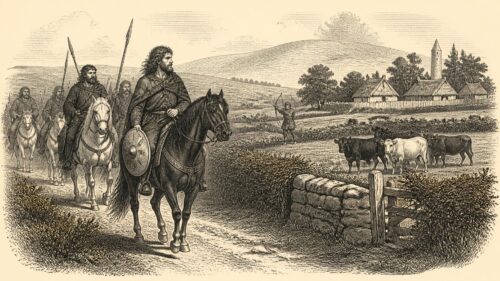
The Uí Maine fighting was not the only contest in which a raid became a wider feud. In Breifne, the sons of Ualgharg Ó Ruairc – Domnall, Áed, Gilla Críst and Ruaidrí – made a major cattle raid against Cathal son of Áed Breifnech. Among those killed during it was Conchobair, of the line of Muirchertach Muimnech. The Annals of Loch Cé describe this as the first rupture between Muintir Ruairc and that lineage, language that marks the episode as a remembered beginning rather than a routine foray.
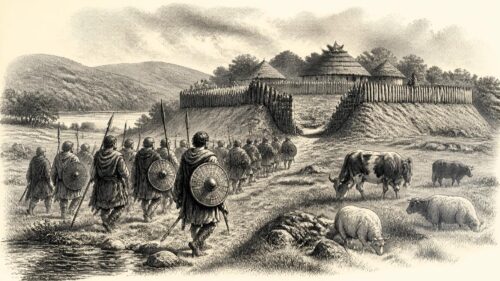
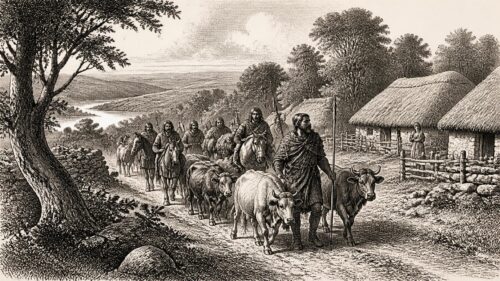
Cathal pursued the raiders and recovered much of the prey. In the ensuing battle Domnall Ó Ruairc, described as the foremost princely figure in all Breifne, was killed; Gilla Críst Ó Ruairc and Mac Consnamha were captured. Captivity could be political currency. Tadhg, son of Ruaidrí Ó Conchobair, who had been held by Ó Ruairc, was released in exchange for Gilla Críst. Such exchanges show that the business of war included negotiation and calculated restraint as well as killing. Cattle, hostages and prisoners were resources through which power could be regained or redistributed.
Other concise notices reinforce the instability of lordship. Eóghan Ó hÉidhín, king of Uí Fhiachrach Aidhne in south Galway, was slain by his own people. Brian Óg Mac Samhradhain was killed by the Tellach Dunchada. Matthew Ó Raghallaigh was killed by Andrias Ó Raghallaigh, after which the latter made major raids in the Bolcan. These entries are too compressed to establish motives or a single regional alignment. They nevertheless demonstrate how readily political competition could operate within a kin-group, not merely between named territories.
De Burgh, Crown and Sea
Connacht’s politics also had an English royal dimension. On 14 March, Edward III pardoned Edmund, son of William de Burgh, known as Edmund Albanach, and his brother Reymund for the king’s suit arising from the killing of Edmund, son of Richard de Burgh, late earl of Ulster, as well as Richard de Flete; the pardon covered other specified offences and consequent outlawries. The grant did not erase the violence that had shattered de Burgh power after the murder of the earl in 1333. It did, however, acknowledge that the Crown needed accommodation with men whose regional following it could not simply command away.
The same year also demonstrates that an Irish lord’s political world extended across the sea. Reymund de Burgh, described in royal records as the king’s yeoman, was ordered in April to prepare men-at-arms and hobelars in Ireland for service in France. By September he received a grant from the farm of Drogheda in recognition of losses incurred in royal service in Ireland, Scotland and overseas. Ireland was therefore not isolated from Edward III’s expanding war against France. Yet this was not an English conquest force sent to impose peace in Connacht. It was a bargain with a regional magnate and an extraction of military service through him.
For ordinary communities, such connections could be indirect but consequential. Men, horses, ships, victuals and cash were all needed for maritime service. The evidence does not permit a precise estimate of Connacht’s contribution in 1340, nor does it show how far the recruitment affected any individual district. It does show that the de Burghs remained tied to royal patronage and obligation even as lordship in Connacht was being refashioned through local war and Gaelic political practice.
Churches, Poets and Loss
Religion and learning appear in the year’s record principally through loss. The church of Cill Rónáin, reported as newly built in 1339 by Ferghal Muimhnech Ó Duibhgeannáin, was burned in 1340. No source identifies the burners or tells whether the building was destroyed in a raid, feud or accident. Its burning is a sober reminder that churches stood within, rather than outside, contested landscapes. They were sacred places, but also visible structures holding local investment, burial associations and community status.
Niall Ó hUiginn, called a sai dána – a learned poet or master of the arts – drowned in the same year. The brief obituary cannot reveal his patrons, poems or circumstances of death. Still, the designation matters. It records the continued place of professional learning in a society whose political news is otherwise dominated by raids and rival kings. Philip Ó Duibhgeannáin, ollamh of Conmaicne, also died. Such notices point to hereditary scholarly networks that preserved genealogy, law, poetry and historical memory, even though the individual works of these particular men cannot safely be assigned to 1340.
The year’s sources require caution. The Annals of Ulster place several events under an entry labelled U1340, but their internal chronology at this point runs three years ahead of the modern calendar; those events belong to 1343, not 1340. Likewise, a later annalistic claim that a Franciscan house at Oirbhealach, near Killarney, was founded in 1340 conflicts with other evidence identifying Muckross as a fifteenth-century foundation. Neither should be converted into a calendar-year fact. The secure picture for 1340 is narrower, but richer: contested succession, coercive diplomacy, cattle-raiding and hostage exchange, a crown negotiating with Irish magnates, and churches and learned people exposed to a violent political world.
Source References
Hover over a number to see the source. Select it to open the source.

- [1] Annals of Loch Cé, Annal LC1340 (English translation)
- [2] Annals of Loch Cé, Annal LC1340 (Irish text)
- [3] Annals of the Four Masters, Annal M1340 (English translation)
- [4] Annals of the Four Masters, Annal M1340 (Irish text)
- [5] Annals of Ulster, Year U1340 (English translation)
- [6] Annals of Ulster, Year U1340 (Irish text)
- [7] Annales Breves Hiberniae
- [8] Calendar of the Patent Rolls Preserved in the Public Record Office: Edward III, A.D. 1338–1340
- [9] Reymund de Burgh, named 1219 to 1340
- [10] O'Connor (Ó Conchobair), Toirrdelbach
- [11] O'Brien (Ó Briain), Muirchertach
- [12] O'Brien (Ó Briain), Brian Bán
- [13] O'Kelly (Ó Cellaig), Donnchad Muimnech
- [14] O'Kelly (Ó Cellaig), Domnall
- [15] Ó Dubhagáin, Seoán Mór
- [16] Muirgius
- [17] CIRCLE: A Calendar of Irish Chancery Letters, 1244–1509
- [18] National Library of Ireland Sources Database: Patent Rolls, 1300–1349
- [19] Lewis Dillwyn's Visit to Kerry, 1809
- [20] Robert de Askeby, named 1258 to 1385
Primary Sources
- Annals of Loch Cé, Annal LC1340 (English translation)
- Annals of Loch Cé, Annal LC1340 (Irish text)
- Annals of the Four Masters, Annal M1340 (English translation)
- Annals of the Four Masters, Annal M1340 (Irish text)
- Annals of Ulster, Year U1340 (English translation)
- Annals of Ulster, Year U1340 (Irish text)
- Annales Breves Hiberniae
- Calendar of the Patent Rolls Preserved in the Public Record Office: Edward III, A.D. 1338–1340
- Reymund de Burgh, named 1219 to 1340
- O'Connor (Ó Conchobair), Toirrdelbach
- O'Brien (Ó Briain), Muirchertach
- O'Brien (Ó Briain), Brian Bán
- O'Kelly (Ó Cellaig), Donnchad Muimnech
- O'Kelly (Ó Cellaig), Domnall
- Ó Dubhagáin, Seoán Mór
- Muirgius
- CIRCLE: A Calendar of Irish Chancery Letters, 1244–1509
- National Library of Ireland Sources Database: Patent Rolls, 1300–1349
- Lewis Dillwyn's Visit to Kerry, 1809
- Robert de Askeby, named 1258 to 1385