Kilkenny’s First Pavement1334 CE
In 1334, severe winter weather injured people and livestock and damaged mills, weirs and bridges across Kilkenny’s region. Kilkenny burgesses began the town’s first recorded paving, later supported by a seven-year royal pavage grant. Local lordship remained contested: Thomas Fanyn seized Moytobyr Castle before Earl James Butler imposed temporary custody. Elsewhere, Donnchad Mac Carthaigh captured David de Barry, John de St Aubin was murdered, and a Connacht force of Gaels and settlers secured Munster hostages but burned a church, killing 180 people. Kilkenny also saw raids, erection of a market cross, crusading branding, and Desmond’s knighting campaign in late December.
Dateline
In 1334, Ireland’s political landscape remained divided among Gaelic lordships, Anglo-Irish liberties, ecclesiastical jurisdictions and royal offices that did not neatly overlap. Yet the year can be approached through unusually vivid local evidence. Friar John Clyn, writing from the Kilkenny Franciscan milieu, recorded weather, civic works, castle seizure, killings and religious observance with a precision absent from many fourteenth-century Irish annals. In Connacht, another annalistic tradition preserved a very different but equally stark event: a joint Gaelic and settler force campaigning into Munster, extracting hostages and causing a mass death in a church. Together, these notices reveal an island in which authority was intensely local, but violence, taxation, movement and urban improvement linked regions together.
The evidence must be read carefully. Some events have firm feast-day dates; others are placed only within the year. Clyn’s account of David de Barry’s capture contains a gap in the surviving text before the reference to the Kalends of August, so it cannot responsibly be assigned to an exact day. Nor should the surviving annals be treated as a complete national record: they illuminate what their compilers considered memorable, not everything that occurred. Even so, 1334 offers a rare glimpse of how roads, castles, churches, markets and winter weather shaped the experience of power.
A Hard Winter
The year opened with severe cold. Clyn recorded eight days of heavy snow in the week before Candlemas, 2 February. The weather harmed animals, but he judged it still worse for people. He described men suffering swelling in their feet, pain and wounds, with some maimed; his language suggests injuries associated with exposure and frost. The thaw brought a second danger. Ice breaking up damaged or destroyed mills, weirs and bridges. A particularly harmful day fell on Tuesday, 31 January.
That compact notice conveys the dependence of medieval communities on vulnerable infrastructure. Mills were not marginal conveniences: they processed grain into flour and generated lordly income. Bridges and river crossings carried people, animals, carts, foodstuffs and military parties. Damage to them disrupted routine exchange as well as travel. The reference to hare-hunting in Clyn’s account may indicate that people were abroad in hazardous conditions for food, sport or both; it should not be stretched into a general explanation for every injury. What is secure is that the winter affected bodies, livestock and the built landscape at once.
Such weather also formed the immediate background to politics. Lords and their followers relied on horses, provisions and passable routes; tenants faced the practical costs when waterways, roads and milling arrangements failed. Clyn’s emphasis on ordinary bodily suffering is therefore valuable. Medieval Irish history is often told through chiefs and campaigns, but the first recorded crisis of 1334 was environmental and social.
Streets and Civic Ambition
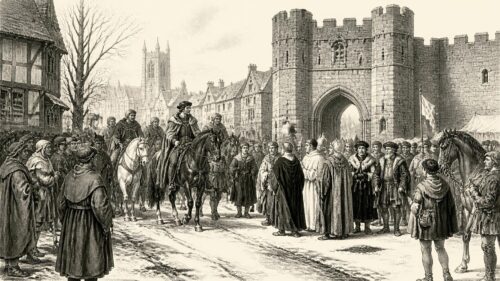
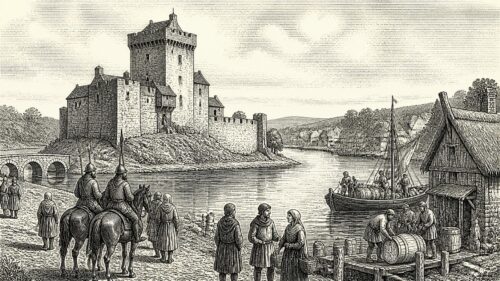
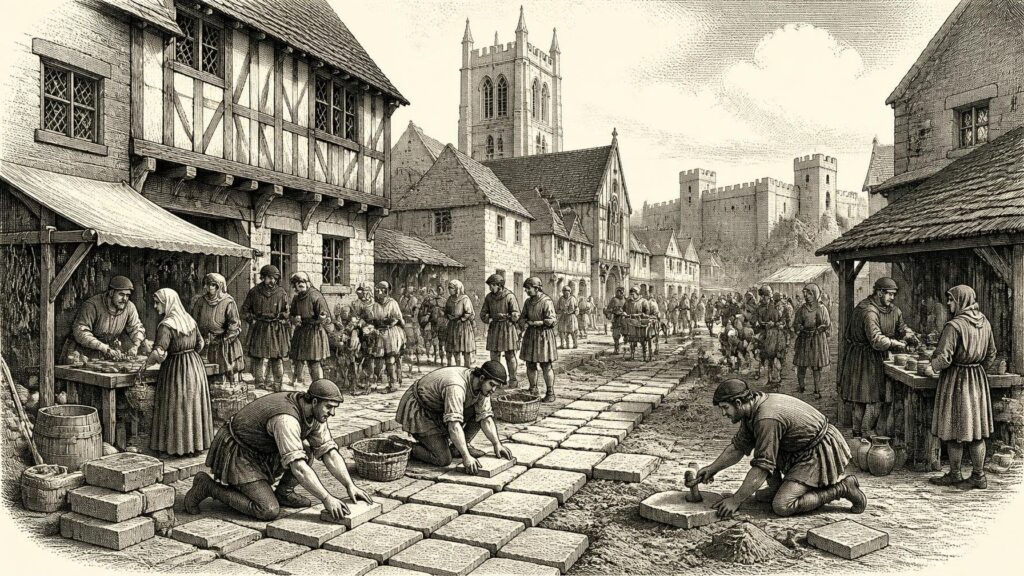
On Thursday, 14 April, the feast of Saints Tiburtius and Valerian, the burgesses of Kilkenny began to pave the town. This is the year’s most revealing urban development. Paving was an expensive collective undertaking, requiring organisation, labour, materials and a recognised civic community able to manage the work. Kilkenny was already a substantial walled settlement on the Nore, with a market-centred High Street, religious houses and a castle-dominated high town. Its burgesses did not create urban life in 1334; they improved a busy place whose commercial and administrative functions made better streets worthwhile.
The work also had a royal dimension. A grant dated 25 November 1334 gave the provost, bailiffs and “true men” of Kilkenny a seven-year right of pavage: a toll intended to finance paving. The chronology is striking. Clyn says work began in April, while the recorded royal grant came later in the calendar year. It is safest to say that local initiative and royal authorisation became connected during 1334, rather than to assume a simple sequence in which permission necessarily preceded every stone laid. What matters is the shared interest of town community and Crown in maintaining a more usable urban street.
Paving had practical, economic and symbolic value. It could make a market route less muddy, improve movement between houses, shops, churches and gates, and signal that burgesses possessed both responsibilities and privileges. A later Kilkenny civic ordinance requiring householders to cleanse the pavement outside their homes shows how such a project could extend into obligations of everyday urban maintenance. That ordinance belongs to 1335, not 1334; it nevertheless helps explain why the first paving works were more than decorative. The new surface created a public space that had to be cared for.
Moytobyr’s Brief Seizure
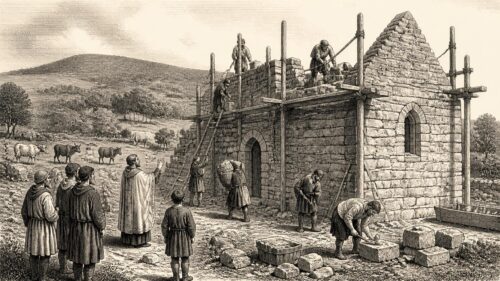
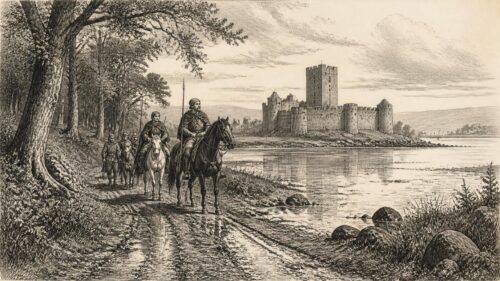
Less than two weeks after the paving began, conflict broke into the record. On Sunday, 24 April, the eve of St Mark’s Day, Thomas Fanyn entered and occupied Moytobyr Castle, expelling the men of Eustace le Poer. The castle’s defenders killed three men during the ensuing struggle: Raymond and David de Angulo, and Thomas Rothgrasse. By the following Saturday, however, they were compelled to surrender the castle to James Butler, earl of Ormond, as lord of the county. It was to be held in a neutral hand until the competing claims to it could be judged.
This was not simply a private brawl. The episode demonstrates how lordship was exercised through fortified places, retainers and legal claims simultaneously. Fanyn’s seizure was a physical assertion of possession; the earl’s intervention imposed a temporary settlement without resolving title on the spot. The phrase that the better right should be determined is especially important. It records an expectation that contested property could be adjudicated, even after violence had already killed men.
James Butler’s role also illustrates the weight of the Ormond earldom in the south-east. He was neither an impersonal agent of a modern state nor merely another armed neighbour. As earl, he possessed county authority and networks of service that enabled him to take custody of a disputed castle. In 1334, order in the lordship of Ireland often depended on precisely such negotiated interventions by magnates, not on a permanently effective royal monopoly of force.
Campaigns, Captivity and Church Sanctuary
Violence was no less visible beyond Kilkenny. Shortly before 1 August, according to Clyn’s damaged entry, Donnchad Mac Carthaigh captured David fitz David de Barry, lord of Olethan in Desmond. About one hundred of de Barry’s men were said to have been killed on the same occasion. The figure cannot be independently checked from Clyn’s brief notice, but the capture itself belongs securely to the year. It points to the dangers facing settler lordships in south-west Munster, where the de Barrys and Mac Carthaighs operated amid overlapping territorial ambitions.
On Saturday, 27 August, John de St Aubin, lord of Kinsale, was murdered in his own chapel by the sons of Walter de St Aubin, men in whom he had trusted. Clyn calls the killing treacherous. The setting matters: a private chapel was a place of worship and household devotion, but it did not make its lord inviolable. Kinship, affinity and inherited lordship could provide protection; they could also create the intimacy in which betrayal became possible.
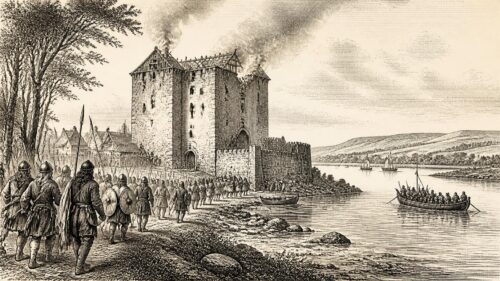
In Connacht, the annals record a major expedition by the men of the province, explicitly including both Galls and Gaels, against Mac Conmara in Munster. The force secured hostages and submission. Yet one contingent burned a church containing 180 people, described as both noble and humble, including two priests. The annalist states that all were burned. This is among the most terrible notices attached to the year. It also cautions against any easy division of Ireland into opposed ethnic blocs. The expedition was a Connacht coalition of people identified as Gaelic and settler; its target was a Munster lord; and the victims included a congregation seeking, or gathered within, church space. Sanctuary was morally powerful, but it was not always militarily secure.
Hostages were central to the politics behind such campaigns. Their delivery did not necessarily mean permanent conquest. It was a means of guaranteeing submission, regulating future conduct and publicising a victor’s superiority. For the families compelled to give them, hostageship placed personal safety at the centre of political negotiation. The church burning shows the brutal human limits of that system.
Market Cross and Sacred Horizons
Religious practice and civic space met again in Kilkenny late in the year. On Thursday, 2 November, All Souls’ Day, the O’Carrolls captured Richard de Marays, Robert Travers and Robert fitz David; John le Bret was killed with others. Clyn supplies no fuller explanation, but the notice confirms that raids and captures crossed social boundaries within the lordship.
On Thursday, 14 December, the day after St Lucy’s feast, a great cross was erected in the middle of Kilkenny’s market-place. At about this time, Clyn says, many people who fled or came to the cross were marked on bare flesh with a red-hot iron in the sign of the cross so that they might go to the Holy Land. His words connect the town’s marketplace to crusading devotion and recruitment. The branding was a grave bodily act, publicly identifying participants with a vowed religious journey. It should not be assumed that all who were marked departed, nor that a large expedition left Kilkenny that year. The firmly dated fact is the raising of the cross and Clyn’s contemporary association of it with crusading signs.
Finally, on Wednesday, 27 December, Maurice fitz Thomas, earl of Desmond, made seven knights near Greyn during an expedition against Bren Ó Briain. Knighthood, war and aristocratic ceremony thus closed the annalistic year. The contrast with paving is instructive rather than contradictory. The same Ireland that invested in market streets, tolls and civic maintenance also remained a place where nobles asserted rank through mounted service, castle possession and campaigns.
1334 was therefore not a year dominated by one island-wide turning point. Its importance lies in a set of sharply observed developments: a punishing winter; Kilkenny’s first recorded paving initiative; a castle dispute contained but not bloodlessly resolved; regional warfare that reached a church full of civilians; and public religious ceremonies in an urban market. They show medieval Ireland not as a static frontier between two peoples, but as a connected and contested society whose local institutions could build, tax, judge, worship, raid and endure.
Primary Sources
- Annalium Hiberniae Chronicon ad annum MCCCXLIX
- The Annals of Ireland by Friar John Clyn and Thady Dowling, Together with the Annals of Ross
- Annála Connacht
- Annals of Loch Cé: Volume 1
- Annals of Ulster Otherwise Annala Senait
- Annales Hiberniae (Grace’s Annals)
- Annales Breves Hiberniae
- Annals of the Four Masters, Volume 4
- Annals of Inisfallen
- Annals of Tigernach
- Chronicon Scotorum
- Annales Dominicani de Roscoman
- Clyn, John
- Bicknor, Alexander
- An Irish Expedition to Scotland in 1335
- Calendar of the Close Rolls Preserved in the Public Record Office: Edward III, 1333–1337
- Calendar of the Patent Rolls: Edward III
- Kilkenny City Walls Conservation Plan
- The Early Development of the Medieval Town of Kilkenny
- Liber Primus Kilkenniensis
- The Town Wall of Kilkenny