Lionel’s Kilkenny Parliament1366 CE
In 1366 Lionel of Antwerp, Edward III’s lieutenant, summoned a parliament at Kilkenny to reinforce the weakening English lordship of Ireland. Its Statutes sought to separate English and Irish inhabitants by restricting intermarriage, fosterage, language, dress, law, ecclesiastical office and cultural exchange. They also regulated warfare, military service, abuses, markets, land, sport and church authority, exposing anxieties about defence and administration. The measures chiefly targeted the lordship rather than Gaelic Ireland and indicate cultural contact rather than achieved control. Contemporary annals record regional conflicts and shifting lordships beyond royal reach. Lionel’s November departure demonstrated the statute’s limits amid Ireland’s diversity.

Dateline
A Parliament on the Marches
The most securely dated Irish event of 1366 was the parliament summoned to Kilkenny by Lionel of Antwerp, duke of Clarence and king Edward III’s lieutenant in Ireland. Its surviving text says that it met on the Thursday after Ash Wednesday in Edward’s fortieth regnal year: 18 February 1366 in modern reckoning. This was not a parliament for the whole island in any representative modern sense. It was an assembly of the Crown’s Irish lordship: archbishops, bishops, abbots and priors, earls, barons, councillors and commons from the areas where royal institutions retained practical force. Yet its legislation, conventionally called the Statutes of Kilkenny, became the year’s most famous political statement.
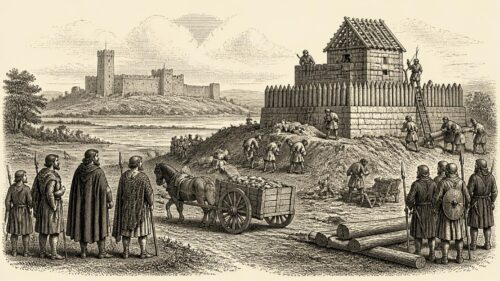
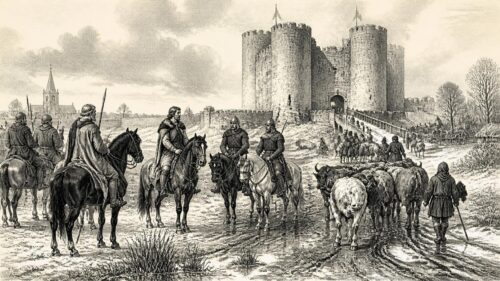
Kilkenny was an apt setting. It was a substantial walled town in the Butler liberty, positioned near the contested frontiers between territories governed through English common law and regions where Gaelic lordships were politically dominant. Lionel had arrived in Ireland in 1361 as a prince with unusually large claims: through his first wife, Elizabeth de Burgh, he was earl of Ulster, lord of Connacht and a major Kilkenny landholder. His mission was to strengthen a lordship whose revenue, military capacity and authority were under heavy pressure. Earlier campaigns had taken him through Leinster and Munster; by 1366, legislation was intended to supplement garrisons and armed expeditions with administrative discipline.
The famous statute must therefore be read as evidence of anxiety rather than as proof that its programme was achieved. Its preamble complained that many people of English lineage in Ireland had adopted Irish language, dress, riding, law and alliances. Such complaints reveal a society of long contact, not two communities living apart. Intermarriage, fosterage, shared households, service in one another’s retinues and the adoption of Irish names could make political and cultural boundaries porous. The government regarded this accommodation as a danger to royal allegiance; many inhabitants of the lordship evidently regarded it as an ordinary feature of life on an island of intertwined kinships and local powers.
The Programme of Separation
The parliament’s response was sweeping. It prohibited marriages, concubinage, fosterage and spiritual kinship—known as gossipred—between those called English and Irish. It forbade the sale of horses and armour to Irish people, and of food in wartime. English inhabitants were ordered to use English names, language, dress and riding equipment. Those with substantial landed income were required to ride with English-style saddles; clerics holding benefices among the English were given until Michaelmas to learn English. The penalties described—loss of land until sureties were offered, imprisonment, forfeiture and, for some offences, treason—were deliberately severe.
These clauses are often summarised simply as a ban on Irish culture. That is broadly true within the political world the statute sought to police, but the detail matters. The law was directed principally at English subjects and Irish people living among them, not at every Gaelic community across Ireland. Nor did it erase the vitality of Irish speech, law or culture. Rather, the very effort to suppress particular customs demonstrates their presence among people whom the Crown hoped to define as a loyal English community. The statute even prohibited insulting distinctions between English people born in Ireland and those born in England, ordering that both be treated as the king’s English lieges. Assimilation was condemned, but the colonial community itself was divided enough for its internal language of contempt to require legislation.
Law was another frontier. The statute insisted that English people settle disputes through the common law rather than Brehon law or march law, forms of customary practice that the legislators dismissed as illegitimate. This was an assertion of jurisdiction as much as a cultural pronouncement. In practice, people on the marches often needed workable arrangements across lordship boundaries: compensation, pledges, cattle seizures, truces and negotiated settlements. The government’s insistence on a single legal allegiance shows how difficult it was to make royal law the only framework for social order.
War, Service and Rural Life
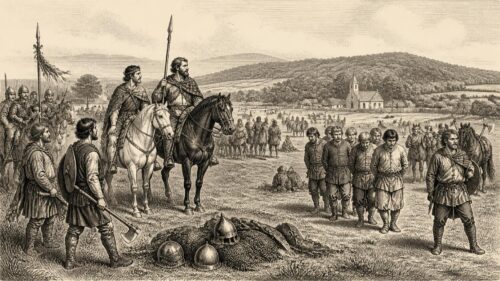
Military insecurity ran through the legislation. The statute required wars to be authorised and directed by the king’s council with the advice of local lords, commons and march inhabitants; private undertakings that ended in a small payment and a fragile peace were condemned. It envisaged hostages as securities for agreements, and declared that surrounding counties should answer raids when warned by sheriffs or wardens of the peace. Four substantial men were to be appointed in each county to assess and inspect men-at-arms, hobelars and foot soldiers. This was an attempt to turn local landholding wealth into regular defensive service.
The provisions also offer glimpses of ordinary burdens. Retainers—kern, hobelars and other armed men—were not to be kept in peaceful districts at other people’s expense. Their taking of food or goods without consent was to be treated as robbery. This indicates the friction caused when magnates and captains sustained mobile military households by imposing on tenants, villagers and townspeople. Similarly, the statute tried to control sheriffs’ fees, prison charges and other official exactions. Its concern with false suits, private maintenance of quarrels, corrupt custody and the concealment of forfeited goods points to grievances within the lordship, not solely threats from outside it.
Even recreation was presented as a military question. People in the warlike marches were forbidden to play hurling with large sticks and a ball on the ground, and to play coiting; instead they were to practise archery and the throwing of lances. The clause does not prove that hurling began in 1366—far from it—but it is unusually direct evidence that the game was familiar enough to legislators to be named, and that physical pastimes occupied time and energy which officials wanted diverted to military training. It is a rare, vivid intersection of sport, social life and frontier policy.
Economic regulation had equal prominence. At ports, towns and cities, local officers and two reputable townsmen were to examine merchants and sailors on purchase costs and freight before setting a ‘reasonable’ selling price. This was designed to restrain profiteering in imported goods, especially during war. Other clauses addressed grazing and impounding livestock on disputed land, debts between people officially at peace, and the opening of waste land to settlers willing to take it in fee or farm. Together they show a government preoccupied with supplies, animals, labour, land and the costs of defence: the practical infrastructure of a fragile polity.
Church, Learning and Cultural Boundaries
The Church stood at the statute’s opening and throughout its enforcement machinery. Ecclesiastical liberties were confirmed; those excommunicated for infringing them could be imprisoned through secular officers until they made satisfaction. The taking of tithes by intimidation was prohibited. Bishops were also to help investigate conspiracies and maintain public order through spiritual censures. This was not a separation of religious and civil authority. The law imagined bishops, sheriffs, chancery and royal council operating together.
At the same time, it drew harsh cultural boundaries around ecclesiastical life in English districts. Irishmen were not to receive benefices there, and religious houses in those districts were barred from admitting Irishmen to profession. Irish pipers, storytellers, rhymers and other performers were portrayed as agents who might gather intelligence; English people who received or rewarded them could be fined and imprisoned. Such provisions illuminate the standing of poets, musicians and learned entertainers, whose travelling linked households and lordships. They also show official suspicion of cultural exchange, rather than an absence of it.
Conflicts Beyond Kilkenny
The annals associated with 1366 give a different view of Ireland: not a single lordship awaiting reform, but many political worlds shaped by succession, alliance and violence. The Annals of the Four Masters, compiled much later, place under 1366 the death of the bishop of Raphoe; killings at Srath-Fear-Luirg involving Fermanagh interests, Clann Murtough and the O’Rourkes; the killing of Cormac Don Mac Carthy, lord of Carbery and Ivahagh; conflict involving Teige mac Manus Ó Conchobair, John O’Donnell and gallowglass forces; and a mobilisation by Domhnall Ó Néill against Niall Ó Néill. These entries should not be treated as precisely dated day-by-day reports, but they responsibly convey the density of regional rivalries in the north, west and south-west.
The Annals of Ulster preserve another cluster under their heading U1366, including the deposition of Philip Ó Raghallaigh and conflict in Breifne, warfare between Niall and Domhnall Ó Néill, and the deaths of bishops in Oriel and Breifne. Their chronological heading itself spans 1366–69, and comparison with other annals shows that several dramatic events placed there belong to a later chronological sequence. It would be misleading to assign all of them firmly to the calendar year 1366. They are nevertheless valuable evidence for the unstable political environment surrounding the year: lordship could be lost through capture, restored through armed action, and secured only through alliances, fleets, castles and hostages.
Lionel continued to move through Ireland during 1366, but departed in November, leaving Thomas de la Dale as custos of the government. His exit underlined the limits of the intervention. The Kilkenny parliament had articulated a far-reaching project: disciplined officials, regulated markets, militarised counties, privileged churches, English law and a culturally distinct colonial community. Ireland in 1366, however, was too politically diverse for a statute to make that project a reality. The year’s enduring importance lies in that contrast—between an ambitious governmental blueprint written at Kilkenny and the negotiated, contested local worlds that continued beyond its reach.
Primary Sources
- A Statute of the Fortieth Year of King Edward III, enacted in a parliament held in Kilkenny, A.D. 1367, before Lionel Duke of Clarence, Lord Lieutenant of Ireland
- A Statute of the Fortieth Year of King Edward III: English text
- A Statute of the Fortieth Year of King Edward III: French text
- The Annals of Ulster, Year U1366
- Annala Uladh: Annals of Ulster otherwise Annala Senait, Year U1366
- The Annals of Ulster
- Annals of the Four Masters, Annals M1362–M1371
- Annals of the Four Masters: translation and edition information
- Annals of the Four Masters: Irish text
- Annals of Loch Cé
- Annals of Loch Cé: Irish text
- Annála Connacht
- Lionel (‘of Antwerp’)
- O’Brien (Ó Briain), Brian Sreamach
- Statute of Kilkenny, for the government of Ireland, 40 Edw. III, National Library of Ireland catalogue record
- Pre-Union Irish Statutes, Irish Statute Book
- Statute Law Revision Act 1983, Schedule
- Annales Hiberniae
- Medieval and Early Modern French Texts at CELT
- Exploring the Irish Annals
- Of the Lawes of Irelande