Kilronan’s New Church1343 CE
In 1343, Ireland saw shifting lordship, violence and religious investment. Toirrdelbach Ó Conchobair regained Connacht and made peace with Conchobar Mac Diarmata, while Clann Feorais and Clann Ricaird crushed Uí Maine, killing eleven Ó Ceallaigh princes. In Thomond, Diarmait Ó Briain briefly succeeded Muirchertach before Brian Bán seized power. In Tír Conaill, Aengus Ó Domhnaill displaced Niall through a broad coalition, granted land to exiles, and defeated his rival’s supporters. Deaths included nobles, churchmen and scholars. Kilronan received a new church, St Mary’s, Kilkenny, a belfry, and Boyle Abbey remained central to Mac Diarmata burials and succession during the year.

Dateline
The annals open 1343 with the first day of January falling on a Wednesday, but Ireland’s political year was anything but orderly. Authority was dispersed among competing kings, lineage heads, Anglo-Irish lords, churchmen and local communities. The most consequential developments recorded for this calendar year occurred in Connacht, Thomond and Tír Conaill, where successions were made, unmade and defended by force. Yet the year was not solely one of raids and killings. A church was built at Kilronan in north-west Roscommon, a new belfry rose at St Mary’s in Kilkenny, and monasteries remained central places of burial, worship and elite memory.
The evidence must be handled with care. Annals often entered events retrospectively, different chronicles sometimes place the same event under different years, and their language can be highly partisan. The Annála Connacht, whose entry is explicitly headed 1343, provides the clearest framework for this year. Its notices are supplemented by later annalistic compilations and by the near-contemporary chronicle of the Franciscan John Clyn at Kilkenny. Where an annalist supplies a precise circumstance, it can be stated firmly; where the record gives only a year, season or sequence, it is safer not to invent a narrower date.
Connacht’s Restored King
The year’s leading political reversal came in Connacht. Toirrdelbach Ó Conchobair “resumed his kingship”, and Conchobar Mac Diarmata of Moylurg made peace with him. The short phrasing conceals a major change. Toirrdelbach had been displaced in 1342 amid conflict involving Mac Diarmata, Aodh Ó Conchobair of Clann Muircheartaigh and Sir Edmund Albanach de Burgh. His recovery in 1343 restored a ruler whose authority depended not on a fixed capital or bureaucracy but on personal alliances, military following, tribute and recognition by powerful neighbouring dynasties.
Peace with Mac Diarmata mattered especially. Moylurg, broadly the country around Lough Key and modern north Roscommon, lay across important routes within Connacht and its rulers were formidable arbiters of provincial politics. The agreement did not create a settled Connacht: it represented a temporary accommodation between two men whose fortunes had recently been opposed. Such settlements were practical instruments. They could secure passage, stop retaliatory raiding, regulate claims over dependants and cattle, and release warriors for other contests. Kingship in this setting was continually negotiated rather than automatically inherited.
Family ties were also political resources. Sláine, an Ó Briain woman and Toirrdelbach’s wife, died during the year. The annals note that she had previously been married into the de Burgh family of Ulster. That brief notice is a reminder that marriages linked the leading Gaelic and Anglo-Irish kindreds across provincial boundaries. They did not prevent war, but they created channels of influence and claims that could outlast the individuals concerned. In 1343, Connacht’s internal contest was inseparable from the wider instability left by the collapse of the old de Burgh lordship after the murder of Earl William de Burgh in 1333.
Defeat in Uí Maine
Connacht also saw a sharp local defeat with wider consequences. Clann Feorais, the Gaelicised descendants of the de Berminghams, and Clann Ricaird, the Clanricarde branch of the de Burghs, heavily defeated Uí Maine. Eleven princes of Clann Cheallaigh were killed, including Conchobar Cerrbach Ó Ceallaigh, remembered by the annalist as “the Gambler”. The named total should not be read as a complete measure of losses among ordinary fighting men and camp followers, but it shows that the blow fell on Uí Maine’s political leadership.
The conflict demonstrates that the simple contrast of “Irish” and “English” does not explain fourteenth-century warfare. Clann Feorais and Clann Ricaird had roots in settler families, but their power was exercised within Irish lordship politics, through regional alliances and conflicts with Gaelic dynasties. Conversely, Ó Ceallaigh rule in Uí Maine was bound into the same contested world. The annals’ labels for communities and kindreds describe affiliations that were real and meaningful, but alliances crossed linguistic and ancestral lines when advantage required it.
Violence could reach learned and religious figures as well as warriors. Cathal Ó Madadháin, described as a sage of Ireland, was killed by Clann Ricaird. Donnchad Cléirech Ó Maoil Bhrénaind, a choral canon of Elphin, was killed by an arrow shot from followers of Hobert, son of David Donn Mac William. These notices do not explain each killing, but they show that scholarship, ecclesiastical office and immunity did not guarantee safety in a politically fractured province. They also reveal the social standing accorded to learning: the death of a saoi, or sage, deserved commemoration alongside the deaths of kings.
Thomond’s Swift Succession
In Thomond, the death of Muirchertach Ó Briain opened another struggle for lordship. Muirchertach had been a dominant and durable ruler, associated with the recovery of Gaelic power in north Munster after the collapse of the de Clare lordship. On his death, his brother Diarmait assumed the kingship. The succession did not hold. Brian Bán Ó Briain expelled Diarmait, and the leading men of Thomond then supported Brian. The record’s sequence is important: accession, expulsion and recognition all occurred in 1343, though no trustworthy day or month is supplied.
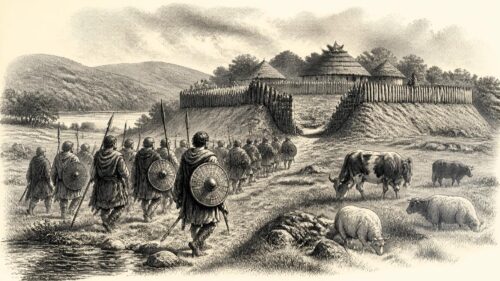
This was not a constitutional transfer in the modern sense. A claimant needed kinship credentials, but he also needed the backing of the region’s great families and fighting men. Brian Bán had long been Muirchertach’s rival before reaching an accommodation with him in the later 1330s. His success in 1343 suggests that this earlier peace had not eliminated competition; rather, it had postponed the question of who would command Thomond after Muirchertach. For farming communities, such contests could mean demands for food, livestock, transport and armed service as rival hosts moved through the countryside.
A Kingdom Contested in the North
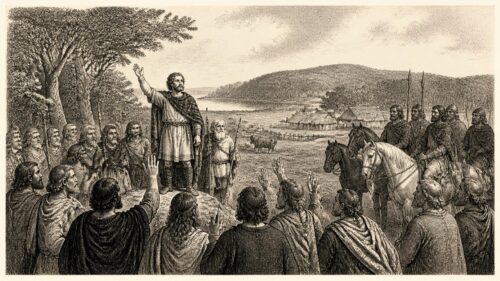
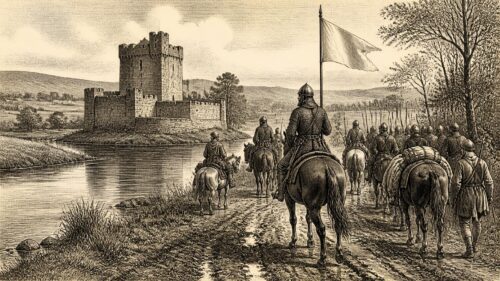
Tír Conaill underwent an equally dramatic change. Niall Ó Domhnaill was deposed by Aengus Ó Domhnaill, aided by Domnall Dubh Ó Baoighill, Ó Dochartaigh, Aodh Reamhar Ó Néill and Clann Suibhne. Aengus was made king, but Niall returned and the contest continued. The breadth of the coalition behind Aengus is striking: it joined leading powers from Donegal and the north-west with an Ó Néill supporter from Tyrone and the maritime military household of Clann Suibhne.
The displacement of Clann Muircheartaigh from Bréifne was woven into this northern struggle. Driven out by Ualgarg Ó Ruairc, Toirrdelbach Ó Conchobair and Tadc Mag Ragnaill, they were granted Tír Aodha in Donegal by Aengus. The annalist specifies not only territory but its “grass and cornlands and other wealth”. Land was valued for pasture, cultivation and the resources that could sustain a lord’s dependants and troops. Granting it to exiles was therefore both an act of patronage and a calculated military investment.
Aengus and Clann Muircheartaigh subsequently defeated Niall’s force. The fighting killed Aindiles Ó Baoighill, chief of Tír Ainmirech, his son, Eogan son of Art Ó Domhnaill, and many others. The victory secured Aengus’s position for the moment, but the casualty list shows its price. Dynastic conflict did not occur at an abstract level: it removed household heads, heirs and local leaders, leaving families and dependent communities to renegotiate protection and property.
Churches, Burials and Building
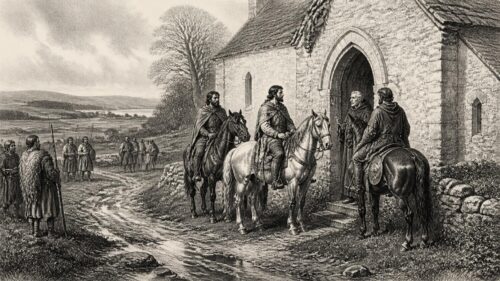
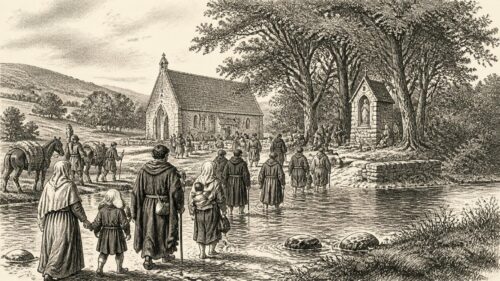
Against this backdrop, the year also produced a rare constructive notice: “the church at Kilronan was built.” The annal does not identify its patron, mason, dedication or architectural form, and it would be unsafe to identify it automatically with a later church on the site. Even so, the entry records deliberate investment in a sacred place at a time of political uncertainty. A new church meant labour, stone or timber, skilled workmanship, liturgical furnishings and a congregation or patron capable of sustaining its use.
Monasteries remained anchors of elite commemoration. Derbail, daughter of Aodh Ó Domhnaill, died while visiting Conchobar Mac Diarmata at Inis Doighre and was buried with honour at Boyle. Conchobar himself died in his own house on the Saturday a week before Samain and was buried at Boyle; his brother Fergal succeeded him as king of Moylurg. The careful wording joins lordship, household, seasonal time and monastic burial. Boyle Abbey, founded under Mac Diarmata patronage, was not merely a religious institution: it was a dynastic mausoleum and a visible centre of regional prestige.
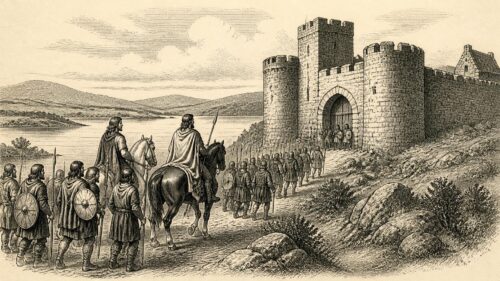
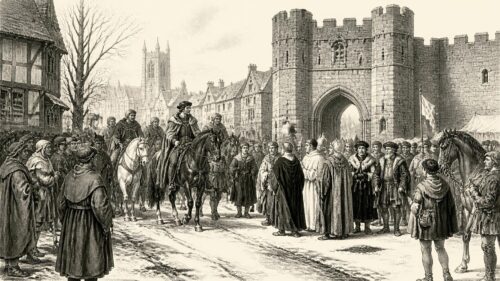
In Kilkenny, John Clyn recorded the building of a new belfry at St Mary’s church. It was a modest notice beside the annals’ princely deaths, but it illuminates a different Ireland: an urban parish with resources for masonry, bells and public worship. Kilkenny stood within the English lordship, yet its church building occurred in the same year as power was being remade in Gaelic Connacht, Thomond and Donegal. The island was politically plural, but its people shared institutions of Christian worship, local markets, kinship, lordship and memory.
Thus 1343 was defined above all by restored and contested rule. Toirrdelbach Ó Conchobair regained Connacht; Brian Bán won Thomond after Muirchertach’s death; and Aengus Ó Domhnaill seized Tír Conaill through coalition and battle. But Kilronan’s new church, the belfry at St Mary’s and the burials at Boyle show another side of the year: communities and patrons still built, prayed and marked the dead while the balance of power shifted around them.
Primary Sources
- Annála Connacht, Annal 1343
- Annals of the Four Masters, Annal M1343
- The Annals of Ulster, Year U1343
- Annalium Hiberniae Chronicon ad annum MCCCXLIX
- Clyn, John | Dictionary of Irish Biography
- O'Connor (Ó Conchobair), Toirrdelbach | Dictionary of Irish Biography
- O'Brien (Ó Briain), Muirchertach | Dictionary of Irish Biography
- O'Brien (Ó Briain), Brian Bán | Dictionary of Irish Biography
- Mág Oireachtaig, David | Dictionary of Irish Biography
- Pembridge, John | Dictionary of Irish Biography
- Registrum de Kilmainham
- Boyle Cistercian Abbey | Heritage Ireland
- School of the West | Heritage Ireland
- St. Mary’s Church & Graveyard | Kilkenny County Council
- Timeline for Kilkenny
- Kilkenny Masterplan Area Archaeological Framework
- Saint Thomas's Church (Kilronan), Glebe, Roscommon | Buildings of Ireland
- Part 105 of Annála Connacht
- Part 1 of Caithréim Thoirdhealbhaigh
- Part 82 of Annals of Inisfallen
- The Annals of Ulster otherwise Annála Senait
- The Annals of the Four Masters
- The Liberty of Trim: A Medieval Lordship in Ireland