Thomond’s August Succession1287 CE
1287 in Ireland was marked by succession, local violence and deaths without island-wide upheaval. Thomas de Clare, lord of Thomond, died on 29 August, leaving his six-year-old heir Gilbert and placing lands under wardship. His death altered but did not end contested power around the Shannon; Toirrdelbach Ó Briain later raided Ormond and Limerick. In Connacht, Diarmait Midech Mac Diarmata and Gilla na nÉc Ó Mannacháin died alongside lesser rulers and clerics. Archdeacon Florint Ó Gibealláin was praised for learning. Máel Sechlainn Mag Oirechtaig was killed in revenge for broken loyalty. Misdated de Burgh campaigns belong to 1291, not 1287.
Dateline
The surviving record for 1287 is unusually quiet in some parts of Ireland and sharply revealing in others. It does not support a single island-wide narrative of decisive conquest, parliament or catastrophe. Instead, the year is best understood through several securely dated deaths, a killing in Connacht, and the passing of Thomas de Clare, lord of Thomond, on 29 August. Together these notices show how precarious authority could be: a lordship might depend upon a minor heir; a regional dynasty upon the death of an elderly ruler; and political loyalty upon a remembered personal obligation.
A Firm Date in Thomond
Thomas de Clare’s death on 29 August is the year’s clearest event in the Anglo-Irish south-west. He was a younger son of the powerful Clare family, but had made himself a substantial Irish magnate through royal favour, military service and marriage to Juliana FitzMaurice. His lordship in Thomond, stretching into the contested country north of the Shannon, was never merely a secure territorial possession. It rested on an unstable accommodation with Gaelic rulers, above all Toirrdelbach Ó Briain, as well as on royal authority, castles, tenants, clients and armed followings.
Later evidence proves the date but is notably silent about the cause. A 1302 proof of age recalled that Thomas died on the feast of the Decollation of St John the Baptist, 29 August 1287, when his heir Gilbert was six. The best modern biographical assessment judges that he apparently died from natural causes. That matters because a much later tradition turned his death into a battlefield episode. There is no good reason to present that dramatic version as a fact of 1287. The evidence permits a death, not a named battle, place of death or funeral narrative.
Thomas’s death nevertheless had immediate political weight. Gilbert was his acknowledged heir but still a child; in due course the lands held of the crown were taken into royal hands during his minority. Juliana and the wider FitzMaurice–FitzGerald connection remained important to the family’s Irish interests, but the loss of an adult lord removed a forceful participant from Thomond politics. It did not make de Clare authority disappear, nor did it give any one neighbouring ruler an automatic victory. It did mean that the balance in the Shannon region had to be managed through wardship, household administration and negotiated local power rather than Thomas’s personal command.
Power Beyond Bunratty
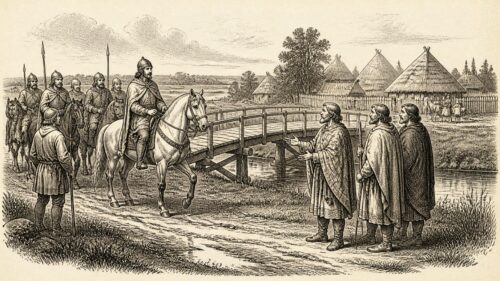
Broad context should not be confused with an event securely dated to the year. Before 1287, Thomas had pursued a lordship in a region where Ó Briain rivalries, de Burgh influence and the interests of the Dublin government overlapped. An accommodation had been reached with Toirrdelbach Ó Briain: later inquest material indicates that Toirrdelbach paid a substantial annual rent for lands claimed by the lord of Thomond. Such an arrangement demonstrates neither peace in the modern sense nor simple submission. It shows the practical mixture of rent, local possession and competing jurisdiction by which power was exercised in late-thirteenth-century Ireland.
In the later part of 1287, Toirrdelbach Ó Briain raided deeply into Ormond and Limerick, according to the Dictionary of Irish Biography’s reconstruction of his career. The source does not allow a precise day, route or tally of losses, and the raid should not be represented as a direct consequence of Thomas de Clare’s death without evidence. It does, however, place armed movement and retaliatory politics in the same calendar year as the de Clare succession. Thomond was not a settled colonial frontier; it was a region in which Gaelic kings, Anglo-Irish landholders and royal officials all had incentives to test one another’s reach.
Deaths in Connacht
The Connacht annals give 1287 a more local texture. Diarmait Midech Mac Diarmata, king of Muintir Máelruanaid, died during the year. The annalist calls him the oldest and noblest member of his kindred, wording that signals both seniority and standing rather than a neutral administrative office. His polity lay in the orbit of Moylurg, in what is now north Roscommon. The following annal year records Cathal Mac Diarmata’s assumption of the kingship of Moylurg, but that is evidence for a succession after the death, not proof that the transfer occurred on the same day or under uncontested conditions in 1287.
Gilla na nÉc Ó Mannacháin, lord of the Three Tuatha, died on 7 September. This is one of the few precise Irish dates in the year’s annalistic notices. The Four Masters places his lordship in the Three Tuatha of Roscommon. His death is a reminder that political Ireland was not composed solely of great provincial kings and Anglo-Irish earls. It also comprised many smaller lordships, each with its own kin group, landholding claims, followers, ecclesiastical ties and succession problems. A death in one of these territories could alter the calculations of neighbours even where no battle followed.
Other notices are briefer still. Pilib Mac Goisdelb died; Ruaidrí Sinnach died on 10 March; and the Four Masters adds the deaths of Adam Cusack, Benmumhan, daughter of Ó Catháin, and Domnall Ó hAinlige, chief of Cenél Dofa. Their compressed treatment is itself instructive. Annals were selective records, shaped by regional interests and retrospective compilation, not modern censuses. They preserve the names of people whom particular learned communities considered worth remembering, while leaving the experiences of most cultivators, herders, craftspeople and household dependants unrecorded.
Learning at Elphin
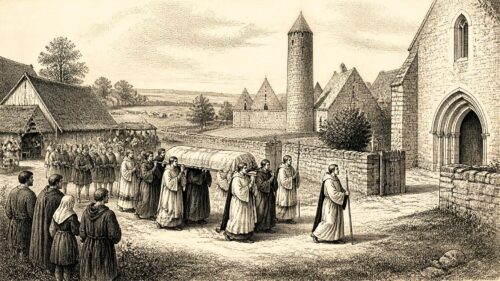
Florint Ó Gibealláin, archdeacon of Elphin, also died in 1287. Both Annála Connacht and the Annals of Loch Cé praise him as a man skilled in knowledge, wisdom, learning and clerical accomplishment; the Loch Cé translation goes further, styling him a philosopher. These are conventional encomiastic terms, but they are meaningful. They show that an archdeacon could be valued not only for ecclesiastical rank but for intellectual and administrative competence. In a society where charters, legal memory, liturgy, genealogical knowledge and Latin learning mattered, senior clergy helped sustain institutions that joined local churches to wider diocesan and European Christian networks.
It would be unsafe to turn Florint’s obituary into evidence for a named school, library or book-production centre at Elphin in this particular year. Yet the language used for him confirms the prestige of learning in the Connacht church. The annals themselves were products of such learned environments: their careful calendrical opening for 1 January 1287 records a Wednesday, the tenth day of the moon, and the relevant solar, lunar and indiction cycles. That dating formula connected an Irish local record to the chronological habits of Latin Christendom.
Vengeance and Obligation
The year’s most explicit act of violence in the Connacht record was the killing of Máel Sechlainn, son of Tomaltach Mag Oirechtaig, by Toirrdelbach, son of Eógan Ó Conchobair. The annals give a motive: revenge because Tomaltach had abandoned Toirrdelbach’s father in favour of Toirrdelbach’s sons. The phrasing is terse and the precise setting is unknown, but it makes political allegiance a family matter with consequences across generations. This was not described as an impersonal prosecution by a central state. It was vengeance grounded in broken loyalty, exercised within a landscape of powerful kindreds.
Such an entry also cautions against a simple opposition between ‘Gaelic’ and ‘English’ Ireland. The same year contains the death of an Anglo-Irish lord in Thomond, the deaths of Connacht rulers and clerics, and a feud inside the Ó Conchobair political world. Different systems of lordship overlapped, competed and adapted. Castles, rents, hostages, kinship, church office and armed retinues were all instruments of power, but none guaranteed lasting control.
Dating the Silence
One apparent difficulty deserves to be made plain. The Annals of Ulster has a heading ‘U1287’ containing major campaigns by Richard de Burgh, the Red Earl, in Tír Eógain, Tír Chonaill and Connacht. But the manuscript heading itself signals a chronological displacement, and the Annals of the Four Masters places the same sequence under 1291. Those campaigns are therefore valuable evidence for the early 1290s and for the complexity of annalistic dating, but they cannot responsibly be presented as securely occurring in calendar year 1287. This restraint leaves a quieter article, but a truer one.
What can securely be said is that 1287 brought a change of lordship in Thomond, a recorded late-year raid by Toirrdelbach Ó Briain, and several deaths that mattered in Connacht’s political and ecclesiastical communities. The year was not empty because its annals are short. Rather, its surviving notices reveal medieval Ireland at the human scale: succession after death, learning remembered in an archdeacon, status marked in obituary, and a killing justified through the language of loyalty and revenge.
Primary Sources
- Annála Connacht: Annal 1287
- Annals of Loch Cé: Annal LC1287
- Annals of Loch Cé: Irish Text, Annal LC1287
- Annals of the Four Masters: Annal M1287
- Annals of the Four Masters: Irish Text
- The Annals of Ulster: Year U1287
- Annala Uladh: Irish Text and Annalistic Dating
- Annals of Inisfallen: Bibliography and Manuscript Information
- Annals of Inisfallen: Text and Translation
- Clare, Thomas de, Dictionary of Irish Biography
- O'Brien (Ó Briain), Toirrdelbach, Dictionary of Irish Biography
- MacDermott (Mac Diarmata), Maolruanaidh, Dictionary of Irish Biography
- Inquisitions and Extents of Medieval Ireland
- Calendar of Documents Relating to Ireland, 1171–1307
- English Lords in Late Thirteenth and Early Fourteenth-Century Ireland: Roger Bigod and the de Clare Lords of Thomond
- English Rule in Ireland, c.1272–c.1315
- Who Was Who in Medieval Limerick City: From Manuscript Sources
- Annals of the Kingdom of Ireland: Library Catalogue Record
- Exploring the Irish Annals
- Annals of Inisfallen to Go on Public Display in University College Cork
- Some Observations on the Dublin Annals of Inisfallen
- The Churches of County Clare, and the Origin of the Ecclesiastical Divisions in That County