Roscommon’s Three Kings1274 CE
In 1274 Connacht suffered a rapid succession crisis after the death of Áed mac Fedlimid Ua Conchobair, a powerful king who had resisted Gaelic and Anglo-Norman opponents. Eogan mac Ruaidrí succeeded him but was killed by kin in Roscommon’s friars’ church after three months. Áed mac Cathail Dall then ruled for a fortnight before being killed at Grainsech Sruthra, leaving Tadc mac Toirrdelbaig king. Elsewhere, deaths and killings altered lordship in Brefne, Annaly and Dartry. Dublin’s forces were defeated at Glenmalure, while Edward I’s coronation and Thomas de Clare’s arrival linked Ireland to Plantagenet politics. The year revealed fragmented power.

Dateline
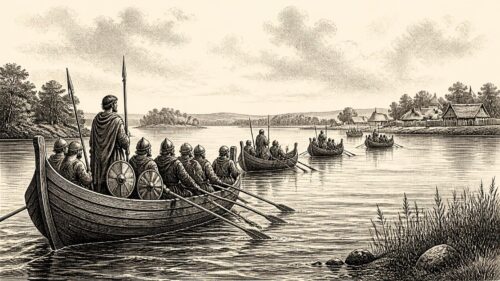
For Connacht, 1274 was a year in which kingship collapsed into a sequence of funerals, killings and hurried proclamations. The death of Áed mac Fedlimid Ua Conchobair on 3 May removed a ruler who had held the provincial kingship for nine years and had made himself formidable to enemies both Gaelic and Anglo-Norman. Before the year ended, two successors had also been killed, and Tadc mac Toirrdelbaig Ua Conchobair had been raised in their place. The rapid turnover did not simply show that Connacht lacked a king: it revealed how contested the very right to rule had become within the descendants of Cathal Crobderg.
Áed’s Death on Holy Cross Day
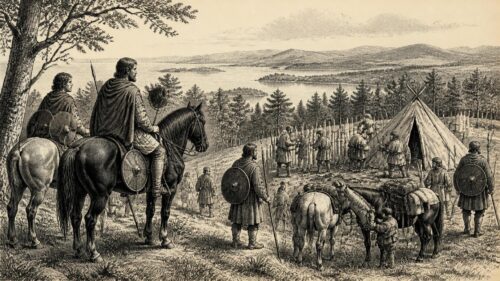
The fullest annalistic account dates Áed’s death precisely. It places it on Thursday, 3 May 1274, the feast then known as the Invention of the Holy Cross. Such careful calendrical detail gives unusual firmness to the date, though the long praise attached to it must be read as royal commemoration rather than neutral reporting. The annalist calls Áed a king who had fought both Galls and Gaels opposing him, inflicted defeats, pulled down courts and castles, and taken hostages from Uí Briúin and Cenél Conaill. These were conventional measures of successful rule, but they also point to the real tools of power: mobile war-bands, the seizure of high-status captives, the destruction of fortified centres, and influence extending beyond Connacht’s immediate heartlands.
Áed’s standing had been built in a divided Ireland. In the annalists’ usage, Galls did not mean people from a single modern nationality; it normally denoted the Anglo-Norman settler and lordly world, together with those connected to it. Connacht was therefore not divided into two sealed communities. Gaelic rulers, Anglo-Norman magnates, churchmen, mercenaries, tenants and local allies all operated across a landscape of overlapping lordships. The eulogy’s claim that Áed was dreaded by the kings of Ireland is literary praise, but his death plainly created a political vacancy of more than local importance.
His death also ended a reign identified with resistance and recovery. Since the mid-thirteenth century, the power of the de Burgh earls and other settler interests had pressed deeply into Connacht, while Ua Conchobair branches competed among themselves. Áed’s career had shown that an energetic Connacht king could still break castles, exact hostages and exploit divisions among opponents. Yet that success did not produce an agreed succession. The crisis of 1274 exposed the cost of a kingship concentrated in one capable leader but claimed by numerous near relatives.
A King in the Friars’ Church
The men of Connacht chose Eogan mac Ruaidrí, another descendant of Cathal Crobderg, as Áed’s successor. The selection itself mattered. Kingship was not transferred automatically from father to eldest son; it depended on acceptance by leading kindreds and fighting men, as well as on a candidate’s descent from the ruling dynasty. Eogan’s position was immediately fragile because other branches of the Ua Conchobair family possessed comparable claims and armed followings.
According to Annála Connacht, Eogan held the lordship for only three months. He was then killed by his own close kin, led by Ruaidrí mac Toirrdelbaig Ua Conchobair, in the church of the friars at Roscommon. The place gives the episode particular force. A friary was a religious institution, a site of burial and prayer, and a place embedded in the political society around it; it did not guarantee safety in a dynastic struggle. The annal records the killing without supplying a day or month, so the event should not be assigned a more exact date than 1274. Nonetheless, its sequence after Áed’s death and Eogan’s three-month tenure makes it one of the year’s clearest landmarks.
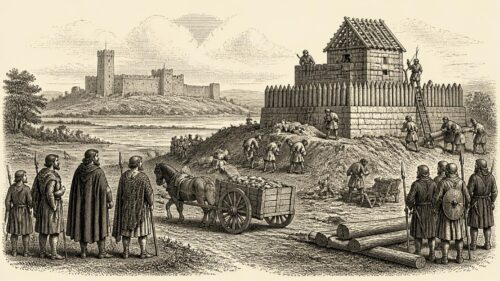
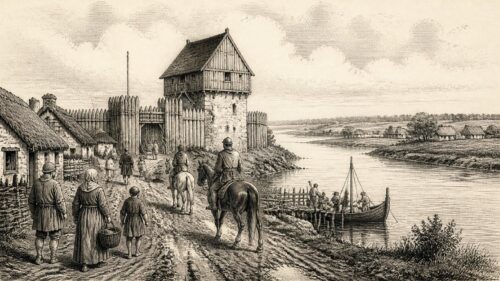
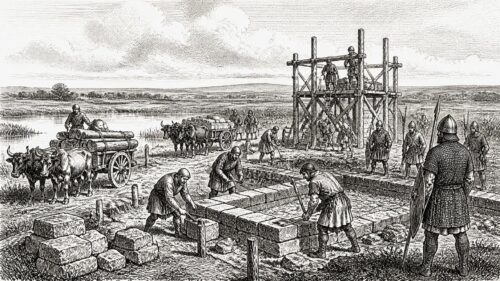
Roscommon was also no isolated devotional refuge. The town and its surroundings lay near a major zone of contest between Connacht dynasties and the lordship’s expanding network of castles and estates. The new royal castle at Roscommon had been established only a few years earlier. In 1274 Geoffrey de Geneville, the king of England’s justiciar in Ireland, was associated with rebuilding royal castles at Athlone, Roscommon and Rindoon, while attempting a temporary settlement among Connacht’s rival claimants. The coexistence of castle repair, negotiation and murder in a friars’ church captures the unstable character of political order: royal administration could strengthen particular strategic points, but could not settle the Ua Conchobair succession by decree.
A Fortnight at Grainsech Sruthra
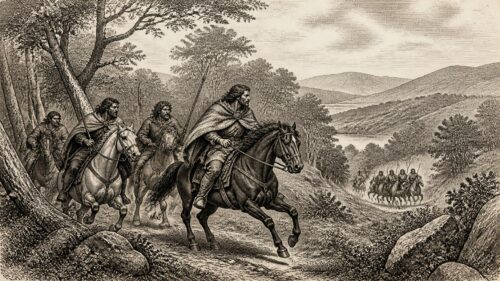
Eogan’s death brought Áed mac Cathail Dall Ua Conchobair to the kingship. His rule was even shorter. The annal gives him only a fortnight before he was killed at Grainsech Sruthra by Tomaltach Mag Oirechtaig and an Ó Birn ally. The precise location is named, but the source provides no securely dated day and does not explain the immediate cause of the attack. What can responsibly be said is that the contest was no longer confined to rival royal cousins. Other Connacht families were active participants, able to determine which claimant survived and which did not.
After this second killing, Tadc mac Toirrdelbaig Ua Conchobair was made king. The annalist underlined the extraordinary compression of events: three kings of Connacht had died within the one year—Áed mac Fedlimid, Eogan mac Ruaidrí and Áed mac Cathail Dall. Tadc’s accession was thus a settlement only in the limited sense that a new ruler had been proclaimed. Later developments show that competition continued, but they should not be read back as events of 1274. For this year, the firm conclusion is narrower and striking enough: Connacht ended it under a fourth ruler after three royal deaths.
Lordship Beyond Connacht
Elsewhere in the Gaelic north and midlands, the annals record changes that reinforce the picture of lordship as personal, local and vulnerable. Tigernán mac Áeda Ua Ruairc, king of Brefne, died. Gilla na Naem Ua Fergail, long-time ruler of Annaly, also died after some thirty years of defending his territory against both Galls and Gaels; his son Cathal succeeded him. In Dartry and Clann Fermaige, Maelsechlainn Ua Ruairc was killed at Killarga by Conchobar Ua Ruairc, who then assumed the kingship. These notices do not describe a single co-ordinated Irish crisis. Rather, they show several political communities undergoing succession, violence or both during the same calendar year.
One cultural loss was marked in Connacht as well. Tadc mac Cerbaill Buide Ua Dálaig, described as ollam in poetry to Áed Ua Conchobair, died in 1274. An ollam was a master of a learned art, and the notice is evidence that a ruler’s household included more than warriors and hostages. Poets preserved genealogy, praise, precedent and political memory; the verses copied beside the royal succession notices demonstrate their role in shaping how power was understood. The language of the annals is not merely decorative. It records a society in which learning, lineage and lordship were bound closely together.
Setback in the Wicklow Mountains
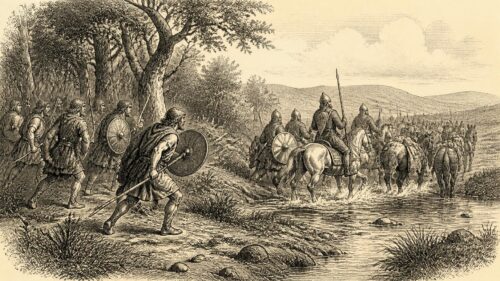
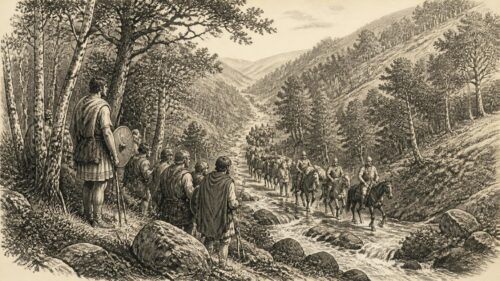
The year also brought a severe reverse for the Dublin government. Geoffrey de Geneville’s administration raised an expedition under William FitzRoger, prior of the Hospital of St John at Kilmainham, against Irish forces in the Wicklow mountains. During 1274 the expedition was defeated at Glenmalure, or at the place called Glindelory in a near-contemporary Anglo-Irish annal. FitzRoger was taken prisoner and other men were killed or captured. He was released only after Geneville freed Irish hostages held in Dublin Castle.
This was more than an embarrassing battlefield defeat. The military religious order based at Kilmainham possessed organisation, land and armed resources, while the justiciar represented the authority of the English crown in the lordship. Their failure in the mountain country demonstrated the limits of mounted and castle-based power in difficult terrain controlled by local Irish kindreds. It also shows the practical value of hostages: they were not abstract symbols of submission but people whose custody could be exchanged when military plans failed.
Royal politics nevertheless continued to draw Ireland into wider Plantagenet affairs. Edward I, who had succeeded Henry III in November 1272, was crowned on 19 August 1274 after returning from crusade. The coronation did not make him king for the first time, but it publicly consolidated his rule. Later that autumn Thomas de Clare arrived in Ireland, probably to assist Geneville, and became sheriff of Limerick. His arrival brought another well-connected royal servant into Irish affairs, although his more dramatic involvement in Thomond belongs to subsequent years.
What the Year Reveals
There is no responsible basis for attaching a general harvest, price movement, epidemic or demographic change to 1274. The surviving evidence instead illuminates political society. It shows Connacht’s royal succession being decided through kinship, armed action and support from allied families; a friars’ church caught in the violence of dynastic rivalry; poets recognised as members of a ruler’s learned household; and the Dublin administration learning again that military authority did not run evenly from its castles into the mountains.
Roscommon stands at the centre of the year’s story because Eogan’s killing there made the succession crisis unforgettable. Yet the wider lesson reaches from Annaly and Brefne to Wicklow and Dublin. Ireland in 1274 was not a country moving uniformly towards either Gaelic recovery or English conquest. It was a patchwork of powers, each dependent on people, places, pledges and military capacity. In Connacht, the death of one strong king exposed that patchwork with exceptional speed.
Primary Sources
- Annála Connacht
- Annála Connacht, Annal 1274
- The Annals of Ulster, Year U1274
- Annals of Ulster
- Annals of the Four Masters, Annal M1274
- Annals of the Four Masters
- Annales Hiberniae
- CELT Project: Annales Hiberniae
- Geneville (Joinville), Geoffrey de | Dictionary of Irish Biography
- Fitzroger, William | Dictionary of Irish Biography
- Clare, Thomas de | Dictionary of Irish Biography
- Calendar of Documents Relating to Ireland, Volume 2, Item 1008 (30 May 1274)
- Virtual Record Treasury of Ireland
- Vaucouleurs, Ludlow and Trim: the role of Ireland in the career of Geoffrey de Geneville (c. 1226–1314)
- The Years of Crisis, 1254–1315 | A New History of Ireland: Volume II
- English Rule in Ireland, c.1272–c.1315
- The Household Knights of Edward I
- Exploring the Irish Annals
- Annals of the Kingdom of Ireland: Table of Contents
- CELT Project: Annála Connacht