Bann Bridge and Connacht Raids1248 CE
In 1248, military and political struggle linked northern and western Ireland across contested regions. Justiciar John FitzGeoffrey compelled Cenél nEógain to give hostages, then built a bridge over the Bann and a castle near Coleraine, strengthening royal leverage without securing conquest. Maurice FitzGerald intervened in Tír Conaill, backing Gofraid Ó Domnaill, whose rival was later killed. In Connacht, revolts, raids, cattle seizures, island warfare and a reverse in Connemara exposed limits to colonial power. Meanwhile, Fedlimid Ó Conchobair endowed Kilmore’s Augustinians, Armagh’s primate returned from Rome, and Henry III addressed baronial liberties, demonstrating intertwined warfare, lordship, church patronage and administration.
Dateline
The evidence for 1248 presents Ireland not as a single political arena but as a connected series of contested regions. Annalistic accounts place the most consequential developments in the north and west: a royal advance into Cenél nEógain, fighting over lordship in Tír Conaill, reprisals and seaborne resistance around Clew Bay, and assaults in Connemara. At the same time, a Connacht king endowed Augustinian canons with land and a costly silk vestment, while the primate of Armagh returned from the papal court. The year therefore shows war, lordship and religious patronage operating together rather than separately.
Sources and the Limits of Dating
The fullest narrative comes from Annála Connacht, with closely related notices in the Annals of the Four Masters and later annalistic traditions. These sources assign the events to 1248, but usually do not supply a day, month or sequence within the year. Their language is also purposeful: Galls, often translated as “Foreigners” or “English”, could mean settlers and forces attached to the colonial lordship rather than every person of English or Welsh ancestry. Likewise, phrases such as “took the kingship” describe political success in a particular Gaelic lordship, not rule over Ireland as a whole. The events below can responsibly be connected with 1248; the exact order of campaigns cannot always be recovered.
The Bann Crossing
John FitzGeoffrey, justiciar of Ireland for Henry III, led a hosting against Ó Néill in Cenél nEógain. A hosting was not simply a battle: it was an organised military expedition, drawing on magnates, tenants, garrisons, supplies and transport. The annals report that the people of Cenél nEógain concluded that the newcomers then possessed the military advantage and agreed to make peace by giving hostages. Such hostages were high-status guarantees for an agreement. They were instruments of coercion, but also of diplomacy, binding a settlement to the personal safety of leading families.
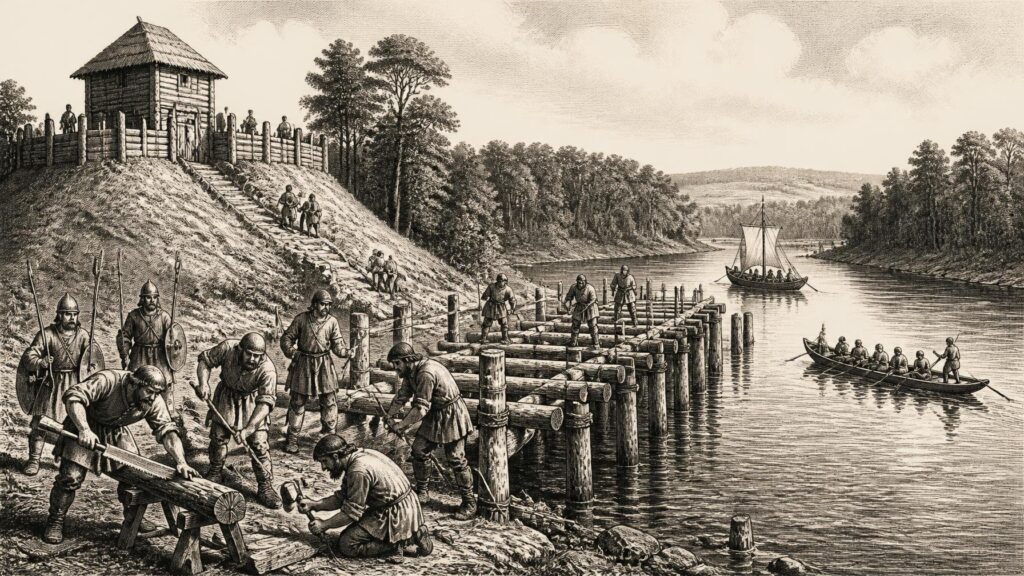
The expedition left a more durable mark than a raid. The Four Masters say that the force built a bridge over the Bann and a castle at Druim Tairsigh; modern scholarship identifies the fortified site with Killowen, near Coleraine. A bridge and castle worked as a pair. The crossing improved movement across a river that was a major barrier and route of communication, while the fort gave the government a defended base from which to supervise it. Neither structure meant that the whole region had been conquered. Rather, they signal an attempt to turn a successful campaign into continuing leverage over travel, military movement and neighbouring lands.
One notice associated with this northern crisis records Brian Ó Néill moving small vessels from Lough Foyle through Magh Ítha and across the Termon Davog towards Lough Erne, where he ravaged territory and demolished a castle. The annal does not provide enough detail to reconstruct every stage of that operation or its precise relationship to the justiciar’s campaign. It does, however, preserve an important reality: waterways, portages and small craft could connect the Foyle and Erne worlds. Political power in the north depended not only on horsemen and fortified points, but on the ability to move men and supplies through riverine landscapes.
Tír Conaill’s Contested Lordship
While the justiciar operated in Cenél nEógain, Maurice FitzGerald, lord of Offaly and former justiciar, campaigned in Tír Conaill. FitzGerald had long sought influence beyond the more securely settled areas of the lordship, using Sligo as an important western base. In 1248 he raided, killed and plundered in Tír Conaill, expelled Ruaidrí Ó Canannáin, and left the lordship of Cenél Conaill to Gofraid, son of Domnall Mór Ó Domnaill. The account is unusually explicit about the political outcome: military intervention was used to decide a local contest for kingship.
The settlement did not go unchallenged. Ó Canannáin joined forces with Cenél nEógain and returned into Tír Conaill. In the ensuing battle, he and many other noblemen were killed by Cenél Conaill and Gofraid Ó Domnaill, who thereby secured the kingship. This was not a simple clash between an Irish side and a colonial side. FitzGerald’s attack had favoured one Gaelic claimant, while the defeated challenger found allies in another Gaelic polity. The episode illustrates the hard political arithmetic of thirteenth-century Ireland: external intervention could help create a ruler, but the success of that ruler ultimately rested on local armed support and the fate of rivals in battle.
The northern operations also reveal the limits of royal and magnate power. FitzGerald’s campaigning could displace a claimant and FitzGeoffrey’s army could extract hostages, but neither action erased the independent political capacities of Cenél Conaill or Cenél nEógain. The apparent gains of 1248 were strategic positions and negotiated submissions, not a settled transformation of the entire north.
Umhall, Islands and Cattle
Conflict was equally intense on the Atlantic-facing coast of Connacht. The sons of Magnus, together with the son of Conchobar Ruad, revolted against the Galls. They burned Mac Henry’s castle, captured its warden and drove the cattle of north Umhall onto the islands of Clew Bay. Cattle were portable wealth, food and a visible measure of lordship. Removing them to islands made pursuit difficult and exploited local knowledge of tides, boats and channels.
The response was rapid and collective. Jordan d’Exeter, John Butler, Robin de la Lé and others assembled, moved through Ballintober to Aghagower, and plundered Umhall north and south. Mac Henry then entered his own lordship with a larger force. Yet the result was not straightforward suppression. He made peace with Domnall, son of Magnus, who promised men and ships for action against his own kinsmen on the islands. When an expedition went to obtain boats, the islanders attacked it. Several men were killed, including Diarmait, son of Magnus, whom the annalist praises as a proven warrior. The chronicler’s judgement that this was “a victory with defeat” captures the ambiguity: the islanders inflicted losses but lost a leader of real consequence.
These events make everyday pressures of war unusually visible. Castles required wardens; armies required routes, local allies and provisions; boats were essential military assets; and livestock could be both prize and provocation. They also show kinship as a field of negotiation rather than an automatic political bond. Domnall’s agreement to act against relatives may have been an expedient bargain under pressure, but it demonstrates how lordship could divide households and kindreds.
Connemara and the Cost of Advance
The annals state bluntly that all Connemara was plundered by the Galls. This is a sweeping formula and should not be read as a precise survey of every settlement. It nevertheless conveys a broad destructive expedition through a region where mountains, bogs, islands and sea routes complicated control. The same account immediately records a reverse: a force sent against Ó Flaithbheartaigh was defeated and many of its men were killed. Thus, even within a year that the annalist described as one in which the Galls had the upper hand in parts of Ireland, local resistance could still inflict serious losses.
For non-combatants, plunder was not an abstract political act. It could mean the taking of animals, food stores and movable goods, the interruption of cultivation, and the danger of displacement. Yet the sources name few ordinary people and do not permit a numerical estimate of casualties or material loss. What can be said is that warfare in 1248 was not confined to formal sieges: it reached pasture, coastal islands, roads and religiously connected settlements.
Church, Gifts and Wider Connections
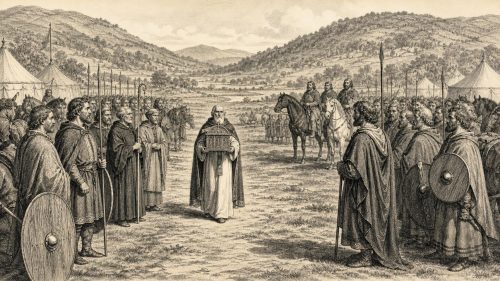
Amid the campaigns, Connacht’s king, Fedlimid mac Cathail Chrobdeirg Ó Conchobair, granted Rath na Rómhánach, now Rathnarovanagh in County Roscommon, to the Augustinian canons of Kilmore. At the same ceremony, held at the urging of Tadc Ó Manacháin and witnessed by Connacht nobles, he presented a silken choir-cape in honour of the Virgin Mary and St Augustine. The gift is firmly placed in the annal for 1248. Its silk is a small but striking sign of long-distance commercial and ecclesiastical connections: such an expensive textile was suitable for elite liturgical display, and its donation publicly joined royal patronage to prayer, status and institutional memory.
The year also brought the death of Diarmait Ó Cuanna, described as the great priest of Elphin, who was buried at Kilmore. Another entry notes the death of Master Gilbert Ó Cerbaill, while violent deaths included Murchad Ó Dubda, an ex-cleric, and Amlaib, son of Cathal Riabach Ó Ruairc. These brief notices suggest a society in which clerical learning, local ecclesiastical standing and secular rivalry overlapped closely. “Master” marks Gilbert as a man of recognised learning, but the surviving notice does not identify his school, writings or office.
Most significantly for the wider church, the coarb, or successor, of Patrick arrived in Ireland as the pope’s penitentiary. Annalistic tradition associates this figure with Reginald, archbishop of Armagh, returning from the papal court with his pallium, the vestment that signified an archbishop’s authority. The sources differ in their wording and later handling of chronology, so the safest conclusion is that 1248 connected Armagh’s primatial office directly with papal administration. Even as armies fought over bridges, hostages and cattle, Irish churchmen remained part of a Latin Christian world extending to the papal court.
Royal Government and a Divided Island
In July, Henry III responded to requests transmitted by the barons of Ireland concerning their liberties as landholders, instructing the justiciar to seek their views on concessions. This administrative business belongs beside the military record. The lordship was governed through negotiations among the king, his justiciar and powerful settlers as well as through expeditions against Irish rulers. It was neither a unitary colonial state nor a collection of wholly separate Gaelic kingdoms.
By the close of 1248, FitzGeoffrey’s bridge and castle on the Bann represented an effort to fix royal influence into the northern landscape. Maurice FitzGerald’s intervention had helped Gofraid Ó Domnaill prevail in Tír Conaill. In Connacht and Umhall, however, raids, counter-attacks, negotiated alliances and losses showed how quickly apparent dominance could be qualified. The land grant at Rath na Rómhánach and the return of Armagh’s primate supply a necessary counterpoint: this was also a year of endowed worship, learned clerics and ties to Rome. Ireland in 1248 was shaped by armed competition, but its political and social life was sustained through institutions, gifts, crossings and agreements as well as conflict.
Primary Sources
- Annála Connacht, Annal 1248
- Annals of the Four Masters, Annal M1248
- Annals of Loch Cé A.D. 1014–1590
- FitzGeoffrey, John
- FitzGerald, Maurice fitz Gerald
- Calendar of Documents Relating to Ireland, 1171–1307, Volume I
- Who Were the Powerful Men Known as ‘Barons of Ireland’?
- Featured Themes: Rathnarovanagh / Ráth na Rómhánach
- Medieval Irish Dominican Studies
- The Pope, a Knight and a Bishop on the Edge of Christendom: the Politics of Exclusion in Thirteenth-century Ireland
- A Community in Competition: The Barons of Leinster in Thirteenth-Century Ireland
- Henry III Fine Rolls
- Annals of the Kingdom of Ireland
- The Annals of Loch Cé
- List of Published Texts at CELT
- The Annals of Ulster
- Annals of Inisfallen
- Annales Breves Hiberniae
- Calendar of Ormond Deeds, Volume I, 1172–1350
- Coleraine Bridge Historic Building Details